
Improving Farm Productivity Through People Management: An Australian Grower’s Guide

What if the most effective way to increase your harvest yield isn't a new piece of machinery, but a fundamental shift in how you lead your crew? Many growers across Australia find themselves stuck in a cycle of high staff turnover and the constant stress of Horticulture Award compliance. It's a common struggle to attract reliable seasonal workers when the competition for labour is so fierce. However, improving farm productivity through people management is about more than just filling gaps in the roster; it's about building a culture where efficiency and ethics work hand in hand.
We understand that managing a farm is complex, and the pressure of potential Fair Work or retailer audits can be overwhelming. This guide will help you discover how robust HR systems and ethical employment standards turn your workforce into a high-performance engine. You'll learn how to reduce recruitment costs, minimise fruit waste, and gain the confidence that your business is fully prepared for any regulatory scrutiny. By the end of this article, you'll see why a commitment to fair treatment is the smartest investment you can make for your bottom line.
Key Takeaways
- Understand how reducing staff turnover minimises the hidden costs of retraining and preserves vital harvest knowledge on your farm.
- Learn why improving farm productivity through people management begins with a compliance-first culture that removes daily operational roadblocks.
- Discover why a structured onboarding process during the first 48 hours is the most critical factor for ensuring high worker output.
- See how ethical treatment and transparent standards act as your most powerful recruitment tools for securing reliable, returning seasonal labour.
- Explore how the Fair Farms certification framework simplifies complex regulatory requirements while positioning your business as a preferred employer.
The Link Between People Management and On-Farm Productivity
In the Australian agricultural sector, productivity is often discussed through the lens of soil health, crop genetics, or the latest harvesting machinery. While these factors are vital, the human element remains the most significant engine of the farm. Improving farm productivity through people management requires a shift in perspective, viewing your workforce as a sophisticated asset to be optimised rather than a simple cost to be minimised. In our regional context, people productivity is defined as the volume of high-quality, compliant work achieved per labour hour. It's the difference between a crew that just "gets through the day" and one that actively contributes to the farm's success.
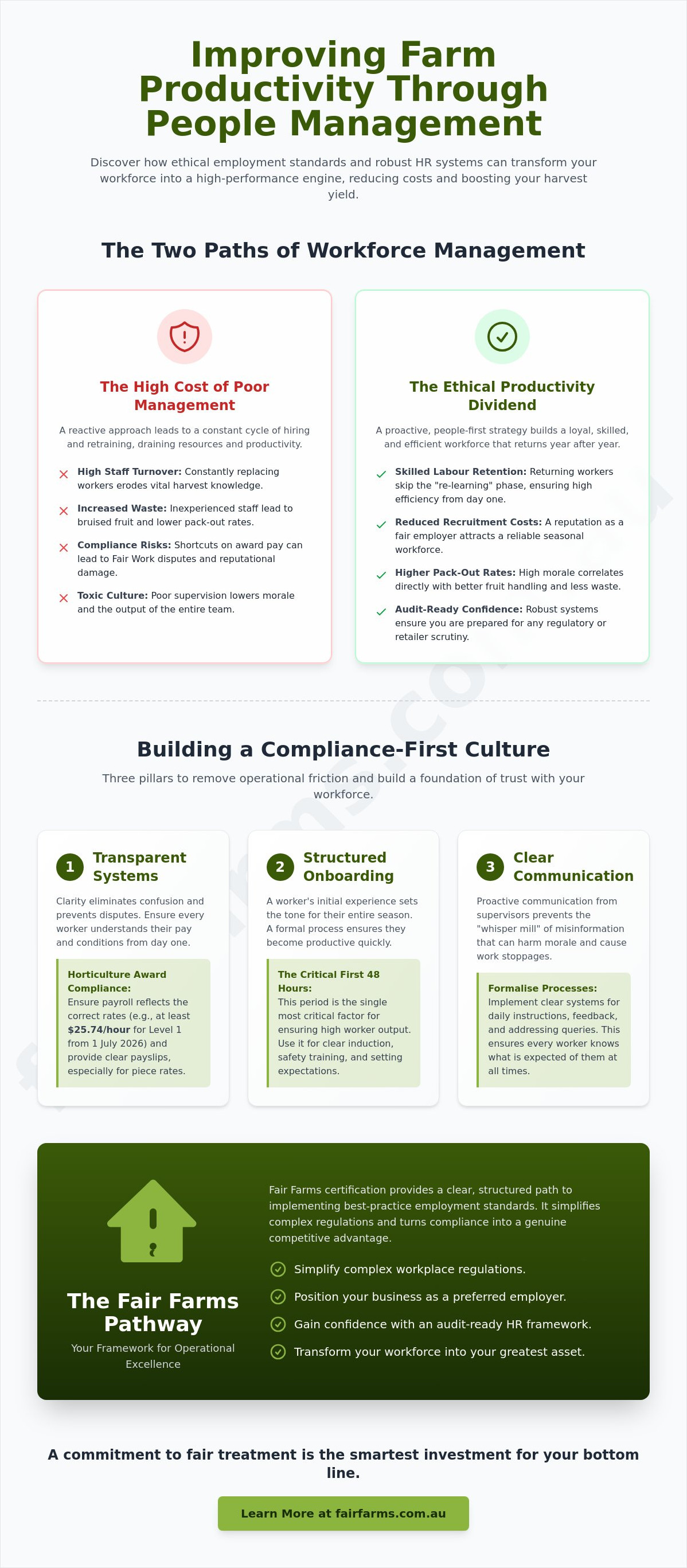
Stability is the secret weapon of successful growers. When a seasonal worker returns for a second or third harvest, you aren't just saving on recruitment fees. You're skipping the expensive "re-learning" phase where mistakes are common and fruit is easily bruised. This stability creates what we call the Ethical Productivity Dividend. This is the measurable financial gain that stems from a loyal, well-treated workforce. This dividend isn't just a feel-good concept; it's a tangible return on investment seen in lower recruitment costs and significantly higher pack-out rates. When you focus on improving farm productivity through people management, you transform labour from a compliance hurdle into a genuine competitive advantage.
Beyond Tonnes per Hectare: Measuring Labour Efficiency
Traditional metrics often miss the nuances of modern labour management. True efficiency isn't just about how fast someone picks; it's about how much of that fruit makes it to the packhouse in a saleable condition. High worker morale directly correlates with better fruit handling and a reduction in waste. By applying Integrated Farm Management principles, growers can identify operational friction points. These are often caused by poor communication or unclear instructions from supervisors, which slow down daily tasks. Implementing clear systems through Fair Farms Certification helps formalise these processes, ensuring that every worker knows exactly what is expected of them from the moment they step onto the block.
The High Cost of Poor People Management
The financial drain of high staff turnover is frequently underestimated. Replacing a worker mid-harvest involves more than just a new induction. It includes the lost output during the vacancy and the supervisor’s time diverted toward training a novice. Management shortcuts, particularly around Horticulture Award compliance, can lead to expensive Fair Work disputes that damage your reputation. With wage theft now a criminal offence under the Fair Work Act as of January 2025, the risk of poor oversight has never been higher. A toxic supervisor culture doesn't just affect one individual; it creates a ripple effect that lowers the morale and output of the entire team, leading to missed harvest windows and lost revenue.
Building a Compliance-First Culture to Reduce Operational Friction
Compliance is often framed as a chore, a set of hurdles designed by people who've never stepped foot in a paddock. In reality, it's the bedrock of a stable, productive workforce. When your team knows exactly where they stand regarding their pay and conditions, they can focus entirely on the harvest. Improving farm productivity through people management is impossible without this foundational trust. Clear communication about the Horticulture Award serves as a management tool that reduces friction. As of 1 July 2026, the Level 1 rate under the Horticulture Award is at least $25.74 per hour. Ensuring your payroll reflects these updates isn't just about avoiding fines; it's about demonstrating respect for your workers' labour.
Transparent pay systems are particularly vital when managing piece rates. While piece rates can incentivise speed, they often lead to confusion if the underlying calculations aren't clearly explained. Providing workers with detailed payslips that show both their output and the guaranteed minimum floor rate builds immediate credibility. This transparency prevents the "whisper mill" on the farm, where misinformation about pay can lead to sudden work stoppages or a drop in morale. Robust record-keeping is your best defence against harvest-time disruptions, ensuring that if a query arises from a worker or a retailer audit, you have the data ready to resolve it instantly.
Industrial Relations as a Strategic Advantage
Understanding your obligations under the Fair Work Act 2009 is no longer just a legal requirement; it's a strategic necessity. With new wage theft laws making intentional underpayment a criminal offence as of 1 January 2025, the stakes for payroll accuracy have never been higher. Clear employment contracts prevent misunderstandings before they start, acting as a roadmap for the employment relationship. Aligning your business with NFF's workforce initiatives can provide additional context on national standards. Regular internal audits are a practical way to catch minor payroll errors before they become expensive disputes. For those seeking structured support, becoming a member provides access to tools that simplify these complex industrial relations tasks.
Training Supervisors for Compliance and Performance
Farm foremen and supervisors are the bridge between your business goals and the workers' output. Too often, supervisors are promoted based on their technical picking skills rather than their ability to lead people. Moving beyond technical skill to "people skill" is essential for maintaining a high-performance culture. Standardising instructions across different picking crews ensures consistent quality and reduces the need for constant correction. You can use Fair Farms Online Training to upskill your management team, ensuring they understand both the legal requirements of the Horticulture Award and the practicalities of ethical leadership. This investment in management capability is a direct path toward improving farm productivity through people management, as it creates a more professional and predictable working environment for everyone involved.
Systems for Efficiency: From Onboarding to Harvest
While a compliance-led culture provides the foundation, improving farm productivity through people management requires robust operational systems. These systems translate high-level values into daily actions on the block. The most critical window for any seasonal worker is the "First 48 Hours". Experience across the sector suggests that a worker's long-term output is largely determined by the quality of their initial induction. If a new arrival spends their first two days confused about their role or struggling with equipment, their frustration often leads to early resignation or poor fruit handling. A structured onboarding process ensures that every individual is equipped with the knowledge and tools they need to be productive from their very first shift.
Modern growers are increasingly moving away from paper-based systems to digital performance tracking. This shift allows for real-time decision-making rather than waiting for end-of-week tally sheets to identify issues. By monitoring output as it happens, supervisors can spot productivity bottlenecks early; perhaps a crew is waiting too long for empty bins or a specific section of the orchard has difficult terrain that requires a benchmark adjustment. Integrating the Fair Farms program into your operational framework provides a clear structure for these systems, ensuring that efficiency never comes at the expense of worker welfare or legal standards. Regular feedback loops between crews and management allow these small friction points to be resolved before they impact the week's total yield.
Streamlining the Onboarding Process
A streamlined induction shouldn't be an administrative burden. Digital onboarding platforms allow workers to complete much of their paperwork and safety training before they even arrive at the farm gate. This leaves more time for practical, on-site demonstrations. Essential checklists should cover everything from correct picking techniques to heat stress management. Beyond the logistics, this is your opportunity to communicate farm values. When workers understand that quality and safety are non-negotiable from day one, they're far more likely to meet those expectations throughout the season.
Performance Management in the Field
Effective performance management relies on setting realistic benchmarks that reflect current crop conditions and the experience level of the crew. Using a "Mentor Approach" can be highly effective; pair your experienced, returning workers with new arrivals to facilitate peer-to-peer coaching. This not only speeds up the learning curve for novices but also gives your skilled labour a sense of responsibility and leadership. Recognising high performance through small rewards or public acknowledgement encourages healthy competition. This is a practical way of improving farm productivity through people management, as it reinforces the link between individual effort and the farm's overall success.
Retaining Skilled Labour in a Competitive Australian Market
Securing a reliable workforce in regional Australia is a significant challenge for many growers. With competition for labour increasing across the sector, fairness is no longer just a moral choice; it's your most effective recruitment tool. Workers within the seasonal and PALM scheme communities communicate constantly. They share detailed information about which farms provide clear instructions, consistent hours, and respectful treatment. By focusing on improving farm productivity through people management, you can transform your farm into a "destination" where workers actively seek employment. This shift reduces your reliance on expensive, last-minute recruitment drives and creates a waiting list of reliable staff.
The link between ethical treatment and worker retention is direct and measurable. A worker who feels respected and safe is far less likely to leave mid-season, which is the most critical time for any grower. In the Australian context, where seasonal labour is often mobile, your reputation as an employer is your strongest asset. When you provide a "fair go," you aren't just meeting a legal requirement; you're building a buffer against the labour shortages that plague the industry. Improving farm productivity through people management starts with the understanding that a happy, stable crew picks more fruit and causes less damage than a high-turnover workforce.
The Ethical Recruitment Advantage
Transparency about pay and conditions is the first step in building an ethical recruitment process. When you're honest about the physical demands of the block and the likely duration of the harvest, you attract staff who are prepared for the work. Vetting your labour hire providers is also a non-negotiable part of protecting your farm's reputation. If a third-party provider underpays workers, the legal and reputational fallout lands on your doorstep. Utilising HR Support for Growers helps you navigate these complex hiring scenarios, ensuring every person on your property is treated according to Australian standards.
Building Long-Term Workforce Stability
Stability is the ultimate goal for any farm manager. A worker who returns for their third season is far more productive than a first-timer because they already understand your specific quality standards and farm layout. This continuity is especially vital for participants in the PALM scheme, who often stay for longer periods and become integral to your operations. Providing decent amenities and clean, safe accommodation is a smart productivity investment. When a worker feels valued and comfortable, the rates of absenteeism and "quiet quitting" drop significantly. A positive farm culture encourages workers to take pride in their output, leading to the higher efficiency levels required for a profitable harvest.
Ready to secure your future workforce? Become a Fair Farms member today to access the specialised tools and support needed to build a stable, ethical labour force.
The Fair Farms Pathway to Operational Excellence
The Fair Farms program is more than a compliance checklist; it's a comprehensive management framework designed specifically for the Australian horticulture industry. By adopting these standards, growers move beyond reactive problem-solving and into a proactive state of operational excellence. Improving farm productivity through people management becomes a structured, repeatable process rather than a guessing game. Certification provides a clear signal to the market that your business is managed with integrity. This is increasingly vital as major retailers like Coles, Woolworths, and Aldi tighten their supply chain requirements to ensure ethical labour practices at every level.
Joining a community of ethical growers allows you to share best practices and stay ahead of regulatory shifts. Instead of navigating the complexities of the Horticulture Award or new superannuation rules alone, you gain access to a network dedicated to raising industry standards. This collective approach doesn't just protect individual farms; it strengthens the reputation of the entire Australian agricultural sector. A stronger reputation makes our industry more attractive to the high-quality labour required for long-term growth. When you align with a standards-setting organisation, you move from being a solitary business owner to becoming a leader in regional progress.
Steps to Fair Farms Certification
The journey begins with a self-assessment that helps you identify specific gaps in your current HR and safety systems. From there, The Certification Pathway guides you through the necessary improvements before an independent audit verifies your compliance. This process is designed to be supportive, providing growers with dedicated HR support to resolve complex workplace issues that might otherwise lead to legal complications. It's a methodical way of improving farm productivity through people management by ensuring every operational "cog" is turning smoothly and legally. The pathway is clear, direct, and instructional, mirroring the procedural journey required for a professional farm business.
Future-Proofing Your Farm Business
The regulatory landscape is shifting rapidly. With the introduction of payday superannuation on 1 July 2026 and the continued implementation of "Closing Loopholes" amendments, the administrative burden on farm owners is set to increase. Being a "Fair Farm" protects your brand from modern slavery risks and ensures you are prepared for increased supply chain transparency. By formalising your commitment to ethical labour now, you ensure your business remains resilient and profitable in a market that no longer tolerates management shortcuts. Ready to lead the way? Contact Fair Farms to start your productivity journey today.
Cultivating a Sustainable Future for Your Farm
Building a high-performance workforce requires more than just meeting the minimum legal standards; it's about embedding integrity into every layer of your operations. We've explored how improving farm productivity through people management starts with a compliance-first culture that reduces daily friction. By implementing structured onboarding and digital tracking, you move from guesswork to precision. These systems, combined with an ethical reputation, ensure your farm remains a destination for reliable, returning labour in a competitive market.
As an industry-led program developed by Growcom, a part of the QFVG, Fair Farms provides the tailored HR support and verified standards necessary to succeed in modern Australian horticulture. Our framework is recognised by major retailers nationwide, ensuring your business meets the highest market expectations while protecting your brand from risk. Join Fair Farms today to access expert HR support and start your certification journey. Investing in your people is the most direct path to a resilient and profitable harvest. We're here to support you in every step toward industry leadership.
Frequently Asked Questions
How does people management actually increase my farm profit?
Effective people management boosts profit by reducing the high costs associated with staff turnover and constant recruitment. When you retain experienced workers, you eliminate the expensive learning curve that often leads to bruised fruit or slow picking rates. Stable teams pick more accurately and handle produce with greater care, which directly improves your pack-out rates and reduces waste. Improving farm productivity through people management ensures your labour spend is an investment in quality rather than a revolving door of training costs.
Is the Horticulture Award too complex for a small farm to manage?
The Horticulture Award serves as a clear roadmap for fair employment rather than a barrier to business. Small farms can manage these requirements effectively by using structured systems and templates provided by industry bodies. Staying compliant with rates, such as the $25.74 hourly minimum for Level 1 workers effective from July 2026, prevents the risk of expensive Fair Work disputes. Clear records and simplified payroll tools make these regulations much easier to handle on a daily basis.
What are the biggest HR mistakes Australian growers make during harvest?
The most common mistakes include inadequate record-keeping and failing to provide a clear induction for new arrivals. Many growers also struggle with incorrectly applying piece rates or failing to update pay scales in line with Fair Work Commission changes. Since wage theft became a criminal offence in January 2025, these administrative errors carry significant legal risks. Prioritising accurate time-tracking and clear employment contracts from the start of the season helps avoid these costly pitfalls.
Can I use piece rates and still be compliant with Fair Work?
You can use piece rates provided you meet the minimum wage floor requirements set out in the Horticulture Award. Every pieceworker must earn at least the hourly rate for their classification, including the 25% casual loading where applicable. This ensures that even on slow picking days, workers are protected by a guaranteed base. Transparently recording both output and hours worked is essential to demonstrate that your piece rate arrangements remain fully compliant with Australian law.
How does Fair Farms certification help with worker recruitment?
Certification acts as a powerful signal to the labour market that your farm is a safe, fair, and professional workplace. In a competitive environment, workers actively seek out certified employers because they know their pay and conditions are independently verified. This reputation helps you attract reliable seasonal staff and PALM scheme participants who prefer destination farms. By improving farm productivity through people management, certification reduces the time and money you spend on constant recruitment drives.
What is the first step to improving my farm’s HR systems?
The first step is conducting a thorough self-assessment of your current employment practices to identify any compliance gaps. Review your record-keeping, induction processes, and payroll accuracy against the latest Horticulture Award standards. Many growers find that formalising their onboarding checklist is a quick win that immediately improves worker clarity and safety. Engaging with a structured program provides the templates and support needed to turn these initial observations into a robust, professional HR framework.
How do I manage the performance of seasonal workers who are only here for a few weeks?
Managing short-term performance relies on setting clear, achievable benchmarks during the first 48 hours of employment. Use a structured induction to demonstrate the exact quality standards required for your specific crop. Regular, informal feedback loops help workers adjust their technique quickly before bad habits set in. Even for brief stays, treating staff with respect and providing decent amenities encourages them to work more efficiently and consider returning for the next harvest.
Does ethical certification really matter to major Australian retailers?
Ethical certification is increasingly becoming a mandatory requirement for growers supplying major retailers like Coles, Woolworths, and Aldi. These businesses face significant pressure to ensure their entire supply chain is free from exploitation and modern slavery. Holding a third-party verified certification provides these retailers with the assurance they need to keep your produce on their shelves. It protects your brand and ensures you remain a preferred supplier in an increasingly transparent and regulated marketplace.