
Farm Business HR Health Check: The Complete 2026 Compliance Guide for Australian Growers

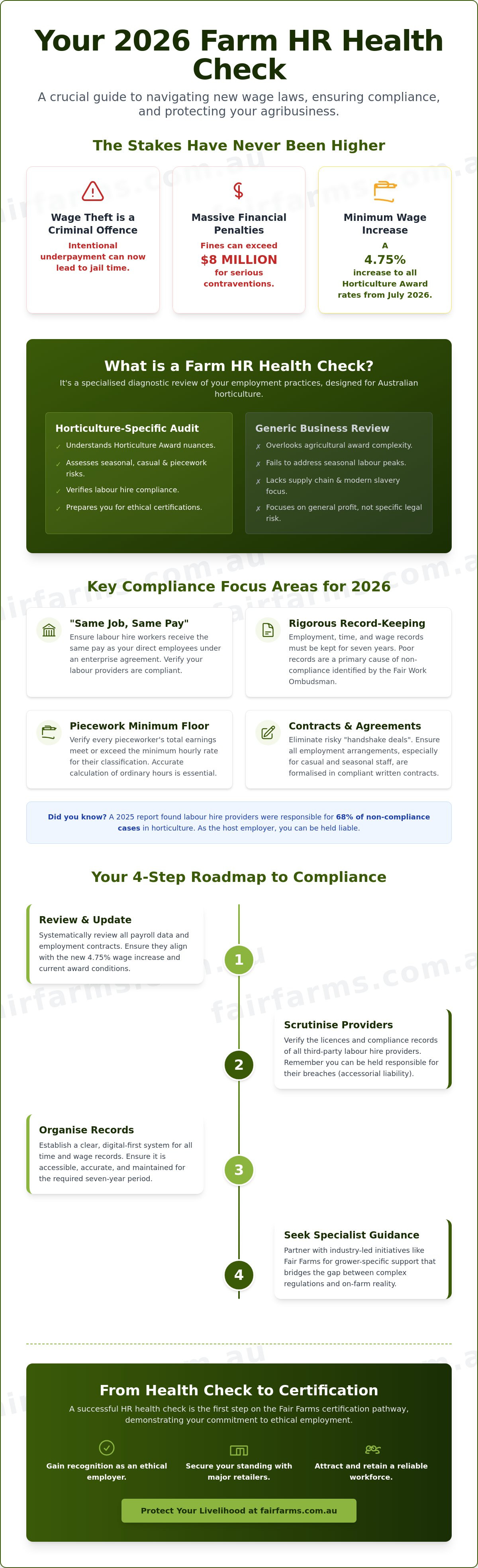
With intentional wage underpayment now a criminal offence carrying potential jail time and fines exceeding $8 million, the margin for error in your payroll has effectively vanished. Since the Fair Work Commission increased minimum wage rates by 4.75 per cent in July 2026, many growers are finding that a comprehensive farm business HR health check is the only way to ensure their compliance standards truly protect their livelihoods.
It's understandable if you feel overwhelmed by the constant stream of Horticulture Award updates and the pressure to secure ethical certification for major retailers. You've worked hard to build your reputation, and you shouldn't have to lose sleep over a surprise Fair Work audit or complex seasonal staff onboarding. We'll show you how to identify hidden gaps and ensure your operations align with the latest 2026 standards. This guide provides a clear roadmap to navigate the new casual employment definitions, manage labour hire risks, and prepare your business for a successful ethical audit so you can focus on a productive season.
Key Takeaways
- Understand the distinction between a generic business review and a horticulture-specific audit tailored for the unique challenges of the Australian agricultural landscape.
- Identify the critical record-keeping essentials required to navigate the latest updates to the Horticulture Award for your casual and piecework staff.
- Learn how to conduct a proactive farm business HR health check to eliminate risky informal employment arrangements and "handshake deals".
- Follow a structured approach to organising your payroll data and employment contracts to ensure every worker is paid correctly under the 2026 award rates.
- Prepare your business for the Fair Farms certification pathway to gain recognition as an ethical employer and secure your standing with major retailers.
What is a Farm Business HR Health Check?
A farm business HR health check is a systematic diagnostic review of your employment practices, payroll records, and workplace policies. It's designed specifically for the unique demands of the Australian primary production sector. Unlike a standard business review that might focus on profitability or operational efficiency, this check-up examines the legal and ethical framework of your workforce. In the complex world of Agribusiness, where seasonal labour peaks and varied award rates are the norm, a generic audit often fails to capture the nuances of the Horticulture Award.
The 2026 calendar year represents a watershed moment for farm compliance. With the criminalisation of intentional wage theft as of 1 January 2025 and the substantial 4.75 per cent minimum wage increase effective from 1 July 2026, the financial and legal stakes have never been higher. A thorough farm business HR health check serves as an early warning system, identifying compliance gaps before they become liabilities. It also plays a vital role in mitigating modern slavery risks within the supply chain, ensuring your farm isn't inadvertently involved in exploitative practices that could lead to your business being delisted by major retailers.
The Purpose of Regular HR Reviews in Agriculture
Regular reviews help you catch "blind spots" in seasonal worker management, particularly regarding record-keeping for casual and piecework employees. A 2025 Fair Work Ombudsman report identified poor record-keeping as a major issue in the horticulture sector, often leading to accidental non-compliance. By proactively identifying these errors, you protect your business from costly interventions and heavy fines. Beyond avoiding penalties, these reviews establish a culture of integrity. When workers see you're committed to fair treatment and correct pay, you naturally attract and retain more reliable labour from both local and overseas pools.
Who Should Conduct Your HR Health Check?
While an internal self-assessment is a helpful starting point, it often lacks the objectivity needed to spot ingrained habits or outdated "handshake deals." Choosing between internal reviews and external professional support depends on your farm's scale and complexity. Generalist HR consultants may understand the law, but they often lack the specific context of regional farming hurdles. This is where industry-led initiatives like Fair Farms provide immense value. They offer grower-specific guidance that bridges the gap between regulatory theory and on-farm reality, ensuring your compliance measures are both practical and robust.
Key Focus Areas for Horticulture Compliance in 2026
The regulatory environment for Australian growers has shifted significantly following the Fair Work Commission's decision to increase modern award minimum wage rates by 4.75 per cent from 1 July 2026. This change affects every level of the Horticulture Award [MA000028]. A reliable farm business HR health check must now account for these new baselines to prevent accidental underpayment. Beyond simple wage rates, your review should scrutinise the "Same Job, Same Pay" provisions for labour hire, which became enforceable in late 2024. These laws require host employers to ensure labour hire workers receive the same full rate of pay as direct employees under an enterprise agreement.
Record-keeping remains a primary target for the Fair Work Ombudsman. You are legally required to maintain employment, time, and wage records for seven years. The 2025 Horticulture Compliance Report highlighted that poor record-keeping was a major contributor to non-compliance across the sector. If you engage third-party labour providers, remember that you may face accessorial liability for their breaches. A June 2025 report found that labour hire providers were responsible for 68 per cent of non-compliance cases in horticulture. Verifying that your providers hold valid licences and adhere to ethical standards is no longer optional; it is a core component of risk management. You can strengthen your oversight by becoming a member to access specialised tools for supply chain transparency.
Wages, Allowances, and the Piecework Debate
The introduction of the minimum wage floor for pieceworkers has fundamentally changed how seasonal payroll operates. Your health check should verify that every pieceworker's earnings meet or exceed the hourly rate for their specific classification. Calculating "ordinary hours" accurately across fluctuating crop cycles is essential to avoid overtime disputes. Miscalculating these hours often leads to significant back-pay claims that can destabilise a farm's seasonal budget.
The PALM Scheme and Seasonal Worker Management
Growers utilising the Pacific Australia Labour Mobility (PALM) scheme face additional layers of HR oversight. These obligations extend beyond the field to include worker accommodation and transport standards. Ethical employment requires a focus on cultural competency and comprehensive inductions. Ensuring that diverse workforces understand their rights and safety protocols is a pillar of modern workplace health and safety. Proper induction records prove that you have met your duty of care and helped foster a respectful, productive work environment.
Common Compliance Gaps Found in Australian Agribusiness
Many Australian growers pride themselves on a "my word is my bond" approach to management. While this builds local trust, it creates significant legal exposure in a high-scrutiny environment. Informal arrangements, often called "handshake deals," lack the documentation required to prove compliance during a Fair Work inspection. A farm business HR health check often reveals that these verbal agreements fail to meet the basic standards of the Horticulture Award, leaving the business owner vulnerable to back-pay claims. Relying on memory or informal notes is no longer a viable business strategy.
Inadequate record-keeping for casual and piecework employees is perhaps the most frequent gap identified during audits. It isn't enough to simply record the total hours worked. You must document start and finish times, break durations, and the specific tasks performed to justify piecework earnings against the hourly floor. Furthermore, misunderstanding the Better Off Overall Test (BOOT) can lead to unintentional underpayment. Even if a seasonal worker agrees to a flat rate, that rate must leave them better off than they would be under the standard award at all times. Finally, failing to verify the legal right to work for every staff member via VEVO checks is a risk that can result in heavy fines under the Migration Act, especially with the high turnover of a seasonal workforce.
Superannuation and Tax Withholding Errors
The distinction between an employee and a contractor is now determined by the practical reality of the work relationship, not just the label on a contract. Misclassifying staff to avoid superannuation is a major compliance trap. You must use SuperStream to manage contributions for your transient workforce, ensuring payments reach the correct funds on time. Employers who fail to pay the correct superannuation by the quarterly due date face the Superannuation Guarantee Charge, which includes the unpaid amount plus interest and a per-employee administrative fee.
Unauthorised Deductions and "Cash in Hand" Risks
Deductions for tools, transport, or accommodation must be authorised in writing and be principally for the employee's benefit. If these costs reduce a worker's pay below the minimum award rate without a valid legal reason, they are considered unauthorised. Cash in hand payments are the fastest way to trigger a comprehensive audit. They suggest an attempt to bypass tax and superannuation obligations, which regulators now treat with extreme gravity. You must also navigate the fine line between "farm perks," like providing free housing, and illegal fringe benefits. If these aren't documented correctly in an employment agreement, they can be viewed as a breach of the Horticulture Award.
How to Organise Your Internal HR Health Check
Organising a farm business HR health check requires a methodical approach that moves from the office files to the packing shed floor. By moving systematically through each department, you ensure no detail is overlooked before an auditor arrives at your gate. This process isn't just about finding errors. It's about building a robust framework that supports your workers and protects your investment. Follow these five steps to conduct a thorough review of your operations.
- Step 1: Gather all current employment contracts and position descriptions. Ensure every staff member has a written agreement that accurately reflects their current role. Outdated contracts are a primary source of confusion during audits.
- Step 2: Review payroll data against the most recent Horticulture Award rates. With the 4.75 per cent increase effective from 1 July 2026, the lowest entry-level rate for permanent staff is now $25.74 per hour. Cross-check your latest pay runs to ensure no one has fallen behind these new minimums.
- Step 3: Audit your labour hire providers’ licences and ethical credentials. Request current copies of their licences and evidence of their workers' compensation insurance. Do not take verbal assurances at face value.
- Step 4: Conduct a physical walk-through of worker facilities and safety signage. Check that first aid kits are stocked, amenities are hygienic, and safety signs are displayed in languages your workforce understands.
- Step 5: Document your findings and create a timed remediation plan. Record every gap identified. Assign a specific person and a deadline to fix each issue, such as updating induction packs within 14 days.
A well-documented remediation plan is your best defence against claims of intentional non-compliance. To simplify this process and access industry-specific templates, you can become a Fair Farms member and gain the tools needed for a professional internal review.
Developing an Audit-Ready Document Trail
Accessibility is the key to a successful unannounced inspection. Organise your records in a way that allows a supervisor to produce signed inductions and safety training registers even if the farm manager is off-site. Moving away from paper folders to digital tools can centre your HR data and significantly reduce manual entry errors. Digital systems also make it easier to track the seven-year history required for wage and time records under Australian law.
Engaging Your Team in the Review Process
Compliance shouldn't be a top-down secret. Interview your supervisors to ensure the policies written in the office are actually being followed in the paddock. Gaining honest feedback from seasonal workers on workplace culture and safety can highlight issues before they escalate into formal grievances. A whistleblower or grievance procedure only works if staff feel safe using it. Establishing a clear, confidential way for workers to report concerns is a hallmark of an ethical employer.
From Health Check to Fair Farms Certification
Completing your internal farm business HR health check is more than just a risk management exercise. It is the essential groundwork for entering the Fair Farms certification pathway. While an internal review identifies where you stand today, certification provides a verified badge of honour that communicates your integrity to the entire supply chain. In an environment where major Australian retailers like Coles, Woolworths, and Aldi demand rigorous ethical standards, being "Fair Farms Certified" ensures your produce remains on the shelves and your market access is protected.
The commercial advantages of this process extend beyond mere compliance. Certified growers often report smoother relationships with seasonal staff and reduced turnover, as workers actively seek out employers with a proven commitment to fair treatment and correct pay. By formalising your processes through this journey, you also gain access to ongoing HR support for growers. This membership provides a safety net, offering the latest regulatory updates and templates that keep your business ahead of the curve as laws continue to evolve through 2026 and beyond.
The Fair Farms Journey: Education over Enforcement
Our programme is built on the belief that most growers want to do the right thing but may lack the specific tools to navigate complex industrial relations. We prioritise education over punishment. The certification process encourages you to identify and fix issues in a supportive, non-adversarial environment. Through Fair Farms Online Training modules, farm managers can build their capability in critical areas like piecework management and worker welfare. This journey allows you to transition from simply being "compliant" to becoming a recognised leader in ethical horticulture, setting a benchmark for the regional community.
Next Steps for Your Farm Business
Securing the future of your enterprise starts with a single, proactive decision. Joining the community of ethical growers by becoming a Fair Farms member gives you immediate access to a network of like-minded professionals and expert resources. If you're unsure where to start with your initial farm business HR health check, we encourage you to contact the Fair Farms team for a confidential discussion. We can guide you through the requirements and help you build a sustainable, resilient business that thrives in the modern agricultural landscape. Taking these steps today ensures your farm is prepared for the challenges of 2026 while protecting the people who make your success possible.
Securing Your Farm's Legacy in 2026
A proactive farm business HR health check is no longer just a recommendation; it is a vital safeguard for your livelihood. By addressing the complexities of the Horticulture Award and closing common compliance gaps, you've taken the first step toward building a resilient, ethical enterprise. Transitioning from a simple internal review to formal certification allows you to demonstrate your commitment to fair work practices to both your staff and the wider industry.
As an industry-led programme developed by Queensland Fruit & Vegetable Growers (QFVG), Fair Farms provides the dedicated HR support required to navigate this specialised sector. Our standards are recognised by major Australian retailers as a benchmark for ethical sourcing, ensuring your business remains competitive and trusted. Start your journey toward ethical certification with Fair Farms today to gain peace of mind before your next audit. Protecting your people is the most effective way to protect your farm's future, and we're here to support you every step of the way.
Frequently Asked Questions
Is a farm business HR health check mandatory for Australian growers?
No, a farm business HR health check isn't a government-mandated requirement for all primary producers. However, it's often a commercial necessity for those supplying major supermarkets that require ethical certification as a condition of entry. Proactively identifying gaps also protects you from the severe penalties associated with the criminalisation of wage theft that commenced in January 2025.
How often should I conduct an HR review on my farm?
You should ideally conduct a review at least once a year, specifically before the July 1st minimum wage increases take effect. It's also wise to perform a check-up before your peak harvest season when seasonal staff numbers are highest. This ensures your onboarding processes and payroll systems are robust enough to handle the increased volume of workers and varied crop cycles.
Does the Horticulture Award require different record-keeping for pieceworkers?
Yes, the Horticulture Award now requires more detailed records for pieceworkers than in previous years. Since the introduction of the minimum wage floor, you must record the actual hours worked by pieceworkers to prove they've earned at least the hourly award rate for their classification. Simply recording the units picked or kilograms harvested is no longer sufficient to meet Fair Work standards.
What happens if I find a compliance gap during my HR health check?
Finding a gap is a positive outcome of a farm business HR health check because it allows you to fix the issue before an inspector arrives. You should document the discrepancy and implement a timed remediation plan to correct it immediately. Taking swift action to pay any back-pay or update contracts demonstrates a commitment to ethical standards and reduces the risk of being accused of intentional underpayment.
Can a labour hire provider join Fair Farms for an HR health check?
Yes, labour hire providers can join as Labour Hire Members to verify their employment practices and demonstrate their integrity to host employers. This membership allows providers to undergo the same rigorous ethical standards as growers, providing much-needed transparency in the supply chain. It helps providers prove they're meeting their legal obligations and reducing the risk of accessorial liability for the farms they serve.
How long does it take to complete the Fair Farms certification pathway?
The timeline for certification depends on your current level of readiness and how quickly you complete the required online training modules. Most growers find that the initial preparation and internal review take a few weeks to organise. Once you've completed the self-assessment and training, you can book a third-party audit, which is the final step in the certification journey.
What are the most common mistakes found in farm HR audits?
The most frequent errors involve poor record-keeping for casual employees, such as missing start and finish times or undocumented break durations. Many audits also uncover incorrect award classifications, where employees are kept at an entry-level rate despite performing duties that require a higher level of skill. Failing to update payroll systems with the latest July 1st wage rates remains a significant and costly pitfall.
Is there a difference between an HR health check and a Fair Work audit?
Yes, an HR health check is a voluntary, internal review designed to help you improve your systems and secure your business reputation. In contrast, a Fair Work audit is a formal investigation conducted by government regulators. While a health check is a supportive process to catch and fix errors, a Fair Work audit is an enforcement action that can result in substantial fines or criminal prosecution.