
How to Hire Farm Workers in Australia: The Complete Grower’s Guide to Ethical Recruitment

What if the labour hire provider you trust to harvest your crop is actually the single biggest threat to your supermarket contracts? Learning how to hire farm workers in Australia has become more than just a seasonal task; it's now a high-stakes exercise in risk management and ethical leadership. You've likely felt the strain of rising input costs and the headache of interpreting the latest Horticulture Award updates, all while trying to keep your retail partners happy with transparent sourcing proof.
We understand that your focus should be on the land, not just the paperwork. This guide provides the clarity you need to master Australian workplace laws, ensuring you meet the 1 July 2026 national minimum wage of $26.44 per hour and navigate the shift away from traditional piece rates. We'll walk through the complexities of the PALM scheme, state-based labour hire licensing, and the practical steps to securing a reliable, productive workforce. By the end, you'll have a clear roadmap to achieving certification that satisfies major supermarket auditors and reinforces your reputation as a principled partner in the industry.
Key Takeaways
- Navigate the latest amendments to the Horticulture Award 2020 to guarantee your payroll meets the mandatory hourly wage floor for all seasonal employees.
- Learn how to hire farm workers in Australia using a strategic approach that balances direct recruitment with the rigorous oversight of licensed labour hire providers.
- Streamline your onboarding process with a practical checklist for VEVO checks and superannuation compliance to protect your farm from regulatory scrutiny.
- Strengthen your retail partnerships by understanding how ethical recruitment directly impacts your ability to pass rigorous supermarket supply chain audits.
- Explore the Fair Farms pathway to access specialised HR support and certification that demonstrates your commitment to equitable and principled workplace standards.
Understanding the Regulatory Landscape of Australian Horticulture
The Australian agricultural sector operates within one of the most robust and scrutinised regulatory frameworks in the world. For growers, understanding how to hire farm workers in Australia requires more than just finding hands for the harvest; it demands a deep commitment to the standards set by the Fair Work Ombudsman. This national body acts as the industry's regulator, ensuring that every participant, from small family orchards to large-scale enterprises, adheres to the same set of rules. Integrity in recruitment isn't just a moral choice. It's a fundamental requirement for business continuity.
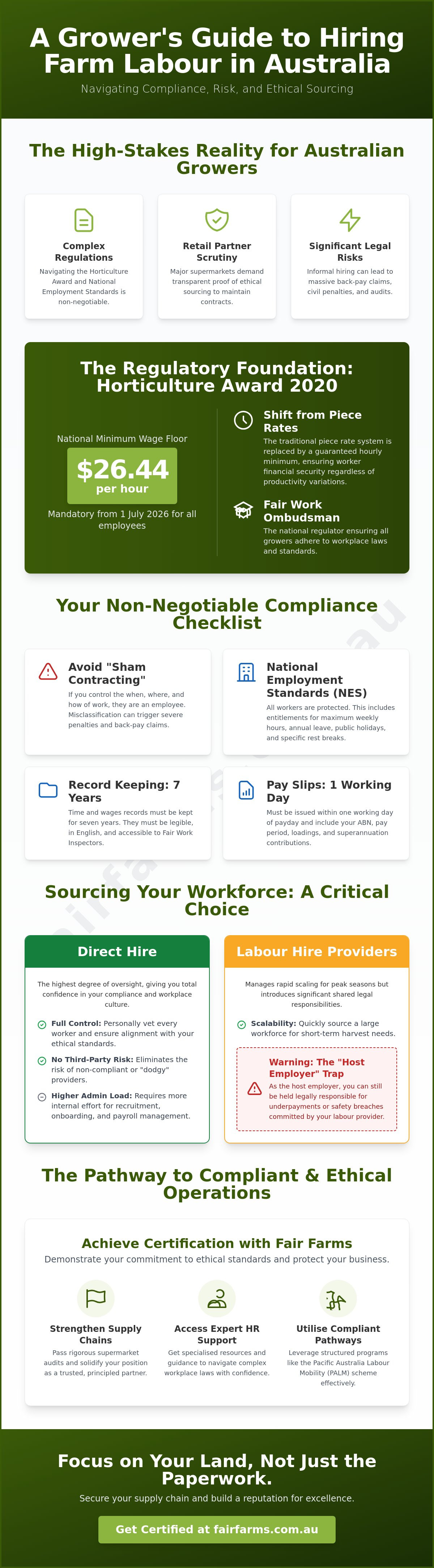
Central to this landscape is the Horticulture Award [2020]. This document has undergone significant transformation, including updates to entry-level classifications in April 2025. A defining feature of the modern award is the guaranteed minimum wage floor. As of 1 July 2026, the national minimum wage has risen to $26.44 per hour. Relying on outdated "handshake deals" or informal cash payments is no longer just poor practice; it's a significant legal liability. These informal arrangements lack the transparency required by modern supply chains and leave growers vulnerable to massive back-pay claims and civil penalties.
Distinguishing between employees and independent contractors is another critical hurdle. Many growers have faced legal action for "sham contracting", where workers are treated like employees but paid as contractors to avoid providing entitlements. If you control when, where, and how the work is done, they are almost certainly employees. Getting this classification wrong can trigger audits that span years of payroll history.
The Horticulture Award and National Employment Standards
Every worker on your farm is protected by the National Employment Standards (NES). These entitlements include maximum weekly hours, annual leave, and public holiday rates. In the horticulture sector, specific provisions for overtime and rest breaks apply. Many growers now utilise the Pacific Australia Labour Mobility (PALM) scheme to source reliable labour, as it provides a structured, compliant pathway that aligns with these standards. The shift from pure piece rates to a mandatory minimum hourly floor ensures that even when productivity varies, the worker's basic financial security is protected. You must ensure your payroll systems can track these hours accurately to meet the 2026 wage requirements.
Record Keeping and Pay Slip Obligations
Compliance isn't just about what you pay; it's about what you prove. Australian law requires you to keep time and wages records for seven years. These records must be legible, in English, and accessible to a Fair Work Inspector if requested. Pay slips must be issued within one working day of pay day. They must include your ABN, the pay period, and all loadings or superannuation contributions. Neglecting these administrative duties is a high-risk strategy. Fair Work often views poor record-keeping as a red flag for deeper exploitation, which can result in significant financial penalties that far outweigh the cost of implementing a proper HR system.
Sourcing Productive Labour: Direct Hire vs. Labour Hire Providers
Deciding how to hire farm workers in Australia often involves a choice between direct recruitment and the use of third-party agencies. Direct hiring offers the highest degree of oversight. It allows you to vet every individual and personally ensure that your workplace culture aligns with the ethical standards expected by modern retailers. While this approach requires more administrative effort, it eliminates the risk of "dodgy" providers and gives you total confidence in your payroll compliance.
Many growers opt for Labour Hire Providers (LHPs) to manage the rapid scaling required for peak harvest seasons. However, this path introduces the "Host Employer" trap. It's a common misconception that outsourcing recruitment removes your legal liability. Under Australian law, a host employer can still be held responsible for underpayments or safety breaches committed by their labour provider. To mitigate this, you should consult the Fair Work Ombudsman's guide to using labour hire to understand your shared obligations. Accessing membership for growers can provide additional resources to help you manage these complex relationships effectively.
The Pacific Australia Labour Mobility (PALM) scheme has become a cornerstone of seasonal labour strategy. As of March 2026, there were 32,725 workers participating in the scheme across Australia. It provides a stable, returning workforce that builds on-farm skills over multiple seasons. Beyond PALM, don't overlook local community networks or agricultural colleges. These institutions are vital for filling skilled roles, such as irrigation technicians or harvest supervisors, who provide the backbone of your operational leadership.
Vetting Your Labour Hire Provider
You must verify that any provider you engage holds a valid licence in your state. Queensland, Victoria, South Australia, and the ACT have established mandatory licensing schemes. A significant red flag is any quote that seems too good to be true. If an LHP offers an hourly rate that barely covers the $26.44 minimum wage plus superannuation and work cover, they are likely cutting corners on worker entitlements. Cash-in-hand offers are an immediate signal to walk away.
Attracting the Right Candidates
To attract high-quality workers, your job descriptions should do more than list tasks. Highlight your commitment to ethical standards and fair treatment. In a competitive market, offering on-farm accommodation or organised transport can be a decisive factor for candidates. Use specialised agricultural job boards and social media groups to reach a wider audience, ensuring your brand is seen as a principled and reliable employer in the regional landscape.
The Step-by-Step Compliance Checklist for Onboarding
A structured onboarding process is the bridge between a successful recruitment drive and a productive harvest season. When you're refining your strategy for how to hire farm workers in Australia, the first day on the farm serves as a critical foundation for compliance and mutual respect. It's the moment where administrative due diligence meets your farm's culture of integrity. Skipping these steps to get pickers into the field faster often leads to costly errors that supermarket auditors will flag later.
Before any work commences, ensure you've collected a Tax File Number (TFN) declaration and a Superannuation Standard Choice form. Every worker has the right to choose their own super fund. If they don't nominate one, you're required to check for a "stapled" fund through the ATO. For non-citizen workers, including those on Working Holiday Maker or PALM scheme visas, conducting a Visa Entitlement Verification Online (VEVO) check is non-negotiable. This simple check protects your business from the significant penalties associated with employing individuals without valid work rights.
A formal, written employment contract is your best defence against workplace disputes. This document should clearly state the worker's classification under the Horticulture Award 2020 and confirm their status as a casual or permanent employee. Alongside this contract, you must provide the Fair Work Information Statement. If you're hiring casuals, you must also provide the Casual Employment Information Statement. These documents are mandatory; they ensure your team understands their basic rights from the very first hour.
The Induction Process: Safety and Standards
Inductions must prioritise Work Health and Safety (WHS). With the recent focus on managing psychosocial hazards and the transition to Workplace Exposure Limits (WEL) starting in December 2026, your briefings must be thorough. Demonstrate equipment use clearly and explain task-specific safety protocols to reduce the risk of injuries and workers compensation claims. When discussing pay, explain how piece rates interact with the mandatory hourly wage floor of $26.44. This clarity prevents future disputes and ensures your team feels secure in their earning potential.
Setting Expectations and Fair Work Statements
Define clear performance standards during the first week to help new arrivals adjust to the pace of harvest. A principled employer provides a transparent point of contact for workplace grievances or payroll queries. This internal communication builds trust and allows you to resolve issues before they escalate. Always document the completion of the induction process with signed acknowledgements. These signed records are vital components of your compliance history and must be stored securely for seven years.
Managing Supply Chain Risks and Ethical Expectations
Securing a contract with a major supermarket is a milestone for any grower, but it brings a new level of accountability. Understanding how to hire farm workers in Australia is no longer just about operational capacity. It's about protecting your place in the retail supply chain. Major Australian retailers now view labour standards as a core component of their quality assurance. They aren't just buying fruit or vegetables; they're buying the assurance that those products were harvested ethically.
The Modern Slavery Act has shifted the burden of proof onto the supplier. Even mid-sized Australian farms must now demonstrate that they've actively assessed their recruitment processes for risks of exploitation. A single compliance breach, such as an unlicensed labour hire provider or a failure to pay the 2026 minimum wage floor, can lead to immediate suspension. Being "blacklisted" by a major buyer is often a terminal event for a farming business. Moving from reactive compliance to a proactive ethical culture is the only way to ensure long-term commercial viability.
Meeting Retailer Quality Assurance Standards
Coles, Woolworths, and Aldi have stringent social compliance requirements. They require evidence that your workforce is treated fairly and that all legal entitlements are met. Third-party certifications are the most effective way to streamline this process. These frameworks provide a structured path to verify your practices, reducing the time spent on individual supermarket audits. Transparency is the currency of these relationships. Sharing your progress and being open about your challenges builds the trust necessary for a stable partnership.
The Cost of Non-Compliance: Reputation and Revenue
Public backlash for poor labour practices can be devastating. We've seen numerous instances where Australian farms faced significant brand damage after reports of worker mistreatment surfaced. The financial reality is simple: the investment required for proper HR systems is far lower than the cost of a Fair Work fine or a lost retail contract. Social compliance is the verification of ethical treatment through formal audits. Achieving this level of transparency is a strategic advantage that sets you apart from competitors. To start your journey toward a verified ethical workforce, you can apply for Fair Farms Certification today.
How Fair Farms Supports Your Recruitment and Retention Strategy
Building a sustainable business requires more than just meeting the bare minimum of the law. It's about creating a workplace where people want to return season after season. When you look at how to hire farm workers in Australia, the most successful growers are those who view compliance as a foundation for excellence rather than a hurdle. Fair Farms provides the structured framework to move beyond basic payroll tasks into a position of industry leadership. We act as a principled mentor, guiding you through the complexities of modern industrial relations with quiet confidence.
Our specialised HR support is designed by people who understand the unique rhythm of Australian horticulture. We don't provide generic advice. Instead, we offer tools that address specific regional challenges, such as managing seasonal peaks or navigating the intricacies of the Horticulture Award. Through our online training, your supervisors can learn to manage teams with a focus on equity and accountability. This investment in your management team directly improves staff retention and productivity, reducing the constant need to recruit and retrain new arrivals.
Membership serves as a beacon of integrity. It tells your workers, your community, and your retail partners that you're committed to equitable treatment. In a market where ethical sourcing is a non-negotiable requirement for supermarkets, having a verified pathway to compliance is a significant strategic asset. It transforms the way you approach how to hire farm workers in Australia, moving from a position of risk to one of reliability and trust.
Becoming a Certified Fair Farms Grower
Achieving Fair Farms Certification is a powerful signal to the market that your business operates with integrity. The process begins with a comprehensive self-assessment tool that lets you look under the bonnet of your own business. It identifies any gaps in your current HR processes before they become legal issues. Once you're ready, an independent audit validates your ethical status. This provides the transparent proof that major supermarket buyers now demand, ensuring your market access remains secure and your reputation stays untarnished.
Joining a Community of Ethical Producers
Becoming part of this movement means more than just a certificate on the wall. Fair Farms Membership connects you with a community of producers who share your commitment to principled employment. You gain access to a suite of templates and resources that simplify your administrative burden, from compliant contract drafts to safety induction checklists. This communal progress ensures that the entire sector thrives together, fostering a regional identity built on hard work and fair treatment. For more information on starting your journey, contact the Fair Farms team today.
Securing Your Farm's Future through Ethical Leadership
Mastering the intricacies of the Horticulture Award and the 1 July 2026 minimum wage adjustment is more than a compliance obligation; it's a strategic investment in your farm's longevity. By refining how to hire farm workers in Australia through rigorous vetting of labour providers and a transparent onboarding process, you safeguard your business against the rising tide of supply chain scrutiny. These principled practices ensure your harvest is both productive and protected from the risks of retail blacklisting.
Fair Farms stands as a trusted industry guardian, developed as an industry-led initiative by QFVG to support growers in this complex landscape. Our certification is widely recognised by major Australian retailers, providing the professional weight needed to satisfy stringent social audits. With access to specialised HR support tailored for horticulture, you can lead your team with the quiet confidence that comes from full transparency. Join Fair Farms today to secure your workforce and your supply chain.
Your commitment to ethical recruitment doesn't just improve your own operations; it strengthens the reputation of the entire Australian agricultural community. Together, we can build a sector that is resilient, fair, and ready for the challenges of the future.
Frequently Asked Questions
Do I need a specific licence to hire farm workers in Australia?
You don't need a specific licence to hire workers directly, but you must ensure any labour hire provider you engage is licensed in your specific state. Queensland, Victoria, South Australia, and the ACT have established mandatory licensing schemes. Operating without a licence or engaging an unlicensed provider can lead to significant penalties. Always verify a provider's status through the relevant state-based online register before signing any contract.
Can I still pay piece rates under the Horticulture Award?
Yes, piece rates are still permitted, but they must now function alongside a mandatory hourly wage floor. Under the Horticulture Award 2020, every pieceworker must earn at least the minimum hourly rate for their classification for each day worked. If their piece-rate earnings fall below this floor, you must top up their pay to meet the minimum wage, which rose to $26.44 per hour on 1 July 2026.
What are my responsibilities if I use a labour hire agency?
As a host employer, you share legal responsibility for the health and safety of every worker on your site. While the agency manages payroll, you remain liable if you're aware of underpayments or if safety standards aren't met. When learning how to hire farm workers in Australia through an agency, you must conduct regular due diligence. This includes checking pay slips and ensuring the provider adheres to the Fair Work Act.
How do I check if a foreign worker has a valid visa to work on my farm?
You should use the Australian Government's Visa Entitlement Verification Online (VEVO) system to confirm a non-citizen's work rights. This service allows you to check visa conditions and expiry dates in real-time. It's best practice to perform this check before the worker starts and at regular intervals during their employment. Keeping a record of these checks protects your business from penalties associated with employing workers who lack valid work rights.
What records do I need to keep for seasonal harvest workers?
You are legally required to store employment records for seven years. These records must include the employee's name, ABN if applicable, hours worked, pay rates, and superannuation contributions. For harvest workers, it's particularly important to document daily start and finish times to prove compliance with the minimum wage floor. These documents must be kept in a legible, accessible format and provided to Fair Work Inspectors if requested during an audit.
Is it mandatory to provide accommodation for farm workers?
Providing accommodation isn't mandatory for most workers, though it can be a significant advantage in attracting staff to regional areas. However, if you're using the PALM scheme, you must ensure workers have access to safe, affordable, and appropriate housing. If you do provide accommodation, any deductions from wages must be for the worker's benefit and authorised in writing. These deductions must also be reasonable and represent the actual cost of the service provided.
What happens if I fail a retail ethical audit?
Failing an ethical audit can lead to the immediate suspension of your supply contract with major retailers. Supermarkets like Coles and Woolworths use these audits to verify that their suppliers meet strict social compliance standards. A failure typically triggers a requirement for corrective action within a specific timeframe. If these issues aren't resolved, you risk being permanently removed from the supply chain, which can have devastating financial consequences for your farming enterprise.
How does Fair Farms membership help with Fair Work compliance?
Fair Farms membership provides a structured pathway to understanding and implementing Australian workplace laws. By joining, you gain access to specialised HR support and templates that simplify the complexities of how to hire farm workers in Australia. Our self-assessment tool helps you identify and fix compliance gaps before a Fair Work inspector arrives. This proactive approach builds a culture of integrity that protects your business and enhances your reputation with retail partners.