
Avoiding Worker Exploitation in Agriculture: A Comprehensive Checklist for Australian Growers
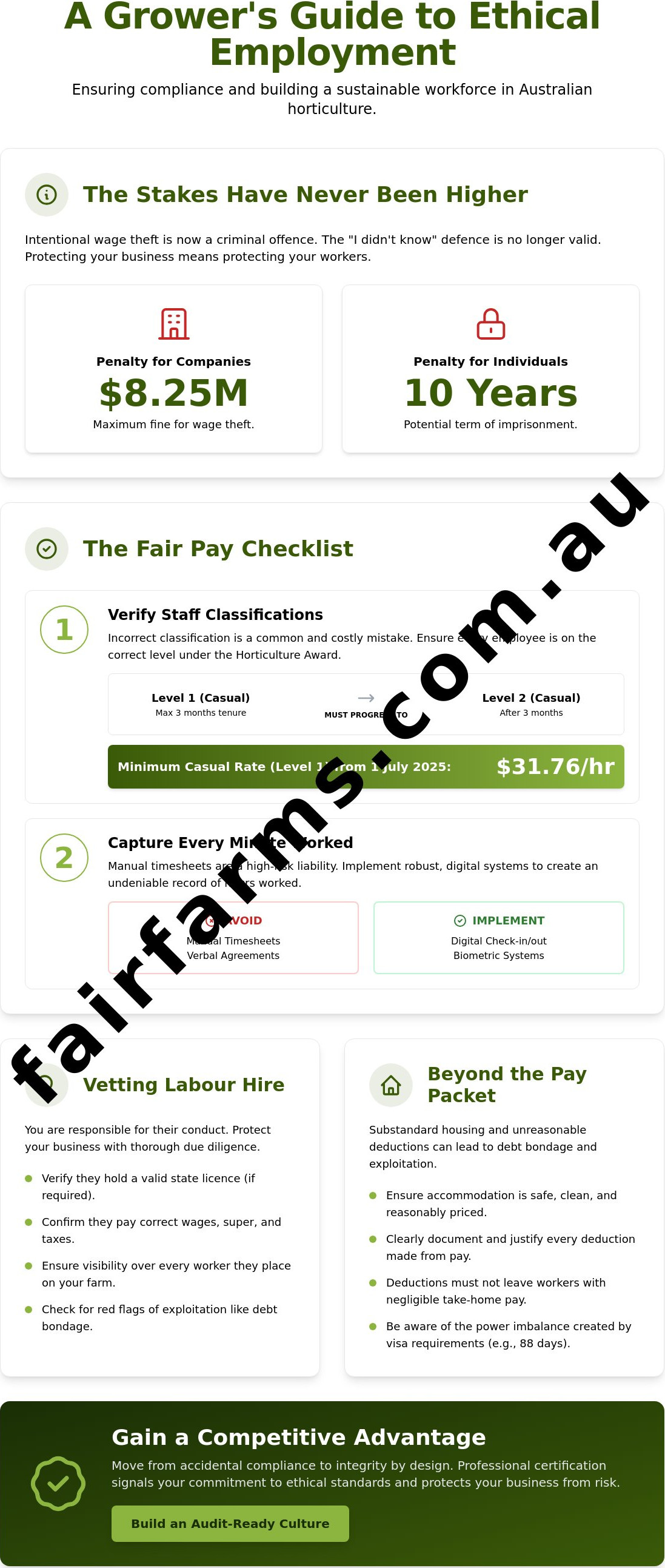
With intentional wage theft now a criminal offence carrying penalties of up to $8.25 million for companies and potential imprisonment for individuals, the "I didn't know" defence has officially been retired. For Australian growers, avoiding worker exploitation in agriculture is no longer just a moral choice; it's a fundamental requirement for business survival and long-term sustainability. You likely feel the pressure of the Horticulture Award's complexity, especially when managing high volumes of seasonal staff and navigating the 1 July 2025 wage increase to $31.76 per hour for casual Level 1 employees. It's a lot to manage while trying to get a crop to market.
We understand that you want to run an ethical business without the constant fear of a Fair Work Ombudsman audit or reputational damage from a dodgy labour hire provider. This article provides a practical, step-by-step framework to help you identify hidden risks, ensure compliance, and foster a workplace culture that attracts reliable staff. We will preview the essential checklist items that move your farm from accidental compliance to integrity by design, giving you total peace of mind in your daily operations.
Key Takeaways
- Identify the subtle signs of exploitation that extend beyond simple underpayment, including deceptive recruitment and the specific risks associated with regional visa requirements.
- Implement a practical framework for avoiding worker exploitation in agriculture by ensuring precise staff classifications and capturing every minute worked through robust attendance systems.
- Establish a due diligence process for vetting labour hire providers to protect your business from being held responsible for the conduct of third-party partners.
- Recognise the impact of substandard accommodation on worker welfare and learn how to manage housing deductions to prevent any risk of debt bondage.
- Gain a competitive advantage in the labour market by using professional certification to signal your commitment to ethical standards and regulatory readiness.
What Does Worker Exploitation Look Like in Modern Australian Agriculture?
Exploitation in the modern agricultural landscape is rarely as overt as a locked gate. Instead, it often manifests through subtle coercion, deceptive recruitment, and the manipulation of worker vulnerabilities. While underpayment is a significant factor, true exploitation includes practices where workers are promised specific conditions to lure them to regional areas, only to find those promises unfulfilled upon arrival. For many Australian growers, avoiding worker exploitation in agriculture begins with recognising that compliance isn't just about the bank transfer; it's about the entire experience of the person in the field.
The "88-day" visa requirement for Working Holiday makers (subclass 417 and 462) creates a unique pressure point. Because workers are often desperate to secure their regional work sign-off to remain in the country, a power imbalance naturally develops. This vulnerability can lead to situations where staff feel they can't report safety issues or pay discrepancies for fear of losing their visa eligibility. Understanding the history of slavery in Australia provides a sobering context for why the Modern Slavery Act 2018 was introduced to address these exact risks in high-stakes sectors like horticulture.
The reputational stakes have never been higher. A single investigation or a viral social media post about "dodgy" labour practices can devalue an entire season's harvest and sever long-standing relationships with major retailers. To protect your business, consider this reputational risk checklist:
- Do you have visibility over every person working on your property, including those hired through third parties?
- Can you justify every deduction made for transport, equipment, or accommodation?
- Would your farm's workplace culture stand up to the scrutiny of a prime-time news segment?
Recognising the Red Flags in Your Workforce
Identifying forced labour requires a keen eye for psychological and physical cues. Workers who appear unusually fearful, avoid eye contact with management, or seem to have their movements restricted by a "middleman" are major red flags. You should also be wary of "debt bondage" indicators, such as unexplained deductions from pay packets that leave workers with negligible take-home pay. If your seasonal staff are poorly equipped for their tasks or seem to lack basic knowledge of their own pay rates, it's a clear sign that avoiding worker exploitation in agriculture requires a deeper audit of your labour supply chain.
The Legal Framework: Fair Work and the Horticulture Award
The Fair Work Ombudsman (FWO) acts as the national watchdog, frequently conducting surprise audits in regional hubs to ensure workers receive their lawful entitlements. This federal oversight often intersects with state-based labour hire licensing schemes, such as those in Victoria, Queensland, and South Australia, which require providers to be "fit and proper" persons. The Horticulture Award [MA000028] serves as the primary legal instrument establishing the minimum pay rates, overtime, and employment conditions for the majority of Australian farm workers.
The Fair Pay Checklist: Ensuring Wage Compliance and Award Alignment
Precision in payroll is your strongest safeguard against regulatory intervention. While many growers intend to pay correctly, the complexity of Award classifications and piece rate calculations often leads to unintentional errors. In the context of avoiding worker exploitation in agriculture, these administrative oversights carry significant legal weight. A systematic approach ensures every worker is compensated according to the law, fostering a culture of transparency and respect that protects both your staff and your business reputation.
- Step 1: Verify classifications. Under the Horticulture Award [MA000028], as of 1 July 2025, the minimum hourly rate for a casual Level 1 employee is $31.76. It’s vital to track tenure closely, as employees can only be classified at Level 1 for a maximum of three months before they must progress to Level 2.
- Step 2: Capture every minute. Relying on manual timesheets or verbal agreements is a high-risk strategy. Implement a robust time-and-attendance system that records start times, finish times, and unpaid breaks with digital precision to ensure no labour goes unrecorded.
- Step 3: Audit piece rates. Every pay cycle requires a check to ensure pieceworkers are earning at least the minimum wage floor. If their productivity falls below the hourly equivalent, you're required to top up their pay to the Award minimum for their classification.
- Step 4: Issue compliant payslips. Your payslips must clearly detail the hours worked, the specific rates applied, and superannuation contributions. Note that the super guarantee rate rose to 12% on 1 July 2025.
- Step 5: Review deductions. Any deductions for transport, tools, or equipment must be authorised in writing by the worker. They must be reasonable and primarily for the employee's benefit rather than the business's profit.
Mastering Piece Rates in 2026
The landscape for piecework has shifted. Any piece rate you set must allow an "average competent worker" to earn at least 15% more than the minimum hourly rate for their specific classification. For detailed guidance on these calculations, the Fair Work Ombudsman agriculture hub provides essential tools to help you stay compliant. Documenting how you arrived at your rate is just as important as the rate itself. If you find these calculations daunting, joining a Membership for Growers can provide the resources needed to simplify your processes.
Record-Keeping: Your Best Defence Against Claims
Australian law requires you to keep employment and payroll records for seven years. This isn't just a bureaucratic hurdle; it's your primary evidence if an underpayment claim is ever made. Digital records are far superior to paper systems because they reduce human error and provide an easily searchable audit trail. When staff have clear access to their own records, it builds trust and significantly reduces the likelihood of disputes. Transparency is a powerful tool for avoiding worker exploitation in agriculture and ensuring your farm remains a preferred destination for reliable seasonal workers.
Vetting Your Supply Chain: A Due Diligence Guide for Labour Hire
In the eyes of regulators and the Australian public, the boundary between a grower and their labour hire provider is increasingly thin. While you mightn't be the direct employer of every person in your fields, you're often held both morally and legally responsible for the conduct of the agencies you engage. This shift in accountability means that avoiding worker exploitation in agriculture requires a proactive "Trust but Verify" approach to supply chain management. You can't simply sign a service agreement and look the other way; you must actively monitor the standards of your partners to protect your farm's reputation.
The first step in any vetting process is confirming the provider holds a valid Labour Hire Licence for your specific state or territory. This is particularly critical in regions like South Australia, which expanded its licensing scheme to cover all industries on 29 January 2026. Similarly, Victoria implemented changes on 1 June 2026 to strengthen the "fit and proper person" test for licence holders. A valid licence is a baseline requirement, not a final guarantee of ethical conduct. You should also request redacted payroll samples from your provider during the season. These documents allow you to verify that workers are receiving the correct Award rates and that superannuation contributions, which reached 12% on 1 July 2025, are being paid into the correct accounts.
Key Questions to Ask Your Labour Hire Agency
Before engaging a new agency, look beyond their hourly quote. Ask specifically about their recruitment methods and whether any "finder's fees" are charged to the workers. Charging employees for the right to work is a major indicator of potential exploitation and modern slavery. You also need to see current proof of workers' compensation insurance and a clear, written process for how they resolve worker grievances or safety concerns. An agency that can't explain how they manage pay disputes or psychosocial risks is a liability your business doesn't need.
Contractual Safeguards for Growers
Your service agreements should act as a shield for your business. Ensure every contract includes a "Right to Audit" clause, allowing you to inspect payroll records or interview workers without notice. It's also wise to specify that the provider must comply with a recognised industry benchmark like the Fair Farms Standard. You can learn more about Fair Farms membership for growers to access the HR support and templates needed to formalise these agreements. By embedding these standards into your contracts, you make avoiding worker exploitation in agriculture a non-negotiable part of your professional relationships.
Beyond the Pay Packet: Managing Accommodation and Workplace Welfare
Ethical farming extends far beyond the payroll office. While correct wages are a legal baseline, the lived experience of your workers, particularly where they eat and sleep, is a critical factor in avoiding worker exploitation in agriculture. Substandard housing isn't just a safety issue; it's often a precursor to debt bondage. When workers are charged exorbitant rates for cramped or unhygienic accommodation, their actual take-home pay is eroded. This leaves them trapped in a cycle of debt to the employer or a labour hire provider, which is a key indicator of modern slavery.
Ensuring housing deductions are transparent and reasonable is paramount. For participants in the Pacific Australia Labour Mobility (PALM) scheme, the stakes are even higher. These workers rely on their employers for safe, culturally appropriate living conditions and clear communication. If a worker feels they'll lose their job for complaining about a leaking roof or a broken stove, the power imbalance shifts from a professional relationship to an exploitative one. True welfare means providing an environment where workers feel secure both in the field and after their shift ends.
The Accommodation Standards Checklist
- Basic necessities: Every worker must have access to clean drinking water, adequate sanitation, and safe, functional cooking facilities.
- Space and privacy: Avoid overcrowding by meeting minimum floor space requirements. Every worker deserves a proper bed and a secure place for their personal belongings.
- Freedom of choice: Workers should have a genuine choice in where they live. Tying employment strictly to on-farm housing can be a major red flag for regulators and auditors.
Workplace Culture and Grievance Mechanisms
A healthy workplace culture is your best defence against psychosocial risks. Since 2025, Australian regulators have placed a significant focus on managing hazards like bullying, harassment, and fatigue with the same diligence as physical safety. Training your supervisors in soft skills ensures that the pressure of harvest doesn't translate into abusive behaviour on the line. This is essential for avoiding worker exploitation in agriculture and maintaining a stable workforce.
To truly foster an ethical environment, you must provide a safe way for staff to speak up. Implementing an anonymous suggestion box or a formal whistleblower mechanism allows you to catch small issues before they escalate into Fair Work investigations. Providing induction materials in the primary languages of your workforce ensures every person understands their rights and your expectations from day one. To help your team master these requirements, consider enrolling in Fair Farms Online Training to build a more resilient and compliant workplace culture.
Building an Audit-Ready Culture through Professional Certification
Certification isn't merely a badge for your website; it's a strategic shield that protects your agribusiness from regulatory scrutiny and catastrophic brand damage. While many view compliance as a hurdle, the most successful Australian growers recognise that a robust social audit is actually a powerful business asset. By committing to a formal standard, you're avoiding worker exploitation in agriculture through systemic checks rather than relying on luck or good intentions. This shift moves your farm from "compliance by accident" to "integrity by design," creating a stable foundation for growth.
In a competitive labour market, an ethical reputation is your most effective recruitment tool. Reliable workers, especially those on seasonal visas, talk to one another. They'll gravitate toward farms where they know their rights are respected and their safety is a priority. When you become an "Employer of Choice," you don't just fill roles; you attract a higher calibre of staff who are more productive and less likely to leave mid-season. Objective proof of your hard work, provided through third-party audits, gives you the confidence to stand by your practices when talking to retailers, investors, and the local community.
The Pathway to Fair Farms Certification
The journey begins with a Self-Assessment Questionnaire (SAQ), a practical tool designed to help you identify any hidden gaps in your current HR systems. This isn't a test you pass or fail, but a roadmap for improvement. From there, you can access Fair Farms online training to upskill your management team on the nuances of the Horticulture Award and modern workplace safety. Once your systems are robust, a formal on-site audit by a registered social auditor provides the final verification that your farm meets the highest ethical standards in the country.
The Long-Term Benefits for Your Agribusiness
Maintaining access to major retailers is a primary driver for many growers, as supermarkets increasingly require transparent social compliance data before they'll stock your produce. Beyond market access, the internal benefits are significant. You'll likely see reduced staff turnover and fewer workplace disputes, as clear processes prevent the misunderstandings that lead to friction. Certification represents a continuous journey of professionalising your farm's HR and operational standards. By embedding these practices into your daily routine, you ensure that avoiding worker exploitation in agriculture becomes a natural outcome of your professional culture rather than a constant administrative burden.
Cultivating a Sustainable Future for Your Farm
The landscape of Australian farming is evolving. Success now depends as much on your HR systems as it does on your harvest. By mastering Award classifications, vetting your labour hire partners, and ensuring your workers have safe accommodation, you're doing more than just meeting legal requirements. You're building a resilient business that's ready for any audit and attractive to the best talent in the region. Achieving a standard of excellence in avoiding worker exploitation in agriculture is a journey of continuous improvement that protects your legacy.
As an industry-led programme developed by QFVG and recognised by major Australian retailers, Fair Farms provides the dedicated HR support regional growers need to thrive. Secure your farm's future by joining Fair Farms today and gain the tools to lead with integrity. You don't have to navigate these complexities alone; professional support is ready to help you grow with confidence.
Frequently Asked Questions
What are the most common forms of worker exploitation in Australian agriculture?
Exploitation often manifests as "debt bondage" where workers are charged for transport or equipment at inflated rates that erode their take-home pay. It also includes "deceptive recruitment," where workers are promised specific hours or conditions that never materialise. These practices, combined with excessive deductions for substandard housing, create a cycle of dependency that defines modern slavery in a regional context.
How can I tell if a labour hire provider is acting ethically?
An ethical provider will proactively offer proof of their Labour Hire Licence and demonstrate a clear, written recruitment process. They don't charge "finder's fees" to workers and are transparent about their payroll systems. If an agency is hesitant to provide redacted payslip samples or proof of superannuation payments, it's a significant warning sign that they may not be prioritising avoiding worker exploitation in agriculture.
Are growers legally responsible for how a labour hire company treats its workers?
Yes, growers can be held liable under "accessory liability" provisions if they're found to be involved in a contractor's breach of workplace laws. This means if you knew, or should've known, that a labour hire company was underpaying staff, you could face the same penalties as the direct employer. Legal responsibility extends to ensuring your entire supply chain operates with integrity and follows the Fair Work Act.
What should I do if I discover a compliance gap in my farm's payroll?
If you identify a gap, you should immediately calculate the shortfall and arrange for back-payment to the affected employees. It's best practice to document the error and the steps taken to rectify it to show a commitment to compliance. Seeking professional HR support can help you update your systems to prevent the same mistake from recurring and ensure your farm remains audit-ready.
How does the Fair Farms certification process help avoid exploitation?
The certification process provides a structured pathway for avoiding worker exploitation in agriculture by identifying risks through a Self-Assessment Questionnaire. It requires growers to implement formal policies and undergo a social audit by an independent third party. This rigorous evaluation ensures that every aspect of the worker's journey, from recruitment to pay, meets high ethical standards and regulatory requirements.
What are the penalties for failing to comply with the Horticulture Award?
Following new wage theft laws that took effect on 1 January 2025, intentional underpayment is now a criminal offence. Companies can face fines up to $8.25 million, while individuals involved in the conduct may face up to 10 years in prison. Even unintentional breaches can lead to significant "compliance notices" and court-ordered penalties that can cripple a farm's financial stability and reputation.
Can I deduct the cost of transport or tools from a worker's wages?
You can only make deductions if they're authorised in writing by the worker and are "principally for the employee's benefit." For example, charging a fair market rate for optional transport might be legal, but forcing workers to use a specific service at a profit to the business is generally prohibited. Any deduction must be reasonable and shouldn't result in the worker's take-home pay falling below the Award minimum.
How does the Modern Slavery Act affect small-scale Australian farmers?
While the $100 million revenue threshold applies for mandatory reporting, small-scale farmers are increasingly affected through supply chain due diligence. Large retailers and exporters must report on their entire supply chain, meaning they'll often only partner with growers who can prove they're managing modern slavery risks. Certification is the most effective way for smaller farms to provide this proof and maintain their market access.