
Labour Hire Membership: Navigating Ethical Compliance in Australian Horticulture

A state labour hire licence is merely the legal floor; true commercial security in Australian horticulture requires reaching for the ethical ceiling. You already know that managing a seasonal workforce is becoming more complex by the day. With the mandatory progression of Level 1 employees to Level 2 after three months of experience and the shift to payday super arriving in July 2026, the administrative burden on your business is significant. The risk of losing contracts with major retailers due to a single compliance oversight is a constant concern for many providers.
This article demonstrates how a Labour Hire Membership provides the structured HR framework and recognised ethical certification you need to protect your business and secure long-term retail contracts. We will explore how to streamline your compliance processes and access expert support tailored specifically to the regional landscape. By moving beyond basic legal requirements, you can position your organisation as a trusted partner and a leader in the fresh produce sector.
Key Takeaways
- Understand why a mandatory state licence is only the legal minimum and how a Labour Hire Membership establishes the ethical credentials demanded by major Australian retailers.
- Discover how to access specialised HR support and online training modules tailored to the unique challenges of managing a seasonal horticultural workforce.
- Learn the structured process for achieving Fair Farms Certification, beginning with a self-assessment to identify and resolve compliance gaps.
- Strengthen your business by joining a national network of ethical employers, benefiting from collective advocacy and professional development opportunities.
Understanding Labour Hire Membership in the Australian Context
The Australian horticultural sector relies heavily on flexible workforce solutions to manage seasonal peaks. While labour hire arrangements in Australia have long been a staple of the industry, the regulatory environment has shifted dramatically. Today, operating a compliant business requires more than just a basic understanding of payroll. It demands a commitment to a 'social licence to operate', a concept where the community and retail partners grant approval based on ethical conduct rather than just legal minimums.
A Labour Hire Membership serves as the bridge between these two worlds. While state-based licensing authorities focus on the 'fit and proper person' test and financial viability, membership in an industry-led programme like Fair Farms focuses on the practical application of ethical standards on the ground. This distinction is vital for any provider aiming to secure contracts with major supermarket chains, who now view third-party ethical certification as a non-negotiable requirement for their supply chain partners.
Industry-led initiatives are essential because they're designed by people who understand the unique pressures of the farm gate. They provide a supportive framework that evolves alongside changing industrial relations laws, ensuring that members aren't left behind when new regulations, such as payday super or classification changes, are introduced.
The Interplay Between Licensing and Membership
Maintaining a valid licence in jurisdictions like Victoria, Queensland, South Australia, or the ACT is a legal necessity. However, a Labour Hire Membership provides the tools to ensure your daily operations actually meet those high standards. By aligning your business with the Fair Work Act 2009, you move beyond a simple 'tick-a-box' approach. Membership offers a structured pathway to verify that your record-keeping, piece-rate agreements, and accommodation standards aren't just legal, but are demonstrably fair and transparent. This proactive stance is the hallmark of genuine ethical leadership.
Who Benefits from Joining a Professional Body?
For labour hire providers, joining a professional body is a strategic move to stand out in a crowded market. It signals to potential clients that you've undergone rigorous self-assessment and training. Host employers also benefit significantly; they can de-risk their own businesses by partnering with verified members who understand the gravity of supply chain compliance. Ultimately, this collective commitment protects the reputation of the entire Australian fresh produce sector, ensuring we remain a preferred supplier in both domestic and global markets.
The Pillars of Support: HR Resources and Training
Managing a seasonal workforce in Australian horticulture involves a complex set of industrial relations obligations. It's no longer enough to rely on spreadsheets and good intentions. With casual Level 1 employees now earning $30.35 per hour and the mandatory progression to Level 2 after just three months of experience, the administrative burden has increased significantly. A Labour Hire Membership bridges this gap by providing practical, industry-specific resources that standard HR platforms often overlook.
By utilising professional templates and record-keeping tools, your business can ensure every payslip and piece-rate agreement stands up to scrutiny. This is particularly vital as we approach the implementation of payday super on 1 July 2026, which will require employers to align superannuation contributions with their regular pay cycles. Having a robust framework in place now prevents a last-minute scramble to meet these new requirements. Securing a Labour Hire Membership is about more than just access to documents; it's about joining a community of practice dedicated to workplace excellence.
Specialised HR Support for Labour Hire
One of the most significant advantages of membership is direct access to experts who understand the nuances of the farm gate. Generalist HR advice often fails to account for the unique pressures of harvest seasons or the specific requirements of the Horticulture Award. Through dedicated HR support for labour hire, members can receive clear guidance on managing worker grievances, workplace relations, and the complexities of overtime and piecework. This level of support ensures that when issues arise, they're handled with integrity and professional rigour.
Fair Farms Online Training Modules
Consistency is key to maintaining ethical standards across a growing organisation. The Fair Farms program offers a comprehensive suite of online training modules designed to upskill management and supervisory staff. These modules cover the entire employment lifecycle, from initial recruitment and induction to termination and final pay. Digital learning allows your team to progress at their own pace while providing you with a clear audit trail of their professional development. It's a proactive way to demonstrate to retail partners that your commitment to ethical practice is embedded in every level of your business operations.
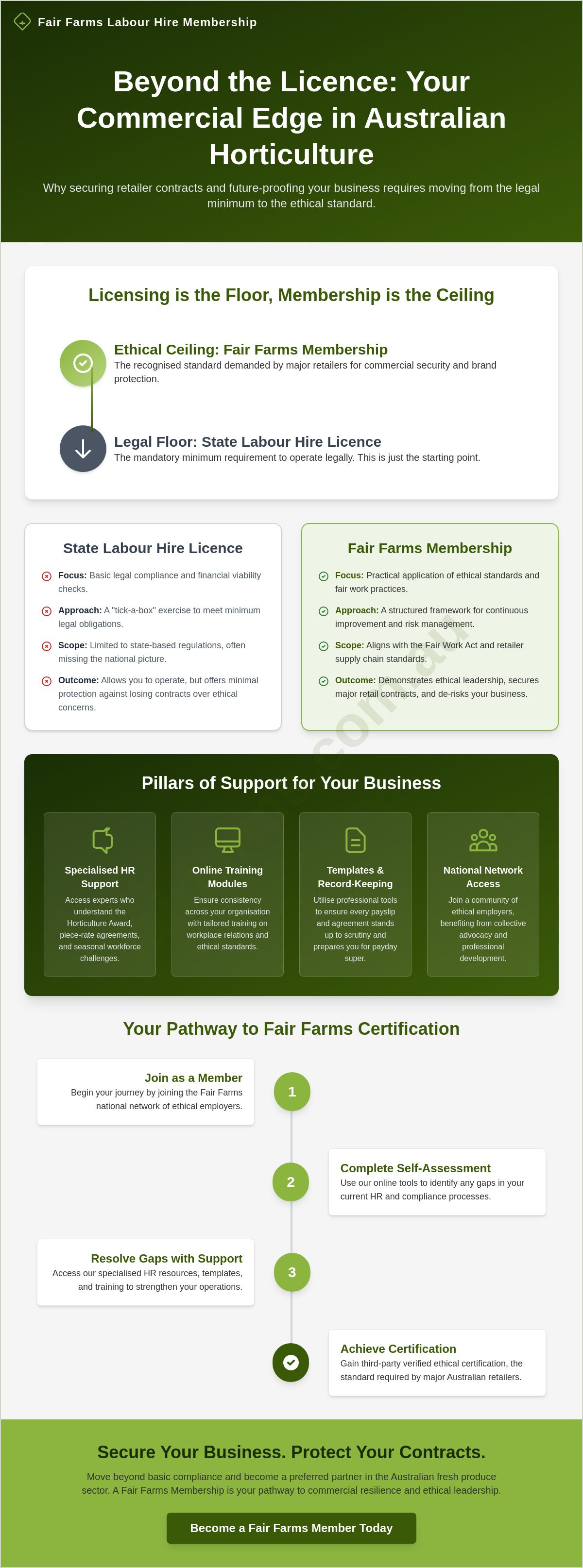
Licensing vs. Certification: Why Membership is Your Competitive Edge
A state-issued licence is your ticket to enter the market; it isn't a guarantee of commercial success. While holding a valid licence in Victoria, Queensland, South Australia, or the ACT is a legal prerequisite, many providers mistakenly believe this is the finish line. In reality, a licence only confirms you've met the bare minimum legal requirements to operate. It doesn't demonstrate the sophisticated ethical management that modern retail contracts demand. This is where a Labour Hire Membership transforms your business from a compliant entity into a preferred industry partner.
Major Australian supermarkets have moved beyond simple legal checks. They now prioritise social compliance, requiring their suppliers to prove that every worker in the chain is treated with dignity and paid correctly. Relying solely on a state licence leaves a significant gap in your business profile. Certification through a Labour Hire Membership fills this void, providing a visible badge of integrity that resonates with corporate procurement teams. It's a proactive way to answer the industry's most pressing question: how do you prove your ethical claims are backed by action?
Retailer Expectations and Supply Chain Transparency
Supermarket giants like Woolworths now implement their own rigorous standards for labour hire providers within their supply chains. These retailers often require third-party verification or specific ethical certifications to mitigate their own reputational risks. A state licence doesn't provide the granular data or the third-party audit results these retailers seek. By engaging with the Fair Farms Certification pathway, you prepare your business for these high-stakes evaluations. Membership ensures you have the documentation and processes ready before a retail auditor even steps onto the farm, turning a potentially stressful inspection into a routine demonstration of excellence.
De-risking the Business for Host Employers
Host employers are increasingly wary of the "joint employment" risks and the heavy penalties associated with non-compliant labour providers. In Victoria, for instance, a corporation can face penalties exceeding $650,000 for engaging an unlicensed provider. However, growers want more than just a licensed partner; they want a partner who won't land them in the headlines for modern slavery or wage theft. Demonstrating a robust HR framework through membership builds immediate trust. It shows growers that you've invested in professional oversight, which significantly reduces their own liability. This commitment to transparency creates long-term financial stability and fosters stronger, more resilient relationships across the regional agricultural community.
The Pathway to Fair Farms Certification
Achieving ethical certification is a structured journey that transforms how your business manages its workforce. Unlike a state licence, which often feels like a regulatory hurdle, the pathway to becoming a certified provider is designed to build internal capacity and resilience. It begins with securing a Labour Hire Membership, which grants you access to the tools and guidance necessary to navigate this professional evolution. This process is not a race; it's a methodical progression toward industry leadership.
The first phase involves registering your business and completing a comprehensive self-assessment. This internal review allows you to benchmark your current HR systems against the Fair Farms Standard. Once you've identified any compliance gaps, the next step is engaging with Fair Farms Online Training. These modules are specifically designed to address common industry challenges, ensuring your management team understands their obligations under the Horticulture Award. Following this preparation, you'll engage an independent auditor for a third-party social audit. Upon successful completion, your business achieves certification, a status you can proudly promote to host employers and retail partners. Maintaining this standard requires annual renewals and ongoing monitoring, ensuring your ethical commitment remains current.
The Self-Assessment Process
The self-assessment is the foundation of your certification journey. By using the digital portal, you can identify both the strengths and weaknesses of your existing payroll and record-keeping systems. It's essential to consult the Fair Farms pathways to guide your progress through this stage. An honest internal review is far more valuable than a superficial one; it allows you to fix issues before they become audit non-conformances. This proactive approach saves time and demonstrates a genuine commitment to ethical improvement.
Navigating the Social Compliance Audit
A social compliance audit involves an on-site visit from an independent auditor who will review your documentation and interview workers. Common pitfalls for labour hire providers include incomplete piece-rate agreements or failing to track the mandatory three-month progression from Level 1 to Level 2 for employees. The audit is not an interrogation but an opportunity for professional evaluation. By turning any findings into an actionable improvement plan, you demonstrate to the industry that your Labour Hire Membership is backed by a culture of accountability. Ready to start your journey? You can register for Fair Farms Certification today to begin the assessment process.
Joining the Community: Ethical Leadership in Horticulture
Stepping into a Labour Hire Membership is more than a commitment to a set of rules; it's an entry into a national network of like-minded professionals. In an industry as vast as Australian fresh produce, which boasts a turnover of $9.1 billion, individual businesses can often feel isolated against the weight of regulatory change. By joining this community, you're no longer operating in a vacuum. You gain the collective strength of a group dedicated to the principle of 'Fair Work, Fair Farms', ensuring that the 70,000 short-term harvest roles across the country are managed with integrity.
Membership offers a steady stream of intelligence that keeps your business at the forefront of the sector. Through exclusive member events, webinars, and regular industry updates, you receive the latest insights into workplace relations and compliance trends. This continuous flow of information ensures you're never caught off guard by shifting standards. It's about building a culture of communal progress where the success of one ethical provider contributes to the reputation of the entire horticultural landscape. This shared knowledge base is a powerful tool for any business owner looking to maintain a principled and stable operation.
Advocacy and Industry Representation
Your membership does more than support your own operations; it fuels the broader mission of the Queensland Fruit & Vegetable Growers (QFVG) and the Fair Farms program. We act as a steady, reliable voice for the industry at a federal level, ensuring that policymakers understand the practical realities of the farm gate. By participating in this program, you're helping to shape the future of labour hire standards in Australia. This representation is vital for ensuring that future industrial relations frameworks are practical, equitable, and supportive of the hardworking people who keep our supply chains moving.
Taking the Next Step
The journey toward ethical leadership provides a clear competitive advantage in a market that values transparency above all else. Throughout this article, we've explored how a Labour Hire Membership delivers the HR support, specialised training, and recognised certification needed to thrive in a demanding retail environment. It's a long-term investment in your brand's reputation and the sustainability of the Australian horticulture sector. If you're ready to transition from basic compliance to genuine industry leadership, the path is clear. We invite you to contact Fair Farms for a consultation to discuss how we can support your business's unique needs and help you secure your place in a transparent, fair future.
Securing the Future of Ethical Labour Hire
The Australian horticultural landscape is evolving rapidly. Meeting the legal minimum of state licensing is no longer enough to satisfy the expectations of major retailers or the community. By investing in a Labour Hire Membership, you're choosing to lead with integrity. This commitment provides your business with the specialised HR tools and training needed to navigate complex industrial relations changes, such as the upcoming transition to payday super in 2026. It's a proactive step that transforms your compliance requirements into a powerful commercial advantage.
Developed by the Queensland Fruit & Vegetable Growers (QFVG), the program is recognised by major Australian retailers and supported by federal government funding. This ensures your ethical credentials carry significant weight across the entire supply chain. You're not just managing a workforce; you're contributing to a fairer, more transparent industry for everyone involved. We invite you to join the Fair Farms community and secure your ethical certification today. Together, we can build a resilient agricultural sector that values every participant and protects the reputation of Australian produce.
Frequently Asked Questions
What is the difference between a Labour Hire Licence and Fair Farms Membership?
A Labour Hire Licence is a mandatory legal requirement in specific states, such as Victoria and Queensland, focusing on basic regulatory compliance and financial viability. In contrast, a Labour Hire Membership through Fair Farms is an industry-led initiative focused on ethical standards and social compliance. While a licence allows you to operate legally, membership helps you secure retail contracts by proving you meet the higher ethical benchmarks demanded by major supermarkets.
Is Fair Farms Membership mandatory for all labour hire providers in Australia?
Fair Farms Membership is not a legal requirement under Australian law, but it's increasingly becoming a commercial necessity. Many major supermarkets and retailers now require their supply chain partners to hold recognised ethical certification. This means that while you can legally operate with just a state licence, you may find it difficult to secure contracts with large-scale host employers who prioritise social responsibility and supply chain transparency.
How much does it cost to become a Fair Farms member?
The cost of membership is structured to ensure the program remains accessible to various business types within the horticultural sector. Fees are generally determined by the specific pathway you choose, such as the Audit or Non-Audit streams, and the scale of your operations. For the most accurate and current details regarding the fee schedule for your specific business profile, it's best to consult the membership portal directly.
Does Fair Farms conduct the audits themselves?
Fair Farms does not conduct the audits itself to ensure a completely transparent and unbiased evaluation process. Instead, we partner with independent, third-party auditing bodies that are specially trained in the Fair Farms Standard. These professional auditors conduct site visits and document reviews, providing an objective assessment of your business's compliance with ethical employment practices and the Horticulture Award.
How long does the certification process typically take for a labour hire business?
The timeframe for achieving certification varies depending on your business's current HR maturity and how quickly you complete the self-assessment and training modules. Some providers with robust systems in place may progress to an audit within a few months; others may take longer to close identified compliance gaps. A steady, methodical approach ensures that your systems are truly resilient and ready for the formal audit stage.
Can I use the Fair Farms logo on my marketing materials?
Certified members are encouraged to use the Fair Farms logo on their marketing materials, websites, and business documentation. This logo serves as a visible badge of integrity, signalling to growers and retailers that your business has successfully met rigorous ethical standards. It's a powerful tool for differentiating your services in a competitive market and building immediate trust with potential host employers across regional Australia.
What happens if my business fails a social compliance audit?
If a business doesn't meet all requirements during an audit, the auditor will issue a list of non-conformances. These are viewed as opportunities for professional improvement rather than permanent failures. You'll be given a specific timeframe to implement corrective actions. Fair Farms provides the necessary HR support and resources to help you resolve these issues, ensuring you can successfully achieve certification upon your next review.
How does membership help me comply with the Modern Slavery Act?
Membership provides a practical framework for identifying and mitigating labour risks, which is a core requirement of the Modern Slavery Act 2018. By implementing the Fair Farms Standard, you demonstrate due diligence and supply chain transparency. This proactive management helps you provide the necessary data and assurances to larger corporate clients who have mandatory reporting obligations under federal law, protecting your place in the supply chain.