
Fair Work Ombudsman Audit Preparation for Farms: The Ultimate Compliance Checklist

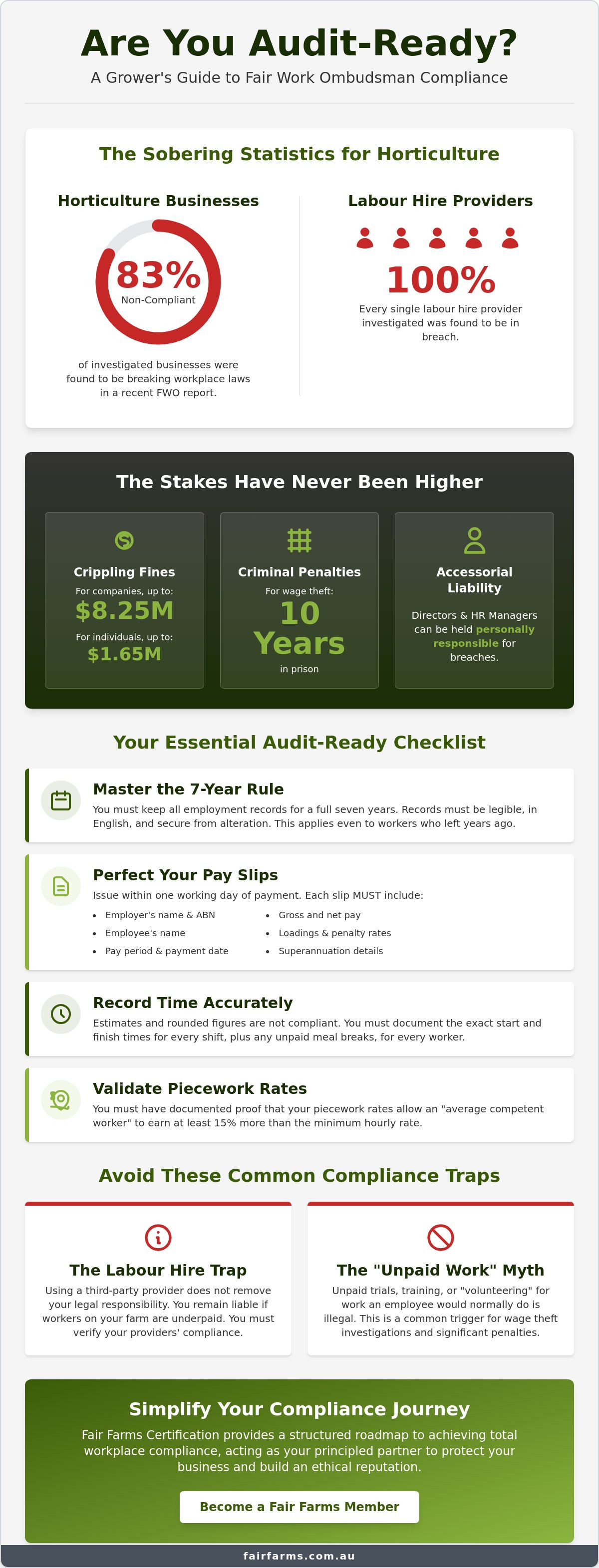
Did you know that a 2025 Fair Work Ombudsman report revealed that 83% of investigated horticulture businesses in the Yarra Valley and Mornington Peninsula were found to be non-compliant? This staggering figure, combined with the fact that every single labour hire provider investigated in those regions was in breach of workplace laws, highlights a significant risk for even the most well-meaning growers. When the stakes involve potential criminal penalties for wage theft and fines that can exceed $170,000 for record-keeping errors, Fair Work Ombudsman audit preparation for farms must be a proactive priority rather than a last-minute scramble.
We know you take your responsibility to your workforce seriously, yet the complexity of the Horticulture Award and the nuances of seasonal labour hire can make compliance feel like a moving target. You deserve the peace of mind that comes from knowing your payroll is 100% accurate and your records are beyond reproach. This guide provides a clear, structured approach to mastering your obligations with confidence. We will walk you through a comprehensive checklist of required documents and the "ethical evidence" needed to satisfy an inspector, ensuring you are prepared to demonstrate your commitment to fair work standards during any visit.
Key Takeaways
- Understand why you must maintain detailed employment records for seven years and how to ensure every pay slip meets strict legal requirements.
- Execute a robust Fair Work Ombudsman audit preparation for farms by conducting internal mock audits and organising essential employee contracts.
- Identify the "Labour Hire Trap" to understand your ongoing legal responsibility for workers, even when engaged through third-party providers.
- Debunk common industry myths regarding unpaid "volunteering" to protect your business from significant wage theft penalties.
- Discover how Fair Farms Certification acts as a principled mentor, offering a structured roadmap to achieving total workplace compliance.
Understanding the Fair Work Ombudsman Spotlight on Horticulture
The Fair Work Ombudsman serves as the independent statutory regulator for Australian workplace relations, tasked with the education, monitoring, and enforcement of the Fair Work Act. For those in the agricultural sector, this presence has intensified significantly following the findings of the multi-year Harvest Trail Inquiry. In 2026, farms remain a top priority because of historically high rates of non-compliance and the industry's reliance on vulnerable migrant labour. Inspectors have shifted their perspective; what was once viewed as an "accidental error" is now frequently treated as a "serious contravention," especially if robust systems for record-keeping are absent.
Taking a proactive stance on Fair Work Ombudsman audit preparation for farms isn't just about avoiding penalties. It's about protecting your farm's reputation and ensuring you remain a preferred supplier for major retail chains. Modern retailers increasingly demand social compliance as a non-negotiable condition of entry. Demonstrating ethical labour practices through programs like Fair Farms Certification helps secure your place in the supply chain. It builds a culture of integrity that attracts reliable, hardworking people to your property.
The Cost of Non-Compliance in 2026
The financial and legal risks have never been higher. Since the new wage theft laws took effect on 1 January 2025, intentional underpayment can result in individual fines of up to $1.65 million or even 10 years in prison. Companies face penalties reaching $8.25 million. Beyond the numbers, "Accessorial Liability" means directors and HR managers can be held personally responsible for breaches. Publicly being "named and shamed" in FWO reports often leads to a total collapse in the ability to recruit seasonal labour, as workers move toward certified, transparent employers who value equity.
What Triggers an FWO Audit?
Audits rarely happen in a vacuum. Most are triggered by anonymous tip-offs from employees or third-party advocates who suspect underpayment. The FWO also conducts regional "blitzes" based on historical data. In early 2026, joint operations in regions like the Yarra Valley showed that regulators are now using sophisticated data-matching. By comparing records between the ATO, Home Affairs, and Fair Work, they can identify discrepancies in reported hours and tax withholdings before they even set foot on your farm. Preparedness is your only reliable defence.
Core Record-Keeping Obligations Under the Horticulture Award
Thorough Fair Work Ombudsman audit preparation for farms begins with an unwavering commitment to the "seven-year rule". Under Australian workplace laws, you're legally required to maintain employment records for seven years. This isn't just a suggestion; it's a foundation of your business's integrity. These records must be legible, in English, and protected against alteration. If an inspector arrives, they'll expect to see a clear history of your relationship with every worker, including those who may have left your employment years ago.
Pay slips are often the first thing an inspector scrutinises. Each slip must be issued within one working day of payment and contain specific details: the employer’s name and ABN, the employee’s name, the pay period, and the date of payment. You must clearly distinguish between gross and net pay, and include any loadings, allowances, or penalty rates. As of July 2025, the minimum hourly rate for a Level 1 casual adult employee is $30.35, which includes the 25% casual loading. Failing to list superannuation contributions or the name of the super fund is a common oversight that can lead to significant fines.
Accurate time-recording is equally vital. You must document the exact start and finish times for every shift, along with any unpaid meal breaks. Estimations or "rounded" figures won't suffice during an investigation. To ensure you haven't missed any critical details, you can use the Fair Work Ombudsman's interactive self-audit checklist to evaluate your current systems. For those using piecework, the requirements are even more stringent. You must document how you determined the piece rate to ensure an "average competent worker" earns at least 15% more than the minimum hourly rate. In 2026, this means a casual Level 1 pieceworker must have the capacity to earn $34.90 per hour.
Digital vs. Paper Records: What Inspectors Prefer
While paper records are still legally acceptable, inspectors increasingly favour digital time-clocking and cloud-based payroll systems. Digital records are harder to lose and easier to organise. They also help you meet the "48-hour retrieval rule," which requires you to produce records within two business days if they aren't kept on-site. When moving to digital systems, ensure you maintain worker privacy while allowing for the transparency required for a principled audit process.
Classification and Pay Rates
Incorrectly classifying workers under the Horticulture Award 2020 is a frequent cause of underpayment. You must ensure every employee is assigned the correct level based on their duties and experience. This classification affects their base rate, overtime eligibility, and public holiday pay. If you have entered into Individual Flexibility Arrangements (IFAs), these must be in writing and ensure the worker is "better off overall" than they would be under the standard Award. Establishing a structured certification pathway can help you verify these classifications are correct before an inspector ever knocks on your door.
Identifying and Fixing Common Compliance Gaps
Many growers approach Fair Work Ombudsman audit preparation for farms by focusing solely on their direct employees. However, a significant portion of risk actually lies in the "Labour Hire Trap". A three-year FWO investigation found that labour hire providers were responsible for 68% of identified non-compliance cases. Under current Australian law, you can be held legally and financially liable for the actions of your contractors. If your labour hire partner underpays workers or fails to provide compliant pay slips, the regulator may look to you to rectify the situation through joint liability principles.
Another common gap involves unpaid work or "volunteering" myths. It's a common misconception that backpackers or seasonal workers can perform "trials" or "volunteer" in exchange for experience or accommodation. If an individual is performing productive work that benefits your farm, they're likely an employee and must be paid the correct Award rate. Similarly, any deductions from a worker's pay for tools, equipment, or transport must be authorised in writing and be principally for the employee's benefit. Accommodation costs must also be kept strictly separate from payroll to avoid any appearance of unlawful wage withholding.
Managing Labour Hire Providers
Protecting your business requires rigorous due diligence on every labour hire contractor you engage. You should regularly request evidence of their payroll compliance and ensure they hold a valid licence in your state. Using the Fair Farms Members portal allows you to verify and connect with ethical partners who share your commitment to workplace standards. We recommend including specific indemnity clauses in your contracts that require providers to demonstrate ongoing compliance with the Horticulture Award. This proactive oversight minimises the risk of third-party errors impacting your farm's standing during an inspection.
Addressing the "Too Much Paperwork" Objection
The administrative load during peak harvest periods can feel overwhelming, but structured HR systems actually reduce your long-term burden. By digitising your onboarding and time-tracking, you eliminate the need for manual data entry and reduce the likelihood of transcription errors. These systems make retrieving records during an audit a simple, stress-free process rather than a frantic search for lost timesheets. Ultimately, workplace compliance is a fundamental investment in your business's long-term stability rather than a mere administrative cost.
The Ultimate Audit Preparation Checklist for 2026
Moving beyond theoretical compliance requires a methodical approach to your farm's internal records. Effective Fair Work Ombudsman audit preparation for farms is built on the principle of "ready at all times." Rather than reacting to an inspector's arrival, you should establish a routine that treats compliance as a standard operational procedure. By following this five-step checklist, you can identify potential vulnerabilities before they become costly liabilities.
- Step 1: Conduct a "Mock Audit" – Select a random sample of your payroll from the last three months. Verify that every hour recorded on timesheets matches the gross pay on the corresponding pay slips, including any overtime or penalty rates for public holidays.
- Step 2: Collate Employee Contracts – Ensure every worker has a signed contract that clearly states their classification level under the Horticulture Award. For casuals, confirm the 25% loading is explicitly mentioned.
- Step 3: Verify Superannuation and ATO Lodgements – Collate SuperStream receipts and your Single Touch Payroll (STP) reports. Inspectors often look for evidence that superannuation was paid into the correct funds by the quarterly due dates.
- Step 4: Organise Labour Hire Documentation – If you use contractors, keep a current copy of their labour hire licence and a certificate of currency for their WorkCover insurance. This confirms you've performed due diligence on your supply chain partners.
- Step 5: Review VEVO Procedures – Maintain a register of "Right to Work" checks for all visa holders. Under the 2025 wage theft legislation, failing to verify work rights can be a red flag that triggers deeper scrutiny of your entire payroll.
The "Audit Day" Folder Structure
Inspectors value efficiency and transparency. We recommend organising your records into a dedicated "Audit Day" folder, either physically or on a secure cloud drive, structured around the employee life cycle. Divide this into three sections: Recruitment (signed contracts and TFN declarations), Payroll (timesheets and pay slips), and Termination (final pay calculations and notice periods). Including a copy of the Fair Work Information Statement for each worker demonstrates that you've met your basic notification duties from day one. If you're unsure where to start with this organisation, you can contact Fair Farms for guidance on establishing robust record-keeping frameworks.
Staff Communication and Inductions
An audit isn't just a review of paperwork; inspectors often interview staff to verify their lived experience on your farm. Ensure your workers know exactly where to access their pay slips and understand their rights under the Award. Implementing Fair Farms Online Training during the induction process ensures every team member, from pickers to supervisors, understands the standards of an ethical workplace. Preparing your supervisors to answer questions calmly and accurately about daily break times and safety protocols can significantly smooth the audit process. When your team is well-informed, it reflects a culture of integrity that inspectors find highly reassuring.
Ready to move from checklists to a fully certified system of compliance? Explore our Fair Farms Certification pathways to secure your farm’s future.
Simplifying Compliance Through Fair Farms Certification
Achieving total workplace compliance is a journey that shouldn't be walked in isolation. While the checklists provided in the previous sections offer a vital foundation, real-world Fair Work Ombudsman audit preparation for farms requires a more integrated, systemic approach. Fair Farms operates with quiet confidence as a principled mentor for the horticulture industry, providing the guidance needed to transform complex regulations into clear, manageable daily practices. We believe that ethical responsibility is the cornerstone of a sustainable agricultural sector.
The Fair Farms Certification pathway serves as a structured roadmap to integrity. It allows you to move beyond the fear of heavy fines by establishing a verified system of "Ethical Evidence." This pathway bridges the gap between meeting minimum legal standards and achieving best-practice ethical employment. In 2026, major Australian retailers and consumers increasingly prioritise produce from certified farms, making compliance a powerful tool for market access and brand reputation. By participating in this movement, you demonstrate a long-term commitment to the success and reputation of your regional community.
Benefits of the Fair Farms Membership
Becoming a member provides more than just a certificate; it offers a supportive partnership. Our members gain access to specialised resources designed to withstand the scrutiny of any regulator. These benefits include:
- HR Support for Growers: Direct access to expert guidance tailored to the unique challenges of the Australian horticulture landscape.
- Compliance Tools: Professionally developed templates and record-keeping tools that satisfy FWO requirements and reduce administrative stress.
- Fair Farms Online Training: Educational modules that empower your entire team to understand their rights and responsibilities.
- A Principled Community: The opportunity to join a network of Fair Farms Members who are leading the way in equitable labour standards.
Next Steps: Securing Your Farm’s Future
The first step toward peace of mind is a simple self-assessment. This internal review helps you identify any remaining gaps in your payroll or record-keeping before they result in a "serious contravention." Once you're confident in your systems, the certification process involves an independent third-party audit to verify your compliance. This external validation provides the ultimate assurance that your farm is 100% compliant and ready for any official inspection. We invite you to contact our team today to begin your journey toward a fairer, more resilient horticulture sector. Let's work together to build a future where every Australian farm is recognised for its integrity and commitment to its people.
Securing Your Farm's Future Through Ethical Leadership
Prioritising compliance is no longer just about avoiding fines; it's about establishing your farm as a leader in ethical agriculture. By mastering the seven-year record-keeping rule and proactively managing labour hire risks, you protect your business from the severe penalties associated with intentional underpayment. Effective Fair Work Ombudsman audit preparation for farms requires a transition from reactive paperwork to a principled system of transparency that satisfies both regulators and your retail partners. This proactive approach ensures that when an inspector arrives, you can present your records with quiet confidence.
As an industry-led and government-supported initiative developed by Queensland Fruit & Vegetable Growers (QFVG), Fair Farms is uniquely positioned to guide you through these regulatory complexities. Our program is trusted by major Australian retailers to provide the rigorous supply chain transparency they demand in the modern market. We invite you to join Fair Farms today to access our full suite of audit-ready templates and HR support. Taking this step ensures your payroll is resilient and your reputation remains beyond reproach. We look forward to supporting your commitment to a fairer, more prosperous horticulture sector.
Frequently Asked Questions
How long does a Fair Work Ombudsman audit usually take?
An on-site inspection typically concludes within a few hours; however, the complete investigation often spans several weeks or months. The duration depends on the volume of records requested and the clarity of your payroll systems. Providing well-organised digital files can significantly expedite the process, allowing the inspector to verify your compliance without unnecessary delays or repeated follow-up requests.
What documents will an inspector ask for first?
Inspectors usually prioritise time and wages records for the previous six months, including timesheets, pay slips, and bank transfer receipts. They'll also request to see employee contracts, piecework agreements, and your register of "Right to Work" VEVO checks. Having these documents collated in an "Audit Day" folder ensures you can meet the 48-hour retrieval rule for records not kept on-site.
Can I be fined if my labour hire contractor is the one underpaying workers?
Yes, you can be held legally responsible for underpayments made by a third-party labour hire provider. Under joint liability principles, the FWO expects growers to conduct thorough due diligence on their contractors' payroll practices. Including this oversight in your Fair Work Ombudsman audit preparation for farms protects you from being caught in the "Labour Hire Trap" and facing significant financial penalties.
Is it compulsory to use digital time-tracking software for farm workers?
No, digital time-tracking is not a legal requirement, but it's highly recommended for maintaining accuracy. Paper records are acceptable provided they're legible, kept in English, and clearly document start, finish, and unpaid break times. Digital systems simply reduce the risk of human error and make the process of retrieving records during an official inspection much more efficient.
What happens if I find an error in my records during an audit?
You should disclose the error immediately and demonstrate a clear plan to rectify the discrepancy, such as back-paying the affected worker. Honesty and proactive remediation are viewed favourably by inspectors and can influence whether they issue a formal fine or a simpler compliance notice. This transparency reflects the principled approach to leadership that defines an ethical horticultural business.
Does Fair Farms certification protect me from an FWO audit?
Certification doesn't grant legal immunity from an FWO inspection, but it does significantly lower your risk profile. Regulators often focus their resources on "high-risk" businesses with no formal compliance systems. By achieving certification, you demonstrate that your systems have already survived a rigorous independent check, which often makes any subsequent FWO audit a much smoother and faster process.
How often should I conduct a self-audit of my payroll?
We recommend conducting a thorough self-audit at least every six months or immediately following your peak harvest season. Regular internal reviews help you identify and rectify small payroll discrepancies before they escalate into systemic issues. This practice is a core component of Fair Work Ombudsman audit preparation for farms, ensuring your business remains compliant with the latest Award rates and legislative requirements.
What is the "Right to Entry" rule for Fair Work inspectors on farms?
Fair Work inspectors have the power to enter your farm during business hours if they suspect a breach of workplace laws has occurred. They aren't required to provide advance notice for these inspections, although they must present their official credentials upon arrival. While on-site, they may inspect work, interview employees, and request to see relevant employment records and pay slips.