
Workplace Bullying and Harassment Policy for Farms: A Comprehensive Guide and Template for Australian Growers
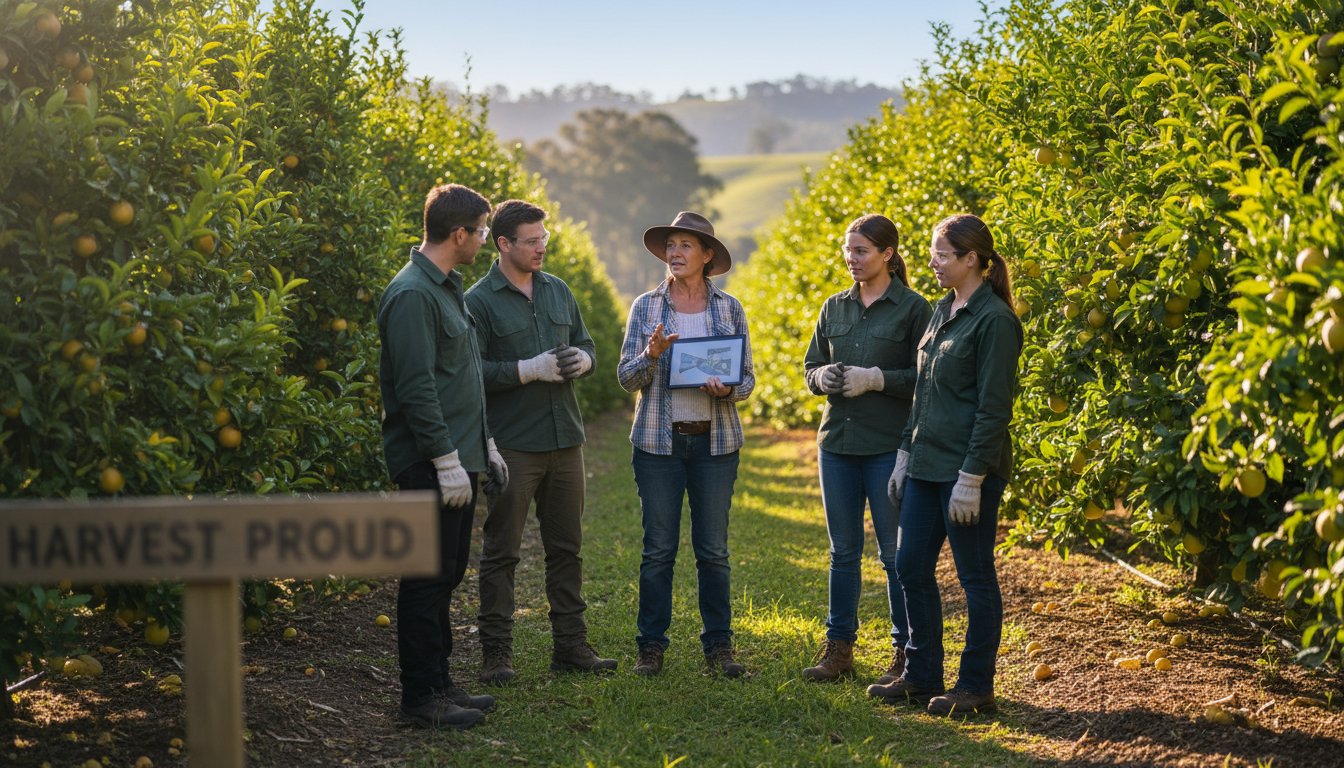
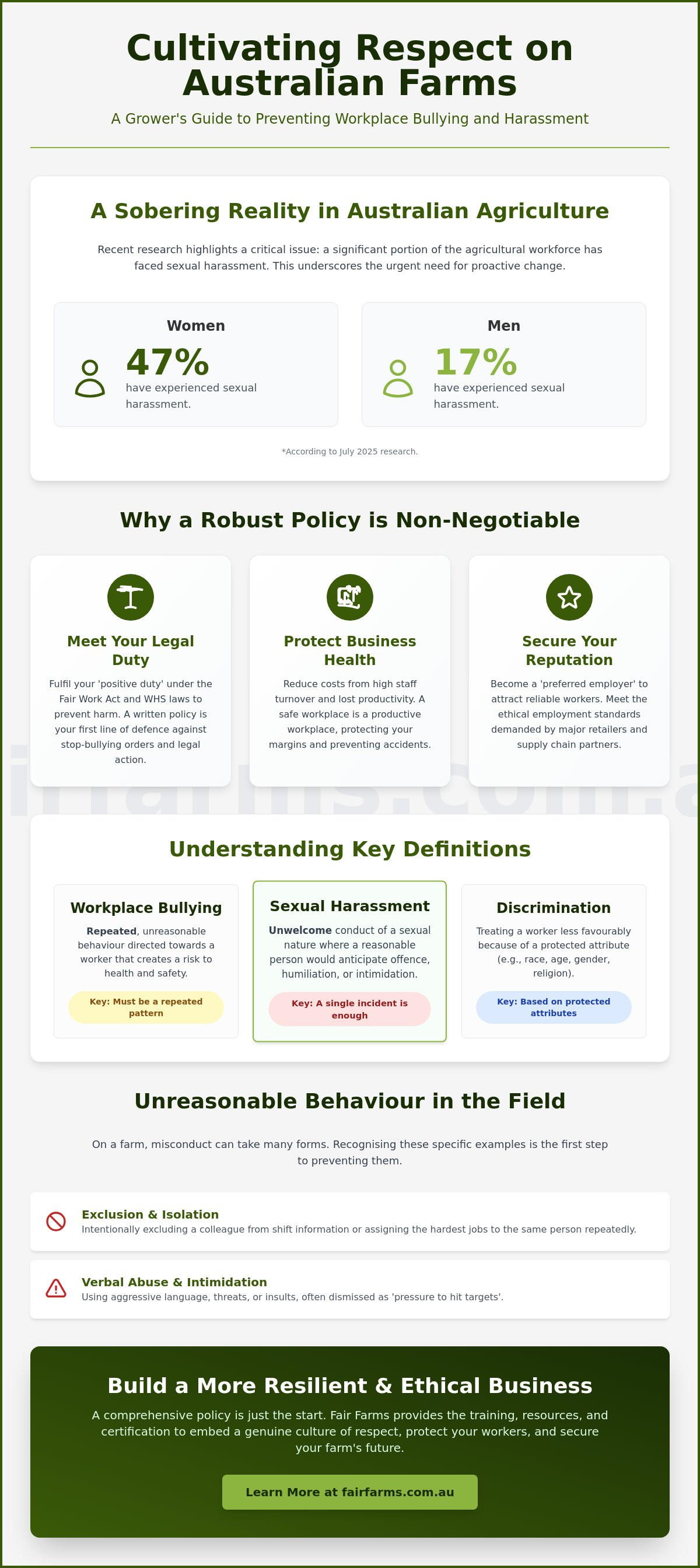
Did you know that 47% of women and 17% of men in the Australian agriculture industry have experienced sexual harassment according to July 2025 research? It's a sobering figure that highlights the urgent need for proactive change across our paddocks and packing sheds. We understand that managing high turnover in seasonal labour while monitoring remote work crews makes maintaining a respectful culture feel like a constant uphill battle against complex Fair Work regulations.
Establishing a comprehensive workplace bullying and harassment policy for farms is no longer just a recommendation; it's a critical component of your positive duty to prevent harm before it occurs. This guide provides the clarity you need to draft, implement, and enforce a robust policy that protects your workers and secures your farm's standing with major retailers. We'll explore the latest legal shifts, offer a practical template for your operations, and show how Fair Farms Certification and dedicated HR support for growers can help you build a more resilient and ethical business.
Key Takeaways
- Understand the legal obligations under the Fair Work Act and national WHS laws that necessitate a formal, written commitment to worker well-being.
- Identify farm-specific examples of unreasonable behaviour, such as exclusion from shifts or verbal abuse in the field, to better protect your seasonal labour.
- Learn why a workplace bullying and harassment policy for farms requires proactive leadership and a genuine culture of respect to be truly effective.
- Access a structural checklist to help you draft a plain-English policy that ensures all workers, regardless of their background, understand their rights.
- Discover how Fair Farms Membership and online training provide the industry-standard tools needed to achieve ethical employment compliance.
Why a Robust Bullying and Harassment Policy is Essential for Australian Growers
A workplace bullying and harassment policy for farms is far more than a bureaucratic requirement; it's a formal pledge to protect the people who are the backbone of your business. In the horticulture sector, where work is often remote and involves diverse seasonal crews, this document provides the essential framework for acceptable conduct. It serves as a clear statement of purpose, ensuring that every worker, supervisor, and manager understands that your farm is a place of mutual respect. This isn't about mere compliance. It's about setting a standard of integrity that resonates throughout your entire operation.
The Legal Framework: Fair Work and WHS
Under the Fair Work Act and national Work Health and Safety (WHS) laws, every Australian grower has a non-delegable duty of care. You're legally responsible for providing a work environment that is safe both physically and psychologically. Workplace bullying can lead to the Fair Work Commission issuing stop-bullying orders, which can disrupt your harvest and damage your professional standing. A written policy is your first line of legal defence. It proves you've taken reasonable and proportionate measures to prevent harm, which is a key requirement of the "positive duty" now placed on employers.
The financial cost of a "toxic" culture is often hidden but always significant. High staff turnover leads to constant recruitment expenses and the loss of experienced hands. When workers feel unsafe or undervalued, productivity drops and the risk of on-site accidents increases. These avoidable costs eat away at your margins, making a robust workplace bullying and harassment policy for farms a sound financial investment as much as an ethical one.
Protecting Your Farm’s Reputation
Modern labour markets are more transparent than ever. A poor workplace culture doesn't stay hidden; it ends up on social media and worker review platforms, making recruitment an expensive nightmare in a competitive landscape. Conversely, growers who prioritise equity and safety quickly become "preferred employers." This status is a massive advantage when labour is tight. It ensures you attract reliable workers who are committed to your farm's success because they know they'll be treated with dignity.
Major retailers and supply chain partners now demand proof of ethical employment. They aren't just looking at the quality of your produce; they're looking at the quality of your leadership. Achieving Fair Farms Certification demonstrates that your business meets the highest standards of Australian workplace law. It secures your reputation and ensures your farm remains a viable, respected part of the national agricultural landscape for the long term.
Defining Bullying and Harassment in the Horticulture Context
To build an effective workplace bullying and harassment policy for farms, you must first understand the legal distinctions between different types of misconduct. Understanding these definitions is the first step toward creating a culture where everyone feels secure. Workplace bullying is defined as repeated, unreasonable behaviour directed towards a worker that creates a risk to health and safety. In contrast, sexual harassment is unwelcome conduct of a sexual nature where a reasonable person would anticipate the possibility that the person harassed would be offended, humiliated, or intimidated. While bullying must be repeated to meet the legal definition, a single incident of harassment can be enough to breach the law. Discrimination occurs when a worker is treated less favourably because of a protected attribute, such as their race, age, or gender.
In a horticulture setting, these issues often manifest in specific ways. Unreasonable behaviour might include a supervisor consistently assigning the hardest rows to the same person, or a group of pickers intentionally excluding a colleague from shift-related information. Verbal abuse in the field, often dismissed as "pressure to hit targets," is another common example. Australian law applies the "reasonable person" test here. This asks whether a neutral observer, knowing the circumstances, would consider the behaviour offensive or intimidating. Accessing the right resources through Fair Farms Membership helps ensure your team stays on the right side of the law while managing these complex interpersonal dynamics.
Identifying Subtle Forms of Harassment
Banter often masks bullying in regional workplaces. While a joke might seem harmless to some, it crosses the line if it targets a person's identity or background. Digital platforms like WhatsApp or Facebook groups, often used to coordinate harvest crews, are high-risk areas for cyber-bullying. Additionally, the isolation of remote farm locations can make workers feel trapped. If bullying occurs in farm-provided accommodation, the impact is magnified because the worker has no clear escape from the hostile environment.
Reasonable Management vs. Unreasonable Behaviour
It's vital to remember that not every difficult conversation is bullying. You have a right to manage your business and maintain standards. Giving constructive feedback on picking speeds, packing quality, or punctuality is a necessary part of farm operations. Setting clear performance targets and holding staff accountable is not bullying, provided it's done without intimidation or public shaming. Reasonable management action is any action taken by an employer or supervisor that is carried out in a fair and transparent manner to direct or control the way work is performed.
Beyond the Paperwork: Implementing a Culture of Respect
A workplace bullying and harassment policy for farms is only as effective as the people who uphold it. While a written document satisfies legal requirements, it's the daily actions of your leadership team that define your farm's true culture. Integrity must start at the very top. If a farm owner or head grower overlooks "rough talk" or exclusionary behaviour, supervisors and harvest crews will naturally assume these actions are acceptable. Leading by example means demonstrating respect in every interaction, especially during the high-pressure environment of a peak harvest when tempers can fray.
Addressing the "bystander effect" is another crucial step in building a resilient workplace. Often, workers witness inappropriate behaviour but remain silent out of fear or a belief that it's "not their business." You must actively encourage a culture where workers feel empowered to support their mates and report issues without hesitation. Given the diversity of the Australian horticultural workforce, this communication must be inclusive. Translating your core policy points into the primary languages of your seasonal crews ensures everyone understands the standard of conduct expected on your property, regardless of their background.
Training and Induction Protocols
Your policy shouldn't sit in a folder in the office. It must be a central part of every new worker’s induction process before they even pick their first piece of fruit. Regular "toolbox talks" are an excellent way to keep these standards top-of-mind, particularly when new seasonal crews arrive and social dynamics shift. To ensure your supervisors have the right skills to manage these sensitive conversations, Fair Farms Online Training provides structured modules that support staff development and reinforce ethical labour standards across your entire operation.
Reporting Mechanisms and Confidentiality
For a workplace bullying and harassment policy for farms to be effective, people must trust the process. Creating a "safe space" for reporting means ensuring that any worker who comes forward is protected from reprisal or victimisation. Many successful farms appoint a designated "Contact Officer", someone who isn't a direct supervisor, to act as a confidential first point of contact. This person listens, explains the options, and helps the worker navigate the farm's formal grievance procedure. This procedure should be a clear, step-by-step process that outlines how a complaint will be investigated and resolved, providing certainty for both the complainant and the business owner.
Step-by-Step: Drafting Your Farm’s Workplace Policy Template
Drafting a workplace bullying and harassment policy for farms requires a methodical approach that looks beyond individual state regulations. While regional guides often focus on specific local laws, a truly effective policy aligns with the national Fair Work framework to provide consistent protection for your entire workforce. Using plain English is non-negotiable. Your policy isn't a legal textbook; it's a practical guide that every worker, from the packing shed to the remote harvest crew, must be able to understand and follow. Avoid complex jargon that might confuse those for whom English is a second language, ensuring the message of respect is accessible to all.
Essential Policy Clauses
Your policy should begin with a strong Statement of Commitment. This is a clear, authoritative declaration from the farm owner that bullying and harassment won't be tolerated under any circumstances. Next, you must define the scope of the policy. In the horticulture sector, work doesn't always end at the farm gate. Your policy should explicitly cover work-related social events, farm-provided transport, and on-site accommodation. Finally, include a Disciplinary Action clause. This section must outline the potential consequences for breaching the policy, ranging from formal warnings to the termination of employment. Providing this level of detail ensures everyone is aware of the gravity of these standards.
Involving Contractors and Labour Hire
A common mistake is assuming that your policy only applies to your direct employees. To protect your farm's reputation and meet your legal positive duty, your workplace bullying and harassment policy for farms must extend to every individual on your property, including contractors and labour hire staff. You should work closely with your labour hire partners to harmonise your policies. If a contractor's worker experiences harassment while on your site, you may still be held liable if you haven't taken reasonable steps to prevent it. This shared responsibility makes clear communication between all parties essential for maintaining a safe and compliant work environment.
Managing these complex relationships with third-party providers can be challenging for even the most experienced growers. If you need assistance in aligning your standards or drafting specific clauses for your labour hire agreements, you should contact Fair Farms for dedicated HR support for growers. Our team can help you navigate these regulatory requirements to ensure your farm remains a leader in ethical employment. Regular policy reviews are also vital. Australian workplace laws are currently evolving at a rapid pace, and an annual check ensures your documentation remains accurate and enforceable.
Strengthening Your Farm’s Reputation Through Fair Farms Membership
Implementing a workplace bullying and harassment policy for farms is a significant step toward ethical leadership, but verifying those standards to the wider industry is what secures your commercial future. Fair Farms serves as the primary industry-led standard for fair and ethical employment within the Australian horticulture sector. By joining this initiative, you move beyond solitary compliance and become part of a collective movement dedicated to integrity and communal progress. Membership provides the practical tools, training, and templates required to ensure your farm doesn't just meet legal minimums but sets a benchmark for excellence in labour management.
The modern agricultural supply chain is increasingly transparent. Major retailers now require rigorous proof that the produce on their shelves comes from farms that treat their workers with dignity. A robust workplace bullying and harassment policy for farms is a cornerstone of this proof. It demonstrates to auditors and buyers alike that you've established a principled framework for worker well-being. This proactive approach reduces your legal risk while simultaneously positioning your business as a reliable, low-risk partner in the global food secondary market.
The Pathway to Certification
The journey toward formal recognition is a methodical, educational process designed to support your business growth. It begins with becoming a member, which grants you access to the Fair Farms Standard and the necessary self-assessment tools. From there, you'll engage in a procedural journey toward a third-party audit. Having a documented and communicated bullying policy is a core requirement for successful certification under Version 4 of the Fair Farms Standards. Once certified, you can confidently demonstrate your compliance to the entire supply chain, ensuring your farm remains a preferred supplier for major retailers who prioritise ethical sourcing.
Accessing Expert HR Support
One of the greatest challenges for regional growers is the sense of isolation when navigating complex regulatory changes. Fair Farms Membership bridges this gap by providing specialised HR support for growers. This service offers a steady, reliable hand to help you interpret new legislation or manage difficult interpersonal disputes on-site. Being part of a member-based organisation means you have a trusted industry guardian to turn to when questions arise. We encourage you to take the first step toward a more resilient and productive workplace today. By investing in your people and your processes, you're not just protecting your workers; you're securing the long-term success and reputation of your entire agricultural enterprise.
Securing Your Farm’s Future Through Ethical Leadership
Building a respectful culture isn't just about avoiding legal risk; it's about creating a workplace where people want to return season after season. We've explored how a robust workplace bullying and harassment policy for farms serves as your foundational blueprint for this change. By defining clear boundaries and establishing trusted reporting channels, you protect your most valuable asset: your workers. This proactive approach doesn't just meet your positive duty; it transforms your farm into a preferred employer in a competitive landscape.
Taking these steps alone can be daunting, but you don't have to navigate the complexities of Australian workplace law in isolation. As an industry-led initiative developed by the Queensland Fruit & Vegetable Growers (QFVG), Fair Farms provides the national support needed across all horticulture sectors. Our standards are recognised by major Australian retailers, giving you a clear advantage in the ethical supply chain. We're here to help you lead with confidence and integrity.
Become a Fair Farms Member today to access expert HR support and policy templates.
Let's work together to ensure your farm remains a productive, safe, and respected part of the Australian agricultural community for years to come.
Frequently Asked Questions
Is workplace bullying a criminal offence in Australia?
Workplace bullying is primarily a civil matter handled under the Fair Work Act and Work Health and Safety laws, though serious cases involving physical assault or stalking can attract criminal charges. In Victoria, Brodie’s Law specifically allows for criminal penalties for serious bullying. For most growers, the focus remains on meeting WHS obligations to prevent these behaviours before they escalate into police matters or costly legal disputes.
Do I need a separate policy for sexual harassment and bullying?
You don't necessarily need separate documents, but your workplace bullying and harassment policy for farms must clearly distinguish between the two. Bullying requires repeated behaviour, while a single incident of sexual harassment is enough to breach the law. Combining them into one comprehensive document is common as long as the specific legal definitions and reporting procedures for each are clearly outlined for your staff.
Can a single incident be considered workplace bullying?
No, a single incident does not meet the legal definition of workplace bullying, which must be repeated unreasonable behaviour. However, a one-off event can still be classified as harassment, discrimination, or a breach of your farm's code of conduct. You should still investigate single incidents promptly to prevent them from developing into a pattern of behaviour that creates a risk to health and safety.
How do I handle a bullying complaint against a farm supervisor?
Complaints against supervisors must be managed through a neutral process that avoids any conflict of interest. The supervisor in question cannot be involved in the investigation or the decision-making process. Using a designated Contact Officer or accessing external HR support for growers ensures the grievance is handled with the necessary impartiality to protect the integrity of the process and the rights of everyone involved.
Does my policy apply to seasonal workers and backpackers?
Yes, your workplace bullying and harassment policy for farms applies to every person on your property, including seasonal workers, backpackers, and volunteers. Under Australian WHS laws, your duty of care extends to all "workers," regardless of their visa status or employment type. Ensuring these groups understand the policy during their initial induction is vital for maintaining a safe and respectful environment during high-pressure harvest periods.
What is the difference between a policy and a code of conduct?
A policy provides the specific rules and procedural steps for handling issues like grievances, while a code of conduct outlines the broader values and standards of behaviour expected on the farm. Think of the code as the "what" and the policy as the "how." Both are essential tools for establishing a principled framework that guides your team's daily interactions and packing shed culture.
How often should I update my farm’s workplace policies?
You should review your farm's workplace policies at least once a year or whenever there is a significant change in Australian workplace law. Recent reforms, such as the positive duty requirements, mean that older policies may no longer be compliant. Regular reviews ensure your documentation remains an effective legal defence and reflects the most current industry standards for worker well-being and ethical employment.
What happens if a contractor refuses to follow our bullying policy?
If a contractor refuses to follow your policy, they are likely in breach of their service agreement and your site safety rules. As the person in control of the business or undertaking, you have a legal obligation to ensure everyone on your site is safe. You may need to suspend their services until they comply or terminate the relationship entirely to protect your workers and your farm's reputation.