
Fair Farms Certification: The Definitive Guide to Ethical Compliance in Australian Horticulture
Did you know that a June 2025 Fair Work Ombudsman report found that 68% of non-compliance cases in the horticulture sector were linked to labour hire providers? For many growers, this statistic confirms a deep-seated worry: that your hard-earned reputation and vital contracts with major supermarkets could be at risk due to factors outside your direct control. It's understandable to feel the pressure as workplace laws become increasingly complex and the penalties for intentional underpayment, which became a criminal offence in January 2025, grow more severe.
We believe that ethical employment shouldn't be a source of stress, but a foundation for growth. By mastering the pathway to Fair Farms Certification, you can secure your supply chain and gain total peace of mind regarding your legal obligations. This guide provides a clear, step-by-step roadmap to achieving ethical compliance under the Version 4 Standard. We'll walk you through the audit process, explain the April 2025 employee reclassification rules, and show you how to maintain your status as a trusted partner for Australia's leading retailers.
Key Takeaways
- Understand how Fair Farms Certification serves as a robust benchmark for Australian workplace law, protecting your business from the risks of accidental non-compliance.
- Discover why major retailers like Coles, Woolworths, and Aldi prioritise certified suppliers and how this status secures your long-term market access.
- Learn the practical 6-step pathway to certification, starting with an online self-assessment designed to identify and bridge gaps in your current HR practices.
- Gain clarity on the core pillars of the program, including essential requirements for financial compliance, superannuation, and correct pay rates.
- Recognise that ethical compliance is a continuous journey and find out how to stay updated on evolving Horticulture Award regulations and Fair Work requirements.
What is Fair Farms Certification and Why Does it Matter?
Fair Farms Certification represents a collective commitment to fairness within the Australian horticultural industry. It's more than just a standard; it's a social compliance program created by growers, for growers. Developed by the Queensland Fruit & Vegetable Growers (QFVG) with support from the federal government, the program was launched in 2019. This was a direct response to the Harvest Trail Inquiry, which highlighted significant breaches of workplace laws across the sector. By providing a home-grown solution, the program ensures that Australian farmers can demonstrate their commitment to ethical treatment through a framework designed specifically for our unique local conditions.
Today, the program fosters a transparent and ethical supply chain that benefits everyone from the picker in the field to the consumer at the checkout. While participation is technically voluntary, it has become a de facto requirement for those wishing to supply major retailers like Woolworths, Coles, Aldi, and Metcash. These organisations use the program to satisfy their own Corporate Social Responsibility policies, ensuring the produce on their shelves is grown under fair conditions. For a farm business, this isn't just about ethics; it's about maintaining the trust required to keep your produce moving through the nation's largest supply chains.
The Problem Certification Solves
The regulatory environment for Australian agriculture is notoriously difficult to manage. Between the intricacies of the Fair Work Act 2009 and the specific requirements of the Horticulture Award 2020, even well-intentioned businesses can find themselves in breach. This complexity creates a gap between farm-gate practices and the expectations of the modern marketplace. Fair Farms Certification bridges this gap by providing a clear framework for compliance. It helps eliminate the risk of worker exploitation, especially in regional areas where oversight has historically been more difficult. With the criminalisation of wage theft in January 2025, having a verified system in place isn't just good practice; it's a vital safeguard for your business's future.
Who is Certification For?
The program is designed to be inclusive, supporting a wide range of stakeholders across the industry. It provides a structured path for various participants to improve their professional standing:
- Growers: From small family-run orchards to large-scale enterprises, growers can use Fair Farms Certification to demonstrate their commitment to their workforce.
- Labour Hire Providers: For those seeking to prove their legitimacy in a market often scrutinised for "rogue" operators, membership offers a way to stand out.
- Supply Chain Members: Wholesalers and retailers use the program to verify that their sourcing meets high ethical standards.
Whether you're just starting your journey or looking to renew your membership, the program provides the tools needed to professionalise your HR operations and protect your reputation.
The Core Pillars: What the Fair Farms Standard Covers
The Fair Farms Standard acts as a rigorous benchmark for Australian workplace law. It doesn't just mirror the Fair Work Act 2009; it provides a practical framework for implementation on the ground. By following the Fair Farms program, businesses move beyond simple compliance into a space of ethical leadership. The Standard covers everything from financial accountability to the physical safety of every person on your property, ensuring no stone is left unturned during an audit.
Financial compliance remains a foundational pillar. This involves ensuring every worker receives the correct pay, superannuation, and tax treatment. For example, as of April 1, 2025, employees can only be classified as Level 1 for a maximum of three months, including any prior industry experience, before they must be reclassified to Level 2. The current Horticulture Award 2020 casual rate is $30.35 per hour, and staying on top of these rates is vital for passing your audit. Looking ahead, the "Payday Superannuation" changes taking effect on 1 July 2026 will require even tighter payroll integration.
Beyond the ledger, the Standard addresses Modern Slavery by encouraging businesses to look deeper into their own operations and those of their partners. It requires a proactive stance on identifying and mitigating risks that go beyond the absolute legal minimums. This holistic approach ensures that Fair Farms Certification isn't just a badge, but a genuine indicator of a healthy business culture.
Wages and Conditions Under the Spotlight
Audit processes focus heavily on the transparency of piece rates versus hourly rates. Under current regulations, you must ensure that pieceworkers earn at least the minimum hourly rate for their classification. Robust record-keeping is the only way to verify this. You'll need to maintain precise logs for all staff, particularly seasonal and migrant workers. This includes managing payslips and employment contracts with total integrity. If you're ready to review your current processes, you can learn more about the certification pathways available to your farm.
Worker Welfare and Safety
The Standard also tackles Workplace Health and Safety (WHS) through a horticultural lens. This includes the provision of safe housing and transport for seasonal staff, which are high-priority areas for regulators. You must manage specific environmental risks, such as heat fatigue and machinery safety, while fostering a culture where workers can "speak up" without fear. This transparency helps identify potential issues before they become legal liabilities. It's about building a workplace where everyone feels safe, respected, and valued.
Certification vs. Basic Compliance: The Competitive Advantage
Relying on "gut feel" or informal self-regulation is no longer a viable strategy for modern farm businesses. While many growers pride themselves on doing the right thing, the marketplace now demands objective, third-party verification. Fair Farms Certification provides this evidence, moving beyond simple compliance into a space of verified ethical leadership. It's the difference between telling a buyer you're a good employer and proving it through a rigorous, industry-backed framework.
This proof is essential because of the "Supermarket Effect". Major Australian retailers including Coles, Woolworths, Aldi, and Metcash have integrated strict ethical sourcing requirements into their supply chain policies. By choosing one of the Fair Farms Certification Pathways, you can satisfy multiple major retailers through a single, industry-recognised standard. This approach significantly reduces "audit fatigue" and lowers the administrative costs associated with managing multiple different compliance requests from various buyers.
There is also a clear advantage in the labour market. Seasonal workers are increasingly selective about where they work, often sharing information about employer reputations online. A certified farm sends a powerful signal to the best workers that their rights will be respected and their pay will be accurate. In a competitive environment, being a "preferred employer" is a practical necessity for securing the hands you need during peak harvest.
Risk Mitigation for Business Owners
Protecting your brand from "guilt by association" is a critical part of modern risk management. As the June 2025 Horticulture Compliance Report revealed that 68% of non-compliance cases were linked to labour hire providers, growers must be vigilant about who they partner with. Certification helps you prepare for Fair Work Ombudsman inspections with total confidence, knowing your records and processes meet the highest standards. To strengthen your position, you can learn about Grower Membership benefits and how they support your long-term business security.
Building a Resilient Supply Chain
A resilient supply chain relies on professional relationships and clear expectations. Certification simplifies the dynamic between growers and labour hire providers by establishing a common language of compliance. Utilising professional HR Support for Growers ensures that your internal systems are as robust as your field operations. By standardising these practices, we don't just protect individual farms; we strengthen the reputation of Australian produce on the global stage, ensuring our industry remains a world leader in ethical production.
The 6-Step Pathway to Becoming Fair Farms Certified
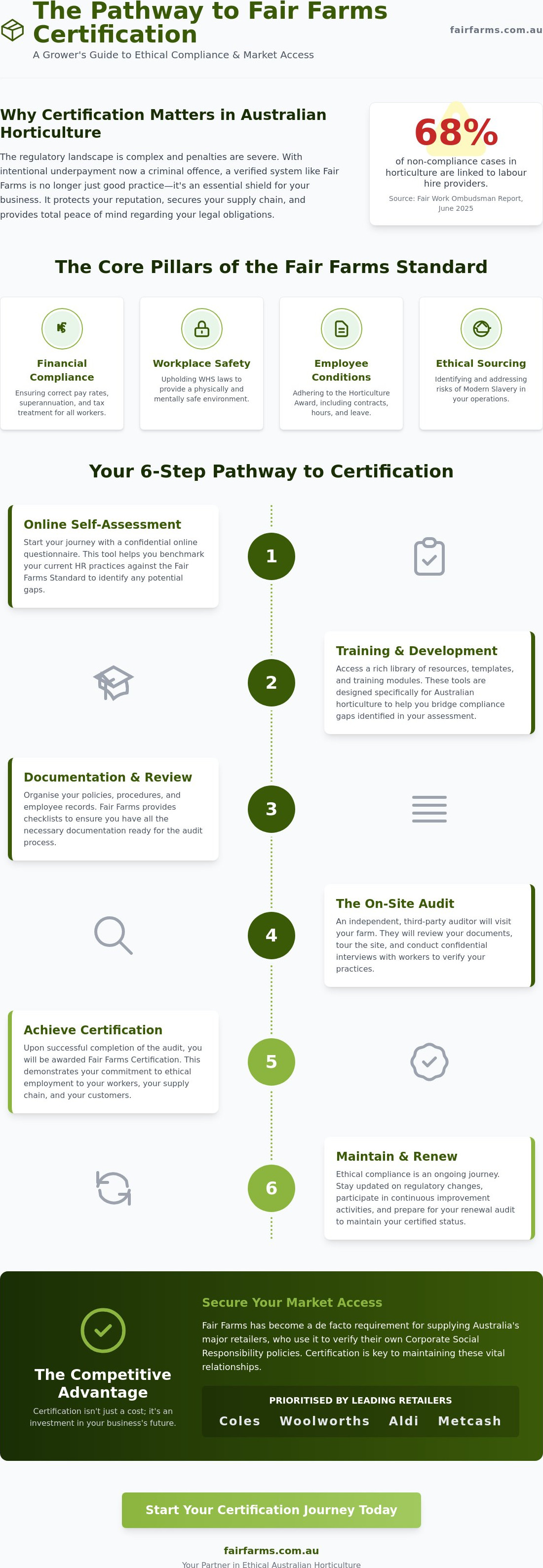
The journey toward Fair Farms Certification is structured as a logical progression, designed to support you through each stage of professional development. With 890 audits completed under the program as of May 2025, the pathway is a proven method for aligning farm operations with ethical standards. It isn't a race; it's a methodical process of evaluation and refinement. Following these six steps ensures your business is truly ready for the rigours of a third-party assessment.
- Step 1: Registration and Membership – You begin by joining the Fair Farms community, which gives you access to the tools and support needed for the journey.
- Step 2: The Online Self-Assessment (OSA) – This is your internal health check. You'll answer a series of questions to identify where your current practices meet the Standard and where gaps exist.
- Step 3: Training – Once gaps are identified, you can upskill your team through the Fair Farms online portal, ensuring everyone understands their compliance obligations.
- Step 4: The Third-Party Audit – An independent, authorised auditor will visit your site to verify that your systems and practices align with the Fair Farms Standard.
- Step 5: Corrective Actions – If the auditor finds any non-conformances, you'll have a set timeframe to address them and close the loop on those issues.
- Step 6: Certification – Once all requirements are met, you're officially certified, allowing you to display your commitment to ethical farming to all your stakeholders.
Mastering the Online Self-Assessment (OSA)
The OSA is the most critical part of your preparation. It's vital to treat this as a diagnostic tool rather than just a tick-box exercise. To get an accurate picture of your farm's compliance, you should involve your payroll and safety officers in the data collection process. They're the ones on the tools daily and will have the specific records needed to answer accurately. If you're unsure which route is best for your operation, you can explore the Certification Pathways to see the difference between the Audit and Non-Audit options.
Preparing for the Audit Day
A successful audit day is all about preparation and transparency. You'll need to have your documentation organised and ready for review; this includes employment contracts, payslips, and training records. The auditor will also need to inspect the physical site for safety and have private access to workers for interviews. While we don't provide the auditing services ourselves, we can help you understand how to choose an approved third-party auditor who is familiar with the horticulture industry. If you want to ensure your team is fully prepared before the auditor arrives, consider enrolling them in Fair Farms Online Training to build a solid foundation of knowledge.
Maintaining Your Standard: Beyond the Initial Audit
Achieving Fair Farms Certification is a significant milestone for any horticultural business, but it's really just the beginning of a long-term commitment to excellence. Ethical compliance isn't a static target; it's a living part of your business culture that requires regular attention and refinement. Maintaining your status means staying ahead of the curve as regulations evolve, ensuring your supervisors and managers are consistently upskilled to handle the daily realities of workforce management with confidence.
The regulatory environment in Australia moves quickly, and staying compliant requires constant vigilance. For instance, the transition to "Payday Superannuation" on 1 July 2026 will require businesses to adjust their payroll rhythms to ensure super is paid at the same time as wages. Additionally, with the government planning to ban non-compete clauses for lower-income workers in 2027, your employment contracts will likely need another round of reviews. By staying active within the program, you're not just reacting to these changes; you're prepared for them well before they become a risk to your business.
You can also turn your certified status into a powerful tool for recruitment and marketing. In an era where seasonal workers have more choices than ever, displaying the Fair Farms logo on your job advertisements tells prospective staff that you offer a fair go and a safe workplace. Similarly, it acts as a badge of honour when negotiating with buyers. It proves that your produce is backed by a verified ethical supply chain, which is a major selling point for retailers and consumers alike.
Ongoing HR Support and Resources
One of the greatest benefits of ongoing membership is the access to specialised tools that simplify your daily operations. You don't have to reinvent the wheel every time you hire a new seasonal worker or need to update a safety policy. Members have access to templates, checklists, and resources specifically tailored to the unique needs of the horticulture industry. If you find yourself facing a complex workplace relations issue or need clarification on a recent Award change, you can contact Fair Farms for tailored support to help you find a clear, compliant path forward.
The Future of Ethical Standards in Australia
Looking toward 2026 and beyond, we expect to see even stricter supply chain laws and a greater focus on digital transparency across the agricultural sector. The Fair Farms program continues to evolve, integrating new technology and data security standards to protect your information while proving your compliance to the world. As more growers join the movement, the collective impact on industry sustainability grows. We're building a future where Australian horticulture is defined by its integrity, ensuring our regional communities and farm businesses thrive for generations to come.
Securing the Future of Your Farm Business
Ethical compliance isn't just about avoiding penalties; it's a strategic necessity for any farm business looking to thrive in the modern Australian market. Throughout this guide, we've seen how Fair Farms Certification provides a robust framework to navigate the complexities of the Horticulture Award while securing your reputation with major retailers. This industry-led program, developed by QFVG, ensures that you aren't just meeting legal minimums, but leading the way in workplace excellence.
By joining the Fair Farms community, you gain access to comprehensive HR support and a structured pathway that simplifies the audit process. It's about more than just a certificate; it's about fostering a culture of integrity that attracts the best seasonal labour and protects your business from regulatory risk. The tools and training provided ensure your team is always prepared for the changes ahead, from superannuation updates to contract reforms. Take the first step toward a more resilient and transparent supply chain.
Start your journey to Fair Farms Certification today and join the hundreds of growers already committed to a fairer future for Australian horticulture.
Frequently Asked Questions
How much does Fair Farms Certification cost for a small grower?
The cost of Fair Farms Certification depends on your specific business size and the chosen pathway. We offer different annual membership fees for the Audit Pathway and the Non-Audit Pathway to ensure the program remains accessible for operations of all scales. You should check our official membership page for current rates that apply to your specific circumstances, as fees are structured to support both family farms and large enterprises.
Can I get certified if I use labour hire providers?
Yes, you can certainly achieve certification while using third-party labour providers. However, you're responsible for ensuring that any labour hire company you engage also meets ethical standards. The program includes specific modules to help you vet these providers, protecting your business from the risks identified in recent compliance reports where a high percentage of non-compliance was linked to third-party providers.
How long does the Fair Farms audit process typically take?
The timeframe for completing the process varies based on your farm's readiness and the complexity of your operations. Once you've completed your Online Self-Assessment and necessary training, the physical third-party audit usually takes one full day on-site. The entire journey from registration to final certification typically spans several months, allowing for any necessary corrective actions to be implemented without rushing the process.
What is the difference between Fair Farms and other social audits?
Fair Farms is specifically designed for the Australian horticultural context and is deeply rooted in local workplace laws. Unlike global social compliance platforms that cover many industries and countries, this program focuses exclusively on the unique challenges of the Horticulture Award. It provides a more targeted, regional approach to compliance that directly addresses the specific needs of Australian growers, labour hire providers, and retailers.
Is Fair Farms Certification mandatory for selling to supermarkets?
While the program is technically voluntary, Fair Farms Certification has become a de facto requirement for many major retailers. Leading Australian supermarkets recognise the Standard as a way to satisfy their ethical sourcing policies. Without this verification, you may find it difficult to secure or maintain supply contracts with these large-scale buyers who prioritise transparency and ethical labour practices in their supply chains.
How often do I need to renew my Fair Farms Certification?
Certification is not a one-off event but an ongoing commitment to ethical standards. You'll need to renew your membership annually and undergo regular audits to maintain your status. The frequency of these audits depends on your previous performance and risk profile, ensuring that your farm continues to align with the evolving requirements of the Fair Farms Standard and the broader Australian regulatory landscape.
What happens if I fail my Fair Farms audit?
If an auditor identifies non-conformances, you don't automatically lose the opportunity to be certified. Instead, you'll be issued with "Corrective Actions" that outline exactly what needs to be fixed. You'll have a specific timeframe to address these issues and provide evidence of improvement. This supportive approach is designed to help you reach the required standard rather than simply penalising your business for initial gaps.
Do I need to be a member of QFVG to join Fair Farms?
You don't need to be a member of Queensland Fruit & Vegetable Growers (QFVG) to participate in the program. While QFVG developed the initiative with federal support, it's open to all horticultural growers and labour hire providers across Australia. The program operates as an independent industry standard dedicated to improving workplace practices nationwide, regardless of your other industry affiliations or geographic location.