
Labour Hire Agreement Checklist for Growers: A Compliance Guide

Could a single oversight by your labour provider leave your farm legally responsible for thousands of dollars in back-pay? Under current accessorial liability provisions, the Fair Work Ombudsman can hold you accountable for a contractor's mistakes. This makes the choice of a labour partner more than just a business decision; it's a commitment to the ethical standards and long-term health of our regional industry.
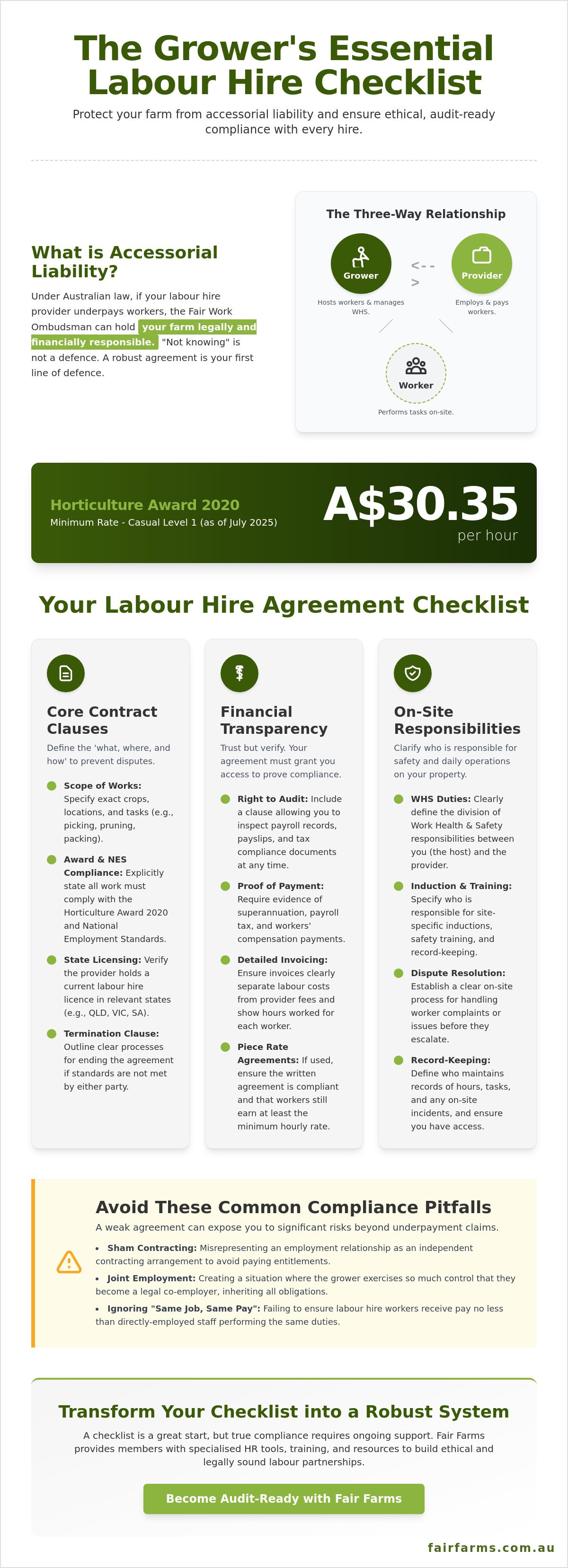
We know that staying on top of the Horticulture Award 2020 pay rates, which reached A$30.35 per hour for casual Level 1 workers in July 2025, feels like a constant battle against shifting regulations. Between the "same job, same pay" laws and onerous record-keeping requirements, the pressure on growers has never been higher. Our comprehensive labour hire agreement checklist for growers is here to help you move from reactive worry to proactive compliance. By using this framework, you can secure your farm's reputation and ensure you're always audit-ready. We'll show you how to clearly divide WHS and payroll duties while reducing the risk of Fair Work penalties through transparent, principled agreements that protect every participant in the supply chain.
Key Takeaways
- Understand the three-way relationship between growers, providers, and workers to clearly define operational duties and payroll responsibilities.
- Utilise a comprehensive labour hire agreement checklist for growers to ensure every contract explicitly commits to the Horticulture Award and National Employment Standards.
- Adopt a "trust but verify" model for due diligence that moves beyond basic paperwork to satisfy the requirements of ethical supply chain audits.
- Identify and mitigate common compliance risks, such as sham contracting and joint employment, which can lead to significant Fair Work penalties.
- Discover how Fair Farms membership provides the specialised HR support and training tools needed to transform a simple checklist into a robust compliance system.
What is a Labour Hire Agreement in Australian Horticulture?
A labour hire agreement is much more than a simple handshake or a basic invoice. In the context of Australian agriculture, it's a formal, legally binding commercial contract between a host employer (the grower) and a labour provider. Understanding what is a labour hire agreement is the first step in protecting your business from the complex risks associated with seasonal work. This document establishes a three-way relationship where the provider employs the workers, but the grower hosts them on-site to perform specific tasks like picking, pruning, or packing.
While the provider is responsible for paying wages and managing payroll tax, the grower retains significant responsibilities. This is where accessorial liability becomes a major factor. If a provider fails to pay the correct award rates, the Fair Work Ombudsman can hold the grower legally and financially responsible. Having a robust labour hire agreement checklist for growers ensures that these risks are identified and managed before the first bin is filled. It's vital to remember that this is a commercial service agreement, not an employment contract; the worker is not your employee, but they are your responsibility under the law.
The Legal Framework: Fair Work and Licensing
The Horticulture Award 2020 sets the standard for how these agreements must operate, dictating minimum pay and conditions that cannot be bypassed. Beyond federal law, growers must navigate state-based licensing schemes in jurisdictions such as Queensland, Victoria, and South Australia. These laws require providers to be licensed to operate legally. The host employer is the party responsible for on-site safety and must ensure the working environment meets all Work Health and Safety (WHS) standards. Failing to verify a provider's license can lead to heavy penalties for both parties.
Why Industry-Specific Templates Matter
Generic templates designed for office environments often fail in the paddock. A farm-ready agreement must address unique variables like piece rates, weather delays, and the specific requirements of different commodities. A citrus harvest has different safety and logistical needs than a berry farm. Using a tailored framework helps you move from a basic template to a comprehensive system. Growers looking to strengthen their arrangements often find that Fair Farms membership provides the necessary context to ensure their agreements are both compliant and practical for the Australian seasonal landscape. A well-drafted agreement reflects the reality of your specific crop and harvest cycle, providing clarity when things don't go to plan.
Essential Clauses for Your Labour Hire Agreement Checklist
A robust labour hire agreement checklist for growers must move beyond generic commercial terms to address the unique pressures of the Australian agricultural sector. It isn't enough to simply state that a provider will supply labour. The contract must be granular, leaving no room for interpretation when it comes to worker safety or pay. By clearly defining these expectations, you protect your farm's reputation and ensure every person on your property is treated with the respect they deserve.
The scope of works should be the first item on your list. This section needs to specify the exact crops, locations, and tasks involved. Vague descriptions can lead to disputes over pay levels or safety requirements. For instance, the skills required for picking delicate berries differ significantly from those needed for heavy citrus harvesting. Similarly, the agreement must explicitly cite the Horticulture Award 2020 and the National Employment Standards (NES). As of May 2026, the minimum hourly rate for a casual adult Level 1 employee is A$30.35. Your contract should state that these rates are the absolute floor, not a suggestion.
Audit rights are your most powerful tool for risk mitigation. You should include a clause that allows you to inspect payroll records and tax compliance at any time. This transparency is essential because, under accessorial liability laws, "not knowing" is not a valid legal defence if your provider underpays staff. Finally, ensure there are clear processes for termination and dispute resolution. A fair process for ending an engagement protects both the grower and the labour provider if standards aren't met.
Payroll and Financial Transparency Clauses
Transparency is the bedrock of a compliant partnership. Your agreement should mandate that the provider supplies proof of superannuation payments and valid workers compensation insurance. For pieceworkers, the agreement must reflect the legal requirement that rates are set so a worker with average productivity earns at least 15% more than the minimum hourly rate. If you're looking to strengthen your oversight, exploring certification pathways can provide a structured approach to managing these financial obligations.
Ethical Standards and Compliance
Major Australian retailers now demand more than just legal minimums; they require evidence of ethical leadership. Clauses in this section should require the labour provider to align with your farm's anti-discrimination and anti-harassment policies. You should also include a "duty to notify" clause. This requires the provider to inform you immediately if they become the subject of a regulatory investigation. Proactive commitment to modern slavery prevention and transparent recruitment practices ensures your supply chain remains clean and your business stays audit-ready.
Beyond the Paperwork: Verification and Due Diligence
A signed contract is a vital foundation, but it isn't a finish line. In the eyes of a social compliance auditor or the Fair Work Ombudsman, a piece of paper alone doesn't prove that workers are being treated fairly. You need to demonstrate that the terms of your agreement are actually being met in the paddock. Moving beyond the initial labour hire agreement checklist for growers requires a shift toward a "trust but verify" mindset. This approach ensures that your farm isn't just legally covered, but ethically sound and ready for any level of supply chain scrutiny.
Busy growers often feel they don't have the time for deep investigations, yet the risk of accessorial liability makes due diligence a non-negotiable task. If your labour provider organises accommodation or transport, these services fall under your sphere of responsibility. You should personally inspect worker housing to ensure it meets basic safety and hygiene standards. Check for working smoke alarms, adequate kitchen facilities, and a lack of overcrowding. Similarly, ensure any transport provided is roadworthy and that drivers hold the correct licences. Documenting these inspections creates a clear paper trail that protects you if a contractor is later found to be cutting corners.
Documenting your due diligence is your primary defence against "dodgy" contractors who might provide false assurances. Keep a log of every site visit, every document request, and every conversation regarding compliance. This proactive record-keeping proves you've taken reasonable steps to prevent exploitation. It transforms your compliance from a static document into a living system that prioritises the welfare of every person on your property.
Conducting Regular Compliance Checks
Spotting red flags early can save your business from a massive financial headache. When reviewing tax invoices, do the maths. If the total cost is too low to cover the A$30.35 casual minimum rate plus superannuation, insurance, and the provider's margin, it's a sign that entitlements might be missing. We recommend interviewing workers privately in a safe, neutral space to confirm they're receiving their full pay and have access to their payslips. Formally documenting these checks is a core requirement for those on a Fair Farms certification pathway, providing the evidence needed to pass rigorous audits.
Managing the Provider Relationship
The most successful labour arrangements are built on ethical transparency rather than a race to the lowest cost. Treat your labour provider as a professional partner in your business success. Joint site inductions are an excellent way to foster a shared safety culture, ensuring both parties are aligned on risk management from day one. You should also have a clear procedure for handling contract breaches mid-harvest. Having a plan in place allows you to address issues immediately without disrupting your picking schedule or compromising worker rights.
Avoiding Common Compliance Pitfalls in Seasonal Contracting
Seasonal contracting moves fast, but speed shouldn't come at the cost of legal precision. Many growers fall into the trap of sham contracting by allowing providers to misclassify employees as independent contractors. This is a significant risk. If a worker is under your direction and performs tasks as part of your business, they're likely an employee in the eyes of the law, regardless of the contract's label. You must also be wary of joint employment risks. If a provider fails to meet their obligations, the Fair Work Ombudsman can look to the host employer to settle underpayments.
Every year, the Fair Work Commission updates award rates. Your labour hire agreement checklist for growers must include a mandatory trigger for an annual review on July 1. Failing to update your contract to reflect the current A$30.35 casual rate, which has been effective since July 2025, can lead to immediate non-compliance. Similarly, record-keeping for piecework is a frequent failure point. You need to maintain detailed productivity data to prove that piece rates allow an average worker to earn at least 15% more than the minimum hourly rate. Without this data, your agreement offers little protection during an audit.
The Danger of "All-In" Flat Rates
Flat rates are often a shortcut to trouble. They frequently fail to account for overtime, public holiday penalties, or legislated superannuation entitlements. Your agreement template should require a transparent breakdown of base rates and loadings. This ensures that the management fee charged by the provider isn't being funded by stripping away worker entitlements. We've seen many cases where a lack of transparency leads to unintentional but costly breaches of the Horticulture Award.
Modern Slavery and Recruitment Risks
Major Australian retailers now demand absolute transparency in recruitment. High-risk practices like debt bondage or charging workers illegal "recruitment fees" can lead to your produce being pulled from shelves. Your agreement should mandate that providers disclose their offshore recruitment methods, particularly when using the PALM scheme. Building an ethical supply chain is a collective effort that requires constant vigilance. If you need help auditing your current arrangements, becoming a Fair Farms member provides the specialised HR support and tools needed to identify these hidden risks before they become liabilities.
Streamlining Compliance with Fair Farms Membership
A labour hire agreement checklist for growers is an essential starting point, but maintaining a compliant farm requires more than just a list of clauses. It demands a culture of continuous improvement and a system that can adapt as industrial relations laws evolve. Fair Farms membership provides the bridge between having a template and running a fully integrated compliance system. By joining, you gain access to the collective knowledge of an industry dedicated to ethical standards, ensuring your business isn't just following the rules but leading the way in fair employment.
One of the most significant advantages of membership is the access to specialised HR support. Navigating the intricacies of the Horticulture Award 2020 or the "same job, same pay" legislation can be daunting for even the most experienced growers. Our team provides the guidance needed to review your labour hire arrangements with a critical eye, identifying potential gaps before they result in Fair Work penalties. This support transforms compliance from a burden into a competitive advantage. It allows you to focus on your core business: growing high-quality Australian produce.
Beyond legal protection, membership offers a way to demonstrate your ethical credentials to retailers and consumers. In a market where social responsibility is a key driver of purchasing decisions, being part of a community of principled Australian growers is invaluable. It shows that you're committed to communal progress and the equitable treatment of every worker in the sector. This transparency builds trust with regional stakeholders and secures your place in a sustainable agricultural future.
The Fair Farms Certification Journey
The path to certification is designed to be educational rather than punitive. It begins with online training modules that empower your management team to understand and implement complex labour standards. This process prepares you to approach a social compliance audit with confidence, knowing your records and practices are in order. Fair Farms members often find that their certification serves as a powerful badge of integrity. It makes them preferred suppliers for major retailers who are increasingly selective about the ethics of their supply chains.
Next Steps for Your Business
Protecting your farm's future starts with an honest assessment of your current practices. We encourage you to review your existing labour hire contracts against this checklist today. Don't wait for an audit to discover a flaw in your "all-in" rates or a missing piecework record. Consult with industry experts to ensure your templates are tailored to your specific commodities and regional context. If you're ready to secure your farm's reputation and legal standing, contact Fair Farms today for expert guidance on implementing a robust compliance framework.
Securing the Future of Your Farm
Protecting your business from the complexities of industrial relations requires a proactive and principled approach. We've explored how a clear division of duties, rigorous verification, and a commitment to transparency can shield your farm from accessorial liability. By using a comprehensive labour hire agreement checklist for growers, you ensure that every seasonal harvest is built on a foundation of legal and ethical integrity. This isn't just about avoiding penalties; it's about fostering a sustainable industry where every participant is valued and protected.
As an initiative developed by Queensland Fruit & Vegetable Growers (QFVG) and supported by the federal government, Fair Farms is here to help you navigate these challenges. Our program is recognised by major Australian retailers, providing you with the ethical credentials needed to thrive in a competitive market. We invite you to join Fair Farms to access expert HR support and ethical certification. Together, we can build a stronger, more resilient agricultural sector that we can all be proud of. Your commitment to these standards today secures the success of your farm for years to come.
Frequently Asked Questions
Does a labour hire agreement protect me from Fair Work penalties?
A written agreement is a vital piece of evidence, but it doesn't offer absolute protection. Under accessorial liability laws, you're still at risk if you're found to be involved in a provider's breach. This includes situations where you should've known a worker was being underpaid based on the low rates you were charged. You must show you took reasonable steps to ensure compliance.
What is the difference between a labour hire agreement and a service contract?
The main difference lies in the level of control and the expected outcome. A labour hire agreement involves providing workers who operate under your direction as the host employer. In contrast, a service contract focuses on a specific result, such as a contractor bringing their own equipment to install a new irrigation system without your daily supervision of their staff.
How often should I review my labour hire agreement template?
You should review your agreement at least once a year, ideally before the annual July 1 award rate increase. This ensures your contract stays aligned with the latest Fair Work Ombudsman pay guides. Regular reviews also allow you to update any changes to your farm's safety protocols or commodity-specific requirements as your business grows.
Can I use a generic template from the internet for my farm?
Using a generic internet template is highly risky for the horticulture sector. These documents often lack essential clauses regarding piecework, seasonal weather interruptions, and the specific requirements of the Horticulture Award 2020. A tailored labour hire agreement checklist for growers ensures your contract reflects the unique operational realities and legal obligations of an Australian farm environment.
Who is responsible for worker safety: the grower or the agency?
Both the grower and the labour provider share legal responsibility for worker safety. As the host employer, you're responsible for the day-to-day safety of the work environment and must provide site-specific inductions. The agency must ensure their workers are fit for duty and have the necessary personal protective equipment (PPE) required for the tasks being performed.
What happens if my labour hire provider loses their licence mid-harvest?
You must cease using the provider's services immediately if they lose their licence. Continuing to use an unlicensed provider is a serious offence under state-based labour hire licensing laws in Queensland, Victoria, and South Australia. It's essential to check the online licensing register regularly to confirm your partner remains in good standing throughout the entire harvest season.
Do I need a separate agreement for each seasonal worker?
No, you don't need an agreement for every individual worker. You sign one overarching commercial agreement with the labour hire provider that sets the terms for all workers they supply to your farm. However, you must still maintain individual records for every person on-site, including their signed site induction forms and any specific piecework agreements they've entered into.
How does Fair Farms certification help with labour hire compliance?
Fair Farms certification provides a structured system to move beyond basic paperwork. It gives you the training and tools to verify that your labour hire agreement checklist for growers is actually working in practice through regular audits. By completing the certification journey, you prove to retailers and regulators that your supply chain is transparent, ethical, and fully compliant.