
Grower Responsibilities for Labour Hire Workers: A National Compliance Guide
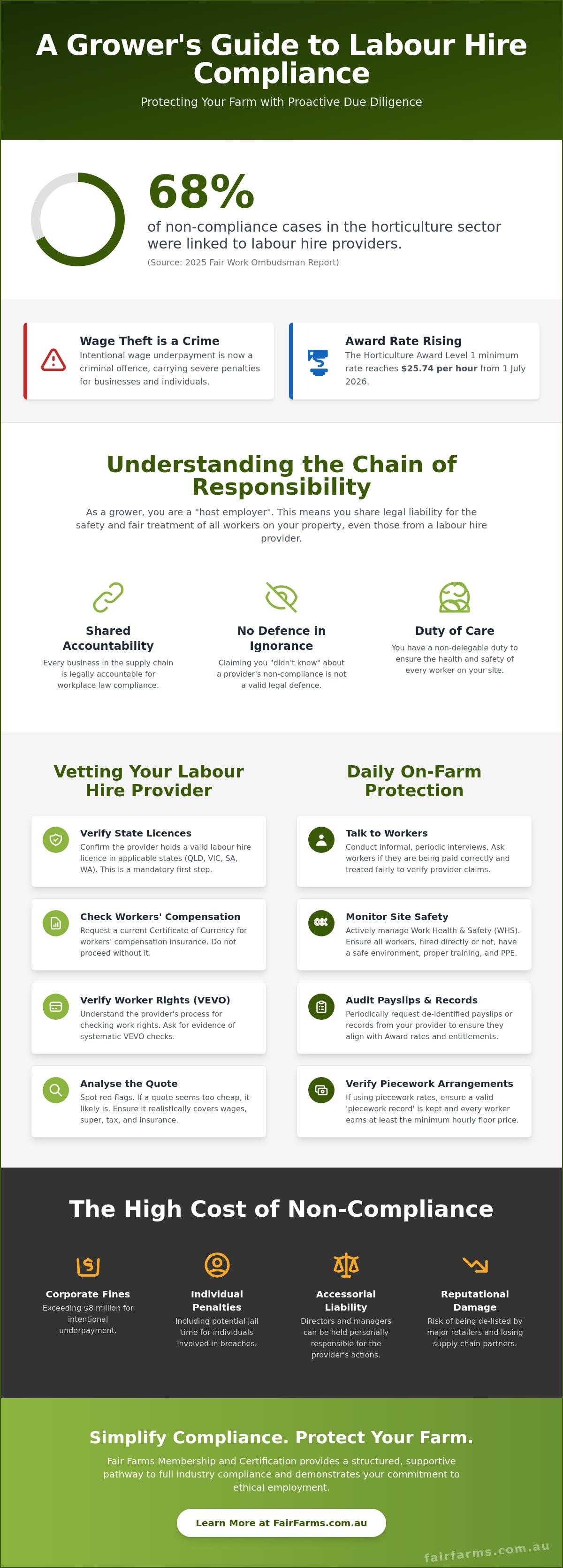
Did you know that labour hire providers were responsible for 68% of non-compliance cases in the horticulture sector according to a 2025 Fair Work Ombudsman report? This figure reveals a hard truth for our industry: outsourcing your harvest labour doesn't mean you're outsourcing your legal liability. Understanding grower responsibilities for labour hire workers is now essential for survival in a regulatory environment where intentional wage underpayment is a criminal offence. With the Horticulture Award Level 1 rate reaching $25.74 per hour from July 1, 2026, staying on top of these details is vital for protecting your farm's future.
Managing a seasonal workforce is a massive task, and it's easy to feel overwhelmed by "Chain of Responsibility" laws or the threat of a sudden audit. You want to focus on your crop, not complex paperwork. We'll help you navigate these ethical and legal obligations so you can engage labour hire with complete peace of mind and protect your business from reputational damage.
This guide provides a practical checklist for vetting your providers and ensuring your supply chain is beyond reproach. You'll gain the clarity needed to guard against host employer liabilities and maintain your standing as a trusted, principled leader in the regional agricultural community.
Key Takeaways
- Understand why "not knowing" is no longer a legal defence under the Australian Chain of Responsibility framework.
- Get a clear checklist for grower responsibilities for labour hire workers, including how to verify state-based licences and VEVO work rights.
- Learn to spot red flags in labour hire quotes and why checking for current workers compensation insurance is a non-negotiable step.
- Discover practical methods for monitoring site safety and conducting worker interviews to maintain ethical standards on the ground.
- Explore how Fair Farms Membership and Certification can provide a structured, supportive pathway to full industry compliance.
Understanding the Chain of Responsibility in Australian Horticulture
In the Australian horticultural landscape, the concept of a "Chain of Responsibility" (CoR) has shifted from a transport-specific term to a fundamental principle of farm management. It means every participant in a supply chain is accountable for the safety and fair treatment of workers. For farm owners, understanding grower responsibilities for labour hire workers is no longer optional. It's a core operational requirement that ensures the entire industry moves forward with integrity.
For a foundational overview of labour hire in Australia, it's clear the industry relies heavily on these arrangements to manage seasonal peaks. However, the legal burden remains shared. Legislators and courts have made it clear that "wilful blindness" is not a valid legal defence. If a labour hire provider is underpaying staff or ignoring safety protocols, you can't simply claim you weren't aware of their internal practices. The Fair Work Ombudsman (FWO) actively investigates host employer liability, often looking for evidence that a grower failed to perform adequate due diligence before signing a contract.
Beyond the courtroom, there's a significant commercial incentive for compliance. Major Australian retailers now demand rigorous proof of ethical sourcing. If your farm is linked to a labour hire scandal, you risk being de-listed by supply chain partners. This reputational damage is often permanent, impacting your ability to secure future contracts and maintain a stable business.
The Host Employer Relationship Explained
When you engage an agency, you become a "host employer". This creates a dual responsibility where both parties must work together to protect the workforce. While the agency handles the administrative side of employment, you control the site where the work happens. Under Work Health and Safety (WHS) legislation, you share a non-delegable duty of care. A contract with an agency might outline their specific duties, but it doesn't absolve you of your responsibility to ensure every person on your property is treated fairly and kept safe.
Legal Risks of Non-Compliance
The financial stakes for getting this wrong are higher than ever. Following the criminalisation of wage underpayment in 2024, intentional breaches can lead to fines exceeding $8 million for corporations and even potential jail time for individuals. You also face the threat of "accessorial liability". Accessorial liability is the legal mechanism where individuals can be fined for a company’s breach. This means directors and managers can be held personally responsible if they were involved in or turned a blind eye to the labour hire provider's misconduct. Protecting your farm requires a proactive approach to membership and industry standards that prove your commitment to ethical labour.
Core Legal Obligations for Growers Engaging Labour Hire
Understanding your role as a "host employer" is the first step in managing grower responsibilities for labour hire workers. While the labour hire agency is the direct employer responsible for paying wages and superannuation, you are the host providing the workplace, equipment, and daily direction. This creates a shared legal framework. You cannot delegate your duty to ensure workers are treated according to Australian law. Following the Fair Work Ombudsman guidelines is essential to ensure your site remains compliant and your business remains protected from accessorial liability.
Adherence to the Horticulture Award 2020 is a non-negotiable requirement. As of July 1, 2026, the minimum hourly rate for a Level 1 employee has risen to $25.74. If you utilise piecework arrangements, you must ensure the "piecework record" is correctly documented and that every worker earns at least the hourly floor price for their age and classification. To ensure your management team is fully equipped to handle these complexities, consider exploring Fair Farms Certification pathways as a structured way to embed these standards into your operations.
State Labour Hire Licensing Schemes
In Queensland, Victoria, South Australia, and Western Australia, labour hire providers must hold a valid licence to operate. As of June 1, 2026, Victoria has introduced even more rigorous "fit and proper person" tests and financial viability declarations for providers. It's your responsibility to verify a provider's status on the relevant state register before they set foot on your farm. Engaging an unlicensed provider is a serious offence that carries heavy financial penalties, even if you weren't aware of their status. Checking the register should be a standard part of your onboarding process for any new agency.
Visa and Right to Work Checks
You must ensure every person working on your property has the legal right to work in Australia. While the provider should perform these checks, a "set and forget" approach is risky. Best practice involves conducting regular audits of the provider's Visa Entitlement Verification Online (VEVO) records. You should also perform occasional spot checks on worker documentation to confirm identities match the records provided. Understanding the specific limitations of different visa types is vital, as some may have restricted work hours or be tied to specific regions. Maintaining your own record of who is on-site and their hours worked is a legal requirement; these records must be kept for seven years to satisfy Fair Work inspectors.
Due Diligence: How to Vet Your Labour Hire Provider
Vetting a labour hire provider is your primary defence against the legal and reputational risks mentioned earlier. It's not enough to simply check if an agency has a website; you must look under the bonnet of their operations. A core part of grower responsibilities for labour hire workers involves performing thorough due diligence before any work commences. This process ensures that your partners share your commitment to ethical standards and communal progress in the regional agricultural sector.
Price is often the first red flag. In 2026, typical labour hire rates for food production range from $44 to $50 per hour excluding GST. If a provider offers a rate significantly below this range, it's a clear signal that they may be cutting corners on wages, superannuation, or insurance. You should also request current certificates of currency for workers compensation and public liability insurance. Without these, the financial burden of an on-site injury could fall back on your business. Reviewing their payroll systems and sample pay slips is another vital step to confirm they are meeting Horticulture Award requirements and providing workers with transparent records.
To help you navigate these vetting steps, becoming part of a supportive network is invaluable. Exploring membership for growers can provide you with the tools and community backing needed to identify reliable partners and uphold high standards across your supply chain.
Critical Questions to Ask Your Agency
Don't be afraid to ask hard questions during the procurement phase. A reputable agency will be transparent about their business model. Ask them exactly how they calculate their hourly charge-out rate and how they account for casual loading and leave entitlements. Inquire about their process for managing worker grievances; an ethical provider should have a clear, documented pathway for staff to raise concerns without fear of retribution. Finally, ask for evidence of recent superannuation and tax payments to ensure they are meeting their statutory obligations to the Australian Taxation Office.
The Importance of Written Agreements
A handshake deal is insufficient in the modern regulatory environment. You need a robust written agreement that clearly defines the boundaries of supervision and safety management. Every labour hire contract should include specific clauses regarding compliance with the Fair Work Act and state licensing laws. Crucially, the contract must allow you to conduct regular audits of the provider's records. This right to audit is a practical way to fulfil your grower responsibilities for labour hire workers, as it allows you to verify that the ethical standards promised in the contract are being delivered on the ground.
Ongoing Monitoring: Protecting Your Farm Daily
Once the contract is signed and workers are on-site, the real work of compliance begins. Active monitoring is the only way to ensure that the standards you vetted during the procurement phase are actually being upheld. Part of your ongoing grower responsibilities for labour hire workers involves conducting regular, informal interviews with the people working on your rows. These conversations don't need to be long. They should simply confirm that workers are receiving their pay slips, have access to proper facilities, and aren't being charged unauthorised fees for things like transport or equipment.
Establishing a clear whistle-blower or reporting line is another powerful tool for ethical management. When workers feel safe reporting concerns directly to the host employer, you can address potential issues before they escalate into Fair Work Ombudsman audits. Since the introduction of the minimum wage guarantee for pieceworkers, you must also review "Piecework Records" with extra care. You need to verify that every worker, regardless of their speed, is earning at least the Horticulture Award hourly floor price. If the provider's records don't clearly show this calculation, your business remains exposed to significant compliance risks.
On-Farm Safety and Inductions
Safety is a shared responsibility that cannot be outsourced. While the agency provides the labour, you provide the environment. Effectively managing grower responsibilities for labour hire workers requires a clear understanding of the "dual duty" framework. You are the custodian of the land and the equipment, meaning you are responsible for the physical safety of everyone on-site. You must conduct site-specific inductions for every new worker, regardless of how long they will be on the farm. Documenting these inductions is vital; it proves you've met your legal obligations and provided a safe system of work for all participants.
Auditing Provider Payroll
Payroll auditing doesn't require you to check every single line every week. Instead, perform a sample audit once a month. Pick three or four workers and cross-reference their pay slips against your on-site attendance records. Look closely for illegal or excessive deductions. Under Australian law, deductions for transport, tools, or accommodation must be reasonable and authorised in writing. Growers should verify that the net pay in a worker’s bank account matches their pay slip. This simple check is one of the most effective ways to catch underpayment or "cash-back" schemes before they become a legal crisis.
To streamline these monitoring processes and ensure your management team is fully prepared for an audit, consider the benefits of Fair Farms Certification.
Simplifying Compliance with Fair Farms Membership
Managing the legal landscape of seasonal labour is a significant undertaking for any farm manager. While earlier sections of this guide detailed the risks of accessorial liability and the need for rigorous vetting, the practical reality is that staying compliant requires a structured system. This is where Fair Farms Membership becomes a vital asset. It provides a principled framework that helps you manage grower responsibilities for labour hire workers with confidence and transparency, ensuring your business is shielded from both regulatory and reputational risks.
The programme offers more than just a badge; it delivers practical tools like Fair Farms Online Training. These modules are specifically designed to educate your management team on the nuances of the Horticulture Award and ethical employment standards. By embedding this knowledge into your daily operations, you move from a reactive stance of fearing audits to a proactive position of industry leadership. Having access to dedicated HR support further ensures you aren't navigating complex wage guarantees or piecework rules in isolation, providing a steady hand in a fluctuating market.
The Fair Farms Certification Pathway
The journey to certification is a steady, methodical process designed to support, not overwhelm. It begins with a comprehensive self-assessment that allows you to identify any gaps in your current systems. Following this, growers engage in professional development through targeted training before undergoing a formal audit by an approved third-party body. This structured approach ensures that every aspect of your labour supply chain meets the highest standards of integrity. Successfully completing the Fair Farms Certification Pathways significantly reduces the risk of government intervention and provides the proof of ethical conduct that major Australian retailers now require for continued supply chain access.
Joining a Community of Ethical Growers
Compliance is not a solitary journey. By joining the programme, you enter a network of like-minded stakeholders who are committed to the long-term success and reputation of the agricultural sector. This community allows for the sharing of best practices and practical solutions to common regional challenges. Members receive regular alerts regarding legislative changes, such as the 2024 Migration Amendment Act or the latest Horticulture Award wage increases effective from July 2026, ensuring you are never caught off guard by shifting regulations. We invite you to become a Fair Farms member today to secure your farm’s future and demonstrate your commitment to a fair, equitable, and sustainable industry for all participants.
Securing the Future of Your Farm and Workforce
The Australian horticultural landscape has reached a turning point where ethical accountability is just as vital as crop yield. We've explored how the "Chain of Responsibility" framework removes the safety net of ignorance, making proactive due diligence a necessity rather than a choice. By implementing rigorous vetting processes and active on-farm monitoring, you do more than just tick a compliance box. You build a legacy of integrity that resonates with consumers and protects your business from the severe penalties of the Fair Work Act.
Successfully navigating grower responsibilities for labour hire workers is a complex task, but you don't have to do it alone. As an industry-led programme by Queensland Fruit & Vegetable Growers (QFVG), Fair Farms offers specialised HR support and a certification recognised by major Australian retailers. We're here to help you simplify these regulatory burdens so you can focus on what you do best: growing world-class produce.
Protect your farm and your workers—Join Fair Farms today. Your commitment to fair standards ensures a stronger, more sustainable future for the entire regional community.
Frequently Asked Questions
Am I responsible if a labour hire agency underpays its workers on my farm?
Yes, you can be held legally responsible for underpayments through the principle of accessorial liability. If a provider fails to pay the correct rates, the Fair Work Ombudsman can pursue the host employer if they were involved in the breach. This involvement includes turning a blind eye to obvious red flags, such as charge-out rates that don't cover minimum award entitlements. Managing grower responsibilities for labour hire workers requires active vigilance to avoid these costly legal traps.
Do I need to check the visas of every labour hire worker myself?
While the agency is responsible for initial checks, you should conduct regular spot audits of VEVO records to ensure compliance. Relying solely on the provider’s word is a significant risk that could leave your farm vulnerable to Department of Home Affairs sanctions. Verifying work rights ensures you aren't inadvertently employing people in breach of their visa conditions, which helps maintain the integrity of your entire harvest operation.
What is the "Horticulture Award" and why does it matter for labour hire?
The Horticulture Award 2020 is the industry-specific legal document that defines minimum pay, casual loading, and piecework rules. It serves as the benchmark for all legal employment in the Australian sector. For labour hire, it ensures workers receive the same base entitlements as direct employees. This prevents a "race to the bottom" on wages and ensures every worker on your property is treated according to the national standard.
How do I know if a labour hire agency is licensed in my state?
You must check the official online registers maintained by the Labour Hire Authority in states like Victoria, Queensland, South Australia, and Western Australia. Each of these states has a public search tool where you can enter the provider's name or ABN to verify their status. Using an unlicensed provider is a serious offence that carries heavy financial penalties for the grower, even if the breach was unintentional.
Can I be fined for the safety breaches of a labour hire provider?
Yes, you can be fined because you share a non-delegable duty of care for everyone on your property. As the host employer, you control the physical site and the equipment used during the harvest. If a worker is injured due to poor site safety or a lack of a site-specific induction, both you and the labour hire agency can be prosecuted under Work Health and Safety laws.
What are the red flags of an unethical labour hire agency?
The most common red flag is a charge-out rate that seems too low to cover the Horticulture Award minimums plus GST and overheads. Other warning signs include a lack of workers compensation insurance, a refusal to provide sample pay slips, or the absence of formal induction processes. If a deal feels too good to be true, it usually indicates that the provider is compromising on worker entitlements.
How does Fair Farms certification help with retail supply contracts?
Major Australian retailers require proof of ethical sourcing to protect their own reputations and satisfy consumer expectations. Fair Farms certification provides this evidence through a rigorous, independent audit of your labour management systems. By achieving certification, you show these partners that grower responsibilities for labour hire workers are a top priority, making your farm a preferred supplier in a highly competitive market.
Is a written contract enough to protect me from legal liability?
A written contract is a vital first step, but it isn't a complete shield against legal liability. The law requires active monitoring and intervention if you suspect a provider is breaching workplace rules. You must follow through with the audit rights defined in your contract to ensure the provider is actually delivering the fair pay and safe conditions they promised on paper.