
Risk Management for Labour Hire in Horticulture: A 2026 Guide for Australian Growers
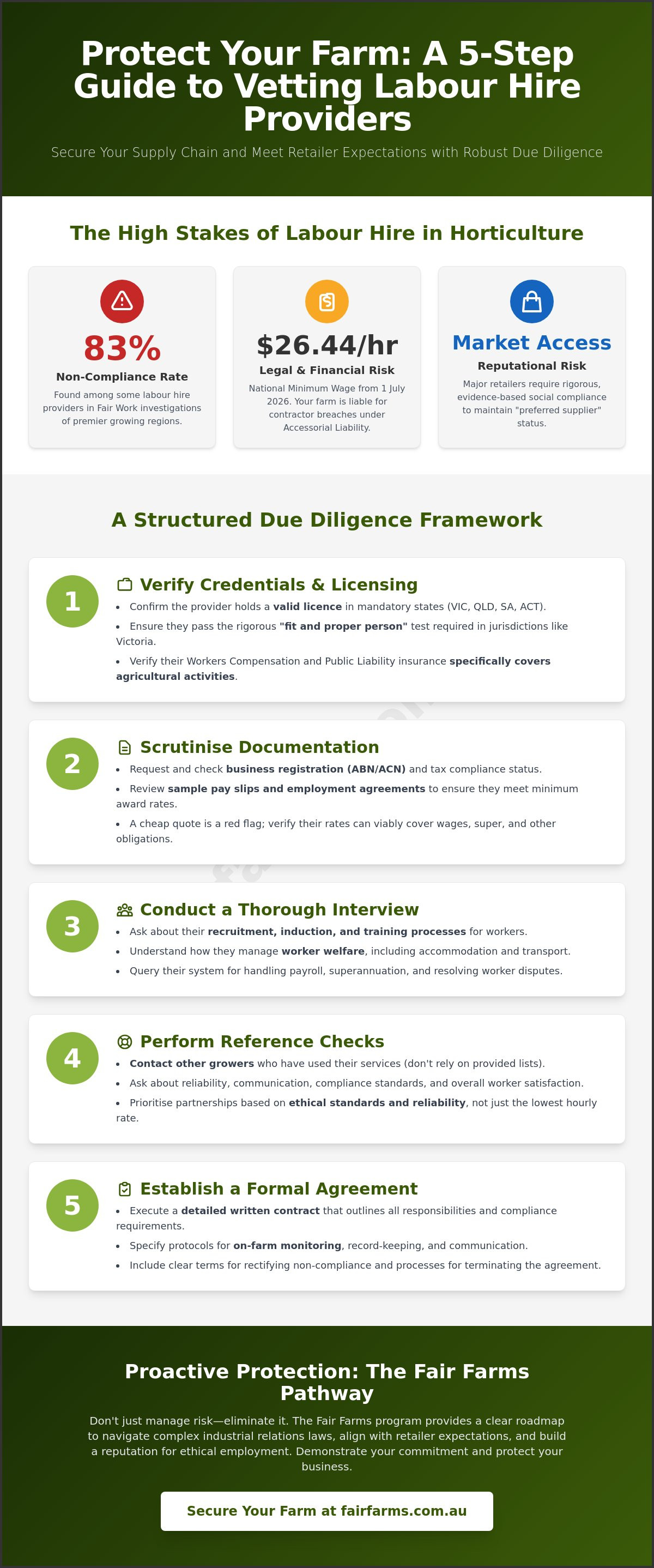
Did you know that recent Fair Work investigations in some of Australia's premier growing regions found non-compliance rates as high as 83 per cent among labour hire providers? With the National Minimum Wage rising to $26.44 per hour from 1 July 2026 and new "Payday Superannuation" rules beginning to impact payroll, the stakes for your business have never been higher. Effective risk management for labour hire in horticulture is no longer just about ticking a box; it's the shield that protects your farm from the legal and reputational fallout of an unscrupulous operator's mistakes.
We understand the anxiety that comes with managing complex regulations and the constant pressure from major retailers to prove your social compliance. You shouldn't have to shoulder the burden of a provider's negligence, especially when your reputation and "preferred supplier" status are on the line. This 2026 guide will show you how to identify and mitigate these complex risks through a robust vetting framework. We'll explore the latest licensing requirements in states like Victoria and South Australia, examine the new piece rate benchmarks, and provide the practical steps you need to maintain a transparent, ethical supply chain that secures your market access.
Key Takeaways
- Understand the principle of shared responsibility and why your farm remains liable for a provider's legal or financial failures.
- Master a structured five-step due diligence process for risk management for labour hire in horticulture that prioritises ethical standards over the lowest price.
- Establish clear protocols for monitoring on-farm compliance and maintaining open communication with labour supervisors once work begins.
- Align your operations with the evolving social compliance expectations of major retailers to secure your "preferred supplier" status.
- Discover how the Fair Farms pathway provides a clear roadmap to navigate complex industrial relations laws while protecting your farm's reputation.
The Landscape of Labour Hire Risk in Australian Horticulture
The horticulture sector relies heavily on seasonal workers to ensure produce moves efficiently from the paddock to the plate. In this ecosystem, the relationship between a grower and a labour provider is defined as a "Host Employer" arrangement. While the provider technically employs the staff, the law views the responsibility for worker welfare as a shared burden. Understanding the history and regulation of Labour hire in Australia is essential for any grower because you aren't just hiring hands; you're inheriting the compliance profile of your partner. Effective risk management for labour hire in horticulture starts with acknowledging that if a contractor fails, the grower often pays the price.
Risks in this space are categorised into three distinct pillars. Legal risks involve direct breaches of the Fair Work Act. Financial risks manifest as heavy fines or back-pay orders that can cripple a farm’s cash flow. Reputational risks are perhaps the most damaging, as they can result in the immediate loss of supply contracts with major retailers. The sector faces intense scrutiny because it employs a high proportion of migrant and seasonal workers. The Fair Work Ombudsman (FWO) has identified these groups as particularly vulnerable, leading to targeted inspection campaigns in regions like the Mornington Peninsula, where non-compliance rates have reached 83 per cent in recent years.
Legal Liability and the Fair Work Act
Under the principle of "Accessorial Liability" in Section 550 of the Fair Work Act, a grower can be held legally responsible if they are "involved in" a contractor's breach. As of July 2026, the National Minimum Wage has increased to $26.44 per hour, and failing to ensure your contractor meets these benchmarks is a high-stakes gamble. For instance, a casual Level 1 employee under the Horticulture Award now requires a minimum of $25.74 per hour, while pieceworkers must be guaranteed a rate that allows a competent worker to earn at least $34.90 per hour. Host employers have a non-negotiable duty of care to ensure that every worker on their property is paid at least the relevant minimum award rate for every hour worked.
Reputational Risk and Market Access
Beyond the courtroom, the court of public opinion is equally unforgiving. Major Australian retailers like Coles, Woolworths, and Aldi have shifted from simple checklists to rigorous, evidence-based social responsibility standards. A single documented case of underpayment or substandard accommodation can lead to a farm being "de-listed" from these essential supply chains. Consumers are increasingly demanding ethically sourced produce, making social compliance a prerequisite for market access. Ethical labour practices aren't just a moral choice; they're a fundamental requirement for the long-term sustainability of your agricultural business. Growers looking to secure their future often turn to Fair Farms Certification to demonstrate their commitment to these standards.
A 5-Step Due Diligence Framework for Selecting Providers
Selecting a labour provider based solely on the lowest hourly rate is a strategy that often leads to systemic failure. In the current regulatory environment, a cheap quote is frequently a red flag for underpayment or neglected statutory obligations. Robust risk management for labour hire in horticulture requires a shift toward sustainable partnerships where compliance is viewed as a non-negotiable operational standard. By implementing a structured vetting process, you can identify partners who prioritise the welfare of their workforce and the security of your supply chain.
Step 1: Verification of Licensing and Insurance
Your first layer of protection is ensuring your provider holds a valid licence in states where schemes are mandatory. As of 2026, Victoria, Queensland, South Australia, and the ACT require all labour hire operators to be licensed. In Victoria, the Labour Hire Authority now applies a more rigorous "fit and proper person" test and requires proof of financial viability. Beyond licensing, you must verify that their Workers Compensation and Public Liability insurance specifically covers agricultural activities. Utilising a due diligence checklist for growers helps ensure you don't overlook these foundational legal requirements during the initial screening phase.
Step 2: Assessing HR and Compliance Capability
A compliant provider must demonstrate the administrative depth to manage complex award conditions. Request evidence of their payroll systems and how they manage piecework records. Under the Horticulture Award, piece rates must be set so a competent worker can earn at least 15 per cent more than the minimum hourly rate, which currently equates to $34.90 per hour for a casual adult. Ask to see their worker induction protocols and safety training records. A provider with a dedicated HR support team is better equipped to handle grievances and ensure that seasonal workers understand their rights and safety obligations on your farm.
Step 3: Commercial Transparency and "The Math"
Transparency in pricing is the most reliable indicator of a provider's commitment to legal compliance. When reviewing a quote, ask for a detailed breakdown of the charge-out rate. With the National Minimum Wage rising to $26.44 per hour in July 2026, a legitimate rate must cover this base plus casual loading, superannuation, workers compensation premiums, and payroll tax before the provider takes a margin. If the total rate sits too close to the base award rate, it's mathematically impossible for the provider to be meeting all their legal obligations. Growers who value this level of transparency often find that becoming a member provides the necessary tools to evaluate these commercial risks effectively.
Step 4: Contractual Safeguards and Step 5: Ongoing Review
Due diligence doesn't end with a handshake. Your formal service agreements should explicitly include clauses regarding compliance with the Fair Work Act and the right for you to audit payroll records. Finally, establish a schedule for regular performance reviews. This ensures that the high standards promised during the tender process are maintained throughout the harvest season, protecting your farm from the "set and forget" mentality that often leads to compliance drift.
Operational Risk Management: Monitoring On-Farm Compliance
Effective risk management for labour hire in horticulture does not end once the service agreement is signed. The moment a contractor’s team enters your paddock, the theoretical risks discussed in the boardroom become live operational challenges. You cannot rely solely on the provider's promises; instead, you must implement a "trust but verify" approach. This ensures that the standards you’ve set are actually being met on the ground every single day of the harvest. Active monitoring is your best defence against the gradual drift in compliance that often precedes a major legal or reputational crisis.
Maintaining clear lines of communication between your farm management and the labour provider’s supervisors is essential. Schedule brief, regular meetings to discuss workflow, safety issues, and any worker concerns. Utilising "Toolbox Talks" is a highly effective way to reinforce workplace standards directly with the crew. These short, on-site briefings allow you to demonstrate your commitment to a safe and fair workplace while ensuring every worker, regardless of their employer of record, understands the behaviour and safety protocols expected on your property.
Regular verification of records is another pillar of operational oversight. Implement a "Spot Check" system where you periodically request redacted payroll samples or piecework records for the workers currently on your site. You aren't looking to manage their payroll, but rather to confirm that the rates being paid align with the Horticulture Award and the agreed commercial terms. If a provider is hesitant to provide this transparency, it's a clear signal that your risk profile is increasing.
On-Site Red Flags to Watch For
Vigilance regarding physical working conditions often reveals hidden compliance issues. Look for signs of substandard or overcrowded worker accommodation, especially following the introduction of the new Fair Farms on-farm accommodation standards on 1 June 2026. Be alert to reports of unauthorised deductions from worker pay for things like transport, equipment, or "administration fees," which are frequent indicators of exploitation. Additionally, ensure that all labour hire staff are equipped with the same high-quality PPE and safety gear as your direct employees. A provider who cuts corners on safety equipment is likely cutting corners on legal entitlements as well.
Worker Feedback and Engagement
Fostering a culture of transparency requires an "Open Door" policy where labour hire workers feel safe reporting concerns without fear of reprisal. Conduct informal, private interviews with workers from time to time to ask about their experience, their pay, and their treatment by supervisors. This direct feedback is often more revealing than any paper audit. To ensure your own team is equipped to handle these interactions professionally, consider using Fair Farms Online Training to educate your farm supervisors on ethical standards and how to spot the early warning signs of modern slavery or labour abuse. By empowering your staff to be the eyes and ears of your compliance programme, you create a robust shield for your business reputation.
Securing the Supply Chain: Meeting Retailer Expectations
In the current Australian retail environment, major players like Coles, Woolworths, and Aldi have transitioned from "Checklist Compliance" to a model of "Evidence-Based Social Responsibility." These retailers view labour hire as one of the highest risk areas in their fresh produce supply chains. For a grower, robust risk management for labour hire in horticulture is no longer just a back-office administrative task; it is the primary mechanism for protecting your commercial contracts. When a supermarket buyer reviews your profile, they are looking for proactive proof that every person picking and packing your fruit or vegetables is treated with dignity and paid correctly.
Transparency in your labour supply chain has evolved into a significant competitive advantage. While some might view the requirement for detailed reporting as a burden, it actually serves as a powerful tool to distinguish your business from less diligent operators. By providing clear visibility into how your labour is sourced and managed, you position yourself as a low-risk, high-integrity partner. This level of openness is exactly what major retailers require to protect their own brand reputations, making you a more attractive supplier for long-term programmes.
Understanding Social Compliance Audits
Preparation for third-party audits is now a routine part of modern farm management. During these sessions, auditors will scrutinise your labour hire arrangements with a focus on "Accessorial Liability." They expect to see a comprehensive "Supply Chain Map" that identifies every labour provider you engage, along with proof of their licensing and compliance history. To simplify this process, many growers utilise Fair Farms Certification to streamline their documentation and demonstrate that their on-farm practices meet rigorous, industry-recognised standards. Having these records organised and ready can significantly reduce the stress and duration of a formal social audit.
The Value of Industry-Led Standards
Retailers generally prefer growers who participate in recognised industry programmes because these frameworks are tailored to the unique seasonal challenges of Australian horticulture. While a "Self-Assessment" is a valuable first step in identifying gaps in your business, "Formal Certification" provides the independent verification that retailers trust. Becoming a certified "Fair Farmer" does more than just satisfy a buyer’s requirement; it enhances your brand with consumers who are increasingly conscious of ethical sourcing. This commitment to communal progress ensures that your farm remains a preferred supplier in a market that values integrity as much as it values quality produce. If you are ready to formalise your commitment to ethical standards, you can start your certification journey here to secure your future market access.
Proactive Protection: The Fair Farms Pathway to Compliance
Navigating the evolving regulatory environment of 2026 requires more than just vigilance; it requires a reliable partnership. Fair Farms acts as a principled mentor for the sector, offering a structured journey toward ethical responsibility. By participating in this industry-led initiative, you move beyond reactive crisis management and toward a proactive model of risk management for labour hire in horticulture. This approach doesn't just satisfy auditors; it builds a foundation of integrity that resonates across the entire regional landscape. It allows you to operate with quiet confidence, knowing your business is aligned with the highest standards of worker welfare.
The horticulture sector is unique, and a "one size fits all" approach to compliance rarely works. We understand that growers and labour providers face distinct challenges, from managing seasonal peaks to interpreting the latest Fair Work Commission rulings. Our mission is to provide the structural clarity needed to transform these complex obligations into manageable daily practices. By joining a community committed to communal progress, you aren't just protecting your own farm; you're contributing to the reputation and success of the entire Australian agricultural industry.
Support for Growers and Labour Hire Members
Membership provides access to specialised HR support that understands the unique seasonal pressures of the Australian paddock. The Fair Farms Member Portal serves as a central hub for essential tools, including templates for piecework agreements and checklists for the new on-farm accommodation standards. These resources are designed to guide you through complex regulatory processes without causing confusion. Whether you're a grower or a labour hire provider, having a clear, instructional framework reduces the risk of legal action and ensures that your business remains a stable fixture in the market. It's about providing the gravity required for a standards-setting organisation while remaining an approachable, community-focused ally.
Join the Movement for Fairer Farms
The shift toward mandatory social compliance is a transformative force in the sector. Industry-led initiatives are often more effective than government regulation alone because they're built on practical, hardworking experience and a deep knowledge of the local farming community. Starting your certification journey today positions your farm as a leader in ethical employment, making you a "preferred supplier" for major supermarkets. If you're looking to de-risk your operations for the 2026 harvest and beyond, the first step is a simple conversation. You can contact the Fair Farms team to discuss your specific risk management needs and learn how our pathway can protect your farm’s reputation. Together, we can foster a culture of accountability that ensures the long-term success and sustainability of the entire Australian horticulture industry.
Securing Your Harvest and Your Reputation
The 2026 landscape of Australian agriculture demands a shift from passive oversight to active leadership. By embedding a rigorous framework for risk management for labour hire in horticulture, you do more than avoid Fair Work penalties; you build a resilient business that retailers trust. We've explored how a structured due diligence process and consistent on-farm monitoring serve as your strongest defences against the failures of unscrupulous operators. Protecting your market access requires this level of transparency and commitment to ethical standards.
Fair Farms is here to support you in this journey. As an industry-led program developed by Queensland Fruit & Vegetable Growers (QFVG), we provide the dedicated HR support and practical templates needed to navigate complex award conditions. Our certification is a recognised pathway to social compliance that major Australian retailers value, ensuring your produce remains on their shelves. It's about collective progress and maintaining the high standards our regional communities deserve.
Join Fair Farms today and secure your farm’s ethical future. We're ready to help you lead with integrity and protect the long-term success of your farm.
Frequently Asked Questions
Is the grower responsible if a labour hire company underpays its workers?
Yes, you can be held legally liable under the "Accessorial Liability" provisions of the Fair Work Act. If a grower is found to be "involved in" a contractor's breach, they can face the same penalties as the employer of record. This shared responsibility makes robust risk management for labour hire in horticulture a commercial necessity. You must ensure your partners are meeting the 2026 National Minimum Wage of $26.44 per hour.
What are the main "red flags" when choosing a new labour hire provider in 2026?
The most significant red flag is an hourly charge-out rate that seems too good to be true. If the quoted rate barely covers the base Award minimum and statutory on-costs like superannuation and payroll tax, it's a sign of potential exploitation. Other warnings include a lack of valid licensing in states like Victoria or South Australia and a provider's reluctance to share their worker induction or safety training protocols during the vetting phase.
How does the Horticulture Award apply to labour hire employees?
The Horticulture Award 2020 dictates the minimum entitlements for all workers on your farm, whether they are direct hires or labour hire staff. This includes the Level 1 rate of $25.74 per hour and the piecework guarantee which ensures workers earn at least the hourly minimum. Labour hire providers must ensure their employees receive these rates, and growers have a duty to verify that these legal benchmarks are being met on their property.
Do I need to check the labour hire licence of a company based in a different state?
Yes, licensing is determined by where the work is actually performed. If your farm is located in Victoria, Queensland, South Australia, or the ACT, your provider must hold a valid licence for that specific jurisdiction regardless of where their head office is based. Using an unlicensed provider in these states is a serious breach of the law. Always verify their status on the relevant state authority’s public register before work begins.
Can Fair Farms certification help me pass a supermarket social compliance audit?
Absolutely. Fair Farms is a recognised pathway for growers to demonstrate their commitment to ethical employment practices to major Australian retailers. Because the programme is industry-led and tailored to the unique needs of the paddock, it provides the specific evidence and documentation that social auditors look for. This certification simplifies the process of maintaining your "preferred supplier" status with supermarkets like Coles, Woolworths, and Aldi.
What records should a grower keep regarding their labour hire contractors?
You should maintain a comprehensive compliance file for every contractor you engage. This includes a copy of their current labour hire licence, certificates of currency for workers compensation and public liability insurance, and a signed service agreement. Additionally, keep records of any "Toolbox Talks" or safety inductions conducted with their crew. These documents prove you have exercised due diligence in your risk management for labour hire in horticulture.
How often should I conduct a "spot check" on my labour hire provider’s payroll?
We recommend conducting a payroll spot check at least once every harvest season or whenever a new crew arrives on site. For year-round operations, a quarterly review is a sound practice. These checks don't need to be exhaustive; reviewing a redacted sample of payslips against the current Horticulture Award rates and superannuation requirements is often enough to confirm that your provider is maintaining their legal obligations.
What is the "Protected Pay Rate" and how does it affect horticulture?
The "Protected Pay Rate" stems from "Same Job, Same Pay" legislation designed to ensure labour hire workers receive the same pay as direct employees for performing the same work. If your farm has an enterprise agreement in place, labour hire workers may be entitled to the same pay rates as your direct staff. This law prevents the use of labour hire to undercut established site rates and requires clear communication with your provider.