
Modern Slavery Act Compliance for Farms: A Practical Guide for Australian Growers

Could a single oversight in your supply chain cost you a vital contract with a major supermarket? While the $100 million reporting threshold is the current legal benchmark, the commercial reality for Australian growers is far more immediate. Major retailers now demand transparency from every link in their supply chain, making modern slavery act compliance for farms a non-negotiable part of staying competitive. It's understandable if you feel buried under red tape or confused about where your responsibility ends and your labour hire provider's begins. You aren't alone in wanting to protect your farm's hard-earned reputation while ensuring every worker is treated with integrity.
This guide navigates the complexities of the legislation and the rising expectations of the marketplace. You'll gain a clear understanding of the difference between your legal requirements and your commercial obligations, helping you discard the confusion and focus on practical steps. We'll explore how ethical labour practices can secure your future contracts and position you as a preferred employer in a tight market. By providing a straightforward path to compliance, we'll help you safeguard your business and contribute to a fairer, more transparent agricultural sector.
Key Takeaways
- Understand how the Act serves as a transparency framework for identifying human rights risks, such as forced labour and deceptive recruiting, within seasonal operations.
- Pinpoint the high-risk compliance blind spots associated with labour hire providers and learn how to maintain oversight during peak harvest periods.
- Recognise why modern slavery act compliance for farms has become a commercial necessity for maintaining supply contracts with major Australian supermarkets.
- Apply a structured five-step framework to audit your current employment practices and formalise agreements that protect your farm's reputation.
- Access specialised tools and training through Fair Farms membership to streamline your compliance journey and demonstrate your commitment as an ethical employer.
Understanding the Modern Slavery Act 2018 in an Australian Farming Context
The Modern Slavery Act 2018 changed the way Australian businesses view their supply chains. It isn't a rigid set of rules designed to catch people out; rather, it's a transparency framework. Its primary goal is to encourage large entities to identify, manage, and mitigate human rights risks. While historical Slavery in Australia might feel like a distant memory, this legislation acknowledges that exploitation has evolved into sophisticated, often hidden practices. For growers, modern slavery act compliance for farms is about ensuring that every person on your property, whether hired directly or through a contractor, is working of their own free will and receiving their legal entitlements.
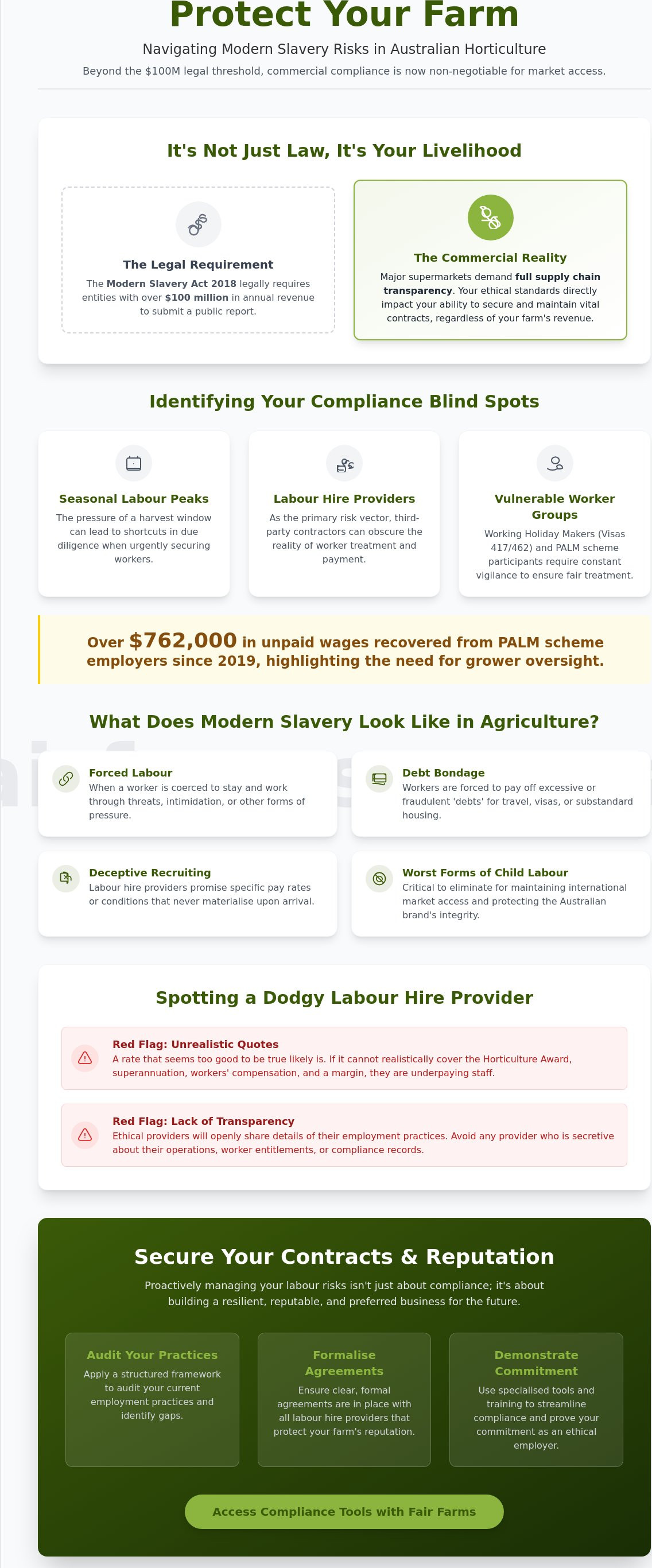
You might think the law doesn't apply to your business if your annual revenue is below the $100 million threshold. This is a common misconception. Large retailers and wholesalers are legally required to submit an annual Modern Slavery Statement that scrutinises their entire supply chain. If you supply fruit or vegetables to a major supermarket, you are part of their mandatory report. Your ethical standards directly impact their compliance, making your labour practices a key factor in your commercial viability.
The 8 Types of Modern Slavery Relevant to Agriculture
Modern slavery in horticulture often appears as forced labour or debt bondage. Forced labour occurs when a worker stays because of threats or coercion, while debt bondage involves workers being forced to pay off excessive "debts" for travel, visas, or substandard housing. Deceptive recruiting is another significant risk; this happens when a labour hire provider promises specific pay rates or conditions that never materialise. For businesses involved in global exports, ensuring there are no instances of the worst forms of child labour is critical for maintaining international market access and protecting the integrity of the Australian brand.
Mandatory vs. Voluntary Reporting
Currently, the legal trigger for mandatory reporting is an annual consolidated revenue of $100 million. These entities must report on the risks in their operations and the actions they've taken to address them. However, many mid-sized Australian agribusinesses are choosing to engage in voluntary reporting or joining industry-led programs. Taking a proactive stance on modern slavery act compliance for farms builds immense trust with investors, banks, and insurance providers who are increasingly focused on environmental, social, and governance (ESG) standards. Demonstrating transparency isn't just about ticking a legal box; it's about proving you are a reliable, ethical partner in a high-pressure industry.
Identifying High-Risk Areas in the Horticulture Supply Chain
The intense pressure of a harvest window often creates the perfect conditions for oversight to fail. When fruit is ready to pick and the weather is closing in, the rush to secure labour can lead to shortcuts in due diligence. These seasonal labour peaks are known compliance blind spots where modern slavery act compliance for farms is most frequently tested. While your own farm's direct employment practices might be beyond reproach, the complexity of the broader supply chain means that risks can hide in plain sight, particularly when third-party contractors are involved.
Labour hire providers are the primary risk vector for exploitation in Australian agriculture. They provide a vital service, but they also create a layer of separation between the grower and the worker. This distance can obscure the reality of how workers are being treated or paid. Vulnerable groups are particularly at risk, including Working Holiday Makers on 417 or 462 visas and participants in the Pacific Australia Labour Mobility (PALM) scheme. Since 2019, investigations into PALM scheme employers have recovered over $762,000 in unpaid wages, highlighting that even regulated programs require constant vigilance from the host farmer.
Labour Hire Provider Red Flags
A quote that seems significantly lower than the market average is your first warning sign. If the rate offered doesn't realistically cover the Horticulture Award, superannuation, workers' compensation, and a reasonable margin, the provider is likely underpaying their staff. Transparency is non-negotiable. Ethical providers will openly share details about worker visas, transport arrangements, and pay slips. If a provider resists site inspections or third-party audits, it suggests they have something to hide. Establishing clear expectations through certified pathways is a practical way to vet your partners and ensure they share your commitment to fair treatment.
On-Farm Indicators of Worker Exploitation
Vigilance must extend to the daily life of workers on your property. There is never a valid reason for a labour hire provider or supervisor to hold a worker's passport or ID documents for "safekeeping". This is a classic indicator of restricted movement. You should also be wary of excessive deductions for transport, tools, or substandard accommodation. When housing is tied to employment, it can quickly lead to debt bondage, where workers are unable to leave because they "owe" the provider money. Look for physical signs of exhaustion or workers who appear fearful or reluctant to communicate with you directly. These signals often point to underlying exploitation that requires immediate investigation.
The Supply Chain Ripple Effect: Why Small Farms Must Act
Many growers assume that because their turnover is well below the $100 million mark, they can safely ignore the compliance paperwork sitting on their desk. This is a risky assumption. While the law technically targets major corporations, those same corporations are legally bound to report on the risks within their entire supply chain. For retailers like Coles, Woolworths, and Aldi, this means every farm providing fresh produce must demonstrate a commitment to ethical labour. In this environment, modern slavery act compliance for farms becomes a commercial license to operate. If you cannot prove your workers are treated fairly, you risk losing access to your primary market.
This shift mirrors the introduction of food safety standards decades ago. Just as HACCP and Freshcare became mandatory for market entry, social compliance is now a standard expectation. When a buyer sends an "Ethical Sourcing" questionnaire, they aren't just being nosy. They are conducting due diligence to protect their own reputation and legal standing. Being unable to answer these questions with documented evidence can lead to a suspension of supply, regardless of the quality of your crop. It's no longer enough to do the right thing; you must be able to prove it through a transparent, auditable process.
Meeting Retailer Expectations
Australian retailers operate under a strict Supplier Code of Conduct. These documents outline the minimum standards for wages, safety, and worker treatment that you must meet to remain on their books. For a small family-run operation, demonstrating due diligence might feel overwhelming. It starts with simple, consistent steps: keeping accurate time records, ensuring pay slips are issued correctly, and vetting your contractors. To combat "audit fatigue," the industry is moving toward harmonised standards. By following established certification pathways, a single, robust audit can satisfy multiple buyers, saving you time and reducing administrative red tape.
Commercial Advantages of Ethical Compliance
Viewing compliance solely as a burden ignores the significant commercial benefits. Farms that prioritise ethical labour often secure longer-term contracts because they represent a lower risk to the retailer. Beyond the buyer relationship, being a recognised ethical employer helps you attract and retain better quality workers. In a competitive labour market, your reputation as a fair boss is a powerful recruitment tool. By formalising your modern slavery act compliance for farms, you also significantly reduce the risk of costly Fair Work Ombudsman investigations. Protecting your business from legal fees and back-pay orders is simply good management and ensures the long-term health of your enterprise.
A 5-Step Framework for Farm Compliance and Due Diligence
Moving from understanding the risks to implementing a robust defence requires a methodical approach. You don't need a massive HR department to achieve modern slavery act compliance for farms; you simply need a clear process that integrates with your daily operations. This five-step framework provides a structured pathway to ensure your property remains a safe, ethical, and commercially viable environment.
- Step 1: Conduct a Gap Analysis. Review your current employment and labour hire practices. Look for missing contracts, incomplete time records, or a lack of oversight regarding how your contractors pay their staff. Identifying these weaknesses early allows you to fix them before they become liabilities.
- Step 2: Formalise Labour Hire Agreements. Never rely on a handshake. Ensure every agreement with a provider includes strict compliance clauses. These should mandate adherence to the Horticulture Award and grant you the right to audit their payroll records at any time.
- Step 3: Implement Comprehensive Worker Inductions. Your induction is your first chance to speak directly to the workforce. Clearly explain their rights, their exact pay rates, and the safety standards on your farm. Workers should leave the induction knowing exactly what to expect and how to raise a concern.
- Step 4: Regular Monitoring and Internal Reviews. Oversight is an ongoing commitment. Periodically cross-check worker sign-in sheets against the invoices provided by your labour hire firm. If you provide accommodation, conduct regular inspections to ensure it meets basic health and safety standards.
- Step 5: Pursue Recognised Industry Certification. External validation is the most effective way to prove your standards to retailers. Achieving Fair Farms Certification provides a clear signal to the market that your business is a trusted, ethical partner.
Vetting Your Labour Hire Partners
The strength of your compliance often depends on the integrity of your partners. Always verify that a provider holds a valid Labour Hire Licence in your relevant state or territory. Beyond the licence, request 'Records of Payment' to confirm that workers are actually receiving the correct Award rates and superannuation. Due diligence is the proactive steps taken to prevent harm before it occurs. By asking these questions upfront, you protect your farm gate from the fallout of a contractor's misconduct.
Implementing an Effective Grievance Mechanism
A grievance mechanism doesn't have to be complex to be effective. It simply needs to be a safe, anonymous way for workers to report concerns without fear of reprisal. In the packing shed, use multi-lingual signage to ensure all workers, regardless of their background, understand how to access this system. If a modern slavery risk is identified on your property, respond with gravity and speed. Your first priority must be the safety of the worker, followed by a thorough investigation of the provider involved. Transparency during these moments is what distinguishes a leader from a laggard in the agricultural sector.
How Fair Farms Membership Supports Your Compliance Journey
Achieving modern slavery act compliance for farms shouldn't feel like a solitary battle against bureaucracy. Fair Farms was built by the Australian horticulture industry to provide a practical, structured pathway for growers to demonstrate their commitment to ethical labour. It's more than just a checklist; it's a comprehensive support system that bridges the gap between complex legal requirements and daily farm management. By participating in this industry-led programme, you transform a regulatory burden into a clear commercial advantage.
The strength of the Fair Farms framework lies in its regional focus. We understand that a family-run orchard in the Goulburn Valley faces different operational challenges than a large-scale corporate operation in the Top End. Our resources are designed to be accessible, grounded, and focused on the practicalities of seasonal work. This supportive approach ensures that every grower, regardless of their size, has the tools to protect their workers and their business reputation with quiet confidence.
The Certification Pathway
The journey starts with a thorough look at your current operations. Through a comprehensive self-assessment process, you can identify areas for improvement before an independent auditor ever sets foot on your property. This transparent process ensures that when you achieve Fair Farms Certification, it carries genuine weight with major retailers and wholesalers. You aren't just ticking a box; you're joining a community of members who are setting a new standard for the sector. This collective commitment helps shift the industry's reputation, proving that Australian agriculture is a global leader in fair employment and modern slavery act compliance for farms.
Practical HR Support for Busy Growers
We understand that your primary focus is on the crop, not on navigating the intricacies of workplace relations law. Membership provides direct access to specialised HR support and templates that are specifically tailored for the unique challenges of farm management. Whether you have a complex question about the Horticulture Award or need a compliant induction template, the Fair Farms helpdesk acts as a reliable mentor. You don't have to guess if your paperwork is up to scratch; you'll have the resources to know it is.
Upskilling your team is equally vital. The online training modules are designed to be accessible for supervisors and managers, ensuring everyone on your property understands the gravity of ethical standards. By educating your front-line staff, you create a culture of accountability that naturally mitigates the risks of exploitation. This proactive approach reduces your administrative burden and protects your commercial contracts, allowing you to focus on the long-term success of your enterprise.
Securing Your Farm's Legacy Through Ethical Leadership
Maintaining a competitive edge in the Australian horticulture sector now requires more than just a high-quality yield. It demands a steadfast commitment to transparency and the ethical treatment of every worker on your property. By identifying high-risk areas in your supply chain and implementing a structured due diligence framework, you protect your business from the commercial and reputational fallout of non-compliance. Modern slavery act compliance for farms is no longer just a legal threshold for the few; it's a vital requirement for any grower wishing to stay on the shelves of major Australian retailers.
As an industry-led programme developed by Queensland Fruit & Vegetable Growers (QFVG) and supported by Federal funding, Fair Farms is your supportive partner in this journey. Our certification is widely recognised by major retailers, giving you a credible way to prove your standards to the marketplace. You don't have to navigate these regulatory complexities alone. Take the next step toward communal progress and industry leadership by formalising your commitment to fair labour practices.
Contact Fair Farms today to secure your farm's future with ethical certification. We look forward to helping you build a more resilient and principled business for the long term.
Frequently Asked Questions
Does my farm need to submit a Modern Slavery Statement if our revenue is under $100 million?
No, you aren't legally required to submit a formal statement if your annual consolidated revenue is under $100 million. However, the commercial reality is quite different for most growers. Large retailers are legally bound to report on their entire supply chain, which means they require modern slavery act compliance for farms from all their suppliers, regardless of turnover. Meeting these standards is often a mandatory condition of your supply contract.
What is the Horticulture Award and how does it relate to the Modern Slavery Act?
The Horticulture Award 2020 is the legal instrument that defines the minimum wages and working conditions for the industry. Compliance with this award is a fundamental pillar of ethical labour standards in Australia. During a social compliance audit, any failure to meet these minimums, especially systematic underpayment or excessive hours, is flagged as a high-risk indicator of potential forced labour or debt bondage.
How can I tell if my labour hire provider is operating ethically?
Ethical providers demonstrate complete transparency regarding their payroll, superannuation, and visa management. You should always verify they hold a valid Labour Hire Licence in your state and request 'Records of Payment' that clearly align with the Horticulture Award. If a provider resists third-party inspections or offers quotes that seem too low to cover legal entitlements and overheads, they are likely a high-risk partner.
What happens if a modern slavery case is found in my supply chain?
Your immediate priority must be the safety and welfare of the affected individuals. You should engage with the relevant authorities and work with your industry body to develop a clear remediation plan. Major retailers generally expect you to take responsibility for managing the issue rather than simply terminating a contract immediately, as a sudden exit can leave vulnerable workers in even greater danger without support.
Is Fair Farms certification recognised by the major Australian supermarkets?
Yes, Fair Farms certification is a widely recognised social compliance standard among major Australian retailers. Supermarkets such as Coles, Woolworths, and Aldi accept this certification as evidence that a grower is meeting their ethical sourcing requirements. It provides a streamlined way for you to satisfy multiple buyers through a single, industry-specific audit process that understands the unique nature of farming.
Can I be held legally responsible for the actions of my labour hire company?
You can be held liable under the "accessorial liability" provisions of the Fair Work Act. If a grower is found to be "involved in" a labour hire provider's breach of workplace laws, such as underpaying workers, they may face significant fines. This makes it essential to conduct thorough due diligence and maintain active oversight of all contractors working on your property to protect your business from legal risks.
How much does it cost to implement a modern slavery compliance program on a farm?
The cost varies based on the size of your operation and the maturity of your existing HR systems. While there are costs associated with membership and independent audits, many growers find these are offset by the commercial security of maintaining retail contracts and the reduced risk of legal penalties. Investing in modern slavery act compliance for farms is best viewed as a necessary insurance policy for your farm's long-term reputation.
What are the most common compliance gaps found during farm audits?
The most frequent gaps include incomplete time and wage records and a lack of formal written agreements with labour hire firms. Auditors also often find that worker inductions don't sufficiently explain workplace rights or how to use a grievance procedure. Addressing these administrative oversights is usually the first and most important step toward achieving a successful certification outcome and proving your ethical standards.