
Casual Farm Worker Rights in Australia: The 2026 Comprehensive Guide
What if the most challenging part of the Australian harvest isn't the heat or the yield, but managing the complex web of workplace laws designed to protect those on the ground? For many, understanding the specific employer obligations casual farm workers rely on can feel like a moving target, especially with the significant legislative shifts seen in 2026. It's common to feel a sense of unease when faced with the choice between piece rates and hourly pay, or when trying to verify if a labour hire contractor is operating ethically.
You deserve to work with confidence, knowing your hard work is backed by the full protection of the Horticulture Award. This comprehensive guide outlines your legal entitlements, current pay standards, and the essential workplace protections you're entitled to as a casual employee. We'll walk you through the July 2026 wage increases, explain the new employee choice pathway for casual conversion, and clarify how the A$30.35 hourly minimum for Level 1 casuals functions. By the end, you'll have the tools you need to keep accurate records while spotting employers who truly value integrity and communal progress.
Key Takeaways
- Learn how the 2026 definition of casual employment focuses on the practical reality of your working relationship rather than just the written contract.
- Understand the core employer obligations casual farm workers are entitled to, including the mandatory 25% loading and the latest Horticulture Award pay rates.
- Master the rules surrounding piece rates to ensure you are always protected by the minimum wage floor for every hour worked.
- Navigate the updated "employee choice" pathway to request a transition from casual to permanent employment after 12 months of regular work.
- Identify reputable workplaces by recognising the Fair Farms Certification as a commitment to ethical standards and transparent labour practices.
What Defines a Casual Farm Worker in Australia?
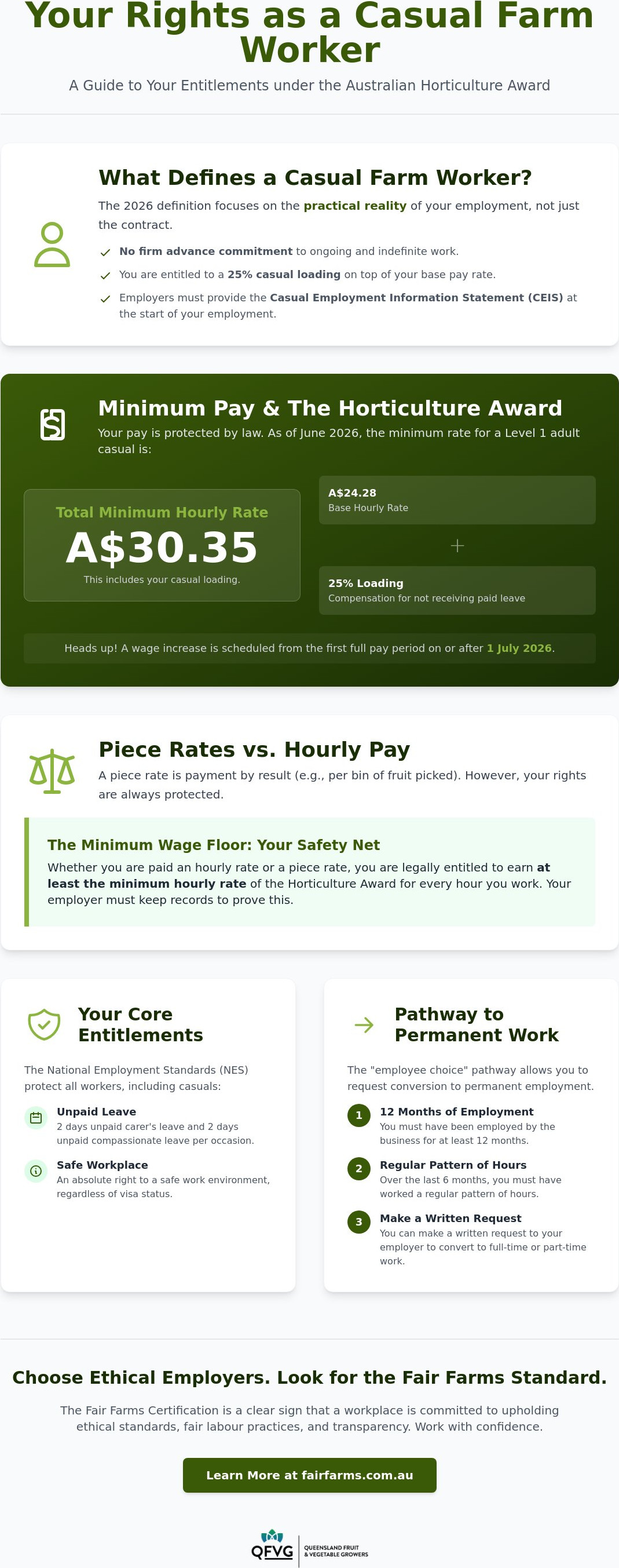
Understanding your status on a farm starts with a clear legal definition. In 2026, a casual employee is defined by the practical reality of their job, not just the words in a contract. You're considered a casual if there's no firm advance commitment to ongoing work and you're entitled to a casual loading. This means your roster might change weekly based on weather, crop maturity, or harvest demands. Under Australian labour law, this assessment looks at the true nature of the relationship; if you don't have guaranteed hours and can choose to accept or reject shifts, you're likely a casual.
A vital part of employer obligations casual farm workers should look for is the provision of the Casual Employment Information Statement (CEIS). Your employer must give you this document when you start. It's a clear guide that explains your rights and the pathways available to transition to permanent work if your role becomes regular over time. Most farm roles, from harvesting various fruits to packing diverse produce, are governed by the Horticulture Award 2020. This Award sets the industry standard for pay and conditions, ensuring everyone is treated with the same level of integrity and fairness.
You might be hired directly by a grower or through a labour hire provider. If you're with a labour hire firm, they're responsible for your pay and tax. However, ethical growers who value communal progress often choose to work with certified providers to ensure their supply chain remains transparent. Regardless of who signs your payslip, the legal protections regarding your safety and basic rights remain the same.
The National Employment Standards (NES)
The NES acts as the essential safety net for every person working in Australia. While casuals don't receive paid annual or sick leave, you're still entitled to specific protections. These include two days of unpaid carer's leave and two days of unpaid compassionate leave per occasion. Importantly, every worker has the right to a safe workplace. This protection is absolute; it doesn't matter what your visa status is or how long you've been in the country. Growers can access professional membership for growers to ensure they're meeting these standards consistently.
Your Role on the Farm
Classification levels are the backbone of the Horticulture Award. Most new arrivals start as Level 1 workers, performing tasks like picking, packing, or general harvesting. As you gain skills or take on more responsibility, your classification should rise, which increases your base rate of pay. It's a good idea to keep a diary of your daily tasks and the hours you work. Always ensure you know the legal name of the business you're working for. Don't rely on a nickname or a first name; having the correct business name and ABN on your records is the best way to protect your interests if a dispute arises.
Minimum Pay, Casual Loading, and the Horticulture Award
The financial foundation of any farm role rests on the Horticulture Award. As of June 2026, the minimum hourly rate for an adult Level 1 casual employee is A$30.35. This figure is a combination of the base rate of A$24.28 and the mandatory 25% casual loading. It's vital to remember that the Fair Work Commission has announced a wage increase effective from the first full pay period on or after 1 July 2026. Ethical growers stay ahead of these changes to ensure their team is always paid correctly.
Understanding employer obligations casual farm workers should monitor includes knowing when overtime kicks in. Under the Award, casuals are entitled to overtime pay if they work more than 12 hours in a single day or more than 304 hours over an eight-week period. These rules prevent burnout and ensure that extra effort is fairly rewarded. Working on public holidays also provides a significant boost, with rates typically reaching 225% of the base hourly rate. This ensures that those who contribute on "red days" are compensated for the time away from their community.
Calculating Your Hourly Rate
Your hourly rate isn't just a single number; it's a reflection of your employment status. Casual loading is a financial buffer provided because casuals don't receive paid annual or sick leave. To calculate it, you simply add 25% to the base rate for your classification level. If you're working night shifts or weekends, additional penalty rates may apply. These penalties recognise the social cost of working irregular hours and are a core part of a fair workplace. Growers who want to demonstrate their commitment to these standards often seek Fair Farms Certification to validate their payroll processes.
Allowances and Deductions
Beyond your base pay, you may be entitled to specific allowances. If you're a designated first aider or if you're required to work in particularly wet weather, these contributions should appear on your payslip. Deductions are a different matter entirely. An employer cannot profit from providing you with housing or transport; this is known as the "no-benefit" rule. Any deduction from your pay must be for your primary benefit and, crucially, you must agree to it in writing. Never feel pressured to sign a deduction agreement that doesn't feel right. Transparency is the hallmark of an ethical farm.
Piece Rates vs. Hourly Pay: The Minimum Wage Floor
Working on a piece rate basis has long been a staple of the Australian horticulture industry. It allows you to be paid based on your individual output, whether that's measured by the bucket, bin, or kilogram. For highly skilled and efficient pickers, this system offers the potential to earn significantly more than the standard hourly rate. However, a piece rate isn't an excuse for sub-standard pay. Every piecework arrangement must be documented in a written agreement before you start your first shift. This document should clearly state the rate being paid and the unit of measure, ensuring both you and the grower are aligned on expectations from the outset.
One of the most critical employer obligations casual farm workers must understand is the minimum wage floor. Introduced to provide a secure safety net, this rule ensures that you can never earn less than the minimum hourly rate for your classification. Even on days when the crop is light or the weather is challenging, your pay is protected. If your piecework earnings for a day fall below what you would have earned on an hourly basis (including your 25% casual loading), your employer is legally required to top up your pay to meet that hourly minimum. This guarantee allows you to work with a sense of security, knowing your time is always valued.
To ensure these rates are fair, the Horticulture Award requires that piece rates be set at a level that allows a worker of average productivity to earn at least 15% more than the minimum hourly rate. This "piece rate uplift" is designed to reward the hard work and efficiency required in the field. When a grower prioritises ethical standards, they ensure these calculations are transparent and based on realistic picking conditions. It's about communal progress, where the success of the farm and the welfare of the worker are inextricably linked.
The Safety Net for Pieceworkers
Your employer is obligated to record every hour you spend on the farm, even if you're being paid by the bin. At the end of each day, they must compare your piecework earnings against the hours you worked multiplied by the minimum hourly rate. If the hourly calculation is higher, that's what you must be paid. If you notice your weekly pay doesn't reflect this top-up, it's a sign that the payroll system may not be compliant. Keeping your own diary of start and finish times is the best way to verify that your entitlements are being met.
Spotting Unfair Piecework Agreements
Transparency is the best tool for identifying a fair employer. Be wary of "verbal" agreements or rates that change daily without a new written record. A reputable grower will provide a clear, dated piecework agreement that references the Horticulture Award. You should also keep a daily tally of your bins or buckets picked. Comparing your personal records against your payslip ensures that no errors occur during the busy harvest season. If a rate seems impossibly low, it may not meet the 15% productivity uplift requirement, which is a significant red flag for any worker.
Casual Conversion Rights and Record-Keeping Obligations
The transition from a casual role to a permanent position is now a more structured process under the 2026 "employee choice" pathway. This legislative shift recognises that many seasonal workers provide the consistent, reliable labour that underpins the Australian horticulture sector. If you've worked a regular pattern of hours for at least six months within a 12-month period, you may have the right to request a move to part-time or full-time employment. For those employed by large businesses, this eligibility period is reduced to just six months. Understanding these employer obligations casual farm workers can rely on ensures that long-term contributors receive the stability they've earned through their ongoing commitment.
While the law provides the framework, your personal records provide the necessary proof. Diligent record keeping is your most effective defence against potential wage theft or confusion regarding your entitlements. Every Australian payslip must contain specific, mandatory details to be considered compliant. This includes the employer's legal name and ABN, the exact pay period dates, your gross and net pay, and any superannuation contributions made on your behalf. If these details are absent or obscured, it's a clear signal that the business may not be meeting its ethical responsibilities. Growers who value integrity often seek Membership for Growers to access the professional support needed to maintain these high standards of transparency.
How to Request Casual Conversion
Starting the process for casual conversion begins with a review of your work history. If your roster has been consistent and you expect it to remain that way, you can submit a formal written request to your employer. Once this is received, the employer is required to respond in writing within 21 days. A refusal is only permitted if it's based on reasonable business grounds, which must be clearly documented. This system is designed to facilitate a transparent, fair conversation between the worker and the grower, ensuring that the path to permanent work is based on the reality of the role rather than just a contract label.
The Work Diary Habit
Establishing a daily work diary habit is a simple yet powerful way to protect your interests on the farm. You shouldn't rely solely on the employer's time-tracking system; instead, record your own start and finish times, along with the duration of your unpaid breaks. If you're working on a piece rate, it's essential to track the number of bins or buckets picked each day. Capturing a quick photo of your daily tally sheets or bin tags creates a digital evidence trail that's incredibly helpful if a discrepancy arises. These small daily actions ensure that when you sit down to check your payslip, you have the confidence of knowing exactly what you've earned.
Choosing Ethical Employers: The Fair Farms Standard
Finding a workplace that respects the employer obligations casual farm workers rely on shouldn't be a matter of luck. In a sector as diverse as Australian horticulture, identifying ethical employers before you step onto the field is a vital skill. A grower's commitment to integrity is often visible through their participation in industry-led compliance programmes. These employers don't just follow the law; they actively demonstrate their accountability to their workforce and the broader community. By choosing a workplace with dedicated HR support, you ensure that any questions about your pay or conditions are handled with professional gravity and transparency.
The Fair Farms Certification has emerged as the definitive mark of integrity within the industry. Major Australian retailers, including Coles, Woolworths, and Aldi, increasingly prefer sourcing from certified growers who can prove their social compliance. This preference isn't just about corporate policy; it's about ensuring every person in the supply chain is treated with dignity. When you work for a Fair Farms member, you're joining a business that has opened its doors to independent evaluation, proving that its practices meet the rigorous standards of Australian workplace law and ethical conduct.
What Fair Farms Certification Means for You
Certification involves a thorough audit process where growers must prove they are meeting all legal requirements. As of 1 June 2026, all audits are conducted against Version 4.0 of the Fair Farms Standard, which includes strengthened protections against modern slavery and exploitation. This rigorous oversight ensures that your rights are not just words on a page but a lived reality on the farm. Before you apply for your next seasonal role, it's a smart move to check the list of Fair Farms members to find employers who have committed to these high ethical standards.
Taking the Next Step
Empowering yourself with knowledge is the best way to ensure a positive harvest experience. You can use the various Fair Farms pathways to gain a deeper understanding of the specific employer obligations casual farm workers are protected by under the law. If you ever feel uncertain about your rights or need clarification on industry standards, you can always reach out for support and contact our team. A fair farm is a productive and sustainable farm. By choosing ethical employers, you're contributing to a stronger, more equitable future for the entire Australian agricultural community.
Securing Your Future in Australian Horticulture
Navigating the 2026 harvest season requires more than just hard work; it demands an informed approach to your workplace rights. You now have a clearer understanding of how the Horticulture Award protects your earnings through the minimum wage floor and the mandatory 25% casual loading. By maintaining a diligent work diary and recognising the new employee choice pathway for casual conversion, you're taking active steps to safeguard your professional journey and financial security.
A thorough grasp of the employer obligations casual farm workers are entitled to is the first step toward a rewarding career in regional Australia. As an industry-led initiative supported by the Australian Government, Fair Farms provides a formal certification pathway that prioritises ethical employment and communal progress. Growers who embrace these standards often benefit from dedicated HR support, ensuring that transparency and accountability remain at the core of their daily operations.
Looking for an ethical workplace? Explore our Fair Farms Member directory to find growers committed to your rights.
Your contribution is the lifeblood of the regional agricultural community. You deserve a workplace that values your integrity as much as your productivity. Work with confidence, stay informed, and thrive in a sector that respects your dedication.
Frequently Asked Questions
Is there a minimum wage for fruit picking in Australia in 2026?
Yes, there is a guaranteed minimum wage for all fruit picking roles in Australia. As of June 2026, the minimum hourly rate for an adult Level 1 casual employee is A$30.35, which includes the mandatory 25% casual loading. Even if you're working on a piece rate basis, your employer must ensure you earn at least this hourly amount for every hour worked. This rate is subject to the National Minimum Wage increase effective from 1 July 2026.
Can my boss fire me for asking about my pay rates?
No, your employer cannot legally dismiss you or take adverse action against you for inquiring about your pay or conditions. Under the Fair Work Act, asking about your entitlements is a protected workplace right. Ethical growers who understand the employer obligations casual farm workers are protected by will encourage open communication. If you face repercussions for seeking clarity on your wages, it's considered a serious breach of Australian labour law and should be reported.
Do casual farm workers get paid for breaks?
Under the Horticulture Award, you're entitled to an unpaid meal break of between 30 and 60 minutes after five hours of work. While these longer meal breaks aren't paid, they're a mandatory requirement to ensure your safety and well-being on the farm. Some employers may provide shorter, paid rest breaks, but these are often at the grower's discretion or specified in a local enterprise agreement. Always check your specific employment contract for these details.
What should I do if my payslip is missing information?
If your payslip is missing essential details like the employer's ABN or your gross pay, you should request a corrected version immediately. Providing a compliant payslip is a legal requirement in Australia. If the employer refuses or continues to provide incomplete records, it may indicate a lack of commitment to ethical standards. Keeping your own diary of hours worked is vital, as it provides the evidence needed to resolve any discrepancies through formal channels.
Am I entitled to superannuation as a casual farm worker?
Yes, casual farm workers are entitled to superannuation contributions from their employer. If you're 18 or older, your employer must pay the Super Guarantee into your nominated fund, regardless of how much you earn in a month. For those under 18, the entitlement kicks in if you work more than 30 hours in a week. These contributions are in addition to your hourly wage and are a critical part of your long-term financial security in Australia.
How do I know if my labour hire company is licensed?
You can verify a labour hire provider's status by checking the official labour hire licensing register in the state where you're working. Queensland, Victoria, South Australia, and Western Australia all have mandatory licensing schemes. A reputable provider will proudly display their license number on their website and recruitment materials. Working with licensed providers is a key part of employer obligations casual farm workers should verify to ensure they're joining an ethical and transparent supply chain.
What happens to my rights if I am on a 417 or 408 visa?
Your workplace rights remain exactly the same regardless of whether you're on a 417 Working Holiday visa or a 408 Pandemic Event visa. Australian labour law provides the same protections to every worker, including minimum wage guarantees, safety standards, and the right to join a union. Your visa status doesn't give an employer the right to pay you less or offer substandard conditions. Integrity and communal progress depend on every participant being treated with equal respect.
Can an employer charge me for safety equipment or tools?
Employers generally cannot charge you for essential Personal Protective Equipment (PPE) required to do your job safely, such as high-visibility vests or specialised gloves. While they might request a refundable deposit for expensive tools, this must be agreed upon in writing and cannot result in the employer making a profit. If an employer is deducting significant amounts from your pay for "equipment hire," it's a major red flag that warrants further investigation into their compliance.