
Horticulture Piecework Agreement Requirements Australia: A Grower’s Guide for 2026
Did you know that recent Fair Work investigations in some of Australia's premier growing regions found non-compliance rates as high as 83 per cent among labour-hire providers? It's a sobering figure for any grower trying to balance a productive harvest with complex industrial relations laws. You likely feel the pressure of rising costs and the constant fear that a simple record-keeping oversight could result in a costly underpayment claim. Understanding the specific horticulture piecework agreement requirements Australia is no longer optional; it's a fundamental part of protecting your farm's future and reputation.
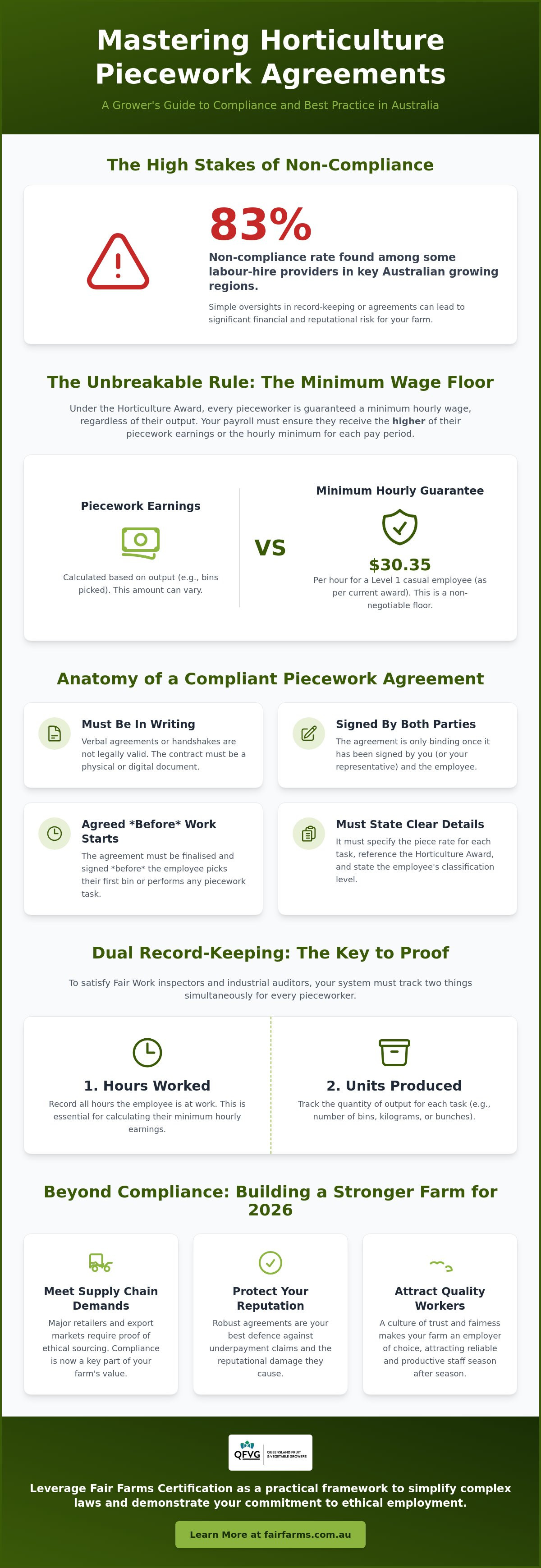
We're here to help you move beyond the stress of shifting regulations and into a position of confident compliance. By mastering the legal essentials for 2026, you can ensure your agreements meet the Horticulture Award standards while maintaining an efficient, motivated workforce. This guide provides a clear roadmap through the mandatory wage floors, including the $30.35 hourly minimum for Level 1 casuals, and the essential documentation required before work begins. We'll explore how to structure your agreements to satisfy Fair Work inspectors and prepare your business for Fair Farms certification readiness.
Key Takeaways
- Draft valid written agreements that clearly define task rates and secure mutual signatures before the first bin is picked to establish a transparent working relationship.
- Ensure your payroll processes correctly apply the mandatory minimum wage safety net, protecting your business from underpayment risks even during slower harvest periods.
- Organise rigorous record-keeping systems that simultaneously track hours worked and units produced to satisfy Fair Work inspectors and industrial auditors.
- Identify the specific horticulture piecework agreement requirements Australia to ensure every contract on your farm is legally binding and reflects current 2026 standards.
- Leverage Fair Farms Certification as a practical framework to simplify complex industrial relations laws and strengthen your reputation as a trusted, ethical employer.
Understanding Piecework in the Horticulture Award
Piecework is a performance-based payment model where employees are paid according to their individual output rather than the time they spend on the clock. In the context of an Australian orchard or vegetable farm, this typically means receiving a set rate for every bin of apples picked, bucket of berries harvested, or tray of mangoes packed. While this model incentivises high productivity and allows skilled workers to maximise their earnings, it must be managed with absolute precision to remain legal. You must ensure that every contract you issue meets the specific horticulture piecework agreement requirements Australia to protect your business from compliance risks.
Under the Horticulture Award 2020, piecework is an optional arrangement. You aren't required to use it by default, but if you do, it operates as a hybrid model. It's a versatile tool available for full-time, part-time, and casual employees alike. The dual benefit is clear: it rewards your fastest, most diligent workers while maintaining the legal safety nets that define a modern, ethical workplace. The goal is to reward efficiency without ever compromising the worker's right to a fair day's pay.
The Legal Framework: Fair Work Act and the Horticulture Award
The Horticulture Award 2020 serves as the primary legal instrument for our industry, establishing the national standards that most growers must follow. These regulations sit within the broader context of Australian labour law, which ensures a fair safety net for all participants in the workforce. Most Australian farming businesses operate as national system employers under the Fair Work Act 2009, though some sole traders or partnerships in specific states may fall under different jurisdictions. You should verify your status to ensure your agreements are built on the correct legal foundation.
Having a written piecework agreement isn't just a recommendation; it's a mandatory legal requirement. You cannot simply agree on a rate with a handshake in the paddock. The document must be signed by both parties before any piecework task commences. If you fail to have a valid, signed agreement in place, the arrangement is legally void. This leaves your business vulnerable to back-pay claims where you might be forced to pay full hourly rates regardless of the actual output achieved during the harvest.
The 2026 Context: Why Compliance Matters More Than Ever
Entering 2026, the agricultural sector faces unprecedented scrutiny regarding supply chain transparency. Major retailers and international markets now demand proof of ethical sourcing, making your employment practices a core part of your business's value. Compliant piecework agreements are a critical defence against modern slavery risks, demonstrating that your farm operates with integrity and accountability. This transparency is no longer just a "nice to have" feature; it's a requirement for staying competitive in a global market.
The industry has moved away from the era of unregulated piece rates. Today, a robust agreement protects your farm from the reputational damage associated with underpayment claims. Programs like Fair Farms support this transition, offering a path toward Fair Farms Certification to help growers demonstrate their commitment to ethical labour standards. By documenting every rate and requirement clearly, you build a culture of trust that attracts more reliable, productive workers to your harvest season after season.
Mandatory Requirements for Valid Piecework Agreements
A handshake in the field won't protect your farm from a Fair Work audit. To be legally binding, your contract must be a written document signed by both you and the employee before any harvest tasks begin. Under the horticulture piecework agreement requirements Australia, this document needs to clearly identify the piecework rate for every specific task, whether that's picking a bin of citrus or packing a tray of stone fruit. You must also explicitly reference the Horticulture Award and the employee's classification, such as Level 1, to ensure they understand their position within the industrial framework. Once the document is signed, you're legally required to provide a copy to the worker immediately. Most importantly, the agreement must be entered into freely; any hint of coercion or duress can render the entire contract void.
Setting the Piecework Rate
Setting a fair rate isn't a matter of guesswork. You must use the "average competent employee" benchmark as your guide. This means a worker with average skill and experience should be able to earn at least 15 per cent more than the minimum hourly rate for their classification. It's vital to document the methodology you used to reach your specific rate. Factors like crop density, fruit size, and even the steepness of the terrain can impact picking speed. Because these conditions change, you should review your rates regularly. If a block has lighter fruit or the weather has impacted the crop, your rates must be adjusted to ensure the "competent worker" can still meet the required earnings threshold. This level of transparency is a core pillar of Fair Farms Certification, helping you build a culture of mutual respect and accountability.
Accessibility and Language Considerations
Workers must fully comprehend the terms and conditions of the agreement before they put pen to paper. If you employ workers with low English literacy, using simple language or visual aids can bridge the communication gap. Best practice involves using translated templates or professional translators to ensure every staff member understands their rights and pay structure. This doesn't just reduce the risk of future disputes; it also demonstrates a commitment to ethical leadership. If you're unsure if your current templates meet the mark, our Membership for Growers provides the resources and support needed to stay compliant with evolving standards. Clear communication ensures that your workforce is focused on the harvest rather than worrying about the fine print of their pay.
The Minimum Wage Floor: Protecting Workers and Your Business
The "minimum wage floor" is a non-negotiable safety net that ensures every worker receives a fair baseline pay, regardless of their individual speed or the day's crop conditions. In 2026, this floor is the most critical element of horticulture piecework agreement requirements Australia. It means that while pieceworkers are still paid by the bin or bucket, their total earnings for any given period must never fall below the minimum hourly rate for their specific classification. For a Level 1 casual employee, this guaranteed safety net is $30.35 per hour, which includes the mandatory 25 per cent casual loading. If the piecework earnings don't reach this amount, you're legally required to bridge the gap.
A common misconception in the industry is that piecework arrangements exempt employers from paying for "waiting time." This is incorrect. If your team is standing in the paddock waiting for bins to arrive, or if they're delayed by a machinery breakdown, that time must be paid at the hourly rate. The floor applies to all hours worked, not just the hours spent actively picking. By understanding this, you protect your farm from underpayment claims and build a reputation as a principled, reliable employer who values the time of every staff member.
Calculating the Top-Up Payment
Managing the "top-up" process requires a methodical approach to payroll. At the end of each pay period, you must compare the total amount earned through piece rates against the total hours worked multiplied by the relevant hourly rate. It's a simple calculation. If the hourly entitlement is higher than the piecework total, you must add a "top-up" payment to the worker's wages. This ensures they receive exactly what they're entitled to under the Horticulture Award.
Daily productivity can fluctuate wildly due to heavy rain, heatwaves, or poor fruit quality in a particular block. You must track these variations accurately. When a top-up is required, it's vital to list it as a separate line item on the employee's payslip. This transparency provides clear evidence of compliance during an audit and shows your workers that their rights are being respected. If you're finding the administrative side of these calculations challenging, our Membership for Growers offers HR support to help you streamline these processes.
Impact on Productivity and Farm Management
The minimum wage floor has transformed farm management from a focus on volume to a focus on efficiency. Because you're paying a guaranteed minimum, there's a greater incentive to provide high-quality supervision and training. If a worker consistently falls below the floor, it's often a signal that they need more coaching or that the farm's logistics—like bin placement—need improvement.
Using performance data allows you to identify these gaps early. You can then balance the piecework incentive, which aims for a "competent worker" to earn 15 per cent above the minimum, with the mandatory safety net. This approach doesn't just satisfy legal requirements; it fosters a more skilled and motivated workforce. Workers who feel supported and fairly paid are more likely to return for the next harvest, reducing your recruitment costs and strengthening your local community.
Record-Keeping and Compliance Checklists
A robust paper trail is your farm's most effective shield against legal disputes and industrial audits. Under the horticulture piecework agreement requirements Australia, your responsibility extends far beyond simply counting bins at the end of a shift. Because every pieceworker is now entitled to a minimum wage floor, you must track both the units produced and the exact hours worked for every individual on your team. This dual-tracking system is the only way to prove that your "top-up" calculations are accurate and that your staff are receiving their full entitlements, including the 25 per cent casual loading where applicable.
Your records must be comprehensive and easily accessible. This includes maintaining signed copies of all piecework agreements, along with any written variations made during the season. When it comes to payslips, clarity is paramount. You must ensure they clearly distinguish between piecework earnings and any additional top-up amounts required to meet the hourly minimum. The Fair Work Act requires you to store these employment records for seven years. Failing to maintain these logs doesn't just risk a fine; it undermines the integrity of your entire operation and makes it nearly impossible to defend against back-pay claims.
Digital vs. Manual Record-Keeping
Many growers are moving toward digital harvest management software to automate the tallying of bins and hours. These systems reduce human error and provide real-time data on harvest costs, which is a significant advantage for larger operations. However, traditional manual systems like bin cards or tally sheets are still valid, provided they're managed with rigour. If you use paper records, they must be legible, signed by a supervisor, and cross-referenced with your payroll system. It's a legal necessity that all records are made contemporaneously, meaning they must be recorded at the time the work is performed rather than reconstructed from memory at the end of the week.
Preparing for a Fair Work or Certification Audit
Auditors often look for specific red flags that suggest systemic non-compliance. These include missing signatures on agreements, inconsistent recording of break times, or piece rates that haven't been adjusted to reflect difficult crop conditions. To ensure your farm is ready for scrutiny, you should conduct a self-audit before the peak of the season. Check that every worker has a valid agreement on file and that your payroll software is correctly identifying when a top-up payment is triggered.
Our Fair Farms Membership provides growers with the HR support and administrative tools needed to navigate these complex requirements with confidence. By using a structured checklist, you can identify and fix record-keeping gaps before they become a liability. A compliant farm is a resilient farm, better positioned to pass audits and maintain a strong standing with major retail partners.
Strengthening Your Workforce with Fair Farms Certification
Achieving full compliance with horticulture piecework agreement requirements Australia is more than just a legal hurdle; it's an opportunity to solidify your farm's position as an industry leader. Fair Farms serves as a steady partner in this journey, providing the framework needed to transform complex industrial relations laws into manageable daily practices. When your piecework agreements are transparent and your record-keeping is impeccable, you aren't just avoiding penalties. You're building a foundation of trust that resonates with workers, auditors, and consumers alike. This principled approach ensures your business remains sustainable in an era of increasing social accountability and retail scrutiny.
Our organisation understands that the administrative burden of staying compliant can feel overwhelming. That's why we offer specialised HR Support for Growers and Labour Hire Membership to help you navigate the nuances of the Horticulture Award. By ensuring your labour hire providers are also held to these high standards, you protect your business from accessorial liability risks. This shared commitment to ethical standards creates a more stable work environment, allowing you to focus on what you do best: growing high-quality Australian produce.
The Certification Pathway
The journey toward ethical excellence begins with the Fair Farms Certification Pathways. This structured approach guides your management team through comprehensive online training modules designed to demystify piecework rules and wage floor calculations. By educating your staff on these nuances, you reduce the risk of unintentional errors that often lead to non-compliance. These modules provide practical scenarios that help supervisors understand how to manage performance while maintaining the mandatory safety net. The process culminates in a third-party audit, which provides an objective verification of your ethical employment standards. This independent seal of approval gives you the confidence to stand by your practices in any forum, from the packing shed to the boardroom.
Building an Ethical Supply Chain
In a competitive labour market, being an "employer of choice" is a distinct advantage. Workers are increasingly seeking out farms that can prove they offer fair, transparent conditions. Fair Farms Certification and our Supply Chain Membership allow you to demonstrate this commitment to the entire industry. By aligning your business with these standards, you secure better market access to major retailers who prioritise social responsibility in their procurement processes. It's about moving beyond individual compliance and contributing to a more resilient, equitable agricultural sector. If you're ready to master your legal obligations and strengthen your workforce, please Contact Fair Farms to start your compliance journey today.
Securing Your Farm's Future Through Ethical Compliance
Mastering the modern harvest requires a shift in focus from simple output to a hybrid model of productivity and protection. By ensuring every worker has a signed, written contract and that your payroll system accurately applies the minimum wage floor, you create a stable environment for your team. Meeting the horticulture piecework agreement requirements Australia is about more than avoiding Fair Work penalties. It's about building a resilient, transparent business that can withstand the scrutiny of a 2026 audit.
As an industry-led initiative by QFVG, Fair Farms provides the specialised HR support you need to navigate these complex horticulture standards. Our program is recognised by major Australian retailers, giving you a distinct advantage in a competitive market. Join Fair Farms today to access expert HR support for your piecework compliance and join a community dedicated to ethical leadership. Together, we can ensure the Australian horticulture sector remains a global benchmark for fairness and quality. Your commitment to these standards today will safeguard your reputation for many seasons to come.
Frequently Asked Questions
Do I still need a piecework agreement if I pay the minimum hourly rate?
You only need a piecework agreement if you intend to pay staff based on their individual productivity. If you choose to pay a flat hourly rate for all harvest tasks, a standard employment contract is sufficient. However, if any portion of the pay is linked to bins or buckets picked, having a written contract is a mandatory horticulture piecework agreement requirements Australia.
Can I fire a pieceworker who consistently fails to meet the minimum wage floor?
You can manage the performance of any worker who fails to meet reasonable productivity standards. While you must pay the minimum wage floor for every hour they work, you aren't required to keep staff who don't meet your farm's performance benchmarks. You should provide clear training and warnings before following a fair dismissal process to ensure your actions are legally defensible.
Does the 25% casual loading apply to piecework rates?
Yes, casual loading is a non-negotiable entitlement for all casual employees under the Horticulture Award. When you set your piece rates or calculate the top-up for the minimum wage floor, you must include the 25 per cent loading. For 2026, this means the Level 1 casual rate is $30.35 per hour, which serves as the baseline for your payroll calculations.
What happens if a worker refuses to sign a piecework agreement?
You shouldn't allow a worker to commence piecework tasks without a signed agreement on file. If a worker refuses to sign, they must be paid the full hourly rate for their classification for all time spent working. Engaging in piecework without a valid, signed document is a breach of the Horticulture Award and leaves your business exposed to significant penalties.
How often should I review my piecework rates during a harvest season?
You should review your rates whenever harvest conditions change significantly. Factors like fruit density, weather, or the ripeness of the crop can all impact how much a worker can harvest in an hour. Regular reviews ensure that an average competent worker can still earn at least 15 per cent above the minimum hourly rate, which is essential for maintaining your compliance.
Are pieceworkers entitled to paid breaks and leave?
Pieceworkers enjoy the same fundamental entitlements as hourly employees under the Horticulture Award. This includes paid rest breaks, which must be included in their "hours worked" when you calculate the minimum wage floor. Full-time and part-time pieceworkers also accrue annual and personal leave, while casuals receive their 25 per cent loading in lieu of these leave entitlements.
What is the "average competent employee" and how do I identify one?
An average competent employee is a worker who possesses the skill and experience to perform the task at a reliable, steady pace. To identify this benchmark, look at the median productivity of your experienced workforce. You shouldn't set your rates based on the exceptional speed of your "gun" pickers or the slower pace of workers who are still in training.
Can labour hire companies use piecework agreements for the workers they supply?
Labour hire providers can use piecework, but they must strictly adhere to the horticulture piecework agreement requirements Australia. As the grower, you have a responsibility to ensure your providers are compliant. Under accessorial liability laws, you can be held legally responsible if your labour hire contractor fails to pay the correct piece rates or the mandatory minimum wage floor.