
How to Verify a Labour Hire Licence: A National Guide for Australian Growers
Would you risk a $2.43 million fine just to get your crop harvested on time? For growers in Queensland, that's the potential reality of engaging an unlicensed labour provider, while Victorian businesses face corporate penalties exceeding $651,000. It's understandable if the patchwork of state-based regulations feels like a frustrating administrative hurdle. You want to focus on your land and your people, not spend hours decoding fragmented government websites to figure out how to verify a labour hire license for your next seasonal crew.
We believe that compliance should be a source of confidence, not constant anxiety. This guide provides the clarity you need to master the essential steps to verify your providers in every state, protecting your farm from significant legal and financial risks. We'll provide a direct list of national registers for Victoria, Queensland, the ACT, and the newly expanded South Australian scheme. You'll also learn how to conduct thorough due diligence in New South Wales and Western Australia, ensuring your supply chain is ethically sound and resilient against Fair Work intervention.
In this guide, you will discover:
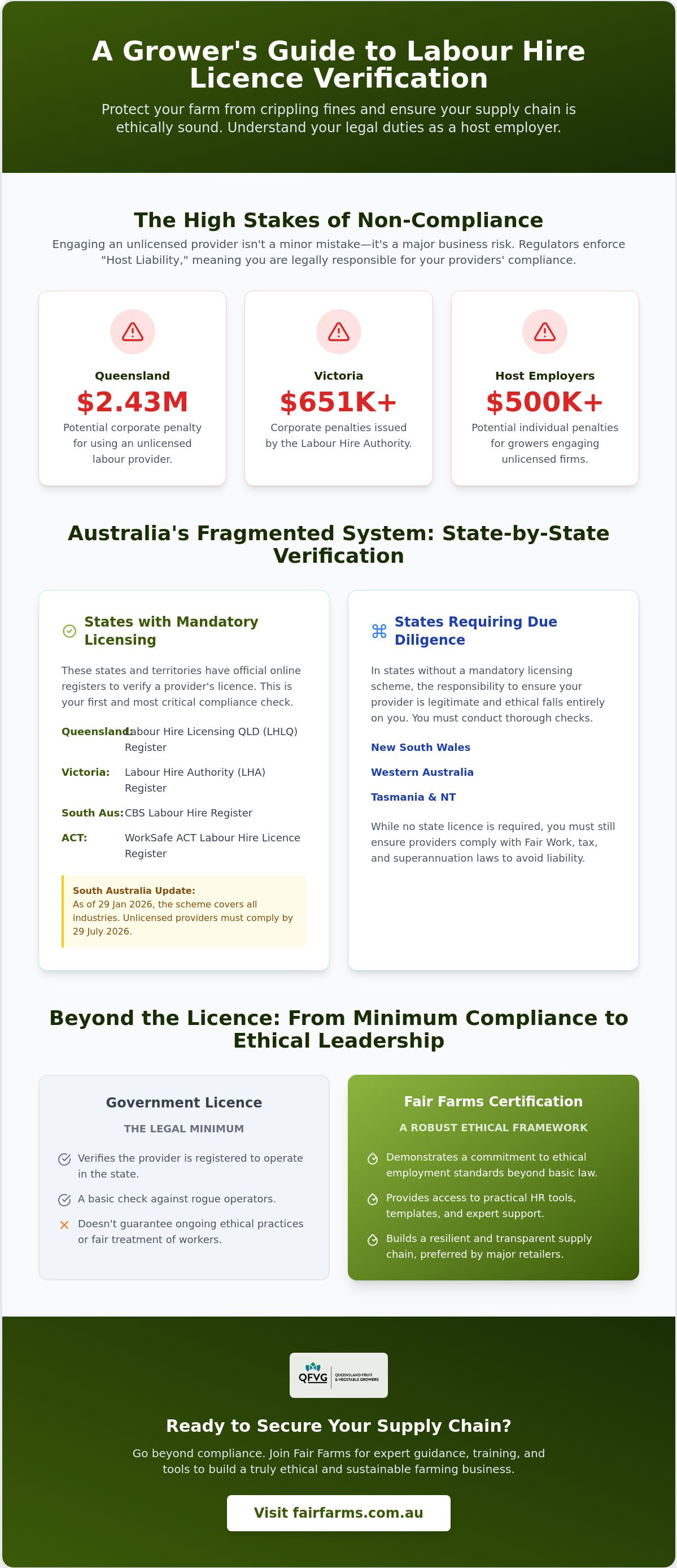
- The significant legal and financial risks of non-compliance, including corporate penalties for host employers that can exceed $500,000.
- A clear, methodical process on how to verify a labour hire license using official government registers across Queensland, Victoria, South Australia, and the ACT.
- The specific due diligence steps required for states like New South Wales and Western Australia where state-based licensing schemes aren't currently in place.
- Why a government licence represents only the minimum legal baseline and how Fair Farms Certification offers a more robust framework for ethical supply chain management.
- How Fair Farms Membership and Online Training can support your business with practical HR tools and professional development to ensure long-term compliance.
Why Verifying a Labour Hire Licence is Non-Negotiable in 2026
In the Australian agricultural sector, the relationship between growers and their workforce has never been under more scrutiny. As a grower, or "host" employer, you have a strict legal obligation to ensure that every labour provider you engage is fully authorised to operate. Understanding what labour hire is and the regulations surrounding it is no longer just a "best practice" exercise. It's a fundamental requirement for business survival. If you are unsure about how to verify a labour hire license, you're leaving your farm exposed to severe consequences that go far beyond a simple administrative error.
The financial stakes are incredibly high. In Queensland, corporations found using unlicensed providers can face penalties of up to $2,430,000. In Victoria, the Labour Hire Authority can issue fines reaching approximately $651,232. Even as the host, you aren't shielded from these repercussions. Host businesses in Queensland and Victoria that engage unlicensed labour hire firms face individual penalties of up to $500,000. These figures represent more than just a line item on a balance sheet; they can be the difference between a thriving enterprise and total closure.
Regulators operate on the principle of "Host Liability." This means you are legally responsible for the compliance of your supply chain, regardless of whether a provider claims they are licensed or "in the process" of applying. Beyond the courtroom, the reputational damage can be permanent. Major Australian retailers and consumers now demand transparency. If worker exploitation or unlicensed labour is discovered on your property, your brand's integrity and your access to premium markets could vanish overnight.
The Legal Framework: State vs National
It is a common misconception that a single national licence exists. Currently, the regulatory landscape is fragmented and managed at a state level. Mandatory licensing schemes are active in Victoria, Queensland, the Australian Capital Territory, and South Australia. In South Australia, the scheme expanded on 29 January 2026 to cover all industries, with a final deadline of 29 July 2026 for previously unlicensed providers to comply. While the federal government continues to discuss a National Labour Hire Scheme to consolidate these rules, growers must currently navigate each jurisdiction individually. Knowing how to verify a labour hire license in each specific state where you operate is essential for cross-border compliance.
Duty of Care and Ethical Responsibility
Verifying a licence is your first line of defence against modern slavery and the exploitation of vulnerable workers. By performing this check, you help eliminate the rogue operators who undercut legitimate businesses and harm the reputation of the entire horticulture sector. Maintaining a clean, verified supply chain is often a prerequisite for securing contracts with major supermarket chains. Host responsibility is a legal safeguard that ensures growers remain accountable for the ethical treatment of the people who harvest their crops.
A National Guide to Labour Hire Registers
While the previous section established the legal gravity of compliance, the practical challenge for many growers lies in the fragmented nature of Australian regulation. Because there is no single federal portal, you must consult the specific register for the state or territory where the work is being performed. Knowing how to verify a labour hire license effectively requires a methodical approach to these different digital databases. Each state has its own nuances, search functions, and reporting styles that can impact your due diligence process.
To maintain a compliant supply chain, you should bookmark the following official registers:
- Queensland: The Labour Hire Licensing Queensland (LHLQ) Register.
- Victoria: The Labour Hire Authority (LHA) Register.
- South Australia: The Consumer and Business Services (CBS) Labour Hire Register.
- Australian Capital Territory: The WorkSafe ACT Labour Hire Licence Register.
For growers operating in South Australia, it is vital to recognise the recent changes. As of 29 January 2026, the scheme now encompasses all industries. If you are engaging providers who were previously exempt, they must be licensed by the 29 July 2026 deadline. If you require more tailored guidance on managing these administrative requirements across different regions, a Fair Farms Membership provides access to expert resources designed specifically for the horticulture sector.
Queensland: Using the LHLQ Portal
The Queensland register is a primary tool for northern growers. When searching, always use the provider’s ABN or full legal name rather than a trading name, as this ensures the most accurate result. The portal clearly distinguishes between "Granted" and "Applied For" statuses. Be cautious: a status of "Applied For" does not always grant the provider the legal right to operate, depending on the specific transitional rules in play. Always look for any conditions or restrictions listed on the licence, such as limitations on the number of workers or specific industry exclusions, which could affect their suitability for your farm.
Victoria: The LHA "Follow" Feature
The Victorian Labour Hire Authority offers a more interactive experience through its "Follow my providers" tool. By creating an account and following your specific contractors, you receive automated email notifications if their licence status changes. This is an excellent way to automate your compliance monitoring. You can also use the portal to view any suspended or cancelled licences. If a provider is currently in the application phase, the register allows for a 14-day window where interested parties can lodge an objection if they have evidence that the provider is not a "fit and proper" person to hold a licence.
Step-by-Step: How to Verify a Provider Correctly
Establishing a rigorous internal protocol is the only way to ensure your business remains compliant. While knowing where to look is important, understanding how to verify a labour hire license with precision is what actually mitigates risk. Before any workers arrive on your property, or even before a contract is signed, you must follow a standardised verification sequence. This process transforms a simple check into a robust legal defence.
Follow these steps for every new provider you engage:
- Request the Data: Ask for the provider’s full legal name, ABN, and Licence Number. Ensure this information is provided in writing.
- Perform the Cross-Reference: Access the relevant state register and enter the ABN. The legal entity name on the register must match the name on your contract exactly. Trading names can be misleading; the ABN is your anchor.
- Verify the Status: Confirm the licence is currently "Active" or "Granted". If a licence is "Expired" or "Under Review", the provider may not have the legal authority to supply labour.
- Check for Conditions: Some licences come with specific restrictions. Read the fine print on the register to ensure the provider is authorised for the specific type of work or volume of workers you require.
- Create an Evidence Trail: Document your search. Take a screenshot of the register result or save the page as a PDF. Store this with your contract as proof of your due diligence.
Common Red Flags to Watch For
Stay alert for providers using an ABN on their invoices that differs from the one listed on their licence. This discrepancy often indicates that the authorised entity is not the one actually receiving payment, which can lead to significant liability issues. Be wary of providers who offer vague excuses when asked for a physical copy of their licence certificate. A legitimate, professional operator will always have their documentation ready. If a licence status appears as "Under Review", proceed with extreme caution and seek direct clarification from the relevant state authority before moving forward.
Ongoing Monitoring Strategies
A one-time check at the start of the season is not enough to protect your business. Licences can be suspended or cancelled at any time due to safety breaches or non-compliance with workplace laws. We recommend implementing a quarterly review process for all active labour hire contracts. This ensures you aren't blindsided by a provider's sudden change in legal status. For growers who find these administrative cycles daunting, a Fair Farms Membership provides the necessary HR support and tools to manage these compliance requirements effectively and with confidence.
Beyond the Licence: Moving Toward Ethical Certification
Understanding how to verify a labour hire license is the first step toward fundamental compliance, but it shouldn't be your final destination. A government licence serves as a permit; it confirms that a provider has met the basic legal criteria to operate within a specific state. It does not, however, offer a deep guarantee that the provider's daily management practices align with the highest ethical standards. For growers who view themselves as industry leaders, the goal is to move beyond the minimum legal threshold toward a culture of genuine social responsibility.
There is a distinct difference between the legal right to operate and the verified practice of ethical employment. While a licence indicates that a provider isn't currently disqualified from the industry, a professional certification demonstrates a proactive commitment to worker welfare and transparent business operations. Major Australian retailers increasingly recognise this distinction. For these stakeholders, a valid state licence combined with an industry-backed certification is the gold standard. This combination provides the assurance they need to keep your produce on their shelves, knowing that the people harvesting it are treated with dignity and equity.
The Fair Farms Certification Pathway
The certification pathway for labour hire providers is designed to bridge the gap between basic licensing and ethical excellence. This journey involves a rigorous self-assessment followed by an independent third-party audit. These audits go deeper than a standard government check, evaluating everything from wage records and safety protocols to the internal culture of the provider. By encouraging your contractors to pursue this pathway, you significantly reduce your own administrative burden. You no longer need to spend hours manually investigating a provider's internal HR health; the certification provides a trusted, independent verification that the work is being done correctly.
Building a Reliable Supply Chain
Partnering with providers who choose to go beyond the legal minimum builds a more resilient and productive farm. Ethical sourcing isn't just about avoiding fines; it directly impacts your bottom line. Providers who treat their staff well typically see higher worker retention rates and improved productivity, which are vital during the high-pressure harvest season. When your workforce feels respected and secure, the quality of their work reflects that stability. Fair Farms provides the comprehensive framework required to achieve this level of supply chain transparency and ethical accountability. Explore the Fair Farms Certification pathway to elevate your supply chain standards.
How Fair Farms Supports Your Compliance Journey
While the technical steps on how to verify a labour hire license provide a necessary legal shield, the ongoing management of a compliant workforce involves constant vigilance. The Australian agricultural landscape is defined by its unique challenges, from seasonal fluctuations to the intricacies of the Horticulture Award. Fair Farms exists to ensure that growers and labour hire providers don't have to navigate these complexities in isolation. We provide a structured environment where ethical responsibility meets practical business support, fostering a community dedicated to long-term industry progress.
Compliance is rarely a one-off event; it's a continuous process of evaluation and improvement. As state regulations evolve and federal oversight increases, having a supportive partner becomes an invaluable asset. Our mission is to move the sector beyond the fear of penalties and toward a culture of integrity and communal success. By bridging the gap between government mandates and on-farm reality, we help you build a business that is not only legally compliant but also ethically resilient.
Accessing Expert HR Support
Our members gain access to dedicated HR support for growers, offering a direct line to experts who understand the regional context of your operations. Whether you're grappling with complex award rates, record-keeping requirements, or workplace relations issues, we provide the clarity required to maintain high standards. This specialised assistance is particularly valuable when cross-referencing state-based licensing rules with federal workplace laws, ensuring no detail is overlooked. For those facing immediate compliance hurdles or seeking specific guidance on their labour arrangements, our Contact page is the primary resource for professional enquiries.
Training Your Team for Success
Education is the cornerstone of a resilient farm. Fair Farms Online Training modules are designed to empower your managers and administrative staff, ensuring they understand the gravity of their legal and ethical obligations. By integrating this training into your business, you build a culture of compliance that protects your brand from the ground up. This proactive approach transforms regulatory hurdles into streamlined professional development, making compliance a natural part of your daily workflow. Taking the next step toward a secure and transparent supply chain is simple; by securing a Fair Farms Membership today, you join a network of principled stakeholders committed to the future of Australian horticulture.
The movement for a fairer Australian horticulture industry depends on the collective commitment of every grower and provider. By combining the rigorous verification of labour hire licences with the comprehensive support of the Fair Farms programme, you position your business at the forefront of industry leadership. Let's work together to ensure your supply chain remains a source of pride and professional stability.
Securing the Future of Your Farm and Workforce
Protecting your farm from significant compliance risks requires more than a casual check. It demands a principled approach to supply chain transparency. You now have the tools to navigate state-specific registers and the practical steps to ensure your documentation is audit-ready. Once you've mastered the process of how to verify a labour hire license, the next logical step is to elevate your business through ethical certification.
As an industry-led initiative by Queensland Fruit & Vegetable Growers (QFVG), Fair Farms is recognised by major Australian retailers as a standard for social responsibility. We offer dedicated HR support for the horticulture sector to help you manage complex workplace relations with quiet confidence. By joining our community, you don't just protect your own interests; you contribute to the collective progress of our regional stakeholders.
Become a Fair Farms Member and Secure Your Supply Chain today. Together, we can ensure the Australian agricultural sector remains a global leader in ethical treatment and professional integrity.
Frequently Asked Questions
Do I need to check the labour hire licence if the provider is from a different state?
Yes, you must verify the licence for the specific state where the work is being performed. A provider based in New South Wales must still hold a valid licence in Queensland or Victoria if they are supplying labour to farms in those jurisdictions. Cross-border operations require a specific licence for every mandated state in which the provider operates.
What happens if I engage a labour hire provider whose licence is later cancelled?
You must cease using their services immediately to avoid breaching host liability laws. If a provider's status changes to "Cancelled" or "Suspended" while they are on your farm, you are legally obligated to stop the engagement. This is why regular monitoring and documenting your search on how to verify a labour hire license is essential for protecting your business from retrospective penalties.
Is a labour hire licence the same as an ABN or business registration?
No, a labour hire licence is a distinct legal permit that is separate from an Australian Business Number (ABN) or general business registration. While an ABN identifies a business for tax purposes, the licence specifically authorises an entity to provide labour hire services. You cannot assume a provider is compliant simply because they have a valid ABN and are registered with ASIC.
How often should I verify the status of my labour hire provider’s licence?
We recommend verifying your provider’s licence status at least once every quarter and before the start of any new harvest season. Because licences can be suspended or cancelled without prior notice to the host employer, a one-off check at the beginning of a contract is insufficient. Using automated tools like the Victorian Labour Hire Authority’s "Follow" feature can help streamline this ongoing oversight.
Can a labour hire provider operate while their licence application is still pending?
This depends on the specific state’s transitional arrangements. In many jurisdictions, a provider cannot legally supply labour until their licence has been officially "Granted". However, during the implementation of new schemes, such as the South Australian expansion in 2026, some providers may operate while their application is pending if they meet specific criteria. Always check the specific register for "Applied For" status rules.
What is the difference between a labour hire licence and Fair Farms Certification?
A labour hire licence is a mandatory legal requirement, whereas Fair Farms Certification is a voluntary, higher-tier verification of ethical practice. While the licence confirms a provider's legal right to operate, our certification involves independent audits to ensure they are meeting rigorous social compliance standards. Achieving both demonstrates a comprehensive commitment to worker welfare and supply chain integrity.
Are there any states in Australia that do not require a labour hire licence?
As of June 2026, New South Wales, Western Australia, Tasmania, and the Northern Territory do not have state-based labour hire licensing schemes. In these regions, the responsibility falls on the grower to conduct thorough due diligence. This includes checking workers' compensation insurance, public liability coverage, and ensuring the provider adheres to the Horticulture Award and federal workplace laws.
How do I report a labour hire provider that I suspect is operating without a licence?
You should report suspected unlicensed activity directly to the relevant state regulator, such as the Labour Hire Authority in Victoria or Labour Hire Licensing Queensland. These organisations provide confidential reporting channels to help protect the integrity of the industry. Reporting rogue operators helps ensure a level playing field for all growers and protects vulnerable workers from potential exploitation.