
Grower and Supply Chain Ethics: A Comprehensive Guide for Australian Horticulture
Your farm's social license is now just as critical to your bottom line as your soil health or your harvest yield. With the criminalisation of intentional underpayment in January 2025 and the upcoming shift to payday superannuation in July 2026, the complexity of grower and supply chain ethics has never been higher for Australian businesses. We understand that keeping up with tighter rules for entry-level classifications and the 68% non-compliance rate often linked to labour hire providers can feel overwhelming. It's a heavy burden to carry when you're simply trying to focus on growing quality produce for the nation.
This guide provides a clear framework for ethical operations to help you protect your business reputation and reduce the risk of modern slavery. You'll learn how to manage these regulatory shifts to ensure you remain a preferred supplier for major retailers. We'll explore the practical steps you can take to foster a fair workplace and build a resilient, compliant supply chain that stands up to the highest standards of industry leadership. By the end of this article, you'll have a roadmap to secure your commercial future while upholding the values of our regional agricultural community.
Key Takeaways
- Transition from voluntary corporate social responsibility to a mandatory due diligence framework that protects your farm's long-term commercial viability.
- Understand why meeting the baseline requirements of the Horticulture Award is often insufficient for satisfying the ethical sourcing standards of major Australian supermarkets.
- Master the core principles of grower and supply chain ethics to move beyond simple compliance and foster a genuine culture of workplace integrity and accountability.
- Learn the specific due diligence questions required to vet labour hire providers and mitigate the risks associated with third-party employment practices.
- Discover how industry-led certification pathways can help you navigate complex regulations while maintaining your reputation as a trusted and preferred supplier.
Defining Grower and Supply Chain Ethics in 2026
In 2026, the definition of grower and supply chain ethics has moved far beyond the simple act of "doing the right thing." It's now a structured, transparent management system that covers labour standards, worker safety, and environmental impact. For the Australian horticulture sector, the era of voluntary corporate social responsibility is over. It's been replaced by a rigorous mandatory due diligence framework. Growers aren't just responsible for their own actions. They're now held accountable for the conduct of their contractors and labour hire providers too. This isn't just about avoiding trouble; it's about building a business that lasts.
This shift is driven by a need for total visibility. Retailers and consumers now demand to see the journey of produce from the farm gate right through to the supermarket shelf. They want proof that the food they buy hasn't been touched by exploitation or environmental neglect. Maintaining your "social license" in this environment means earning the trust of the community every single day. Without this trust, a business risks losing its status as a preferred supplier. It doesn't matter how high your quality is if your ethics are in question. Trust is the new currency of the supply chain.
The Three Pillars of Ethical Horticulture
To build a resilient operation, growers must focus on three interconnected areas of responsibility that form the foundation of a modern farm:
- Social Responsibility: This ensures fair treatment, lawful pay, and a safe working environment for every person on site. It involves strict adherence to the Horticulture Award and the Fair Work Act to protect the human rights of both local and seasonal workers.
- Environmental Stewardship: Ethical operations prioritise supply chain sustainability through responsible land use and resource management. This pillar ensures that today's harvest doesn't come at the expense of tomorrow's soil health or water security.
- Governance: This is about transparency and accountability in all business dealings. It requires clear Horticulture Produce Agreements (HPAs) and honest relationships with all supply chain participants to prevent corruption or unfair trading.
Why Ethics Matters to Modern Consumers
Australia is seeing a significant rise in the "conscious consumer." These shoppers aren't just looking at the price per kilo. They're looking at the story behind the brand. A single ethical lapse on one farm can quickly go viral, causing widespread brand damage and tarnishing the reputation of the entire Australian horticulture industry. Supply chain ethics is the collective responsibility of all participants to uphold human rights.
When a business invests in ethical practices, they're doing more than just avoiding legal trouble. They're positioning themselves as leaders in a competitive market. It's about showing that you value your workers and your land. This builds a loyal customer base that trusts your produce. It's a practical, hardworking approach to long-term success. By being transparent, you aren't just ticking a box; you're securing your future.
The Australian Regulatory Landscape: Beyond the Basics
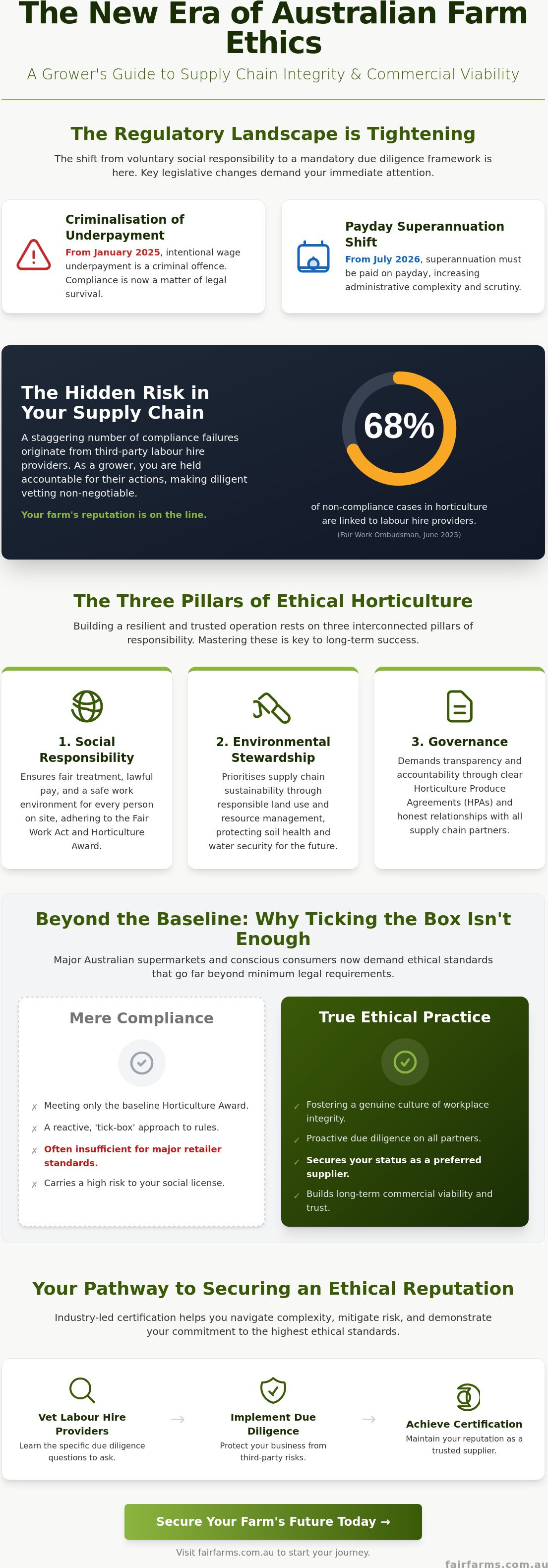
While the concept of grower and supply chain ethics might feel like a moral choice, it's firmly anchored in Australian law. The Fair Work Act 2009 serves as the non-negotiable baseline for every farm business. It sets out the minimum standards that protect both your workers and your professional reputation. In 2026, the regulatory environment is tighter than ever. Intentional underpayment became a criminal offence in January 2025, meaning that compliance is now a matter of legal survival. You simply can't afford to get this wrong.
State-based labour hire licensing schemes also play a vital role in this landscape. These laws mean you're essentially responsible for the ethics of your contractors. If a labour hire provider fails to pay their workers correctly, the shadow falls directly on your farm. A June 2025 report from the Fair Work Ombudsman highlighted that 68% of non-compliance cases in our sector were linked to these third-party providers. This makes vetting your partners a critical part of your daily operational due diligence.
Fair Work and the Horticulture Award
The Horticulture Award [MA000028] is the heartbeat of fair pay in our industry. As of July 1, 2025, the minimum hourly rate for a Level 1 casual adult employee is $30.35. Since April 1, 2025, you must also remember that employees can only remain at Level 1 for a maximum of three months before they must be progressed to a higher classification. Managing piece rates correctly is equally vital; they must be applied in a way that ensures every worker earns at least the minimum hourly rate. Robust record-keeping isn't just paperwork. It's your primary evidence that you treat people with dignity and fairness. If you're finding these changes difficult to track, seeking tailored HR support can provide the clarity your business needs.
Addressing Modern Slavery Risks
The Modern Slavery Act 2018 requires medium-to-large growers to look deep into their operations to find and fix potential exploitation. It's not just a concern for global corporations. Red flags often hide in multi-tiered supply chains where visibility is naturally lower. These might include workers having their passports withheld or being forced to live in substandard, overcrowded accommodation. Fair Farms members use specialised tools and online training to spot these risks early. By shining a light on every corner of your supply chain, you protect your workers and ensure your business remains a trusted partner for major retailers.
Ethics vs. Compliance: Why Ticking the Box Isn’t Enough
Many businesses confuse compliance with ethics. While compliance means meeting the minimum legal requirements, true grower and supply chain ethics involves a proactive commitment to the well-being of every person in your operation. In the current climate, simply avoiding a fine isn't enough to secure your future. Legal minimums are the floor, not the ceiling. If your business only aims for the bare minimum, you'll constantly be playing catch-up as regulations and buyer expectations evolve. Real leadership means looking beyond the paperwork to the people who make your harvest possible.
Major Australian retailers like Coles, Woolworths, Aldi, and Metcash have moved beyond basic legal standards. They now expect their suppliers to demonstrate a higher level of social license. This is why programs that focus on ethical best practices have become de facto mandatory for anyone wanting to stay on the shelves. Failing to meet these higher bars doesn't just lead to penalties. It can lead to an immediate loss of market access. When a major supermarket pulls a contract due to ethical concerns, the financial damage far outweighs any government fine. You aren't just protecting your workers; you're protecting your right to trade.
Retailer Expectations and Audit Culture
Maintaining "preferred supplier" status in 2026 requires more than just high-quality fruit or veg. It requires a transparent, audit-ready business model. By embedding ethical standards into your daily routines, you remove the stress of last-minute fixes before a social compliance audit. This readiness signals to buyers that you're a reliable, low-risk partner. Over time, this reputation for integrity can lead to better contract stability and even stronger farm-gate prices, as buyers look to de-risk their own supply chains. It's about being the grower that retailers can't afford to lose.
The ROI of Ethical Employment
Investing in your people pays dividends that go straight to your bottom line. When workers feel respected and are paid correctly under the Horticulture Award, they're far more likely to return next season. This drastically reduces your recruitment and training costs. A motivated workforce is also a more productive one; people work harder and take more care when they know their employer has their back. Ethical treatment is a proven driver of long-term farm profitability. By building a reputation as a fair boss, you'll naturally attract the best seasonal staff in a competitive labour market. It's a practical, hardworking strategy for success.
Practical Steps to Ethical Supply Chain Management
Moving from theory to practice requires a clear-eyed look at your current operations. Start with an internal audit of your HR systems and workplace culture. Are your records up to date? Do your employees feel comfortable raising concerns? This self-reflection is the first step in mastering grower and supply chain ethics. It's not about catching yourself out; it's about identifying gaps before they become liabilities. A proactive approach helps you build a more resilient business that can withstand the scrutiny of retailers and regulators alike.
Ethical leadership starts at the top but must be practiced by everyone in a management role. Training your supervisors in conflict resolution and ethical decision-making ensures that your farm's values are upheld even when you aren't there. It's also vital to regularly review all supply chain partners. Ethics isn't a "set and forget" task. It requires ongoing commitment and a willingness to walk away from partnerships that don't align with your standards of integrity.
Vetting Your Labour Hire Partners
With 68% of non-compliance cases in our sector linked to labour hire providers, your due diligence must be thorough. Checking a labour hire licence is only the beginning. You should request evidence of historical compliance and sample pay records to ensure they're meeting the Horticulture Award requirements. It's also wise to conduct your own informal audits by talking directly to on-hired workers about their experience on your property. Ensure your contracts include explicit clauses regarding ethical standards and safety protocols. If a provider is hesitant to share their records, consider it a significant red flag for your business.
Worker Empowerment and Grievance Mechanisms
A fair workplace relies on open communication. Providing multi-lingual induction materials ensures that a diverse workforce understands their rights and your expectations from day one. Establishing safe, anonymous feedback loops or whistleblower protections allows workers to report issues without fear of reprisal. This isn't just about compliance; it's about respect and the Australian "fair go." When staff recognise their rights through structured training, they're more likely to feel valued and perform better. To help your team build this foundation of knowledge, you can access Fair Farms Online Training to ensure everyone is on the same page regarding best-practice standards.
The Fair Farms Pathway: Securing Your Ethical Reputation
Managing the evolving landscape of grower and supply chain ethics doesn't have to be a solitary struggle. Fair Farms acts as the vital bridge between the daily realities of farm management and the rigorous expectations of Australia's major retailers. By providing a structured, supportive environment, we help you transform complex regulatory requirements into manageable business processes. This isn't about top-down enforcement; it's about an industry-led initiative that understands the unique pressures of the regional landscape. We're here to ensure your commitment to integrity is recognised and rewarded by your customers and the wider community.
Moving from a standard membership to full certification is a logical progression for any business prioritising long-term stability. While membership provides the essential tools and initial framework, certification offers the definitive proof of your ethical standards. It's a clear signal to the entire supply chain that your operation is built on a foundation of fairness and accountability. Along this journey, you can access dedicated HR support to help you navigate the nuances of workplace relations. This ensures your employment practices remain both compliant and principled, even as laws change.
The Certification Journey
The Fair Farms certification pathway is designed to be a clear, methodical progression rather than a confusing obstacle. It begins with a comprehensive self-assessment to identify where your systems currently stand. From there, our online training modules simplify complex legal obligations into practical, actionable steps. Once you've refined your processes, a third-party audit verifies your compliance, leading to full certification. Displaying the Fair Farms mark in the Australian marketplace provides an immediate boost to your reputation. It shows buyers you're a leader in ethical horticulture.
Joining the Community of Ethical Growers
Becoming part of Fair Farms means joining a dedicated community of like-minded businesses committed to communal progress. You'll have the opportunity to network with other growers and labour hire providers to share best practices and solve common challenges. Our regular industry updates keep you ahead of legislative changes, such as the upcoming payday superannuation requirements, so you're never caught off guard. It's a practical way to stay informed while building a more resilient sector. Ready to lead the way? Contact Fair Farms today to start your ethical journey.
Securing the Future of Your Farm Business
Building a resilient business in the modern horticulture sector requires a shift from passive compliance to active leadership. By integrating grower and supply chain ethics into your daily operations, you're doing more than just meeting legal requirements; you're securing your social license and protecting your farm's commercial future. We've seen how vetting your partners and empowering your workforce creates a culture of integrity that naturally attracts the best seasonal staff. This journey is best taken with a partner who understands the unique challenges of the Australian regional landscape.
Fair Farms is an industry-led initiative developed by Queensland Fruit & Vegetable Growers (QFVG). Supported by Federal Government funding and recognised by major Australian retailers, the program offers a steady and reliable framework for all participants. It's a practical, hardworking path toward a more equitable and profitable future for everyone involved in the supply chain. Join Fair Farms and lead the industry in ethical horticulture to ensure your business remains a trusted cornerstone of our agricultural community. Together, we can build a transparent industry that every Australian grower can be proud of.
Frequently Asked Questions
What is the difference between social compliance and ethical sourcing?
Social compliance is the process of meeting specific legal and regulatory standards such as pay rates and safety laws. Ethical sourcing is a broader, proactive commitment to human rights and environmental values across the entire journey of a product. While compliance is often about ticking a box to meet a minimum requirement, ethical sourcing is a strategic choice to ensure all participants are treated with dignity and respect.
Does the Modern Slavery Act apply to small family farms in Australia?
The mandatory reporting requirements of the Modern Slavery Act apply to entities with a consolidated revenue of at least $100 million. However, smaller farms are frequently required to provide ethical information to their larger retail customers who are legally obligated to report. This means even small operations must understand their role in grower and supply chain ethics to maintain their market access.
How can I prove to my retail buyers that my labour hire is ethical?
You can demonstrate ethical practices by maintaining clear records of your contractor vetting and due diligence processes. Retailers typically look for evidence such as valid labour hire licences, proof of correct pay under the Horticulture Award, and participation in industry-led certification programmes. Providing this documentation shows buyers that you're a low-risk partner with a transparent and accountable operation.
What are the most common ethical risks in the horticulture supply chain?
The most frequent risks involve the underpayment of wages, inadequate worker accommodation, and a lack of transparency in multi-tiered labour hire arrangements. These issues often occur when there's a breakdown in communication or oversight between a farm and its contractors. Without robust management systems, these gaps can lead to significant legal breaches and long-term damage to your professional reputation.
How does Fair Farms certification differ from a standard financial audit?
A financial audit focuses on your accounts, while Fair Farms certification evaluates your social and ethical management systems. It examines how you treat your people, your safety protocols, and your overall workplace culture. This process ensures you aren't just meeting your financial obligations but are also upholding the human rights and well-being of every worker on your property.
Can ethical practices actually help with seasonal labour shortages?
A reputation for fair treatment is one of the most effective recruitment tools in a competitive market. Workers are far more likely to return to a farm where they feel respected, safe, and are paid correctly for their hard work. Reducing staff turnover through ethical employment lowers your training costs and ensures you have a more experienced, reliable workforce ready for each harvest season.
What happens if an ethical breach is discovered in my supply chain?
If a breach is identified, you should document the issue immediately and take practical steps to remediate the harm to the affected workers. This might include ensuring back-pay is settled or terminating a contract with a non-compliant labour hire provider. Taking swift, transparent action is essential to protecting your social license and proving to retailers that you're committed to high standards.
How much time does it take to implement an ethical management system?
The timeframe depends on your current HR systems, but many growers find they can establish a solid foundation within several months. It's a steady, methodical process of updating induction materials, training supervisors, and refining your record-keeping. Using structured online training modules helps you break the work into manageable steps that can be completed around the busy demands of your seasonal harvest schedule.