
Agricultural Supply Chain Transparency: The 2026 Guide for Australian Horticulture
In 2026, agricultural supply chain transparency isn't just a technological milestone; it's your social licence to operate in the Australian horticulture sector. With the independent review of the Horticulture Code of Conduct delivering its recommendations mid-year and corporate penalties for breaches reaching up to $99,000, the stakes for growers have never been higher. You're likely feeling the weight of increasing red tape and the constant pressure to monitor every third-party labour hire provider to avoid being delisted by major supermarkets. It's a heavy burden for any primary producer to carry alone while trying to manage a productive farm.
We understand that you want to focus on growing quality produce rather than getting lost in administrative paperwork. This guide explains how embracing transparency protects your farm’s reputation, ensures ethical compliance, and secures your long-term retail market access. You'll discover a streamlined approach to demonstrating ethical standards and protecting your business against modern slavery risks. We will walk you through the latest ACCC recommendations, the role of emerging technologies like blockchain, and the practical steps you can take to remain a trusted partner in the Australian horticulture market as it grows toward a projected USD 33.4 billion by 2034.
Key Takeaways
- Understand the vital distinction between simple product traceability and process-driven transparency to ensure your farm meets the highest integrity standards.
- Learn why agricultural supply chain transparency is now centred on the human element and how to effectively monitor labour hire providers to mitigate ethical risks.
- Gain a clear understanding of what major Australian retailers require from your compliance reporting to secure long-term market access and meet Modern Slavery Act obligations.
- Discover a step-by-step approach to conducting HR gap analyses and performing due diligence on third-party contractors to simplify your administrative workload.
- Explore how the Fair Farms program provides an industry-led pathway to demonstrate ethical commitment and protect your farm's social licence.
What is Agricultural Supply Chain Transparency in the Australian Context?
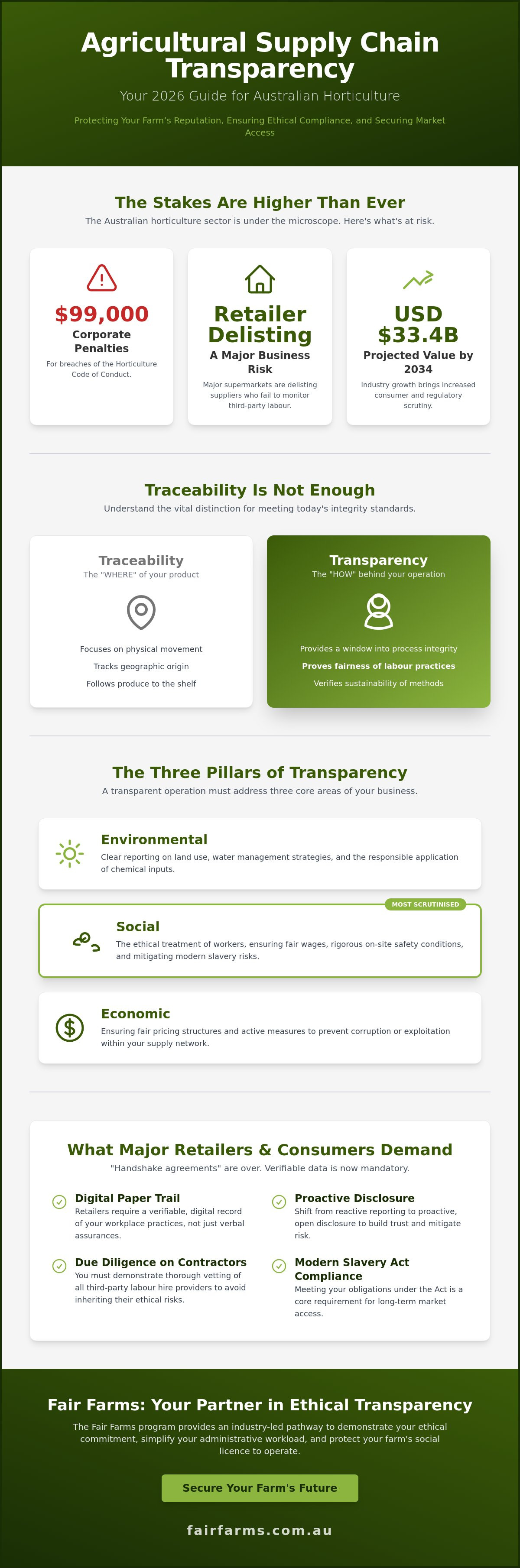
Understanding agricultural supply chain transparency requires looking beyond the physical movement of goods. It encompasses total visibility across every stage of the agricultural value chain, tracking the journey of produce from the initial seed right through to the supermarket shelf. While many in the industry use the terms interchangeably, there is a vital distinction between traceability and transparency. Traceability is focused on the "where" of a product, such as its geographic origin and movement. Transparency, however, is focused on the "how". It provides a window into the integrity of your processes, the fairness of your labour practices, and the sustainability of your farming methods.
For Australian horticulture, 2026 represents a definitive turning point. With the market projected to grow at a rate of 5.75% annually toward a value of USD 33.4 billion by 2034, the industry is under a microscope. Consumers and retailers no longer take "quality" at face value. They demand data that proves your farm meets the "Fair Go" standard that Australians value. Achieving true agricultural supply chain transparency involves moving away from anecdotal evidence and toward verifiable data that secures your social licence to operate.
The Three Pillars of Transparency
To build a transparent operation, you must address three specific areas of your business:
- Environmental: This involves clear reporting on land use, water management strategies, and the responsible application of chemical inputs.
- Social: This is the most scrutinised pillar in 2026. It covers the ethical treatment of your workers, ensuring fair wages, and maintaining rigorous safety conditions on-site.
- Economic: This ensures fair pricing structures and active measures to prevent corruption or exploitation within your specific supply network.
Why "Good Enough" is No Longer Enough
The days of relying on informal "handshake" agreements with contractors are over. In a regulatory environment where corporations face penalties of up to $99,000 for breaches of the Horticulture Code of Conduct, documentation is your best defence. Modern retailers like Coles and Woolworths require more than just a verbal assurance of compliance; they need a digital paper trail. Transparency is a commitment to open disclosure of workplace practices.
By shifting from reactive reporting to proactive disclosure, you transform transparency into a powerful risk mitigation tool. It protects your agribusiness from the reputational damage associated with hidden labour exploitation. For growers looking to formalise this process, becoming Fair Farms members provides a structured way to transition from informal practices to a robust, documented system of process integrity.
Beyond Traceability: The Human Element of Your Supply Chain
While the National Agricultural Traceability Strategy provides a vital framework for tracking the physical movement of produce, it's the "who" and "how" of labour that defines modern agricultural supply chain transparency. In 2026, the human element is the most scrutinised link in the Australian horticulture sector. It's no longer enough to prove where a pallet of berries originated. Retailers and consumers now demand proof that the people who picked and packed that fruit were treated with dignity and paid according to the law.
Managing this visibility becomes significantly more complex when your farm relies on third-party labour hire providers. If these contractors operate in the shadows, your business inherits their risks. Ethical employment practices do more than just tick a compliance box; they build a more resilient, loyal, and productive workforce. By demanding total transparency from your partners, you create a robust barrier against the risks of modern slavery, ensuring your farm remains a safe and sustainable part of the industry.
The Risks of Opaque Labour Practices
Opaque labour practices are a ticking time bomb for farm brand value. Underpayment scandals can lead to immediate delisting by major supermarkets, a blow from which many agribusinesses never fully recover. Beyond the reputational damage, the legal ramifications of non-compliance with the Fair Work Act are severe. In the current regulatory climate, "not knowing" about a contractor's wage theft is no longer a valid legal or ethical defence. You're expected to have oversight of your entire workforce, regardless of who signs the paycheques.
Transparency as a Competitive Advantage
Fostering a transparent and respectful culture is one of the most effective ways to attract high-quality seasonal workers. Word travels fast in regional communities. Workers naturally gravitate toward farms with a reputation for fairness and open communication. This reduces staff turnover and the constant need for retraining, which directly improves your bottom line. Signalling this commitment to the market is essential for staying ahead of the curve.
Taking the first step toward total visibility doesn't have to be a solo journey. You can strengthen your oversight by utilising Supply Chain Membership, which provides a structured way to monitor and vet your labour partners. For growers looking to simplify this process, accessing professional compliance resources can help you turn transparency into a long-term business asset rather than a hurdle.
Retailer Expectations and the Modern Slavery Act
Compliance is no longer a side-desk task for Australian growers; it's a non-negotiable condition of trade. The Modern Slavery Act 2018 (Cth) has fundamentally altered the relationship between primary producers and the major retailers. While the Act specifically mandates reporting for businesses with an annual consolidated revenue of more than $100 million, its practical effects trickle down to every farm in the country. To meet their own reporting obligations, supermarkets must ensure their entire agricultural supply chain transparency is beyond reproach. The Modern Slavery Act requires businesses to identify and address risks in their operations. This means if you want your produce on the shelves of Coles, Woolworths, or Aldi, you must be prepared to prove your ethical standing with granular data.
This regulatory shift acts as a shield for your agribusiness. By maintaining high standards of visibility, you protect your farm from being found "guilty by association" if a partner or subcontractor further down the chain is found to be acting unethically. Transparency ensures that your reputation remains intact, even when the broader industry faces scrutiny. It's about moving from a reactive stance to a proactive position of leadership.
Meeting Supermarket Standards
Major retailers are rapidly moving toward a zero-tolerance policy for opaque supply chains. In the past, a signed declaration of compliance might have been enough to satisfy a buyer. Today, third-party social audits have become a mandatory prerequisite for supply. These audits scrutinise everything from payslips and tax records to accommodation standards and workplace safety. Maintaining a clear paper trail isn't just about passing an inspection. It's about documenting your daily commitment to fairness. Retailers now prioritise suppliers who can provide real-time evidence of their ethical practices, making a robust documentation system a vital business asset.
Mitigating Modern Slavery Risks
Identifying red flags in your operations is a critical skill for the modern farm manager. This is particularly vital when dealing with subcontractors who provide "all-in" quotes that seem too good to be true. If a labour hire rate doesn't allow for the Horticulture Award minimums plus a reasonable margin, it's a major warning sign of potential exploitation. Effective agricultural supply chain transparency relies on continuous monitoring rather than a "once-a-year" audit. Regularly checking time-and-attendance records and speaking directly with workers helps ensure that your site remains a safe, compliant environment. For growers looking to formalise these checks, Fair Farms Certification provides a recognised framework that satisfies the social compliance requirements of most major Australian retailers.
Practical Steps to Improve Transparency on Your Farm
Improving agricultural supply chain transparency starts with a clear-eyed assessment of your own internal systems. You can't manage what you don't measure, and for most growers, this begins with a thorough gap analysis of HR and payroll records. It's essential to ensure every worker has a valid contract and that piece rates or hourly wages align strictly with the latest Horticulture Award requirements. This internal review identifies vulnerabilities before they become liabilities during an external audit.
Vetting your labour hire providers is the next critical step. This isn't just about checking a licence; it's about a formalised due diligence process. Ask for proof of workers' compensation insurance and evidence of their payroll compliance. Training your supervisors is equally vital. They are your front line on the farm. If they understand the ethical standards you've set, they can help maintain the transparency required to protect your farm's reputation.
Digital Tools for the Modern Grower
Moving beyond manual spreadsheets is no longer just a convenience; it's a necessity for remaining audit-ready. Dedicated HR and compliance software allows you to record data in real-time, which significantly reduces the stress of a surprise site visit. These tools help you organise records while ensuring data privacy for your workers. When your records are centralised and digital, sharing necessary transparency data with retail partners becomes a seamless task rather than a week-long administrative headache.
The Certification Pathway
Formal recognition is the most efficient way to prove your commitment to ethical standards. Following a structured Fair Farms certification pathway allows you to move through the process methodically, from initial training to a completed audit. This certification isn't just a badge; it's a marketing tool. It signals to premium buyers that your produce is backed by a transparent and ethical supply chain. This distinction often makes the difference when competing for lucrative retail contracts.
Ready to formalise your commitment? You can access Fair Farms Online Training to begin identifying the specific steps needed for your farm's unique situation.
Fair Farms: Your Partner in Ethical Transparency
Navigating the landscape of social compliance doesn't have to be a solitary struggle for Australian growers. Fair Farms was established to bridge the gap between complex regulatory requirements and the practical realities of life on the land. By adopting a "by industry, for industry" approach, we ensure that the path toward agricultural supply chain transparency is both achievable and sustainable. We act as a principled mentor, guiding you through the intricacies of the Horticulture Award and retailer expectations with quiet confidence. Our mission is to foster a culture of integrity that benefits everyone from the farm gate to the dinner table.
Joining this movement connects you with a community of like-minded agribusinesses. These are producers who recognise that ethical treatment and transparency are the foundations of a modern, profitable sector. We provide the technical weight and professional oversight needed to turn compliance from a burden into a point of pride. This collective commitment strengthens the entire regional landscape, ensuring that the Australian "Fair Go" remains a visible part of our global brand.
Membership Benefits for Growers
A Membership for Growers provides more than just a certificate; it offers a suite of practical tools designed for the regional landscape. Members gain access to Fair Farms Online Training modules that break down complex workplace laws into manageable, instructional steps. This training ensures your management team is aligned with national standards before an audit ever takes place. Key benefits include:
- Educational Resources: Online modules that simplify the complexities of Australian workplace relations.
- Audit Preparation: Dedicated support to help you organise your records and meet the requirements for Fair Farms Certification.
- Brand Recognition: The right to use a nationally recognised ethical brand that signals your commitment to retailers.
- Specialised HR Support: Access to HR Support for Growers to help you manage contracts, payroll queries, and labour hire vetting.
Securing the Future of Australian Horticulture
Beyond the individual farm, Fair Farms plays a vital role in protecting the reputation of the entire sector. We advocate for growers at a national level, ensuring that the unique challenges of seasonal labour and regional production are understood by policymakers. Our long-term goal is a transparent, profitable, and respected industry that can confidently meet the demands of a market projected to reach USD 33.4 billion by 2034. By participating in this programme, you contribute to a collective effort that secures the future of Australian farming. It's about building an industry where equitable treatment is the norm and where every participant is valued.
Ready to lead the way? Become a Fair Farms Member today.
Securing the Future of Your Agribusiness
The landscape of Australian horticulture is shifting toward a model where integrity is as valuable as yield. Embracing agricultural supply chain transparency isn't just about meeting the requirements of the Modern Slavery Act or satisfying supermarket audits. It's about building a resilient operation that attracts quality workers and protects your farm's hard-earned reputation. By moving from informal agreements to documented, digital systems, you ensure your business remains a preferred partner for major retailers as the market continues to evolve.
Fair Farms is here to support you in this transition. Developed by the Queensland Fruit & Vegetable Growers (QFVG) and supported by Federal Government funding, our program is designed by the industry for the industry. Our standards are recognised by major Australian retailers, providing you with a clear, trusted pathway to demonstrate social compliance without the guesswork. You don't have to navigate these regulatory complexities alone. We invite you to Join Fair Farms to secure your supply chain transparency and become part of a community dedicated to equitable treatment and long-term profitability. Together, we can ensure the Australian horticulture sector remains a global leader in ethical production.
Frequently Asked Questions
What is the difference between traceability and transparency in agriculture?
Traceability focuses on the physical movement of a product, identifying its location at any given time. Transparency goes deeper by revealing the integrity of the processes used to grow and harvest that product. While traceability tells a retailer where a punnet of strawberries originated, transparency provides the verifiable proof that the workers involved were treated ethically and paid according to Australian standards.
How does the Modern Slavery Act affect small Australian farms?
Even if your farm doesn't meet the $100 million revenue threshold for mandatory reporting, you're still impacted by the ripple effects of the legislation. Major retailers who must report under the Act require granular data from their entire supply chain to satisfy their own legal obligations. Maintaining high levels of agricultural supply chain transparency is therefore essential for any grower wishing to secure and keep access to major supermarket contracts.
Why are supermarkets demanding social compliance audits now?
Supermarkets are responding to intense consumer and regulatory pressure regarding ethical sourcing and corporate responsibility. They require social compliance audits to mitigate the risk of being associated with labour exploitation or hidden modern slavery. These audits provide a standardised, independent way for retailers to verify that their suppliers are adhering to the Fair Work Act and other essential workplace safety standards.
Can I be held responsible for the practices of my labour hire provider?
You can be held legally and reputationally accountable for the actions of third-party labour hire providers on your site. Under Australian law, businesses can be found liable for accessorial liability if they're involved in a contractor's breach of workplace laws. Proactive monitoring and formal due diligence are the only ways to protect your agribusiness from the fallout of a subcontractor's unethical practices.
How much does it cost to implement a transparency program on my farm?
Implementation costs are an investment in your farm's long-term market access and risk management strategy. While there are costs associated with membership, training, and potential digital system upgrades, these are often offset by the reduced risk of being delisted by buyers or facing legal penalties. Every farm is different; we suggest starting with an internal gap analysis to identify exactly what your specific operation requires.
What are the first steps to getting Fair Farms certified?
The process begins with becoming a member and engaging with our specialized educational resources. Your first practical step is to complete the Fair Farms Online Training, which helps you understand the requirements of the Fair Farms Standard. From there, you'll conduct a self-assessment to identify any gaps in your current HR and payroll systems before proceeding to a formal, independent audit.
Is transparency only about wages, or does it include safety too?
Transparency is a holistic concept that covers every aspect of worker welfare and site management. While fair wages and correct award rates are central, agricultural supply chain transparency also encompasses workplace health and safety, adequate accommodation, and the prevention of discrimination. It's about providing a complete and honest picture of the working environment to ensure every participant is treated with dignity.
How does supply chain transparency help me attract more workers?
A reputation for transparency makes your farm a far more attractive workplace for both seasonal and permanent staff. Workers naturally gravitate toward employers who provide clear contracts, transparent pay structures, and a safe, respectful environment. In a competitive labour market, being known as an ethical and open employer is a significant advantage that reduces staff turnover and long-term recruitment stress.