
Farm Payroll Compliance Australia: A Guide to Software and Standards in 2026
In 2026, a paper diary and a handshake are no longer enough to protect your farm from a rigorous Fair Work audit. With the commencement of Payday Super and the legislated 12% superannuation guarantee, managing farm payroll compliance Australia has evolved from a back-office chore into a critical pillar of your business's ethical reputation. You likely feel the mounting pressure of the Horticulture Award's complexity, especially when balancing piece rate calculations against the genuine fear of accidental wage theft penalties that now carry heavy consequences.
We believe that your time is best spent on the land, not buried in manual record-keeping. This guide will help you master these regulatory shifts, showing you how to choose software that automates the heavy lifting and ensures you meet the latest 2026 standards with quiet confidence. We'll explore the transition to real-time reporting, the essential requirements for Fair Farms certification, and how to streamline seasonal worker onboarding to keep your retail supply contracts secure and your workforce respected.
Key Takeaways
- Prepare for the 1 July 2026 "Payday Super" mandate by ensuring your internal systems can handle real-time superannuation contributions alongside wage payments.
- Discover how to select specialised tools that automate farm payroll compliance Australia and STP Phase 2 requirements, moving beyond the limitations of generic accounting software.
- Eliminate the risk of accidental wage theft by implementing digital record-keeping systems that accurately document casual loading and piecework rates.
- Take a proactive approach to audit readiness by conducting a payroll health check and correctly mapping your workforce to Horticulture Award classifications.
- Learn how Fair Farms membership and professional HR support provide the ethical framework and data trail needed to protect your retail supply contracts.
Navigating Farm Payroll Compliance in Australia: The 2026 Regulatory Landscape
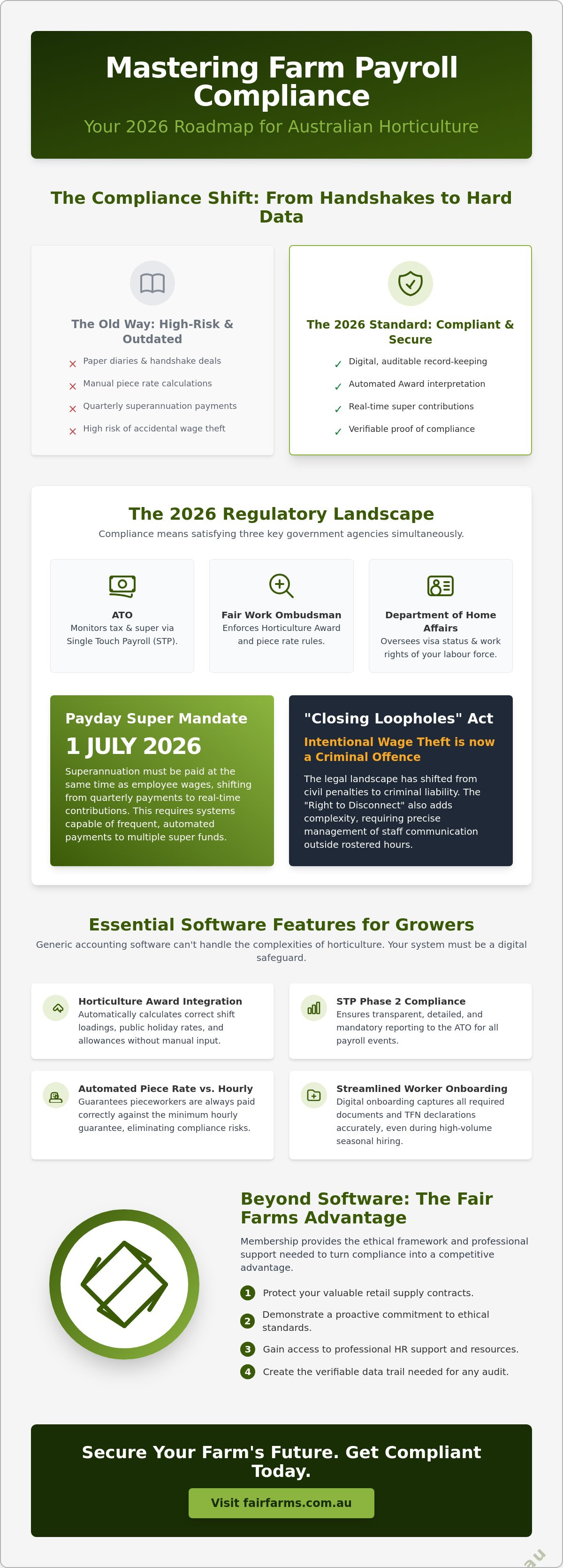
Compliance is a multifaceted obligation involving three major regulators. The Australian Taxation Office (ATO) monitors your tax and superannuation reporting through Single Touch Payroll. The Fair Work Ombudsman (FWO) ensures you follow the Horticulture Award and piece rate regulations. Finally, the Department of Home Affairs oversees the visa status and work rights of your seasonal labour force. Achieving farm payroll compliance Australia requires a system that satisfies all three agencies simultaneously. It's no longer just about the numbers; it's about the verifiable integrity of your entire employment process.
The FWO prioritises the agricultural sector because of its reliance on seasonal workers. With over $500 million in unpaid wages recovered in recent years, the message from the government is clear. Regulators are investing heavily in enforcement and data matching. This scrutiny isn't just about finding big companies to fine. It's about cleaning up the entire supply chain to ensure local farms remain competitive and ethical. For growers, this means moving away from informal arrangements toward a professionalised, software-backed approach to payroll management.
The 2026 Payday Super Transition
From 1 July 2026, the Payday Super legislation fundamentally changes how you manage your farm's cash flow. Instead of making quarterly payments, you'll be required to pay superannuation at the same time you pay employee wages. This shift is a significant hurdle during peak harvest periods when labour costs are at their highest. Relying on manual spreadsheets for a crew of fifty seasonal workers is now a high-risk strategy that invites error and ATO intervention. To maintain compliance, your systems must be capable of real-time reporting and frequent, automated payments to multiple super funds.
Criminal Penalties and the "Closing Loopholes" Act
The legal landscape has shifted from civil penalties to criminal liability for intentional wage theft. Under the Closing Loopholes Act, the consequences of getting it wrong have never been higher. Within the broader framework of Australian labour law, growers must also navigate the "Right to Disconnect" and evolving worker classifications. These changes mean you must be precise about when and how you communicate with your staff outside of rostered hours. Maintaining "reasonable steps" through structured membership and consistent training is your best defence against these rising legal risks. It demonstrates a proactive commitment to ethical standards that can protect your business if an accidental error is ever questioned.
Selecting the Best Farm Payroll Software: Essential Features for Growers
Generic accounting software often struggles with the unique pressures of the Australian agricultural sector. While a standard platform might manage a small, stable team, it frequently lacks the specialised logic required to automate the Horticulture Award. To achieve robust farm payroll compliance Australia, your chosen system must do more than just process payments. It needs to act as a digital safeguard, ensuring that every casual loading, overtime rate, and allowance is applied correctly without manual intervention. This is particularly vital given the high-volume nature of seasonal work, where onboarding dozens of new employees in a single morning can lead to data entry errors if your systems aren't designed for speed and accuracy.
Any modern payroll tool must be fully STP Phase 2 compliant. This isn't just a recommendation; it's a requirement for transparent reporting to the ATO. Beyond basic tax obligations, the best software for growers integrates seamlessly with harvest management apps and electronic time-tracking. This connectivity ensures that the data flowing from the paddock to the payroll office is clean, verifiable, and ready for an audit. When your payroll system talks to your harvest scales, you eliminate the "he-said, she-said" disputes that can damage workplace culture and trigger regulatory interest.
Horticulture Award Integration
Your software should come pre-loaded with the Horticulture Award's specific rules. This includes the automatic calculation of shift loadings, public holiday rates, and the complex overtime triggers that vary between casual and permanent staff. As workers move through different stages of the season, the system must easily manage the transition between employment statuses. It should also support multiple pay rates for different crop types or tasks, allowing you to track labour costs accurately while remaining compliant with the varied pay scales found across a single farm. Maintaining this level of detail is a core part of the Fair Farms mission to foster ethical and legal employment practices.
Piece Rate and Minimum Wage Guarantee Tools
Managing piece rates is perhaps the most difficult aspect of farm payroll compliance Australia. In 2026, your software must track piecework earnings against the mandatory hourly "floor" in real time. The system should provide automated alerts if a worker’s productivity falls below the level required to meet the minimum hourly rate. Furthermore, the software should be capable of generating compliant piecework agreements and earnings statements that clearly show how the 15% "competent worker" loading is being applied. These tools transform compliance from a guessing game into a precise, data-driven process. If you're looking to strengthen your business's reputation and secure your supply chain, consider exploring our certification pathways to ensure your systems meet the highest industry standards.
Addressing Common Compliance Pitfalls in Horticulture Payroll
Relying on outdated payroll habits is one of the fastest ways to attract regulatory attention. A frequent trap is the incorrect application of casual loading. Under the Horticulture Award, casual employees are entitled to a 25% loading on top of their base hourly rate. It's not enough to simply pay an all-in rate; your records must explicitly show this loading as a separate component. Failing to document this correctly can lead to claims of underpayment, even if the total amount paid seems sufficient on the surface.
In 2026, digital timesheets have moved from being a "nice to have" to a non-negotiable requirement for farm payroll compliance Australia. Paper-based systems are simply too risky. They don't provide the real-time visibility or the immutable audit trail needed to satisfy the Fair Work Ombudsman. Digital systems ensure that start times, finish times, and break durations are captured accurately, creating a robust "source of truth" that protects both the grower and the worker from disputes.
One area where generic guides often fail is explaining the piecework "minimum floor" guarantee. Every pieceworker must earn at least the minimum hourly rate for their classification, plus any applicable casual loading. If their productivity falls short during a shift, you're legally required to provide a "top-up" payment to bridge the gap. Managing this manually for a large crew is nearly impossible. Your payroll software must be capable of identifying these shortfalls and automatically applying the necessary adjustments to ensure no one is underpaid.
The Complexity of Allowances and Deductions
Managing additional payments like wet weather allowances or travel reimbursements requires meticulous attention to detail. You can't just group these into a general pay category. Every allowance must be clearly itemised on the payslip to remain compliant. Similarly, deductions for on-farm accommodation or transport must be reasonable and authorised in writing. If these subtractions aren't handled with total transparency, they can easily be misconstrued as illegal wage deductions during an audit.
Labour Hire and Supply Chain Responsibility
Many growers assume that using a labour hire firm shifts all compliance risk away from the farm. This is a dangerous misconception. Under the principle of joint responsibility, you can be held liable if your labour provider fails to meet their obligations. Vetting your partners is essential to protecting your business reputation. Encouraging your providers to hold a Labour Hire Membership is a practical way to mitigate supply chain risk. It demonstrates that your partners are committed to the same high standards of ethical employment that you uphold on your own farm.
Establishing a Compliant Payroll System: From Software Setup to Audit Readiness
Moving from a reactive approach to a proactive, software-backed system is the most effective way to secure your farm's future. Building this resilience requires a methodical process that goes beyond simply installing a new program. Software is a powerful tool, but its output is only as reliable as the data and logic you provide. To achieve true farm payroll compliance Australia, you must treat your payroll system as a living part of your business operations, not a task to be rushed on Friday afternoon.
The journey begins with a comprehensive payroll health check. This involves reviewing your past two years of records to identify any historical underpayments or classification errors. Catching these discrepancies yourself allows you to rectify them on your own terms rather than during a stressful Fair Work investigation. Once your history is clear, map your entire workforce to the correct Horticulture Award classifications. This ensures that the base rates, casual loadings, and overtime triggers we've discussed are applied to the right individuals from their first day on the job.
The next steps focus on the daily flow of information. Implement digital time-and-attendance tracking that feeds directly into your payroll engine, eliminating the risks associated with manual data entry. You should also establish a regular internal audit schedule. By reviewing a small sample of payslips every month, you can catch minor glitches before they evolve into systemic failures. Finally, ensure your data is aligned with the Fair Farms Certification pathway. This alignment serves as a bridge between basic legal compliance and the higher ethical standards required by major retailers.
Digital Onboarding and TFN Declarations
Paper forms are a significant liability in a fast-paced harvest environment. Switching to a digital onboarding process ensures that Tax File Number (TFN) declarations and Super Choice forms are captured accurately and stored securely. A professional digital workflow also includes integrated VEVO checks to verify the "Right to Work" status of every seasonal hire. This automation is essential for maintaining farm payroll compliance Australia, as it provides an immediate, date-stamped record of your due diligence for every employee on your property.
Preparing the Data Trail for Auditors
Social compliance audits are more rigorous than standard financial reviews. An auditor will look for a clear link between the hours worked in the paddock and the final amount deposited into a worker's bank account. They'll specifically scrutinise your piecework agreements and "top-up" payments to ensure the hourly floor was always respected. Your system must be able to export "audit-ready" files that demonstrate this transparency without hours of manual compilation. Keep in mind that contacting our support team can help you understand exactly what records you need to maintain for the mandatory seven-year period to satisfy both the ATO and industry auditors.
Beyond Software: Strengthening Your Business with Fair Farms Membership
Software is a powerful engine for your business, but even the most advanced platform is only a tool. It cannot interpret the subtle nuances of a workplace dispute or anticipate the next major shift in federal legislation. While digital systems provide the data trail necessary for farm payroll compliance Australia, true resilience comes from being part of a community that prioritises ethical responsibility. Membership offers the human expertise and industry-led guidance that software alone cannot replicate. It transforms compliance from a technical hurdle into a core business strength that protects your reputation and your people.
By joining a collective of like-minded growers, you gain access to a support network designed specifically for the Australian horticulture context. This proactive approach allows you to stay ahead of the curve, preparing for changes like Payday Super well before they become a source of stress. It also positions your farm as an "Employer of Choice." In a competitive labour market, workers are increasingly drawn to businesses that can demonstrate a verifiable commitment to fair treatment and transparent pay practices. This reputation is your best asset for attracting and retaining the reliable seasonal labour you need for a successful harvest.
Accessing Expert HR Support
Interpreting the Horticulture Award is notoriously difficult, even for experienced farm managers. Our Grower Membership provides a vital safety net through access to a specialised helpdesk. Whether you are dealing with a complex query about wet weather allowances or need help clarifying a piece rate "top-up" calculation, expert advice is only a phone call away. This support is complemented by industry-led training modules that empower your team to handle payroll and HR tasks with confidence. Investing in this knowledge prevents minor misunderstandings from escalating into expensive payroll disputes or regulatory investigations.
Securing Retail Market Access
The Australian retail landscape has changed. Major buyers and supermarkets now demand more than just high-quality produce; they require proof of social compliance throughout their supply chains. Holding Fair Farms Certification has become a prerequisite for many lucrative supply contracts. It provides a clear, third-party verification of your employment practices, giving retailers the confidence they need to stock your goods. This status differentiates your produce in a crowded market, proving that your business operates with integrity and long-term vision. If you are ready to elevate your standards and protect your market share, you can start your compliance journey by reaching out to our team today. We are here to support your progression toward a more secure and ethical future for farm payroll compliance Australia.
Securing Your Farm's Future Through Ethical Excellence
The transition to Payday Super and the tightening of wage theft laws mean that farm payroll compliance Australia is no longer a static goal; it's a continuous commitment to your workforce and your industry. By implementing specialised software and moving to digital record-keeping, you've already taken the first steps toward mitigating risk. However, true long-term stability comes from aligning your operations with an ethical framework that major retailers trust and your employees respect.
Fair Farms, an industry-led initiative by the Queensland Fruit & Vegetable Growers (QFVG), provides the specialised HR support and certification pathways needed to navigate these complexities. Our program is recognised by major Australian retailers, ensuring that your commitment to fair employment translates directly into secure market access. You don't have to face these regulatory shifts alone. With the right tools and a principled partner, you can transform compliance from a burden into a competitive advantage.
Join Fair Farms today to secure your farm’s future and master compliance. Together, we can build a resilient, transparent, and thriving agricultural sector for all Australians.
Frequently Asked Questions
What is the most common payroll mistake on Australian farms?
The most frequent error is failing to document casual loading as a separate line item on employee payslips. Many growers pay a flat "all-in" rate, but the Horticulture Award requires the 25% loading to be explicitly identified. This lack of transparency is often the first thing flagged during a review of farm payroll compliance Australia, as it makes it difficult to prove the correct rate was applied.
Does my payroll software need to be STP Phase 2 compliant in 2026?
Yes, STP Phase 2 compliance is a mandatory requirement for all Australian employers reporting to the ATO. By 2026, your software must be capable of providing the granular data required by the tax office, including detailed breakdowns of allowances, gross pay, and paid leave. Using non-compliant software significantly increases the risk of reporting errors and subsequent ATO investigations into your business.
How does Payday Super change my obligations to seasonal workers?
Payday Super requires you to pay superannuation contributions at the same time you pay wages, effective from 1 July 2026. This replaces the previous quarterly payment system. For seasonal workers, this means you can't wait until the end of the harvest season to settle super accounts. It requires tighter cash flow management and payroll systems that can automate these frequent, real-time payments to various funds.
Can I still use piece rates for fruit picking in 2026?
Yes, piece rates remain a valid payment method, provided they are managed alongside the "minimum floor" guarantee. You're required to ensure every pieceworker earns at least the minimum hourly rate for their classification, plus any applicable casual loading. If their production earnings fall below this level during a shift, you must provide a "top-up" payment to meet the legal minimum requirement.
What records must I keep to pass a Fair Farms audit?
You must maintain detailed records of hours worked, signed piecework agreements, itemised payslips, and proof of superannuation payments for at least seven years. Auditors specifically look for a clear link between digital time-tracking data and the final amounts deposited into bank accounts. Keeping these records in a digital format ensures your evidence is immutable and easily accessible during the farm payroll compliance Australia certification process.
Is it a criminal offence if I accidentally underpay a worker?
No, criminal penalties under the "Closing Loopholes" Act are generally reserved for intentional wage theft rather than genuine administrative errors. However, accidental underpayments still carry significant civil penalties and mandatory back-pay obligations. Maintaining robust systems and conducting regular internal audits is your best defence against claims of intentional misconduct and protects your reputation as an ethical employer.
How do I handle payroll for workers on a Pacific Australia Labour Mobility (PALM) scheme?
PALM scheme workers require meticulous record-keeping regarding authorised deductions and minimum net pay guarantees. You must ensure all deductions for accommodation or transport are reasonable, authorised in writing, and don't take the worker's pay below the legislated weekly minimum. Your payroll system should be configured to handle these specific award provisions and the unique reporting requirements associated with the scheme.
Do I need different payroll software if I use a labour hire company?
Not necessarily, but your software should help you verify the compliance of your labour hire provider. While the provider handles the direct payroll, you should maintain independent records of the hours worked on your property to cross-check against their invoices. Using your own system to track these hours ensures you can satisfy "joint responsibility" requirements and confirm the provider is meeting Horticulture Award standards.