
ALDI Farm Supplier Requirements: A Guide for Australian Horticulture Growers (2026)

What if your farm's next social compliance audit wasn't a source of anxiety, but your strongest competitive advantage? Most Australian horticulture growers understand that the regulatory landscape is shifting rapidly. Between the revised Food and Grocery Code of Conduct that came into force on 1 April 2026 and the increasing focus on Positive Duty, keeping up with Aldi farm supplier requirements can feel like chasing a moving target. It's a stressful environment where the cost of non-compliance isn't just a fine; it's the potential loss of a major retail contract.
We recognise that you're balancing the daily demands of a working farm with a complex web of Fair Work and WHS obligations. This guide provides a clear roadmap to mastering ALDI's stringent ethical standards. You'll learn how to align your workplace practices with their global sustainability expectations while building a resilient, compliant business. We'll explore the mandatory HARPS Version 2.0 certification, the nuances of the 2026 Code of Conduct revisions, and how a proactive approach to labour standards can secure your future with major retailers.
Key Takeaways
- Understand the shift from reactive complaint handling to the proactive due diligence mechanisms required by ALDI’s 2023 sustainability baseline.
- Identify the unique risks in horticulture, including worker accommodation and visa dependency, that form a core part of modern Aldi farm supplier requirements.
- Learn how to conduct a robust internal review of your payroll and HR records to prepare your business for a successful social compliance audit.
- Explore how Fair Farms Membership and specialised HR support can simplify the certification process and protect your long-term retail contracts.
Understanding ALDI’s Business Partner Sustainability Standards in Australia
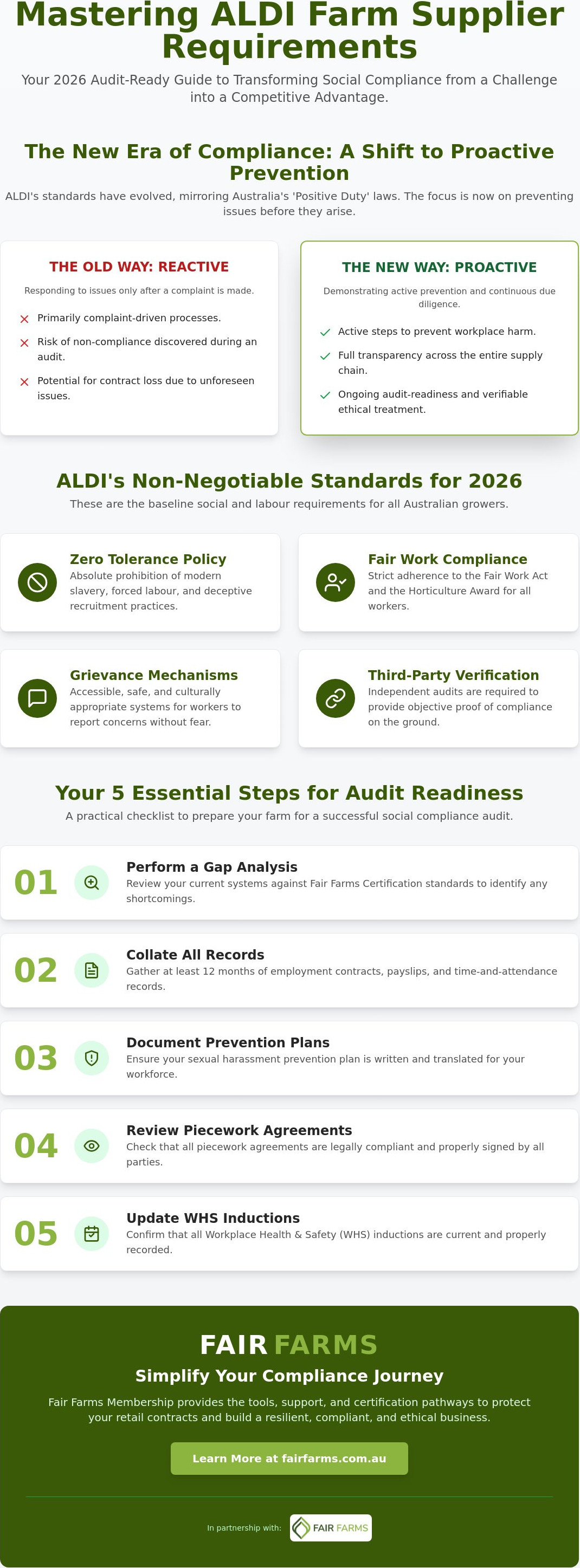
Meeting Aldi farm supplier requirements isn't a one-off box-ticking exercise. It's an ongoing commitment to the retailer's Business Partner Sustainability Standards, which serve as the non-negotiable baseline for every grower in the country. Since ALDI's history in Australia began in 2001, their business model has relied on lean efficiency and long-term, transparent partnerships. By 2026, this expectation has evolved from simply reacting to complaints to a model of proactive prevention.
This shift mirrors the broader Australian legal landscape, specifically the "Positive Duty" obligations that require employers to take active steps to prevent workplace harm before it occurs. ALDI expects its partners to demonstrate full transparency across their entire supply chain. For horticulture growers, this means you must be able to verify the ethical treatment of every person on your property, whether they're permanent staff or sourced through a third-party labour hire provider.
Key Social and Labour Requirements for 2026
Compliance in 2026 requires strict adherence to the Fair Work Act and the Horticulture Award. ALDI maintains a zero-tolerance policy for modern slavery, forced labour, and deceptive recruitment practices. Your farm must have accessible, culturally appropriate grievance mechanisms in place. These systems ensure that all workers, particularly those on temporary visas or from diverse backgrounds, can report concerns safely and without fear of retribution.
The Role of Third-Party Ethical Audits
ALDI relies on independent, third-party certifications to verify that social standards are being met on the ground. These audits provide the objective proof needed to maintain a retail contract and protect your farm's reputation. Maintaining a Supply Chain Membership is an effective way for businesses to demonstrate their ongoing dedication to these standards and keep their documentation audit-ready at all times.
How to Prepare Your Farm for an ALDI-Ready Social Compliance Audit
Preparing for a social compliance audit is a rigorous process that demands absolute data integrity. Meeting Aldi farm supplier requirements involves more than just a clean packing shed; it requires a deep dive into your payroll and HR systems. Auditors will look for evidence that every worker is paid correctly under the Horticulture Award and that your records reflect actual hours worked without discrepancies.
Horticulture presents unique risks that auditors scrutinise closely. If you provide worker accommodation or transport, these facilities must meet safety and hygiene standards. Visa dependency is another critical area. You must demonstrate that no worker is being coerced or exploited due to their residency status. If you engage third-party contractors, ensure they hold valid state-based labour hire licences. Relying on an unlicensed provider is a major non-compliance that could jeopardise your retail standing.
Modern audits also require proof of your proactive measures against sexual harassment and discrimination. This isn't just about having a policy in a drawer. You need to show that your team understands these rules through regular, documented training sessions. Evidence of these proactive steps is now a central expectation for any major retail supplier in Australia.
Five Essential Steps for Audit Readiness
- Perform a detailed gap analysis against Fair Farms Certification standards to identify where your current systems might fall short.
- Collate all employment contracts, payslips, and time-and-attendance records for at least the past 12 months.
- Ensure your sexual harassment prevention plan is written down and translated into the primary languages spoken by your workforce.
- Review your piecework agreements to ensure they are legally compliant and signed by both parties.
- Check that all workplace health and safety (WHS) inductions are up to date and recorded.
Businesses looking for a structured approach often find that following established certification pathways helps streamline this preparation.
Managing Psychosocial Hazards and Worker Welfare
Auditors now look beyond physical safety to assess psychosocial hazards. In isolated regional environments, the risk of social isolation or bullying can increase. You must identify these risks and implement mitigation strategies. This includes training your supervisors on their duty of care and how to handle bystander obligations. When staff feel safe and respected, your farm is much more likely to pass a social compliance audit with flying colours.
How Fair Farms Membership Supports Your ALDI Supplier Journey
Aligning with Aldi farm supplier requirements shouldn't be a solitary struggle against complex red tape. While the retailer sets the standards, Fair Farms provides the practical, industry-led pathway to help you meet them. We act as a supportive partner, offering specialised HR support that is deeply rooted in the Australian horticulture landscape. This ensures your business isn't just compliant on paper but is operating with a robust, ethical framework that stands up to the closest scrutiny.
The relationship between retailers and growers is legally governed by the Food and Grocery Code of Conduct, which was significantly revised in April 2026 to ensure greater transparency. By adopting Fair Farms Training and Certification, you move beyond a reactive, complaints-based management style. Instead, you embrace a preventative model that identifies risks before they become breaches, satisfying both the ACCC's expectations and ALDI's sustainability goals.
The Benefits of an Industry-Led Framework
Our programme is developed by growers, for growers. This perspective is vital when navigating the intricacies of the Horticulture Award and regional labour hire licensing. Membership provides access to online training modules that simplify everything from payroll management to understanding bystander obligations. By utilising these tools, you demonstrate a level of ethical maturity that makes your farm an attractive, low-risk partner for ALDI buyers. It’s about building a reputation for integrity that goes beyond the basic audit requirements.
Securing Your Supply Chain for the Future
The cost of overlooking compliance is far higher than the investment in certification. Under current Australian laws, legal penalties for serious contraventions can reach up to $99,000 per instance. Beyond the financial risk, the reputational damage of a labour scandal can lead to the immediate termination of major retail contracts. Ethical management does more than protect you from fines; it helps you build a more reliable and satisfied workforce. When workers feel they are treated fairly, productivity increases and staff turnover drops. Ready to align your farm with retail standards? Contact the Fair Farms team today to start your journey toward a secure and compliant future.
Securing Your Place in Australia's Retail Future
Securing a contract with a major retailer in 2026 requires more than high-quality produce; it demands a demonstrable commitment to ethical leadership. By understanding the evolving Aldi farm supplier requirements and shifting toward a preventative management model, you'll protect your business from legal risks while building a more resilient workforce. It's about moving beyond basic compliance to foster a culture of integrity that resonates throughout the entire supply chain.
Fair Farms was developed by Queensland Fruit & Vegetable Growers (QFVG) to provide a practical, industry-led solution for this exact challenge. Our programme is fully aligned with the National Code of Practice 2025 and offers specialised HR support tailored specifically to the Horticulture Award. This ensures you've got the necessary tools to navigate complex workplace laws with confidence, ensuring your farm remains audit-ready and competitive.
Taking the first step toward certification doesn't have to be an overwhelming process. With the right support, you can turn compliance into a strategic advantage that opens doors to Australia's largest retail markets. Join Fair Farms and Start Your Certification Journey today and lead the way in ethical horticulture. We're here to support your success every step of the way.
Frequently Asked Questions
What are the minimum social standards required to be an ALDI supplier?
ALDI requires all partners to adhere to their Business Partner Sustainability Standards, which establish a non-negotiable baseline for human rights and environmental due diligence. For Australian growers, this means absolute compliance with the Fair Work Act and the Horticulture Award. You must demonstrate transparent record-keeping and a proactive approach to identifying and mitigating ethical risks across your entire operation.
Does ALDI require a specific third-party ethical audit for Australian growers?
ALDI requires direct produce suppliers to maintain HARPS Version 2.0 certification, which incorporates food safety and legal requirements. To satisfy the social compliance component of Aldi farm supplier requirements, the retailer accepts industry-recognised certifications like Fair Farms. These independent audits verify that your labour practices meet the high ethical benchmarks expected by major Australian retailers.
How does the Fair Work Act impact my ability to supply to major retailers?
The Fair Work Act is the legal bedrock of your employment relationships, and retailers view any breach as a critical commercial risk. Under the Food and Grocery Code of Conduct, ALDI expects suppliers to be fully compliant with all workplace laws. Failure to pay correct award rates or maintain accurate time-sheets can lead to the loss of your supply contract and significant legal penalties.
What is "Positive Duty" and why does it matter for my farm audit?
Positive Duty is a legal requirement for employers to take proactive steps to prevent workplace sexual harassment, discrimination, and victimisation. In a modern social compliance audit, simply having a policy is no longer enough. You must provide documented evidence of preventative actions, such as staff training and risk assessments, to prove you are actively protecting your workforce from harm.
Can I use any labour hire provider if I want to supply to ALDI?
No, you must only engage labour hire providers that hold a valid licence in states where licensing schemes are mandatory. ALDI's ethical standards require that any third-party labour provider also meets strict social compliance criteria. Using an unlicensed or non-compliant provider is a major breach that will likely result in a failed audit and the suspension of your retail agreement.
How much does it cost to get ethically certified in Australia?
The investment required for ethical certification varies based on the size of your farm and the complexity of your existing HR systems. Costs typically include membership fees, online training modules, and the independent third-party audit itself. Because every horticulture business is different, you should contact a certification provider directly to receive a quote tailored to your specific operational needs.