
Labour Hire Agreement Checklist for Growers: The 2026 Compliance Guide

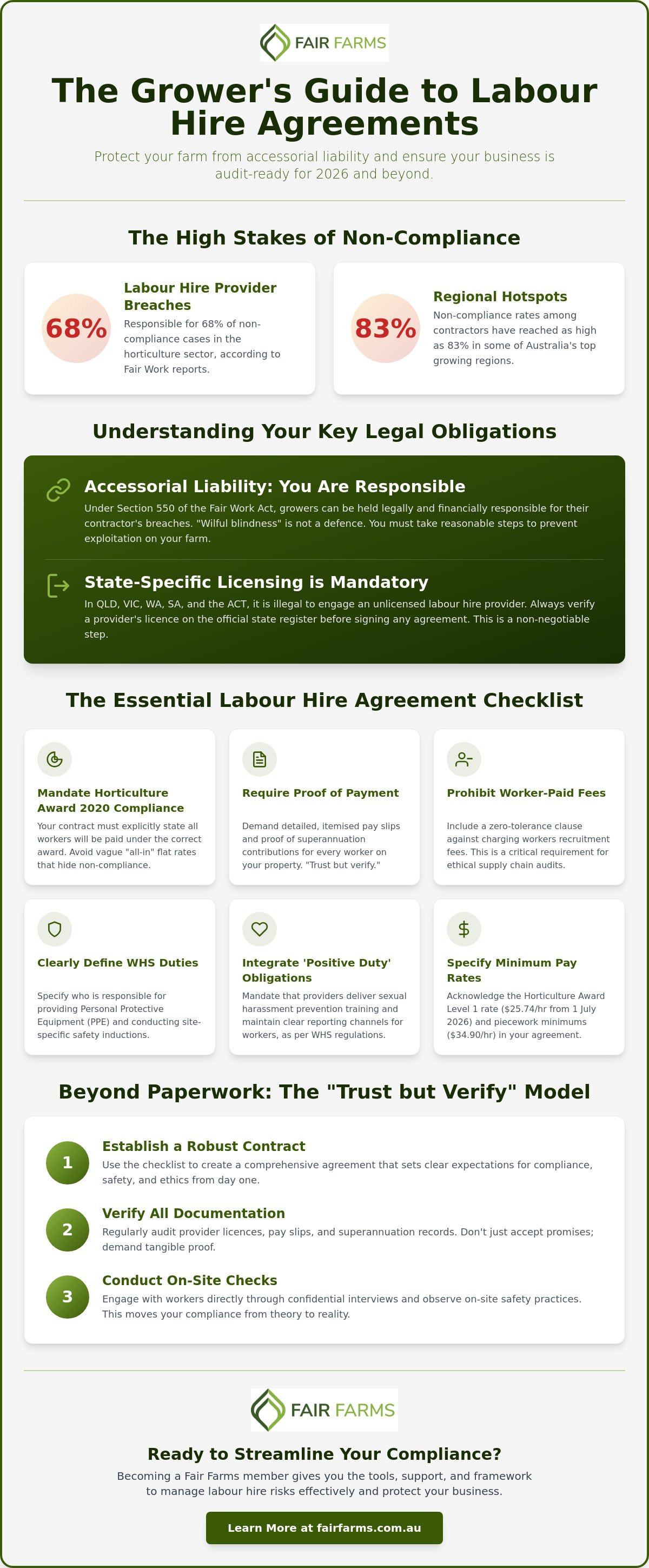
Did you know that labour hire providers were responsible for 68% of non-compliance cases in the horticulture sector according to recent Fair Work reports? In some of Australia's premier growing regions, investigators have found non-compliance rates as high as 83% among contractors. As a grower, you likely feel the pressure of these statistics, especially with the Horticulture Award Level 1 rate rising to $25.74 per hour on 1 July 2026 and new Positive Duty obligations for sexual harassment prevention now in full effect. It’s a lot to manage while trying to get a crop off the vine or out of the ground.
You shouldn't have to risk your livelihood on a contractor's mistake. This labour hire agreement checklist for growers is designed to help you master your contractual obligations and shield your farm from accessorial liability. We will outline the mandatory clauses your contracts must include to satisfy ethical supply chain audits and provide a clear verification process. By the end of this guide, you will have a practical roadmap to ensure your business is audit-ready and your reputation remains protected.
Key Takeaways
- Understand the legal mechanics of accessorial liability and how the Fair Work Ombudsman holds growers accountable for contractor breaches.
- Utilise a comprehensive labour hire agreement checklist for growers to ensure your contracts include mandatory clauses for payroll transparency and Horticulture Award compliance.
- Learn to mandate specific evidence from providers, including detailed pay slips and proof of superannuation contributions, to mitigate the risk of wage theft claims.
- Discover how to implement a "trust but verify" model that uses worker interviews and site safety checks to move your compliance strategy beyond mere paperwork.
- Prepare your business for ethical supply chain audits by aligning your labour hire practices with the expectations of major retailers and industry standards.
The Legal Foundation: Why Your Labour Hire Agreement is a Critical Risk Shield
In the Australian agricultural sector, the relationship between a grower, a provider, and a worker is a specialised form of temporary employment. While the Labour Hire Provider (LHP) is the direct employer, you as the grower act as the host. This three-way arrangement creates a shared responsibility for the welfare and lawful payment of every person on your property. Relying on a handshake or a generic contract is no longer viable. A comprehensive labour hire agreement checklist for growers serves as your primary legal shield, ensuring that every party understands their obligations before the first bin is picked.
One of the most immediate red flags in any agreement is the "all-in" flat rate. If a provider offers a rate that seems too good to be true, it usually is. With the Horticulture Award Level 1 rate set at $25.74 per hour as of July 2026, any quote must realistically account for casual loading, superannuation, and workers' compensation. Accepting a rate that sits below these baseline costs is an admission of risk. The Horticulture Award 2020 remains the non-negotiable standard for seasonal labour, and your agreement must explicitly reflect this to avoid the pitfalls of sham contracting.
Understanding Accessorial Liability and the Fair Work Act
Section 550 of the Fair Work Act establishes that you don't need to be the direct employer to be held responsible for workplace breaches. Accessorial liability is the legal mechanism that allows regulators to penalise growers for a provider's payroll failure. If you are "involved in" a contravention, even through wilful blindness, the Fair Work Ombudsman can seek penalties against you personally. It's vital to step in the moment you suspect a provider is failing to meet National Employment Standards (NES). Proactive oversight is the only way to demonstrate you've taken reasonable steps to prevent exploitation.
State-Specific Labour Hire Licensing Requirements
Regulatory requirements vary significantly across borders, making state-specific knowledge essential. If your farm is in Queensland, Victoria, Western Australia, South Australia, or the ACT, you are legally required to engage only licensed providers. In June 2026, Victoria introduced more rigorous "fit and proper person" tests and financial viability declarations. Engaging an unlicensed provider carries the weight of heavy fines and severe reputational damage. Always verify a provider's licence status on the official state register before signing any commercial agreement. This verification is a core pillar of any labour hire agreement checklist for growers and ensures you are partnering with a legitimate business.
The Ultimate Labour Hire Agreement Checklist: Essential Clauses for 2026
A robust contract is the backbone of your compliance strategy. Your labour hire agreement checklist for growers must move beyond generic templates to address the specific complexities of seasonal horticulture. Every agreement should mandate that the provider supplies detailed pay slips and proof of superannuation contributions. It isn't enough to assume they're paying correctly; you need to see the evidence. This includes an explicit commitment to the Horticulture Award 2020. Under current 2026 rules, a competent casual worker must be able to earn at least $34.90 per hour on piece rates, which is 15% above the minimum hourly rate. Aligning your practices with AUSVEG's guide to managing labour hire risks ensures you don't leave gaps in supervision or safety.
Ethical recruitment is another pillar of a modern agreement. You must include clauses that strictly prohibit the charging of recruitment fees to workers. This is a non-negotiable requirement for ethical supply chain audits and protects your reputation with major retailers. Clearly defining Work Health and Safety (WHS) duties is equally vital. Your contract should specify who provides personal protective equipment (PPE) and who conducts site-specific inductions. Growers looking for structured support in these areas often find that becoming a Fair Farms member provides the necessary tools to streamline this process.
Integrating Positive Duty and Sexual Harassment Prevention
The Work Health and Safety (Sexual and Gender-based Harassment) Code of Practice 2025 requires a proactive approach to worker welfare. Your contracts must mandate that providers deliver comprehensive sexual harassment training and maintain clear, accessible grievance procedures. This responsibility doesn't end at the farm gate. The agreement should explicitly cover safety standards in any employer-provided accommodation or transport to ensure workers are protected throughout their entire engagement.
Record-Keeping and Audit Rights
A "Right to Audit" clause is your most powerful tool for maintaining oversight. It should allow you to inspect payroll records with just 24 hours' notice. To ensure true transparency, require providers to maintain records in the preferred languages of their migrant workers. All worker inductions and safety training must be documented and immediately accessible to you. This level of detail ensures that if an auditor walks onto your property, you have the proof of compliance ready to go.
Beyond the Paperwork: Implementing a "Trust but Verify" Model
A signed contract is a vital safeguard, but it's only the first step in a robust compliance framework. True oversight requires a "trust but verify" mindset that extends from the office to the orchard. You can't simply rely on a provider's word; you need to see compliance in action. Implementing a regular schedule of worker interviews allows you to cross-check pay rates and assess the site's safety culture first-hand. These informal chats often reveal discrepancies that formal paperwork might hide. Maintaining open communication between your farm manager and the labour hire supervisor is equally critical. If a problem arises, you need a clear escalation pathway. Your agreement must include specific triggers for contract termination to ensure you can act quickly if a provider fails to meet their ethical or legal obligations.
Conducting Regular Compliance Spot-Checks
Regular spot-checks are the most effective way to catch issues before they escalate into Fair Work penalties. Review a random sample of pay slips against your farm’s own time-and-attendance records to ensure every hour is accounted for. It’s also wise to request evidence that superannuation and tax withholdings are actually being paid to the ATO. For those using piece rates, ensure the records include the required calculations demonstrating that a competent worker can earn the $34.90 per hour benchmark. Using your labour hire agreement checklist for growers as a live document for these checks keeps your oversight sharp and your business audit-ready.
The Fair Farms Pathway to Certification
The Fair Farms Certification process transforms a simple checklist into a verified ethical standard. By joining the community of Fair Farms members, you demonstrate a genuine commitment to equitable treatment and industry leadership. This framework provides regulators with clear evidence that you've taken reasonable and proportionate measures to prevent workplace harm and exploitation. It’s about moving from reactive fixes to a proactive culture of integrity that protects your reputation and every participant in your supply chain.
Securing Your Farm's Future Through Ethical Leadership
Protecting your business in 2026 requires more than just good intentions. It demands a proactive stance on every aspect of your supply chain. We've explored how a strong legal foundation and clear contractual clauses can prevent accessorial liability and shield you from heavy penalties. By moving beyond paperwork and implementing regular spot-checks, you ensure that your farm remains a safe and fair workplace for everyone. Using a robust labour hire agreement checklist for growers is more than a compliance task; it's a strategic investment in your farm’s resilience and long-term reputation.
Our framework is Fair Farms Version 4 compliant and was developed by Queensland Fruit & Vegetable Growers (QFVG). It’s fully aligned with the Fair Work Act and the 2025 WHS Code of Practice, giving you the confidence to lead with integrity. You don't have to navigate these complex regulatory shifts alone. Download our comprehensive resources or contact the Fair Farms team today to secure your farm’s compliance. We're here to support your journey toward a sustainable and ethical future for Australian agriculture.
Frequently Asked Questions
What is the most common mistake growers make in labour hire agreements?
The most common mistake is relying on informal "handshake" deals or accepting a flat hourly rate that doesn't account for statutory entitlements. These "all-in" rates often fail to cover the Horticulture Award's casual loading, superannuation, and workers' compensation. Without a detailed labour hire agreement checklist for growers, you may inadvertently engage in sham contracting. This leaves your business exposed to accessorial liability under the Fair Work Act.
Do I need a different agreement for seasonal workers versus permanent staff?
Yes, your agreements should distinguish between seasonal casuals and permanent staff because their entitlements under the Horticulture Award 2020 are fundamentally different. Seasonal workers often operate under piece-rate provisions, which require specific "average competent worker" calculations to meet the 15% benchmark. A one-size-fits-all contract rarely captures the nuance of casual loading or the specific induction requirements needed for high-turnover seasonal crews.
How does the 2025 National Code of Practice affect my labour hire contracts?
The 2025 Code of Practice mandates a proactive approach to managing psychosocial risks, specifically sexual and gender-based harassment. Your contracts must now explicitly state that the provider is responsible for delivering training and maintaining accessible grievance procedures. This "Positive Duty" requires you to ensure that the provider's safety culture extends beyond physical hazards to include the mental well-being and safety of workers in shared transport or accommodation.
Can I be fined if my labour hire provider fails to pay superannuation?
You can absolutely be penalised if you are found to be "involved in" a provider's failure to pay superannuation. Under Section 550 of the Fair Work Act, regulators can hold growers accountable if they knew, or should have known, that underpayments were occurring. This is why verifying "Payday Superannuation" compliance is a critical item on any labour hire agreement checklist for growers, as ignorance is no longer a valid legal defence.
What should I do if my labour hire provider refuses to show me their payroll records?
A refusal to provide payroll records is a significant red flag that suggests potential non-compliance or wage theft. You should immediately refer to your "Right to Audit" clause to demand access within 24 hours. If they continue to obstruct your oversight, it's necessary to trigger contract termination pathways. Transparent record-keeping is a non-negotiable requirement for maintaining your farm's ethical standing and audit-readiness.
How often should I review and update my labour hire agreement?
You should review your agreements at least once a year, ideally before the July 1st award rate increases. Regulatory shifts, such as the 2026 Horticulture Award Level 1 rate rise to $25.74, happen frequently. It's also vital to update your contracts whenever there's a change in state-specific licensing laws, such as the rigorous new financial viability declarations introduced in Victoria in June 2026.