
Farm Payroll Compliance Australia: A Guide for Growers in 2026

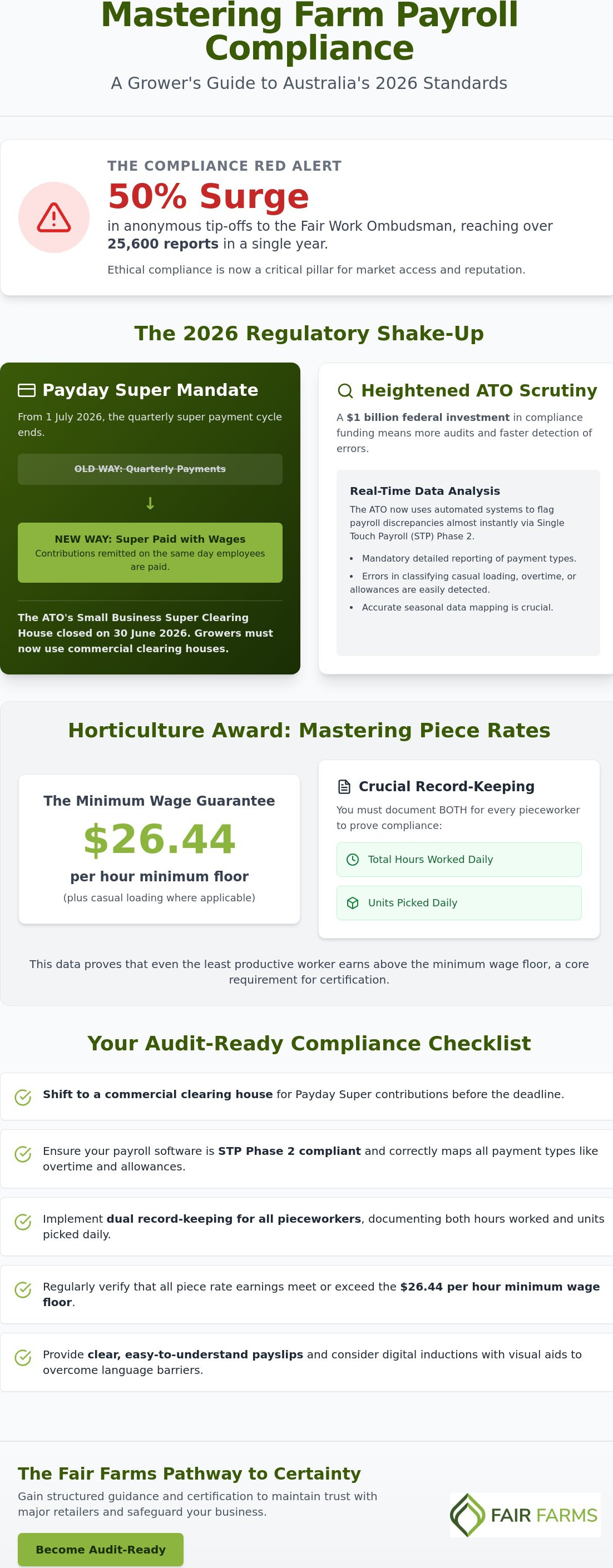
Did you know that anonymous tip-offs to the Fair Work Ombudsman regarding workplace non-compliance have surged by 50 per cent recently, reaching over 25,600 reports in a single year? For growers across the country, managing farm payroll compliance Australia is no longer just a back-office task; it is a critical pillar of your ethical responsibility and market access. You likely feel the weight of the new Payday Super mandate and the complexities of ensuring piece rates remain 15 per cent above the updated minimum wage of $26.44 per hour.
We understand that keeping up with these shifting regulations while running a productive farm is a significant challenge. This guide provides the clarity you need to master the 2026 standards, from navigating the closure of the ATO Small Business Super Clearing House to meeting the 12 per cent superannuation guarantee. You will gain the peace of mind that comes with being audit-ready and maintaining your standing with major retailers. We provide a practical compliance checklist and a detailed breakdown of the latest Horticulture Award rates to ensure your team is paid fairly and your business remains secure.
Key Takeaways
- Prepare for the mandatory shift to Payday Super and learn why real-time contributions are now a non-negotiable standard for Australian growers.
- Navigate the intricate requirements of the Horticulture Award, including the critical need to balance piece rate calculations with the daily minimum wage guarantee.
- Strengthen your farm payroll compliance Australia by adopting a proactive framework that prioritises ethical labour standards and thorough record-keeping.
- Discover how Fair Farms membership provides the structured guidance and certification necessary to maintain trust with major retailers and safeguard your reputation.
The 2026 Regulatory Landscape: Payday Super and ATO Scrutiny
Farm payroll compliance Australia involves a rigorous commitment to real-time reporting, superannuation obligations, and Modern Award standards as enforced by the Australian Taxation Office (ATO) and the Fair Work Ombudsman. The landscape changed fundamentally on 1 July 2026 with the introduction of Payday Super. This reform ended the traditional quarterly payment cycle, requiring employers to remit superannuation contributions on the same day they pay their workers. It's a shift designed to ensure that employee entitlements are protected and visible throughout the year.
The federal government's $1 billion investment in compliance funding between 2025 and 2029 has significantly increased the likelihood of farm gate audits. This funding specifically targets the superannuation gap and payroll tax accuracy. Given the immense scale of Agriculture in Australia, which reached a record production value of $18.4 billion in 2026, the ATO is utilising automated, real-time data to identify discrepancies faster than ever before. For growers, this means that unintentional errors in seasonal data mapping are now flagged almost instantly.
Real-Time Superannuation and Cash Flow Management
The Payday Super mandate ensures contributions reach an employee's fund within seven business days of their pay date. While this improves long-term retirement outcomes for your team, it requires a shift in how you manage seasonal liquidity. During peak harvest, when your workforce expands rapidly, the transition from quarterly to weekly or fortnightly super payments can strain cash reserves. To maintain stability, many growers are now integrating their payroll systems with commercial clearing houses, as the ATO's Small Business Super Clearing House closed to existing users on 30 June 2026. If you're concerned about how these cycles impact your liquidity, you can contact our team for support.
STP Phase 2 Maturity in Horticulture
Single Touch Payroll (STP) Phase 2 is the mandatory reporting of specific payment categories, such as overtime, allowances, and paid leave, directly to the ATO. A common error involves the misclassification of casual loading, which must be reported separately from the base rate to ensure tax and super calculations are accurate. Rectifying these errors before the end of the financial year is essential to avoid the penalties associated with unintentional non-compliance. Ensuring your software correctly maps these seasonal variations is the best way to protect your business from regulatory scrutiny.
Horticulture Award Nuances: Piece Rates and Entitlements
Many growers find that generic payroll software simply isn't built for the unique complexities of the agricultural sector. While these systems manage standard retail or office rosters well, they often struggle with the Horticulture Award Nuances that dictate daily operations. Achieving robust farm payroll compliance Australia means moving beyond basic automation. You need a system that understands the specific triggers for overtime, casual loading, and the intricate piecework rules that apply to your harvest team during peak season.
Payroll accuracy is also a vital component of your "Positive Duty" to ensure a safe workplace. Financial stress caused by underpayment or late wages directly impacts worker mental health and increases psychosocial risks. For visa holders and backpackers, pay transparency is a matter of safety and dignity. When entitlements are unclear, it creates a sense of vulnerability that can lead to broader workplace issues. Ensuring every migrant worker understands their pay structure is not just a legal requirement; it's a commitment to ethical leadership within the industry.
Mastering Piecework Records and Minimum Wage Floors
The introduction of the pieceworker minimum wage guarantee has fundamentally changed record-keeping requirements. You must document both the hours worked and the units picked for every individual on a piece rate. This data proves that even your least productive workers are receiving at least the minimum hourly floor of $26.44, plus casual loading where applicable. Maintaining these dual records is a core requirement if you're pursuing Fair Farms Certification, as auditors will look for clear evidence of this safety net in action.
Addressing Language Barriers in Payroll Reporting
A diverse seasonal workforce often includes participants with limited English literacy. Providing payslips and entitlement summaries that are easy to navigate is essential for maintaining trust. Digital inductions are an excellent tool here. They allow you to explain pay rates and piecework rules using visual aids or translated content before the first bin is even picked. This proactive approach reduces confusion and ensures that every member of your team feels valued and informed from the moment they arrive on site.
Proactive Compliance: The Fair Farms Pathway to Certification
Establishing a robust framework for farm payroll compliance Australia is about more than just avoiding fines; it's about building a resilient and ethical business. While many growers feel pressured by the increasing complexity of industrial relations, moving from a reactive "complaint handling" model to a proactive prevention-based approach offers long-term stability. This shift ensures that your payroll integrity is a shield rather than a vulnerability, particularly as the Fair Work Commission introduces more stringent measures like stop orders to address workplace grievances.
The Fair Farms Pathway provides a structured journey for growers to demonstrate their commitment to fair employment. By aligning your internal processes with the Fair Farms standard, you aren't just ticking boxes for an auditor. You're creating a transparent culture where every hour worked is accounted for and every entitlement is correctly paid. This level of oversight is essential for maintaining the trust of your workforce and the integrity of your brand in a competitive market.
Certification as a Competitive Advantage
Major Australian retailers increasingly require proof of ethical labour practices before granting supply chain access. Verified payroll standards serve as a powerful differentiator, reducing the frequency and intensity of third-party audits by providing a recognised mark of quality. When your records are already aligned with industry best practices, you can face any inspection with quiet confidence. Learn more about our certification pathways to see how this process can protect your market standing.
Accessing Specialist HR Support for Members
Legislative changes, such as the National Code of Practice 2025, can be difficult to interpret while managing the daily demands of a farm. Fair Farms membership provides growers with dedicated HR support to navigate these complexities without the need for expensive legal counsel. Whether you're adjusting to new reporting requirements or need guidance on a specific Award interpretation, our team acts as a supportive mentor. Explore the benefits of Fair Farms membership to strengthen your internal compliance capabilities.
Securing Your Farm's Future Through Ethical Compliance
Maintaining farm payroll compliance Australia is no longer just about administrative efficiency; it's a commitment to the integrity of your business and the wellbeing of your workforce. The transition to real-time superannuation and the rigorous record-keeping required for piecework rates under the Horticulture Award demand a proactive approach. By moving away from reactive management, you ensure your farm remains resilient against audit pressure while fostering a workplace culture rooted in fairness and transparency.
Fair Farms is a proud industry-led initiative by Queensland Fruit & Vegetable Growers (QFVG). Our program is strictly aligned with modern legislative reforms, including the Fair Work Act and Sex Discrimination Act. This makes our certification a mark of quality trusted by growers and major retailers across the country. We provide the tools and support you need to demonstrate ethical leadership and secure your standing in the national supply chain.
Ready to transition from regulatory risk to operational reliability? Protect your farm and join Fair Farms today. We look forward to supporting your journey toward a more equitable and sustainable agricultural future.
Frequently Asked Questions
What is the penalty for farm payroll non-compliance in 2026?
Penalties for failing to maintain farm payroll compliance Australia can reach hundreds of thousands of dollars for serious or systemic underpayments. In the 2024-2025 financial year, the Fair Work Ombudsman recovered $358 million for underpaid workers. Beyond direct fines, non-compliance can lead to court-enforced undertakings and the loss of certification required for retail supply chains. It's essential to treat these obligations as a core business risk.
How does Payday Super affect seasonal harvest workers?
Payday Super requires you to pay superannuation contributions on the same day you pay your seasonal harvest workers. This mandate, effective from 1 July 2026, ensures that contributions reach the employee's fund within seven business days of payday. For growers with a high turnover of seasonal staff, this necessitates real-time data entry and more frequent communication with commercial clearing houses to ensure every worker receives their entitlements promptly.
Can I still use piece rates under the Horticulture Award in 2026?
Yes, piece rates remain a valid payment method, provided they include a minimum wage guarantee for every day worked. You must set the rate so a worker with average productivity earns at least 15 per cent more than the minimum hourly rate, which increased to $26.44 in July 2026. Accurate records of both units picked and hours worked are essential to prove that every employee has received their daily safety net.
Do I need a written prevention plan for workplace harassment as part of my HR compliance?
Growers are legally required to take proactive steps to eliminate workplace harassment under the Positive Duty provisions of the Sex Discrimination Act. While the legislation focuses on outcomes, maintaining a written prevention plan is a practical way to demonstrate you've identified risks and implemented controls. This plan should include worker training and clear reporting channels, which are also core components of achieving ethical certification within the Australian agricultural sector.