
Meeting Woolworths Supplier Ethical Standards: A Guide for Australian Horticulture
For many Australian growers, the dense documentation outlining the latest Woolworths supplier ethical standards feels less like a helpful guide and more like a significant administrative hurdle. It’s a common sentiment in the horticulture sector: the weight of "Positive Duty" requirements and the anxiety of an upcoming third-party audit can easily overshadow the daily work of running a farm. We recognise that keeping pace with evolving regulations, such as the January 2025 criminalisation of intentional wage underpayment, requires more than just good intentions; it demands a structured, principled approach to labour management.
This article provides the clarity you need to navigate Woolworths’ responsible sourcing requirements and implement a robust social compliance framework for your business. You will learn how to move beyond "tick-box" compliance to build a resilient operation that protects both your seasonal workers and your market access. We will preview the January 2026 standards updates, offer practical tools for documenting multi-tier supply chains, and outline a clear roadmap to ensure your next audit is a mark of excellence rather than a source of stress.
Key Takeaways
- Understand the core pillars of the January 2026 update, including human rights, health and safety, and environmental stewardship requirements.
- Learn how to conduct a comprehensive gap analysis to align your farm’s HR and OHS systems with the latest Woolworths supplier ethical standards.
- Discover the practical steps required to implement a formal Sexual Harassment Prevention Plan to meet your "Positive Duty" obligations by the upcoming deadlines.
- Explore how Fair Farms Membership for Growers provides a recognised, industry-led pathway to satisfy retailer expectations through structured certification.
- Protect your business reputation and reduce the risk of audit failure by shifting from reactive "tick-box" exercises to a proactive social compliance model.
Understanding the Woolworths Responsible Sourcing Framework
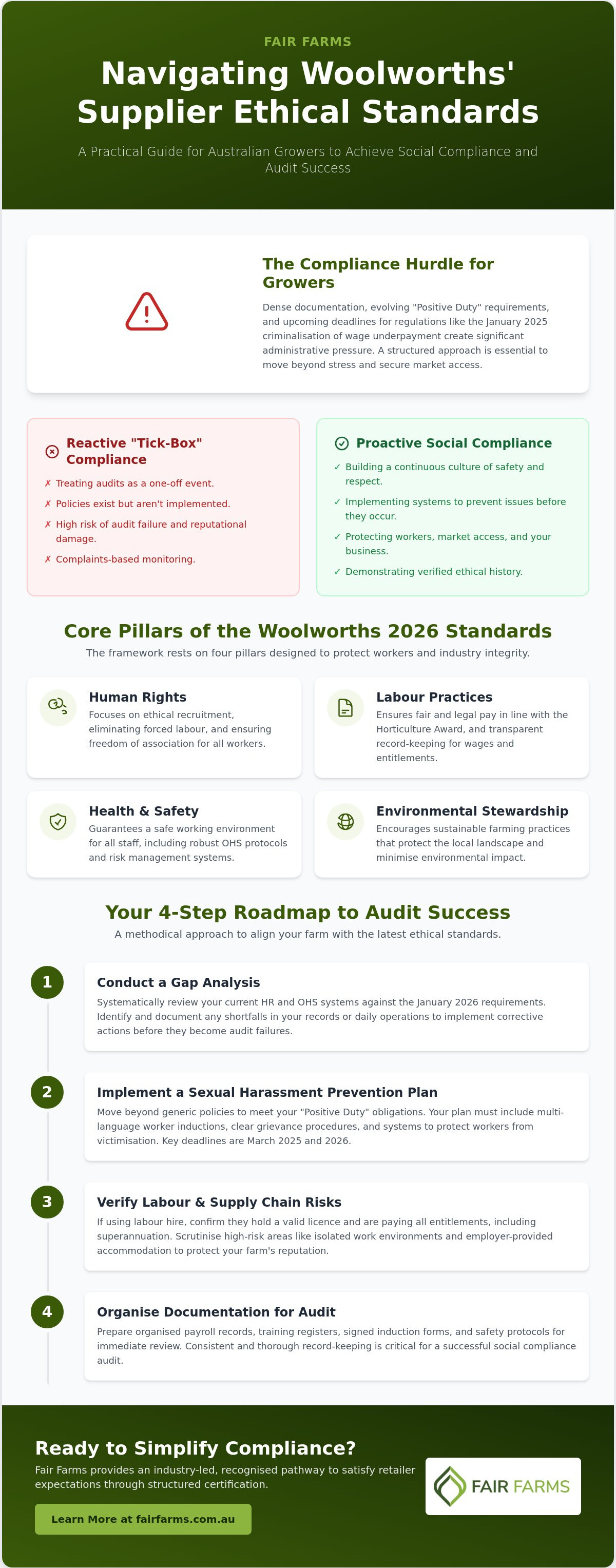
The January 2026 update to the Responsible Sourcing Standards marks a definitive shift in how Woolworths (Australia) manages its vast supply chain. For horticulture growers, these requirements are no longer just administrative suggestions. They're rigid prerequisites for maintaining supplier status. The framework prioritises transparency and traceability, moving away from reactive, "complaints-based" monitoring towards a model of proactive prevention. This ensures that every piece of produce on the shelf is backed by a verified ethical history. Meeting these Woolworths supplier ethical standards is now essential for any business aiming to secure or keep "private label" or "branded" contracts.
The framework rests on four core pillars designed to protect the integrity of the industry:
- Human rights: Focuses on ethical recruitment and the elimination of forced labour.
- Labour practices: Ensures fair pay and adherence to the Horticulture Award.
- Health and safety: Guarantees a safe working environment for all seasonal and permanent staff.
- Environmental stewardship: Encourages sustainable farming practices that protect the local landscape.
The Supplier Code of Conduct and Social Compliance
Woolworths utilises the Ethical Trading Initiative (ETI) Base Code as its primary benchmark. This international standard focuses on fundamental rights such as fair pay, freedom of association, and safe working conditions. Compliance isn't a one-off event; it's a continuous process monitored through approved online compliance databases and regular third-party social audits. Woolworths segments suppliers into risk categories, ranging from minimum to specialised. This classification determines the level of due diligence and the frequency of audits your farm will face.
New Regulatory Obligations: Positive Duty and Sexual Harassment
A significant shift in the 2026 standards involves the alignment with recent Australian workplace reforms. Retailers now expect suppliers to demonstrate "Positive Duty" regarding the prevention of workplace sexual harassment. It's no longer enough to have a policy tucked away in a drawer. You must show you're taking "reasonable measures" to eliminate risks before they occur. Failing to meet these expectations carries heavy financial penalties from the Fair Work Commission. These penalties are often uninsurable and can cause irreparable damage to your business reputation within the regional community.
Practical Steps to Align Your Farm with Ethical Standards
Aligning your farm with the latest Woolworths supplier ethical standards requires a methodical review of your existing HR and OHS protocols. You should begin by conducting a comprehensive gap analysis to identify where your current records might fall short of the January 2026 responsible sourcing requirements. This process isn't merely about ticking boxes; it's about verifying that your daily operations reflect a genuine culture of safety and respect. By identifying weaknesses early, you can implement corrective actions before they become audit failures.
A critical milestone for every grower is the implementation of a formal Sexual Harassment Prevention Plan. With deadlines approaching in March 2025 and 2026, you must move beyond generic policies. Your plan should include worker inductions delivered in multiple languages to ensure all seasonal staff understand respectful behaviour and their bystander obligations. Establishing clear, accessible grievance procedures is equally vital. These systems must protect workers from victimisation and provide a safe pathway to raise concerns, demonstrating your commitment to "Positive Duty" in a practical, measurable way.
Managing Labour Hire and Supply Chain Risks
Verification is the only reliable way to mitigate supply chain risks. If you use labour hire, you must confirm they hold a valid licence under the National Labour Hire Licensing Scheme and are paying full entitlements, including superannuation and leave. In horticulture, isolated work environments and employer-provided accommodation are high-risk areas that auditors scrutinise closely. Ensuring your providers are transparent about their recruitment practices is essential for protecting your farm's reputation.
Preparing for a Social Compliance Audit
Success in a social compliance audit depends on the quality of your documentation. You'll need organised payroll records, training registers, and safety protocols ready for immediate review. Common gaps often include missing signatures on induction forms or inconsistent record-keeping for migrant workers. Demonstrating proactive risk management through accurate data is the best way to build trust with retail stakeholders. For those seeking structured support to prepare, exploring Membership for Growers can provide the practical tools needed to streamline this journey.
How Fair Farms Facilitates Woolworths Supplier Compliance
Fair Farms serves as a trusted, industry-led pathway for Australian growers to meet the rigorous Woolworths supplier ethical standards. By adopting the Fair Farms Version 4.0 framework, which became effective on 1 June 2026, businesses can transition from a reactive management style to a proactive, prevention-based model. This structured approach doesn't just satisfy retailer requirements; it fosters a workplace culture built on integrity and equity. We believe that when ethical standards are integrated into the heart of a business, compliance becomes a natural outcome of good management rather than a seasonal burden.
The Fair Farms Certification Pathway
The Fair Farms certification process offers a clear, step-by-step journey toward compliance. It begins with comprehensive online training modules designed to prepare your management team for the realities of a third-party audit. These modules break down complex legalities into actionable tasks, ensuring that when an auditor arrives, your documentation is beyond reproach. Holding a "Fair Farms Certified" status provides a significant advantage during negotiations, as it signals to major retailers that your operation meets the highest benchmarks for social responsibility.
Expert HR Support and Prevention Training
Navigating the complexities of the Horticulture Award is a constant challenge, especially with the 4.75% minimum wage increase that took effect on 1 July 2026. Through Membership for Growers, participants gain access to tailored HR support that simplifies workplace relations. This includes specialised training for supervisors on their duty of care and the nuances of a respectful workplace culture. By focusing on education rather than just enforcement, we help management teams recognise and mitigate risks before they escalate. Fair Farms acts as the vital link that translates corporate ethical expectations into sustainable, everyday farming practices.
Securing Your Market Access through Ethical Excellence
Maintaining market access in the modern horticulture landscape requires a shift from reactive compliance to a proactive culture of accountability. By understanding the core pillars of the Responsible Sourcing Framework and implementing practical measures like Sexual Harassment Prevention Plans, you protect your workers and your business reputation. These steps ensure you don't just meet Woolworths supplier ethical standards but exceed them, positioning your farm as a leader in regional agriculture. It's about moving beyond the paperwork to foster a workplace where everyone feels safe and valued.
Fair Farms is here to support you through this transition. As an industry-led initiative developed by Queensland Fruit & Vegetable Growers (QFVG), our program is specifically designed to align with the latest Australian workplace reforms and retailer expectations. We provide dedicated HR support tailored for the horticulture sector, helping you navigate complex awards and audit requirements with quiet confidence. This steady, principled approach ensures your business remains resilient in a fluctuating market.
Ready to strengthen your social compliance framework? Contact Fair Farms today to start your ethical certification journey. We're committed to your success and look forward to building a stronger future for the Australian farming community together.
Frequently Asked Questions
Does Woolworths accept Fair Farms certification for its suppliers?
Yes, Woolworths recognises Fair Farms as a valid industry-led certification program that meets their responsible sourcing requirements. By achieving Fair Farms certification, growers demonstrate they have the necessary systems in place to manage labour and safety risks effectively. This alignment helps streamline the onboarding process and ensures your farm meets the Woolworths supplier ethical standards without needing to navigate multiple conflicting frameworks.
What are the most common reasons horticulture suppliers fail ethical audits?
Most failures stem from systemic record-keeping gaps rather than intentional misconduct. Common issues include incomplete payroll records that don't clearly show Horticulture Award compliance, missing worker induction signatures, and inadequate management of labour hire providers. Auditors also look closely at "Positive Duty" obligations; failing to show a formal prevention plan for workplace harassment is becoming a frequent point of non-compliance for many regional businesses.
How does the "Positive Duty" legislation affect my Woolworths supplier status?
The "Positive Duty" requirement is now a fundamental component of your legal and ethical obligations as a supplier. Because Woolworths requires all partners to comply with Australian workplace laws, a failure to meet these legal standards directly threatens your supplier status. Demonstrating a structured prevention plan and active risk management is now a non-negotiable part of proving your commitment to ethical labour practices and long-term business integrity.
What is the difference between a social compliance audit and a standard OHS audit?
The primary difference lies in the scope of the evaluation. While a standard OHS audit focuses on physical safety and hazard management on the farm, a social compliance audit evaluates the entire employment lifecycle. It examines wage accuracy, recruitment ethics, freedom of association, and the prevention of forced labour. Think of the OHS audit as checking the safety of the site, while the social compliance audit verifies the integrity of the business’s relationship with its people.
Do I need to ensure my labour hire provider is also ethically certified?
You're responsible for the ethical conduct of any third-party labour providers you engage. Woolworths expects you to verify that these partners hold the necessary state-based licences and adhere to the same Woolworths supplier ethical standards that apply to your own operation. Using an unverified or non-compliant labour hire firm creates a significant risk of audit failure and can lead to immediate contract termination if exploitation is discovered within your supply chain.
How often do Woolworths suppliers need to undergo social audits?
The frequency of social audits is determined by your business's specific risk profile as categorised by Woolworths. Suppliers in "priority" or "specialised" categories often face annual audits, while "minimum" risk suppliers may only require a full audit every two years. Maintaining consistent, high-quality records between audits is the best way to ensure you're always ready for a scheduled or unannounced review, regardless of your current risk rating.