
Essential Interview Questions for Australian Horticulture: Hiring for Compliance and Culture
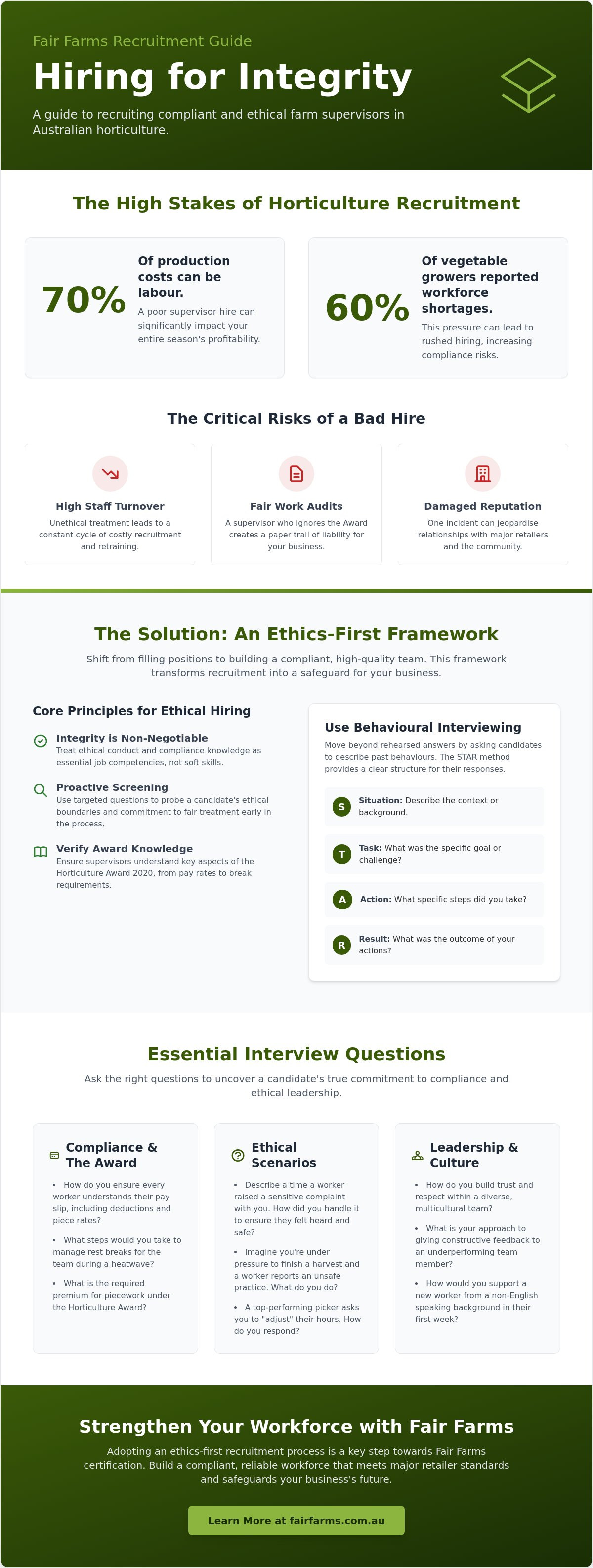
What if your next supervisor hire is actually your biggest compliance risk? With labour constituting up to 70% of production costs for some Australian crops, you can't afford to hire someone who treats ethical standards as an optional extra. In an environment where 60% of vegetable growers reported workforce shortages in 2025, the pressure to recruit is high, but using the right interview questions is a vital step in protecting your business from Fair Work Ombudsman audits.
We recognise that managing seasonal turnover while staying across the Horticulture Award is a constant challenge for growers and labour hire providers alike. This guide will help you master the art of farm recruitment with industry-specific questions designed to secure skilled, ethical, and compliant workers. You'll learn how to identify supervisors who truly value fair treatment, which helps you build a reliable workforce and move closer to Fair Farms certification readiness.
Key Takeaways
- Understand why standard recruitment processes often fail to identify ethical risks and how a tailored approach protects your business reputation.
- Learn to apply the "Ethics-First" framework to ensure integrity remains a non-negotiable trait in your farm's leadership team.
- Master behavioural interviewing techniques, including the STAR method, to accurately assess a candidate's past performance in rural settings.
- Access a targeted list of interview questions designed specifically for farm labour supervisors and labour hire liaison roles.
- Discover how Fair Farms Membership and industry-led training can help you build a compliant, reliable workforce that meets major retailer standards.
Beyond the Basics: Why Horticulture Needs a Tailored Interview Process
In the Australian horticulture sector, the stakes of recruitment go far beyond simply filling a position on the picking line. Labour can constitute up to 70% of total production costs for intensive crops; this means a single poor hiring decision can ripple through an entire season. Generic interview questions often fail because they focus on surface-level experience. They rarely probe the ethical integrity required to manage a diverse, often vulnerable, seasonal workforce. To protect your business, you must look for leaders who understand that compliance is as vital as the harvest itself.
The Australian agricultural landscape has faced significant pressure, with 60% of vegetable growers reporting workforce shortages in 2025. This scarcity often leads to rushed hiring, but the cost of a bad fit is too high to ignore. You aren't just looking for someone who can manage a crew; you're looking for a partner in risk management. A supervisor who ignores workplace standards doesn't just affect morale; they create a paper trail of liability that can lead directly to a Fair Work Ombudsman audit.
The Risks of Poor Selection in Seasonal Work
A supervisor who lacks a deep understanding of the Horticulture Award 2020 is a liability. When worker rights are sidelined, staff turnover spikes. This creates a cycle of constant retraining that drains your time and budget. Beyond the farm gate, the ripple effect on your supply chain reputation is severe. Major retailers now require objective proof of ethical labour practices. One unethical incident under a poorly chosen supervisor can jeopardise your standing with buyers and the wider community. Ethical recruitment is the first line of defence against these systemic risks.
Shifting from "Body on the Ground" to Quality Hires
The industry is moving away from the old mindset of needing "bodies on the ground." In 2026, a quality hire is defined by their ability to maintain compliance and foster a positive culture. Technical skills are only half the battle. Supervisors act as the cultural gatekeepers of your farm. They set the tone for every interaction, ensuring that ethical treatment is the standard rather than the exception.
By utilising behavioral interviewing techniques, you can move past rehearsed answers. These methods allow you to see how a candidate handles real-world pressure and ethical dilemmas. This shift is essential for growers pursuing Fair Farms Certification. It ensures your management team is aligned with the program's standards from the very first interaction. Hiring for integrity is no longer a luxury; it is a fundamental requirement for a sustainable farming business.
The Ethics-First Framework: Interviewing for Compliance and Integrity
An ethics-first approach to recruitment transforms the hiring process from a simple administrative task into a robust safeguard for your farm. This framework, central to the philosophy of Fair Farms Membership, ensures that every new hire aligns with the values of fair treatment and legal accountability. Integrity is no longer a "soft skill" in Australian agriculture; it's a non-negotiable competency. In an era of increased regulatory oversight, your management team must be as committed to the Horticulture Award as they are to the harvest schedule.
During the screening phase, transparency is your best tool. Candidates who are hesitant to discuss compliance or who view record-keeping as a burden often signal a risk to your business. By integrating specific interview questions that probe a candidate’s ethical boundaries, you can identify those who might prioritise speed over standards. This proactive screening helps build a culture where workers feel respected and protected, which is a key driver for retention in a competitive labour market. Growers looking to formalise these ethical standards often start by reviewing our membership options for growers and labour hire providers.
Screening for Awareness of the Horticulture Award
A supervisor’s lack of knowledge regarding the Horticulture Award 2020 is a significant liability. In your interviews, you should test their understanding of the 1 July 2025 pay rates, such as the $30.35 hourly rate for casual Level 1 employees. Ask how they manage rest breaks during peak heat or how they calculate the 15% piecework premium. Relying on "on-the-job" learning for these legal requirements is a risk that modern farming businesses cannot afford to take. Their answers will reveal if they have the technical weight to lead a compliant crew.
Identifying Red Flags in Labour Hire Management
With ABARES reporting that 64% of horticulture farms used contract workers in 2022–23, managing labour hire relationships is a critical supervisor skill. Use your interview questions to explore their experience with third-party agencies. Watch for candidates who seem indifferent to "unauthorised subcontracting" or who cannot explain how they verify a worker's right to work in Australia. A candidate’s awareness of the Modern Slavery Act and their commitment to identifying signs of exploitation are essential markers of a leader who will protect your farm's integrity and supply chain reputation.
Behavioural Interviewing Techniques for Farm Supervisors
Traditional interviews often let candidates hide behind vague promises or hypothetical scenarios. In the high-pressure environment of an Australian harvest, you need more than just a "good feeling" about a supervisor. Behavioural interviewing is a technique that focuses on past performance as the most reliable predictor of future behaviour. By asking a candidate to describe specific instances from their previous roles, you move beyond "what would you do" and uncover exactly "what have you done." This approach is particularly effective for farm roles where practical problem-solving and ethical decision-making are tested daily.
When you use targeted interview questions based on behavioural principles, you force a candidate to provide evidence of their skills. It's easy for someone to say they value worker safety; it's much harder to invent a detailed story about how they managed a heat-stress incident during a record-breaking January scorcher. These techniques help you filter out those who talk a good game but lack the grounded experience required to lead a compliant and productive crew.
Using the STAR Method in a Rural Context
The STAR method is a tool for verifying past performance on the farm by breaking down specific professional experiences into four components: Situation, Task, Action, and Result. To get the most out of this technique, you should prompt candidates for specific harvest examples. If a candidate is too general, ask follow-up questions like, "What was your specific role in that outcome?" or "What exactly did you say to the worker in that moment?"
- Situation: Ask them to describe a difficult day in the paddock or shed.
- Task: What was the goal? Perhaps they needed to meet a strict supermarket deadline while short-staffed.
- Action: This is the most important part. What steps did they take? Look for evidence of personal responsibility rather than blaming the weather or the crew.
- Result: What happened in the end? A successful result in horticulture isn't just about volume; it's about maintaining quality and compliance under pressure.
Assessing Soft Skills and Conflict Resolution
Modern farm supervisors lead diverse, multicultural workforces, often in challenging conditions. Heat stress, fatigue, and language barriers can easily lead to friction. You need to know if a candidate possesses the empathy and communication skills to de-escalate tension before it turns into a formal grievance. A supervisor who lacks empathy is often a primary driver of high staff turnover, which directly impacts your bottom line.
Ask interview questions that probe how they've handled disagreements between workers or how they've delivered bad news, such as a shift cancellation. Their answers will reveal their leadership style. A supervisor who prioritises clear, respectful communication helps build a stable workforce. This alignment with ethical leadership is a cornerstone of Fair Farms Certification, ensuring your management team supports a culture of communal progress and integrity.
Essential Interview Questions for Australian Farm Roles
Selecting the right team members requires a targeted set of interview questions that address both the practicalities of the paddock and the complexities of the law. As the industry moves toward greater digitisation and stricter oversight, your candidates must demonstrate more than just physical endurance. They need to show they can lead with a focus on Work Health and Safety (WHS) and maintain the meticulous records required for modern payroll compliance. Fair Farms members already benefit from expanded HR toolkits that streamline this process, but the initial interview remains your most powerful filter.
Beyond technical ability, you must assess a candidate's digital literacy. With the Australian Taxation Office requiring employers to pay superannuation on the same day as wages from 1 July 2026, your management team needs to be comfortable with real-time data entry and accurate record-keeping. A supervisor who cannot manage digital attendance logs is now a significant compliance risk.
Questions for Farm Labour Supervisors
Supervisors are your first line of defence against workplace grievances and safety incidents. Their answers should reflect a balance of firm leadership and ethical responsibility. Use these prompts to gauge their suitability:
- "Can you describe a time you had to correct a worker regarding safety or pay? How did you handle it?" Look for a response that demonstrates clarity, respect, and a commitment to the Horticulture Award.
- "How do you ensure every member of a diverse team understands their rights under the Horticulture Award?" This reveals their ability to overcome language barriers and foster an inclusive, informed culture.
- "Give an example of how you have managed a harvest deadline without compromising ethical standards." Integrity is tested most during peak season; this question identifies those who won't cut corners when the pressure is on.
Questions for Labour Hire Liaison Officers
Liaison officers must be vigilant. With the South Australian labour hire licensing scheme expanding to cover all industries as of 29 January 2026, your team must be experts at verifying credentials. These interview questions help identify candidates with the necessary oversight skills:
- "How do you verify that a labour hire provider is currently licensed in this state?" A competent candidate should mention checking official government registers and expiration dates.
- "What steps do you take to ensure seasonal workers are not being charged illegal recruitment fees?" This probes their awareness of modern slavery risks and their commitment to worker welfare.
- "Describe your process for auditing time and attendance records for accuracy." Accuracy is essential to avoid Fair Work scrutiny and ensure everyone is paid correctly for every hour worked.
If you need to strengthen your recruitment process and ensure your management team is fully equipped, become a Fair Farms member to access our full suite of HR resources and compliance tools.
Strengthening Your Workforce with Fair Farms Membership
Mastering the initial recruitment phase is a significant milestone for any grower or labour hire provider. However, the journey toward a truly resilient business doesn't end when the contract is signed. Ensuring your new hires remain compliant as regulations evolve requires a structured approach to professional development. Fair Farms simplifies this HR journey by providing the tools and training necessary to transform a promising candidate into a high-performing, principled leader.
By moving from a successful interview to a compliant workplace, you protect your business from the persistent risks of high staff turnover and regulatory scrutiny. Our mission is to support you in building a workforce that values equity and accountability as much as productivity. This long-term commitment to ethical standards is what distinguishes industry leaders in the modern Australian agricultural landscape.
Accessing Expert HR Support and Training
Fair Farms Online Training modules are built for the unique realities of the Australian shed and paddock. They provide new supervisors with a clear roadmap for managing workplace standards, moving beyond the theory discussed during the hiring process. Our dedicated HR support is particularly valuable when navigating complex Award changes or preparing for new regulations, such as the requirement for employers to pay superannuation on the same day as wages from 1 July 2026.
Using our membership resources, you can build a robust induction program that sets clear expectations from the start. This ensures that the integrity and awareness you screened for with your interview questions are nurtured and maintained throughout the worker's tenure. Having access to templates and expert advice allows you to focus on your harvest while we help you manage the administrative weight of compliance.
The Path to Fair Farms Certification
The foundation of a successful certification pathway is the people you choose to lead your teams. When your supervisors and liaison officers are aligned with ethical principles, the certification process becomes a source of pride rather than a source of stress. A compliant, well-trained workforce is your best defence against the costs of non-compliance and the reputational risks of a failed audit.
Certification serves as the ultimate signal to major retailers and the community that your business is a "Fair Farm." It confirms that you don't just talk about ethics; you practice them every day. By investing in the right people and supporting them with industry-led training, you build a stable, reliable workforce that can withstand the fluctuations of the seasonal market. Ready to secure your farm's future? Contact Fair Farms today to begin your ethical employment journey and secure the long-term success of your farming business.
Securing the Future of Your Farm Through Ethical Leadership
Building a resilient workforce begins with a fundamental shift in recruitment. By moving beyond technical skills and using targeted interview questions to probe for integrity, you establish a standard that protects your business from the ground up. We have explored how a tailored recruitment process, backed by behavioural interviewing techniques, allows you to identify supervisors who truly value fair treatment and legal compliance. These leaders don't just manage a harvest; they act as guardians of your farm's reputation in an increasingly scrutinised supply chain.
Fair Farms is here to support you at every stage of this journey. As a recognised national standard for ethical employment, industry-led by Queensland Fruit & Vegetable Growers (QFVG), we provide the dedicated HR support and training your management team needs to excel. Join Fair Farms today to access our full suite of HR recruitment tools and take the next step toward a stable, compliant, and thriving future for your farm. Investing in the right people today ensures a sustainable and respected business for years to come.
Frequently Asked Questions
What are the most important interview questions for a farm supervisor?
The most important questions focus on the intersection of productivity and ethical leadership. You should ask candidates to describe how they balance meeting harvest deadlines with ensuring all workers receive their mandatory rest breaks. Questions that require specific examples of managing a diverse crew or resolving a safety breach will reveal if they possess the principled approach required for modern Australian horticulture.
How do I check if a supervisor understands the Horticulture Award?
You can verify their knowledge by asking for specific scenario-based applications of the Horticulture Award 2020. Ask them to explain how they calculate the minimum wage guarantee for pieceworkers or what the current casual hourly rate is for a Level 1 employee. A candidate who is familiar with the 1 July 2025 rate of $30.35 demonstrates they are stayng up to date with legal requirements.
Can I ask a candidate about their experience with labour hire licensing?
Asking about labour hire licensing is essential for any role involving third-party contractors. With the expansion of the South Australian labour hire licensing scheme in early 2026, a competent supervisor must know how to verify a provider's status. Ask them what steps they take to ensure a labour hire firm is licensed and how they monitor for signs of unauthorised subcontracting on the farm.
What are red flags to look for when interviewing seasonal labour managers?
Key red flags include a dismissive attitude toward record-keeping or a lack of empathy for seasonal workers. If a candidate refers to compliance as "unnecessary paperwork" or seems indifferent to worker grievances, they are a significant liability. Evasiveness regarding past Fair Work interactions or a failure to understand the basics of the Modern Slavery Act should also be viewed as a warning sign.
How does the STAR method apply to farm work?
The STAR method applies by forcing candidates to provide concrete evidence of their actions during a harvest. When you use this technique in your interview questions, you ask for a specific Situation, the Task involved, the Action they took, and the Result. This prevents candidates from giving generic answers and proves they can handle the practical and ethical pressures of a rural workplace.
Why should I include ethical compliance questions in my hiring process?
Including these questions is your best defence against the high cost of non-compliance and staff turnover. With labour costs reaching up to 70% for some crops, you need leaders who protect your bottom line by treating workers fairly. Using targeted interview questions to screen for integrity ensures your team is aligned with the standards required for Fair Farms Certification and major retailer audits.
How can I verify a candidate's claims about past compliance?
Verification should involve targeted reference checks that specifically ask about the candidate's compliance history and crew retention rates. Contact previous employers to ask how the candidate handled safety audits or if they ever faced issues with Award adherence. You can also request to see evidence of completed industry-led training or certifications that support their claims of being a compliant and ethical manager.
What is the best way to explain our commitment to Fair Farms during an interview?
The best approach is to present your commitment as a foundational part of your farm's identity and culture. Explain that as a member, you utilise dedicated HR support and training to ensure a fair, safe, and legal workplace for everyone. This sets a professional tone from the first interaction and helps attract high-quality candidates who value integrity and communal progress within the agricultural sector.