
HR Support for Labour Hire in Australian Horticulture: The 2026 Compliance Guide
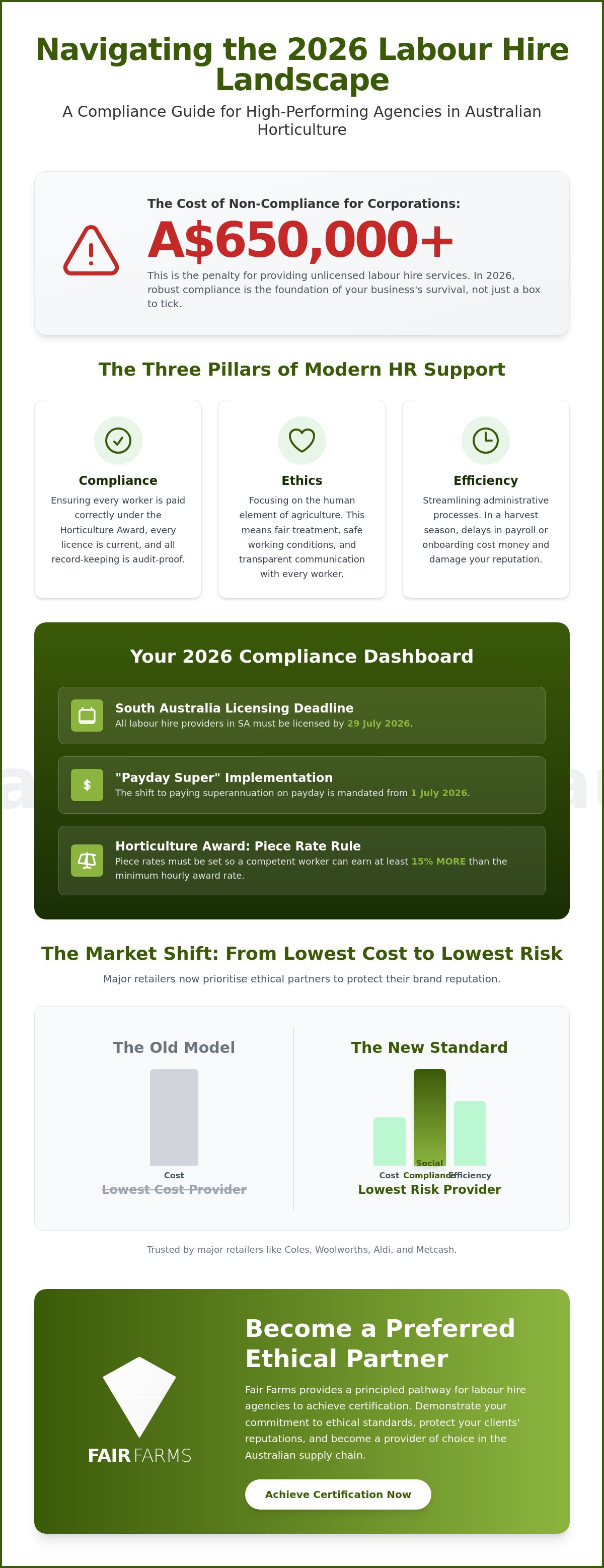
Across Australia, the penalty for providing unlicensed labour hire services has now climbed past A$650,000 for corporations. It's a sobering figure that underscores a hard truth: in 2026, compliance isn't just a box to tick; it's the foundation of your business's survival. You likely feel the weight of complex payroll calculations for the Horticulture Award and the constant need for robust HR Support for Labour Hire to navigate fragmented licensing schemes. It's exhausting to manage these administrative hurdles while trying to prove your value to major growers who are under their own ethical sourcing pressures.
This guide will show you how to turn these compliance challenges into a strategic asset. We'll help you understand how to streamline your processes, protect your reputation, and significantly reduce the risk of a Fair Work Ombudsman audit. We will walk you through the essential 2026 updates, from crucial national licensing deadlines to the shift toward "Payday Super," providing a clear path to becoming a trusted provider of choice in the Australian supply chain.
Key Takeaways
- Identify why specialist HR Support for Labour Hire is essential for managing the unique seasonal pressures and regulatory complexities of the Australian horticulture industry.
- Navigate the updated 2026 requirements for state-based licensing and the Horticulture Award to ensure your operations remain fully compliant and audit-ready.
- Understand the shift toward ethical sourcing and why social compliance has become the new benchmark for securing long-term contracts with major retailers.
- Implement practical strategies for robust worker inductions and clear communication channels to enhance safety and operational transparency across the supply chain.
- Discover how Fair Farms membership provides a principled pathway for agencies to achieve certification and be recognised as a preferred ethical partner.
What is HR Support for Labour Hire in the Horticulture Sector?
Specialist HR support in the horticulture sector is a highly specific discipline. It's designed to manage the unique seasonal ebbs and flows of regional agriculture while adhering to the strict regulatory framework governing Labour hire in Australia. Generic HR firms often struggle in this space because they lack granular knowledge of the Horticulture Award 2020 or the nuances of piecework rates. For an agency, HR Support for Labour Hire means having systems that handle 4:00 am starts, remote workforce management, and the complexities of the Horticulture Industry Labour Agreement (HILA) without missing a beat.
Modern labour hire HR stands on three essential pillars. First is compliance, ensuring every worker is paid correctly and every license is current. Second is ethics, which focuses on the human element of agriculture and fair treatment. Third is efficiency, because in a harvest season, administrative delays cost money. Specialised HR support acts as the vital bridge between meeting basic legal minimums and achieving true ethical excellence in the field.
The Evolving Landscape of Australian Labour Hire in 2026
The regulatory environment has shifted dramatically. With South Australia's licensing expansion in early 2026 and Victoria's massive penalties for unlicensed providers, the "she'll be right" attitude has become a liability. Major retailers like Coles, Woolworths, Aldi, and Metcash now explicitly look for suppliers who can demonstrate social compliance through programs like Fair Farms. They've moved from a "lowest cost" model to a "lowest risk" provider model. If you can't prove your HR systems are airtight, you're a significant risk to their brand reputation.
The Strategic Advantage of Specialised HR Support
Investing in robust HR isn't just about avoiding a Fair Work Ombudsman audit. It's a powerful tool for building trust with host employers. Growers are increasingly selective; they want partners who protect their reputation and ensure a stable workforce. High-quality HR Support for Labour Hire also addresses the 13% proficiency gap noted in early 2026 by focusing on better inductions and training. When workers feel their rights are protected and their pay is accurate, turnover drops, and your agency becomes a provider of choice in a competitive market.
Navigating the Compliance Maze: Licensing and Awards
Managing a legal workforce in 2026 is a high-stakes endeavour. With the national minimum wage currently set at A$24.95 per hour and the Superannuation Guarantee rate at 12%, the financial margin for error has never been thinner. For agencies, HR Support for Labour Hire is the only way to ensure these figures are applied correctly across diverse workforces. You've got to be across the Horticulture Award 2020, particularly the 2026 updates regarding paid parental leave increases to 26 weeks and the looming shift to "Payday Super" on 1 July 2026.
Payroll pitfalls often centre on piece rates and overtime. Under the Award, a piece rate must be set so a competent worker can earn at least 15% more than the minimum hourly award rate. If your records don't clearly demonstrate this calculation, you're exposed during an audit. Licensing authorities also look closely at the "suitable person" test. This isn't just about your past; it's an ongoing assessment of your financial viability, honesty, and ability to comply with workplace laws. Maintaining this status is essential for licence renewals and keeping your business operational.
Mastering the Horticulture Award and Fair Work Standards
Record-keeping is the first thing an auditor will ask for during a site visit. You need to track every hour worked, every break taken, and every casual loading payment made. Managing seasonal flux requires a strategy that balances worker availability with strict rest period requirements. Agencies seeking to stand out often pursue Fair Farms certification for labour hire to validate their systems and prove they operate well above the legal floor.
Labour Hire Licensing: A National Perspective
Cross-border compliance remains a significant challenge for agencies operating in multiple regions. While Victoria, Queensland, and the ACT have established schemes, South Australia has recently expanded its requirements. All labour hire providers in South Australia must be licensed by 29 July 2026. The risks of non-compliance are extreme; in Victoria, penalties for providing unlicensed services can exceed A$650,000 for corporations. Automating your compliance checks and staying informed through specialised membership resources can help you avoid these devastating fines and protect your host employers from vicarious liability.
The Shift to Ethical Standards: Beyond Legal Minimums
In the 2026 horticulture market, meeting basic legal requirements is simply the entry price for doing business. While we've discussed the heavy penalties for unlicensed operations, true industry leadership requires moving toward social compliance. This involves a shift from merely avoiding prosecution to actively demonstrating ethical responsibility. Specialist HR Support for Labour Hire provides the framework to prove your business treats workers with dignity, which is now a non-negotiable requirement for major retailers.
Legal compliance focuses on the "what" of employment law, such as paying the correct Award rate. Social compliance, however, focuses on the "how." It examines how you manage worker welfare, how you handle grievances, and how you ensure transparency across your entire operation. When your HR systems are built on these ethical pillars, you're naturally prepared for the rigorous third-party audits required by the Australian supply chain. While the cost of a single compliance breach can reach hundreds of thousands of dollars and result in total loss of market access, the value of an ethical certification lies in its ability to secure your commercial future as a trusted partner.
Meeting Retailer Expectations for Supply Chain Transparency
Major supermarkets now demand granular visibility into how labour is managed on the farms that supply them. They look for labour hire partners who can provide documented evidence of fair treatment. Small agencies often mistakenly believe they're exempt from Modern Slavery scrutiny due to their size, but the reality is that retailers apply these standards to their entire supply chain. Being a "Certified Ethical Provider" offers a distinct commercial advantage, as it removes the burden of proof from the grower and makes your agency the safest choice for their business.
Building a Culture of Fair Treatment
An ethical HR strategy includes robust grievance mechanisms that give workers a voice without fear of retribution. This isn't just about moral obligation; it's a critical tool for HR risk management that allows you to identify and resolve issues before they escalate into Fair Work claims. There's a clear link between ethical treatment and increased on-farm productivity, as workers who feel respected are more likely to be proficient and committed. By moving from transactional hiring to professional workforce management, you transform your agency into a stable, high-performing pillar of the agricultural community.
Practical HR Strategies for High-Performing Agencies
To thrive in the competitive 2026 landscape, agencies must move beyond basic administration to implement high-performance systems. Proactive HR Support for Labour Hire is the engine that drives this transition. It starts with a four-step framework designed to eliminate compliance gaps and build a resilient workforce. By standardising these processes, you move from a reactive stance to one of quiet confidence and operational excellence.
- Step 1: Implement a robust induction programme that covers workplace rights, safety, and modern slavery awareness.
- Step 2: Establish clear communication channels that link the host employer, the agency, and the worker in a transparent loop.
- Step 3: Standardise recruitment to ensure a "right fit" for specific roles, matching worker capability to the physical demands of different crops.
- Step 4: Conduct regular internal HR health checks and "mock audits" to ensure your record-keeping is always ready for official scrutiny.
Effective Induction and Onboarding for Seasonal Workers
A compliant induction is your first line of defence against workplace disputes. In the horticulture sector, this often requires multi-lingual HR resources to ensure every worker fully understands their Award entitlements. Don't wait for the first pay cycle to explain the details. Ensure workers can read their pay slips and understand how their casual loading is calculated from day one. This transparency builds immediate trust and helps close the proficiency gap, ensuring workers feel supported and informed as they begin their roles.
Managing the Host-Provider Relationship
The "host-provider" relationship is where many compliance errors occur if responsibilities aren't clearly mapped. To avoid these gaps, you must define "who does what" in the HR lifecycle through a formal agreement. While the host manages daily tasks on the farm, the agency remains the primary employer with a non-delegable duty of care. When performance issues or workplace disputes arise, have a documented process for resolution that involves both parties. Regular site visits are essential; having "boots on the ground" allows you to identify safety risks or grievances before they escalate. This collaborative approach ensures that both the agency and the grower remain protected and aligned in their ethical standards.
If you're ready to professionalise your operations and lead the industry in ethical standards, consider accessing our specialised HR Support for Labour Hire resources through a Fair Farms membership.
How Fair Farms Supports Labour Hire Providers
Fair Farms serves as a principled mentor for the horticulture industry, offering a dedicated pathway for agencies to demonstrate their commitment to fair employment. Our membership is designed to provide the specific HR Support for Labour Hire that generalist firms simply cannot offer. We understand that your business is more than just a recruitment agency; it's a vital link in the Australian food supply chain. By providing access to expert resources and structured training, we help you master complex Award requirements and licensing obligations with quiet confidence.
Our training modules are constantly updated to reflect the latest regulatory shifts, such as the 12% superannuation guarantee and the 2026 South Australian licensing expansion. These resources break down dense legislative language into instructional, actionable steps. This allows your team to focus on workforce productivity while we provide the governance framework necessary for legal and ethical excellence. It's about building a business that isn't just compliant, but one that leads by example.
The Path to Fair Farms Certification
Achieving certification is a journey of professional development rather than a simple administrative hurdle. The Fair Farms certification pathway begins with a comprehensive online self-assessment. This tool is critical for identifying hidden gaps in your current HR systems, from record-keeping to worker grievance mechanisms. Once you've addressed these areas using our educational resources, you'll move toward a formal third-party audit. This process doesn't just verify your compliance; it transforms your operational culture, ensuring you meet the high standards expected by major retailers and host employers alike.
Joining a Community of Ethical Providers
When you become a Fair Farms member, you aren't just ticking a box. You're joining a community of like-minded regional stakeholders who value communal progress and integrity. This network connects you with growers who prioritise ethical labour hire partners, effectively opening doors to new commercial opportunities. Staying ahead of the curve is simple when you have access to regular industry updates and specialised training sessions. If you're ready to lead the industry and secure your place as a provider of choice, contact the Fair Farms team today to begin your journey toward certification.
Securing Your Position in the Ethical Supply Chain
The landscape of 2026 requires a fundamental shift in how labour hire agencies operate. You've seen that avoiding penalties is no longer enough; success now depends on your ability to demonstrate social compliance and ethical leadership. By mastering the Horticulture Award and staying ahead of state-based licensing updates, you protect your business and the growers you serve. Professional HR Support for Labour Hire is the key to transforming these regulatory burdens into a competitive advantage that major retailers trust.
Fair Farms is an industry-led initiative by QFVG, specifically designed to help you navigate this journey. Our program is recognised by major Australian retailers and provides specialised horticulture HR training modules tailored to your unique seasonal needs. Don't leave your compliance to chance in an increasingly transparent market. Become a Fair Farms Labour Hire Member and secure your supply chain future.
The path toward ethical excellence is a collective effort that strengthens the entire agricultural sector. We're here to support you as a trusted partner, ensuring your agency remains a resilient and respected pillar of the community.
Frequently Asked Questions
Do I need a labour hire licence if I only provide workers for one farm?
Yes, you generally need a licence regardless of the number of clients you serve. In states like Victoria, Queensland, and South Australia, the law applies if you provide a worker to do work for another person in the course of your business. The scale of your operation doesn't exempt you from these mandatory state-based licensing schemes; providing even a single worker requires you to be a licensed and suitable provider.
How does the Horticulture Award 2020 affect piece rate payments in 2026?
The Award requires that pieceworkers must be able to earn at least 15% more than the minimum hourly rate for their classification. You must ensure that even if a worker is on a piece rate, they never earn less than the minimum hourly rate for the actual hours they've worked. This "minimum wage floor" is a critical protection that requires diligent record-keeping and regular rate reviews to ensure compliance.
What is the difference between an HR consultant and an ethical certification body?
An HR consultant typically provides internal advice and administrative tools, while an ethical certification body like Fair Farms offers a structured framework for industry-wide recognition. While consultants help you manage daily tasks, a certification body provides a transparent, third-party verified "stamp of approval." This certification is what major retailers look for to verify your social compliance across the supply chain.
Can a grower be held liable for a labour hire agency’s payroll mistakes?
Yes, host employers can be held liable under "accessorial liability" provisions if they knew or should have known about a provider's breach. This is why many growers now insist on HR Support for Labour Hire that includes transparent auditing and certification. It's a shared responsibility to ensure every worker in the supply chain receives their legal entitlements and is treated fairly under Australian law.
What are the most common compliance gaps found in horticulture HR audits?
The most frequent gaps include inadequate record-keeping of hours worked, incorrect application of casual loading, and missing multi-lingual induction records. Many agencies also fail to document their piecework rate calculations correctly or lack a formal grievance mechanism. Ensuring these foundational documents are accurate and accessible is the first step toward passing a formal audit and maintaining your labour hire licence.
How much does Fair Farms membership cost for a labour hire agency?
Membership fees are structured based on the type of business you operate and the pathway you choose for certification. We don't provide specific dollar amounts here as fees are reviewed periodically to reflect the level of support and resources provided. We encourage you to visit our membership page or contact us directly to discuss the most appropriate membership level for your agency's professional development.
Is Fair Farms certification recognised by major Australian retailers?
Yes, Fair Farms certification is officially recognised by major Australian retailers including Coles, Woolworths, Aldi, and Metcash. These retailers accept our certification as evidence that a supplier meets their strict ethical sourcing policies. This recognition helps streamline the audit process for growers and ensures that certified labour hire providers remain preferred partners in the national agricultural supply chain.
What should be included in a labour hire worker’s employment contract?
A robust contract should clearly state the worker's classification under the Horticulture Award, their pay rate including casual loading, and their specific duties. It must also include clear information on superannuation, leave entitlements, and safety obligations. Providing this information in the worker's primary language is a best practice that ensures true transparency and helps satisfy HR Support for Labour Hire requirements for social compliance.