
Farm Record Keeping Requirements: A Guide to Compliance for Australian Growers

What if the most critical tool for your harvest isn't the machinery in the shed, but the "moral ledger" you maintain in the office? For many Australian growers, meeting farm record keeping requirements feels like a secondary burden to the physical demands of the land. It's easy to feel overwhelmed by the volume of paperwork needed to prove compliance, especially with the national minimum wage rising to $26.44 per hour as of 1 July 2026. You likely worry about the threat of heavy fines or the confusion of balancing Fair Work standards with Quality Assurance programs.
We understand that your priority is running a productive, ethical business that supports the local community. This guide will help you master your essential record-keeping obligations under Australian law, ensuring you protect your farm and remain audit-ready. We'll provide a clear checklist of required documents and show you how to streamline seasonal labour management. By the end of this article, you'll have the confidence to navigate the latest Fair Farms Standard Version 4.0 and ensure your workplace remains a fair and safe environment for everyone.
Key Takeaways
- Understand how the Fair Work Act and Horticulture Award dictate the rigorous documentation standards required for modern retail supply chains.
- Identify the essential payroll and personnel documents needed to satisfy farm record keeping requirements, including precise time-and-wage data for all staff.
- Master the documentation of ethical standards, from conducting thorough worker inductions to verifying VEVO checks for visa-holding employees.
- Learn why the seven-year retention rule is vital and how to choose between digital and paper systems to ensure your business is always audit-ready.
- Discover how Fair Farms membership and online training provide the specialised HR support needed to streamline your compliance processes.
Understanding the Australian Farm Record Keeping Landscape
The regulatory environment for Australian agriculture has shifted significantly. It's no longer just about the harvest; it's about the data behind it. The intersection of the Fair Work Act 2009 and the Horticulture Award creates a complex framework that every grower must navigate. While many are familiar with operational tracking, such as the National Livestock Identification System (NLIS) for animal traceability, the focus has broadened to include the ethical treatment of people. Meeting modern farm record keeping requirements is now a central pillar of business survival and industry integrity.
Major retailers and supply chain partners no longer accept "good enough" documentation. They require granular proof that every worker is treated fairly and paid correctly. The Fair Work Ombudsman (FWO) actively monitors compliance, ensuring that the National Employment Standards (NES) are upheld on every property. These standards represent the minimum safety net for employees, covering aspects such as:
- Maximum weekly hours of work
- Requests for flexible working arrangements
- Parental leave and related entitlements
- Annual leave, personal leave, and public holidays
Without precise records, you cannot prove you've met these obligations. This lack of evidence leaves your business vulnerable during even a routine spot check by the FWO.
Legal Obligations vs. Ethical Standards
There is a distinct difference between keeping records for the tax office and maintaining evidence of ethical employment. While mandatory tax records focus on the bottom line, ethical standards require proof of fair treatment, safety inductions, and correct award application. The Australian horticulture sector is moving toward total transparency. Major supermarkets now demand evidence of ethical labour practices before they'll even consider a supply agreement. This shift means that your farm record keeping requirements are your ticket to market access. High-quality documentation proves that your farm isn't just profitable, but principled.
The Consequences of Non-Compliance
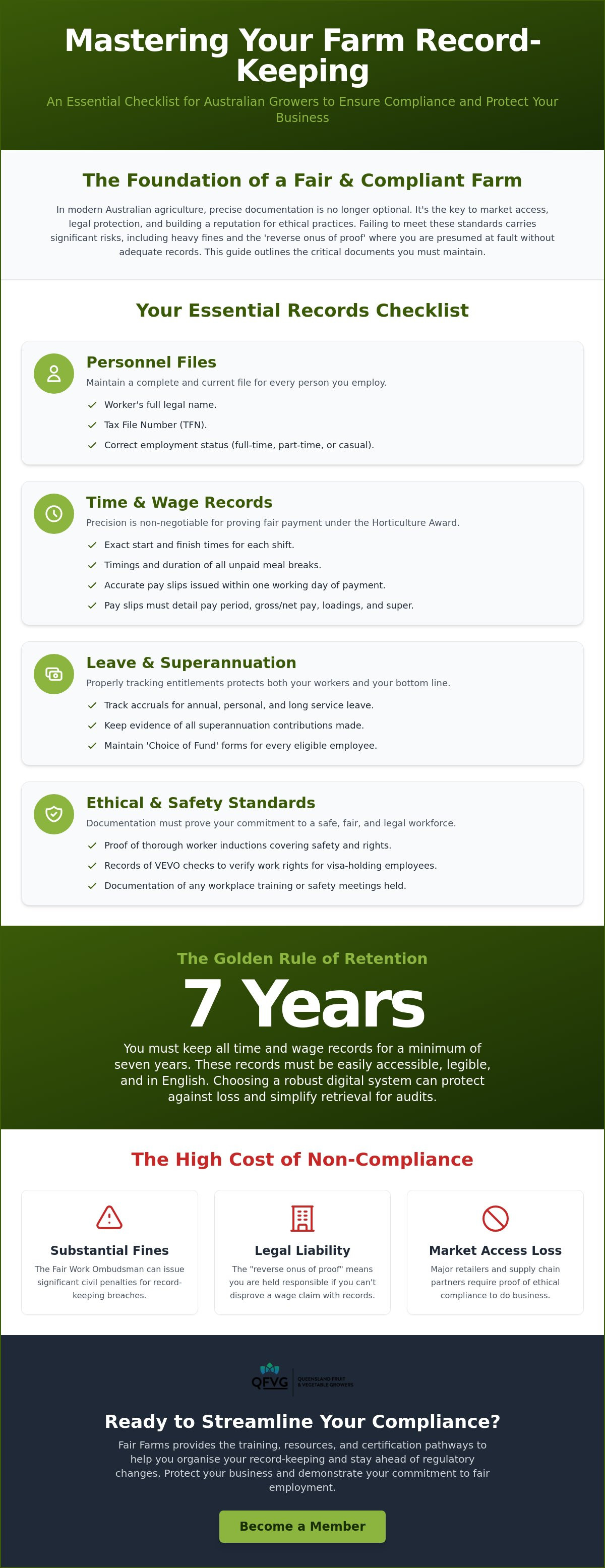
Neglecting your documentation carries heavy risks. The FWO can issue infringement notices and substantial civil penalties for record-keeping breaches. Perhaps most daunting is the "reverse onus of proof" introduced in recent years. If an employee makes a claim about unpaid wages and you lack the required records, the law often presumes the employee's claim is correct unless you can prove otherwise. Beyond the financial hit, the reputational damage within your regional farming community can be irreparable. Maintaining integrity in your paperwork protects both your bank balance and your name. Becoming a member of a recognised industry body can help you stay ahead of these regulatory changes and protect your legacy.
Essential Personnel and Payroll Records for Growers
While yield data and harvest logs help you manage your crop, payroll and personnel records protect your business's future. Accurate documentation is the first line of defence in meeting farm record keeping requirements. You must maintain a comprehensive file for every worker that includes their full name, Tax File Number (TFN), and employment status. Whether a worker is full-time, part-time, or casual, their status dictates their specific entitlements under the Horticulture Award, and misclassification can lead to significant back-pay liabilities.
Precision is vital when tracking time and wages. You cannot simply record "eight hours worked" and expect to pass an audit. You must document exact start and finish times, including the timing of unpaid meal breaks. This data ensures that pay slips, which you must issue within one working day of payment, are accurate. Every slip needs to clearly show the pay period, gross and net amounts, any loadings, and superannuation contributions. Tracking leave accruals for annual, personal, and long service leave is equally critical to ensure your balance sheet reflects your true labour liabilities.
Superannuation compliance is another area where "near enough" is never good enough. You're required to keep evidence of all contributions made and maintain choice of fund forms for every eligible employee. If you're looking to streamline these processes, our Fair Farms training and certification pathways provide the structured framework needed to keep your office as organised as your orchard.
The Horticulture Award and Piecework Records
The Horticulture Award has specific, rigorous rules for pieceworkers. You must keep written piecework agreements on file and document that your rates allow a worker of average competence to earn at least 15% more than the minimum hourly rate. Crucially, your records must prove that every pieceworker has achieved the "minimum wage floor" for every shift. This means if their piecework earnings fall below the hourly rate for their level, you've documented the top-up payment to meet the legal minimum.
Allowances and Deductions
Your records must show clear evidence for all allowances paid, including overtime, shift work, and public holiday rates. If you provide on-site accommodation or transport, any payroll deductions require the worker's explicit written consent. These agreements must be kept on file and clearly state the amount and purpose of the deduction. Without this written proof, even a mutually beneficial arrangement could be flagged as a breach of the Fair Work Act during a formal inspection.
Documenting Ethical Standards and Workplace Safety
Compliance extends far beyond the payroll office. To truly meet modern farm record keeping requirements, you must document the safety and dignity of every person on your property. This begins with robust induction records. An induction isn't just an informal chat; it's a structured process where you provide proof that workers understand safety protocols and conduct expectations. For visa-holding employees, you must maintain evidence of Right to Work via Visa Entitlement Verification Online (VEVO) checks. Failing to verify a worker's status can lead to severe legal repercussions and immediate disqualification from ethical supply chains.
Workplace Health and Safety (WHS) documentation is quite literally a matter of life and death. Since 2001, there have been 1,705 fatalities on Australian farms. Accidents involving farm vehicles or mobile machinery account for 32% of these deaths. Your records must include detailed incident reports and proactive risk assessments that identify hazards before they cause harm. For example, you should have documented proof that all tractors are fitted with a Rollover Protection Structure (ROPS), as required by the model WHS Act. Training logs are equally vital. You need to keep copies of machinery tickets and chemical handling certifications to prove that your team is competent and authorised to perform their tasks.
Modern Slavery and Supply Chain Integrity
Ethical leadership means looking beyond your own gate. If you use labour hire providers, you must request and store documents that prove they're paying their workers correctly and treating them fairly. This due diligence is a key part of modern slavery prevention. You should also maintain evidence of worker grievance mechanisms. This shows that you've communicated a clear, safe way for staff to report issues without fear of retribution. It's about building a culture of accountability that resonates throughout the entire regional agricultural sector.
Accommodation and Transport Standards
When you provide housing or transport, your record-keeping duties expand. You should maintain safety checklists for farm-provided housing to ensure living conditions remain decent and safe. For transport, keep vehicle maintenance logs and verify the driver's licences of anyone operating farm vehicles. If you charge for these services, you must keep proof of fair pricing. This ensures that costs aren't being used as a hidden way to reduce a worker's take-home pay, which is a critical point of interest for any ethical auditor.
Organising Your System for Audit Readiness
Having the right information is only half the battle. How you store and retrieve that data determines whether an audit is a minor check-up or a major business disruption. Under the Fair Work Act 2009, Australian growers must adhere to strict farm record keeping requirements, which include keeping employment records for seven years. This 7-year rule applies to everything from time-and-wage sheets to piecework agreements. If you can't produce a pay slip from six years ago when requested, you're technically in breach of the law.
While a simple notebook or diary might seem practical in the paddock, it rarely stands up to the rigours of a modern HR audit. Paper systems are prone to damage, loss, or illegible handwriting. Digital systems, on the other hand, offer searchable, secure, and backed-up data. However, moving to a digital platform requires a focus on data security. You're handling sensitive worker information, including TFNs and bank details. Protecting this privacy isn't just good practice; it's a requirement under the Privacy Act. Ensuring your digital locks are as strong as your physical ones is a hallmark of a professional operation.
Don't wait for an official notice to check your files. Conducting regular "mock audits" allows you to find and fix compliance gaps before they become liabilities. It's a proactive way to ensure your business reflects your ethical values and remains resilient against scrutiny. If you're unsure where to start with your internal review, you can contact our team for guidance on aligning your systems with industry standards.
Step-by-Step: Preparing for a Certification Audit
To ensure a smooth review process, start by collating all payroll data for the specific audit period requested. Verify that every employee contract and piecework agreement is signed and dated by both parties. You must also ensure your Fair Farms membership details are current, as this forms the basis of your certification journey. Finally, organise your records by category, such as recruitment, payroll, and safety, to help the auditor navigate your documentation efficiently. This level of organisation demonstrates your commitment to transparency and ethical leadership.
Maintaining Records in the Field
Accuracy starts at the source. Using mobile apps to capture real-time time-and-attendance data reduces the risk of errors that occur when transcribing paper logs later in the week. Supervisors play a vital role here. They must be trained to ensure field records are precise and completed daily. Centralising this data from multiple farm blocks into a single digital hub ensures you have a single source of truth for your entire operation. This methodical approach not only simplifies compliance but also provides valuable insights into your workforce productivity.
How Fair Farms Membership Simplifies Compliance
Meeting the complex web of Australian agricultural regulations is a significant undertaking. You don't have to manage these pressures in isolation. Fair Farms provides a principled framework that transforms compliance from a daunting hurdle into a streamlined part of your daily operations. Through our specialised HR support tailored for Australian horticulture, we help you translate legislative requirements into practical, actionable steps on the ground. This support is designed to build your confidence, ensuring you feel prepared for any regulatory scrutiny.
Educating your management team is a vital component of this journey. Our online training modules empower your staff with the knowledge they need to uphold your farm's integrity. These resources ensure that every person in a leadership role understands their responsibilities, from correct award application to maintaining the highest safety standards. By investing in this education, you build a resilient business culture that values equity and accountability. It's a proactive approach that protects your employees and your reputation simultaneously.
The Fair Farms Certification Pathway
Your journey begins with an online self-assessment tool. This diagnostic process is designed to highlight any existing gaps in your farm record keeping requirements, allowing you to address them before they become legal or financial risks. Once you've refined your processes and feel ready, you can move toward full Fair Farms certification. This pathway includes a rigorous third-party audit, which serves as a powerful signal to major retailers and supply chain partners. It proves that your produce isn't just high quality, but is grown under conditions that meet the highest ethical standards in the country.
Join a Community of Ethical Growers
Membership offers more than just a checklist; it connects you with a community of like-minded professionals. Networking with other growers allows you to share best practices and find practical solutions to common compliance challenges. We also ensure you stay updated on any shifts in the Horticulture Award or Fair Work rules, protecting you from the risks of outdated information. This communal progress strengthens the reputation of the entire regional agricultural sector. If you're ready to secure your farm's future and demonstrate your commitment to fair treatment, contact Fair Farms today to start your compliance journey.
Securing Your Farm’s Future Through Ethical Leadership
Mastering farm record keeping requirements is more than a legal necessity; it’s a commitment to the people who power your property and the legacy you’re building. By maintaining precise payroll data and robust safety logs, you create a business that is resilient, transparent, and prepared for any audit. These systems don't just protect you from regulatory risks; they serve as a badge of honour that opens doors to major retail supply chains across the country.
You don't have to navigate this complex terrain alone. Fair Farms is a dedicated industry-led initiative by QFVG, recognised by major Australian retailers for its commitment to workplace standards. We provide specialised HR support for growers, offering the practical training and tools needed to transform overwhelming paperwork into a streamlined system of accountability. This partnership ensures you stay ahead of award changes while fostering a fair environment for your entire team.
Become a Fair Farms Member and Access HR Support to begin your journey toward a more secure and ethical operation. Taking these steps today protects your business and strengthens our regional agricultural community for the long term.
Frequently Asked Questions
How long must I keep farm employment records in Australia?
You must keep all employment records for a minimum of seven years. This requirement covers time and wage records, leave accruals, and superannuation contributions for every staff member. Maintaining these files ensures you can respond to retrospective claims or official audits, protecting your business from the "reverse onus of proof" that applies when documentation is missing. It is a critical safeguard for your business reputation and legal standing.
Do I need a written agreement for piecework under the Horticulture Award?
Yes, you must have a written piecework agreement in place before a worker starts piecework under the Horticulture Award. This document must clearly state the piecework rate and how it was calculated to ensure a "competent person" can earn at least 15% above the minimum hourly rate. Every worker must also be guaranteed the minimum wage floor for every shift they work, regardless of their individual productivity levels during that period.
What information must be included on a worker’s pay slip?
Every pay slip must include the employer’s name and ABN, the employee’s name, the pay period, and the date of payment. You also need to list the gross and net amounts, any loadings or penalty rates, and the name and amount of superannuation contributions. Providing this information within one working day of payment is a core part of meeting farm record keeping requirements and ensuring total payroll transparency for your workforce.
Can I keep my farm records digitally, or do I need paper copies?
You can keep records either digitally or on paper, provided they are legible and readily accessible in English. Digital systems are often preferred because they reduce the risk of physical damage and make it easier to search for specific data during a compliance review. Regardless of the format, you must ensure that sensitive worker information is stored securely to comply with Australian privacy standards and protect your employees' personal data.
What happens if I lose my records before an audit?
Losing your records is considered a breach of the Fair Work Act and can lead to significant civil penalties for your business. If an employee makes a claim for unpaid wages and you cannot produce the required evidence, the court may presume the employee’s claim is correct. This highlights why conducting regular internal audits and using secure cloud-based backups are essential strategies for maintaining your farm record keeping requirements over the long term.
Are labour hire workers my responsibility when it comes to record keeping?
While the labour hire provider is the primary employer, you share a legal and ethical responsibility to ensure those workers are treated fairly on your property. You should request and store documentation from your provider that proves they are meeting their payroll and safety obligations. This due diligence protects your supply chain integrity and ensures that everyone on your farm is working under safe, compliant, and ethical conditions.
What records are required for seasonal workers on temporary visas?
For workers on temporary visas, you must keep records of their Right to Work, including Visa Entitlement Verification Online (VEVO) checks. You should also maintain copies of their passport and monitor any specific work hour limitations attached to their visa subclass. Documenting these checks proves you are conducting the necessary due diligence to prevent illegal work practices and uphold the highest standards of supply chain ethics within the horticulture industry.