
Social Compliance Audit for Horticulture: The Complete Guide for Australian Growers

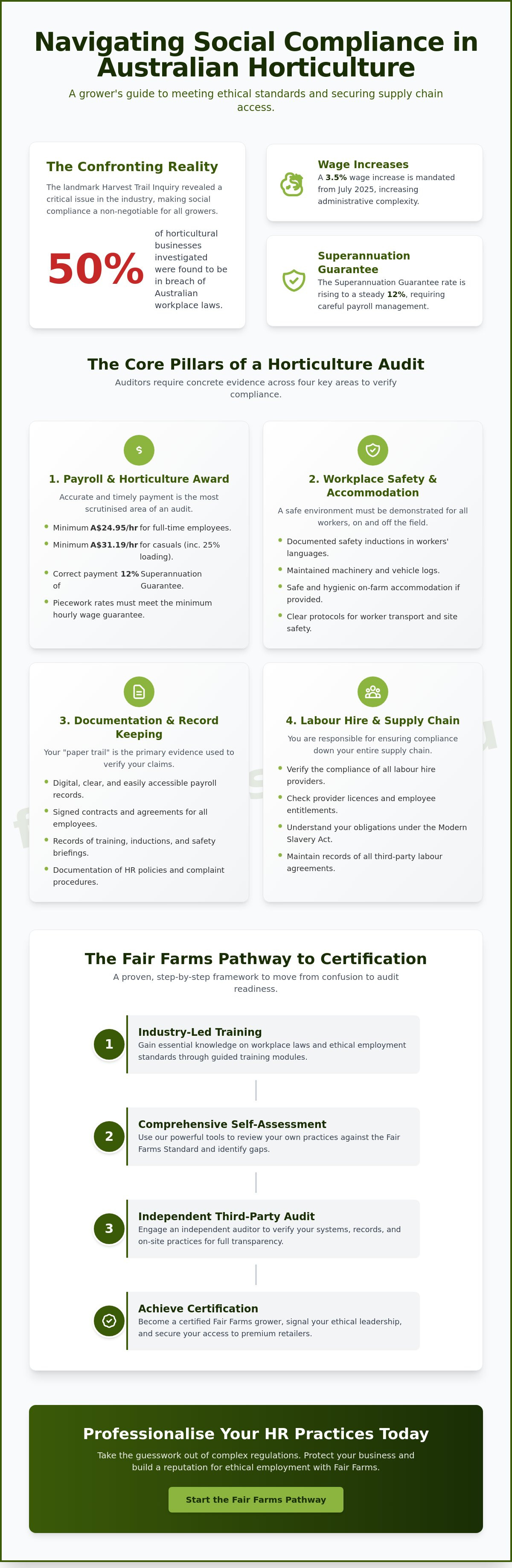
Did you know that the landmark Harvest Trail Inquiry found that 50% of the 638 horticultural businesses investigated were in breach of Australian workplace laws? This confronting statistic highlights why a social compliance audit horticulture Australia has moved from a "nice to have" to a non-negotiable requirement for staying in the national supply chain. We understand that between managing the 3.5% wage increase from July 2025 and keeping up with the 12% Superannuation Guarantee rate, the administrative burden on Australian growers has never been heavier.
It's completely normal to feel overwhelmed by the constant updates to the Horticulture Award or the mounting pressure from major supermarkets to prove your ethical standards. This guide promises to cut through the confusion, offering you a streamlined path to certification that protects your farm business and ensures a fair go for your workforce. We'll explore the specific audit requirements for 2026, detail the latest pay rates like the A$24.95 hourly minimum, and provide a clear framework to professionalise your HR practices and secure your future with premium retailers.
Key Takeaways
- Gain a clear understanding of why independent assessments are now essential for maintaining access to major Australian retail supply chains.
- Master the core pillars of a social compliance audit horticulture Australia by ensuring your wage records and safety protocols align with the latest Horticulture Award requirements.
- Follow a proven, step-by-step pathway to certification by utilising industry-led training and comprehensive self-assessment tools.
- Protect your business from common audit failures by learning how to document your "paper trail" and verify the compliance of your labour hire providers.
- Professionalise your farm's human resources with dedicated support designed to take the guesswork out of complex regulatory changes and ethical employment standards.
What is a Social Compliance Audit in Australian Horticulture?
A Social audit in the context of farming is an independent, third-party assessment of a business's commitment to its people. Unlike a standard financial audit, a social compliance audit horticulture Australia examines the human element of your operations. It verifies that your farm isn't just growing quality produce, but is also fostering a safe, legal, and fair environment for every worker on site. This process moves beyond simple guesswork; it provides a structured way to prove you're meeting both legal obligations and industry expectations through a rigorous review of your records and site practices.
For the Australian horticulture sector, these audits are about protecting our collective reputation. When one farm fails to meet standards, it impacts the "fair go" identity we've worked hard to build. It's vital to distinguish between a legal inspection and a voluntary certification. While a Fair Work Ombudsman inspection is a mandatory legal check focused on compliance with the Fair Work Act, a voluntary industry certification audit is a proactive business strategy. It signals to the market that you're a leader in ethical employment and a reliable partner in the national food chain.
The Driving Forces Behind Ethical Auditing
The shift toward mandatory auditing isn't happening in a vacuum. Major Australian retailers, including Coles, Woolworths, and Aldi, have implemented strict ethical sourcing policies that require their suppliers to undergo regular third-party assessments. This commercial pressure is reinforced by the Modern Slavery Act 2018, which requires large entities to report on risks within their supply chains. Today's consumers are also more informed. They want to know that the fruit and vegetables in their trolley were produced without exploiting workers, with recent industry data showing that ethical production is a primary concern for the modern Australian shopper.
Key Terminology for Australian Growers
It's helpful to distinguish between Quality Assurance (QA) and social compliance. While QA focuses on food safety and product standards, social compliance focuses on the people. Social compliance is the verification of fair wages, safe conditions, and lawful treatment. The Fair Work Ombudsman sets the legal baseline for pay and conditions, but an audit provides the evidence that you're actually meeting those benchmarks daily. Preparing for this level of scrutiny requires a clear roadmap. Many growers find that following the Fair Farms Pathways provides the necessary structure to move from internal confusion to audit readiness. This systematic approach ensures your documentation is robust enough to satisfy both regulators and retail partners.
The Core Pillars of a Horticulture Social Compliance Audit
A successful social compliance audit horticulture Australia relies on more than just good intentions; it requires concrete evidence of rigorous systems across four key areas. Auditors look for a culture of transparency that starts in the office and extends to the furthest row of the orchard. By categorising these requirements into clear pillars, growers can move away from reactive fixes and toward a sustainable business model that satisfies both the law and retail partners. It's about ensuring that every person on your property is treated with the dignity they deserve.
Payroll and the Horticulture Award
Getting the numbers right is the most common hurdle for growers during an audit. As of 1 July 2025, the national minimum wage is A$24.95 per hour for full-time employees and A$31.19 for casuals, inclusive of the 25% loading. Auditors scrutinise payroll to ensure these rates, along with the 12% Superannuation Guarantee, are paid correctly and on time. Since the introduction of the piecework minimum wage guarantee, every pieceworker must earn at least the hourly rate for their classification. Common non-conformances often stem from failing to document these "minimum floor" calculations or neglecting to update rates following the annual wage review. Clear, digital record-keeping is your best defence against these traps.
Workplace Safety and Farm Accommodation
Safety standards extend well beyond the field. Auditors inspect packing sheds, machinery maintenance logs, and even worker transport systems. Documented safety inductions are essential; they must be provided in a language the worker understands to be truly effective. If you provide on-farm accommodation, it must meet basic hygiene and safety standards, and any charges must be fair and transparent. Managing heat stress is another critical focus, especially given the Australian climate. You need a clear policy for outdoor work during extreme conditions to protect your team and your compliance status.
Managing third-party contractors is equally vital. Under current regulations, you share responsibility for the treatment of workers brought on-site by labour hire providers. Verifying their licences and auditing their payroll practices is no longer optional. It's about ensuring a workplace free from coercion where freedom of association is respected. If you're unsure where to start with these categories, exploring Fair Farms certification pathways can help you identify gaps in your current systems. Fostering these ethical practices doesn't just pass an audit; it builds a resilient workforce. You can learn more about the certification process to see how these pillars fit into your daily operations at fairfarms.com.au.
The Fair Farms Pathway: Preparing for Your Audit
Preparing for a social compliance audit horticulture Australia doesn't have to be a source of anxiety. By following a structured pathway, you can transform the process from a daunting inspection into a valuable business health check. The Fair Farms journey is designed to support growers through five logical phases that move your business toward verified ethical status:
- Step 1: Join a recognised industry programme to access the necessary training and resources.
- Step 2: Complete a comprehensive Self-Assessment Questionnaire (SAQ) to baseline your current compliance.
- Step 3: Engage in targeted training to bridge identified gaps in your HR or safety systems.
- Step 4: Organise an on-site audit with an approved independent, APSCA-registered body.
- Step 5: Achieve certification and share your verified status with your retail supply chain.
The Importance of the Self-Assessment
The Self-Assessment Questionnaire (SAQ) is your most powerful tool. Think of it as a mock audit that reveals your vulnerabilities before an external auditor sets foot on your property. Many growers discover they lack formalised grievance procedures or written anti-discrimination policies during this stage. Using Fair Farms training allows you to bridge these gaps systematically. This is particularly important when you consider findings from the Horticulture Compliance Report, which highlighted widespread issues with record-keeping and pay slip accuracy across the sector. Addressing these internal issues early saves time and reduces the risk of non-conformance during the final inspection.
Selecting an Auditor and Booking the Site Visit
When you're ready to book, ensure your auditor is registered with the Association of Professional Social Compliance Auditors (APSCA). An industry-approved professional understands the unique pressures of Australian farming. During the site visit, expect a thorough tour that includes private worker interviews and a deep dive into your payroll software. It's helpful to explain the audit's purpose to your staff beforehand. When workers understand that the audit is there to ensure their "fair go" and protect the farm's future, they're more likely to speak openly and confidently. Completing a social compliance audit horticulture Australia is the final hurdle to securing your spot in the premium supply chain, so professional preparation is key.
Avoiding Common Compliance Gaps and Audit Failures
Many growers approach their first inspection with the belief that being a "good boss" is enough to pass. However, a social compliance audit horticulture Australia is an evidence-based process where verbal assurances carry no weight. The most common reason for audit failure isn't a lack of intent, but a lack of documentation. If a practice isn't recorded, in the eyes of an auditor, it simply didn't happen. This "paper trail trap" can catch out even the most well-meaning farm businesses, especially during the height of harvest when administrative duties often take a back seat to operational demands.
Deductions and charges are another area where compliance gaps frequently emerge. If you provide transport or accommodation, any costs deducted from a worker's pay must be authorised in writing and must be principally for the employee's benefit. Auditors look closely to ensure these charges don't dip an employee's take-home pay below the legal minimums set by the Horticulture Award. Similarly, induction records are vital. You must be able to prove that every seasonal worker, regardless of how short their stay, received training on their rights and safety protocols before they started work.
Mastering Record-Keeping for Payroll
Under the Fair Work Act, you're required to keep employee records for a minimum of seven years. These must be legible, in English, and readily accessible for inspection. While paper-based systems are still acceptable, they're often inefficient during a social compliance audit horticulture Australia, as finding specific documents can take hours. Digital records allow for faster searching and better accuracy. Regardless of the format you choose, auditors prioritise time-and-wages records above all other evidence. Ensuring these records include start and finish times, break periods, and specific piecework details is the most effective way to demonstrate your compliance.
Managing Labour Hire Risks
When you use third-party contractors, you don't outsource your ethical responsibility. Under Australian law, host employers can be held jointly responsible for worker welfare and pay breaches. You must conduct thorough due diligence on any labour hire provider before they set foot on your property. This includes verifying they hold a valid licence in states like Queensland, Victoria, South Australia, or the ACT. Utilising Fair Farms memberships allows you to vet your supply chain partners more effectively and ensures you're only working with compliant operators. Taking this proactive step protects your business from the reputational and legal fallout of a contractor's mistakes. To ensure your contractors meet the same high standards you do, become a Fair Farms member today and access our full suite of supply chain vetting tools.
Fostering Ethical Practice with Fair Farms Support
Completing a social compliance audit horticulture Australia is a significant milestone, but it shouldn't be the end of your journey. At Fair Farms, our mission is to move beyond mere compliance and help growers lead the way in responsible employment. We believe that a farm business built on ethical foundations is inherently more resilient. By providing dedicated HR support, we take the guesswork out of complex regulatory shifts, such as the tightened Level 1 classification requirements introduced in April 2025. This allows you to focus on what you do best: growing world-class produce for the Australian market.
Adopting these standards does more than satisfy a retail contract; it transforms your reputation as an employer. In an industry where seasonal labour is often scarce, being known for a "fair go" is your greatest competitive advantage. When you treat workers with respect and ensure every cent is accounted for, you attract and retain the best talent. You aren't just a farm owner; you're part of a community of 452 certified businesses (as of May 2025) that are collectively raising the bar for the entire sector. This communal progress fosters trust with consumers and secures the long-term viability of our industry.
Beyond the Audit: Continuous Improvement
Viewing compliance as a management tool rather than a hurdle can lead to surprising gains in productivity. Clearer communication and better-organised records reduce friction on site and minimise time-wasting errors. To stay ahead of the curve, our members access the Fair Talk newsletter, which provides regular updates on changes like the upcoming "Payday Super" requirements starting in July 2026. This transition from being "audit-ready" to "culture-first" ensures that fair and responsible employment practices become a natural part of your daily operations, rather than an annual stress.
Next Steps for Your Farm
The best time to prepare for the 2026 harvest season is now. Taking a proactive approach allows you to identify and fix system weaknesses without the pressure of a looming retail deadline. You can begin your journey by registering for a membership, which provides immediate access to our online training modules and self-assessment tools. If you have specific questions about how the process applies to your unique setup, you can reach out to the Fair Farms contact team for one-on-one guidance. We're here to support you in protecting your business, your workers, and the future of Australian horticulture.
Securing Your Farm's Future through Ethical Leadership
Mastering the social compliance audit horticulture Australia is about more than ticking boxes; it's about building a robust business that thrives in a transparent market. By professionalising your record-keeping and aligning with the Horticulture Award, you protect your operation from regulatory risks and secure your place in premium supply chains. This journey transitions your farm from reactive compliance to a culture of fairness that attracts the industry's best seasonal workers.
Fair Farms was developed by Queensland Fruit & Vegetable Growers (QFVG) as an industry-led and government-supported initiative. Today, it stands as a trusted framework recognised by major Australian retailers, ensuring that growers have the tools they need to succeed without the guesswork. You don't have to navigate these complex standards alone. Join Fair Farms today and start your pathway to ethical certification to demonstrate your commitment to a fair go for every worker on your land. We look forward to supporting your progress toward a more resilient and reputable future in Australian agriculture.
Frequently Asked Questions
How much does a social compliance audit cost for an Australian farm?
Audit fees are set by independent auditing bodies and depend on your farm's size, location, and the number of workers on site. While Fair Farms provides the training and certification framework, you'll pay the on-site audit fee directly to your chosen third-party provider. Currently, Fair Farms membership for the Audit Pathway is A$250 per year, but we recommend requesting quotes from several approved auditors to accurately budget for the inspection itself.
Is Fair Farms certification mandatory for all horticulture growers?
Certification isn't a legal requirement under the Fair Work Act, but it's often a mandatory commercial condition for supplying major retailers. Supermarkets like Coles, Woolworths, and Aldi require third-party proof of ethical sourcing to satisfy their own reporting obligations under the Modern Slavery Act 2018. Even if your current buyers don't require it, becoming certified is a proactive way to professionalise your HR and protect your farm's reputation.
How long does the Fair Farms certification process take from start to finish?
The timeline for a social compliance audit horticulture Australia typically spans three to six months. This timeframe includes joining the program, completing the Self-Assessment Questionnaire (SAQ), and attending any necessary training to bridge identified gaps. We suggest starting the process at least four months before your peak harvest to ensure you can book an auditor and finalise your certification without the pressure of a busy season.
Can I use one audit to satisfy multiple supermarket retailers?
Yes, one of the greatest benefits of the Fair Farms program is its broad acceptance across the Australian retail landscape. Instead of undergoing separate, repetitive inspections for every customer, you can share your single certification status with multiple supply chain partners. This industry-led approach significantly reduces "audit fatigue" and streamlines your administrative workload, allowing you to focus on the day-to-day running of your farm.
What happens if an auditor finds a "non-conformance" on my farm?
A non-conformance isn't an automatic failure; it's a signal that a specific system needs adjustment. You'll receive a report detailing the issues and will be asked to complete a Corrective Action Plan (CAP) within a set timeframe. Once you provide evidence that these gaps have been closed, such as updated payroll records or improved safety inductions, the auditor will clear the non-conformance and your certification can proceed.
Do I need a social compliance audit if I only employ family members?
If your farm is strictly family-owned and operated with no external staff or contractors, you generally don't need a formal audit. However, the moment you hire a seasonal worker or engage a labour hire provider, you're required to demonstrate compliance with the Horticulture Award. You should always check your specific supply contracts, as some retailers may still require a formal declaration of your family-only status to maintain your supplier listing.
How often do I need to renew my social compliance certification?
Renewal typically occurs every one to three years, depending on the risk rating assigned during your previous audit. Farms that demonstrate high standards and have zero major non-conformances are often rewarded with longer intervals between on-site inspections. Maintaining your annual Fair Farms membership and keeping your documentation updated ensures that each renewal is a straightforward confirmation of your ongoing commitment to fair work.
Why should I choose a local program over a global auditing framework?
Global auditing frameworks often lack the specific nuance required to navigate the complexities of the Australian Horticulture Award. Fair Farms is an industry-led program designed specifically for the Australian agricultural landscape, providing practical guidance on domestic piece rates and wage guarantees. By choosing a localised pathway, you ensure your audit is assessed against our specific legal standards rather than generic international benchmarks that may not align with our unique workplace laws.