
Seasonal Worker Program HR Requirements: The 2026 PALM Scheme Checklist
Maintaining your status as an Approved Employer is no longer just about filling labour gaps; it's a high-stakes commitment to ethical leadership that 537 Australian businesses are now navigating under increasingly strict oversight. As the industry moves further into 2026, mastering the latest seasonal worker program HR requirements is the difference between a thriving harvest and a failed compliance audit. You likely feel the weight of version 2.1 of the PALM scheme guidelines, especially when managing the complex welfare needs of Pacific island workers and the mandatory A$200 weekly net pay guarantee.
We're here to help you turn this regulatory complexity into a strategic advantage for your business. This article provides a comprehensive 2026 PALM scheme checklist to ensure you meet every obligation, from the June 30 Fraud Control Plan deadline to the updated A$300 airfare contribution rules. You'll gain the clarity needed to foster a reliable, ethical workforce while securing your certification outcomes and protecting your reputation in the Australian horticulture sector. By following these methodical steps, you can ensure your operations remain both compliant and competitive in a fluctuating market.
Key Takeaways
- Understand how the PALM scheme consolidates previous initiatives to create a unified, high-standard framework for seasonal labour in Australia.
- Navigate the updated seasonal worker program HR requirements, focusing on the 30-hour weekly work guarantee and strict payroll compliance under the Horticulture Award.
- Evaluate the administrative balance between direct recruitment and labour hire while acknowledging the shared ethical responsibility for worker welfare.
- Implement a robust compliance checklist covering critical milestones from pre-arrival accommodation standards to comprehensive onboarding inductions.
- Discover how Fair Farms certification provides a structured pathway to meeting PALM obligations and demonstrating your commitment to ethical employment to major retailers.
Understanding the Shift: From Seasonal Worker Program to PALM Scheme Compliance
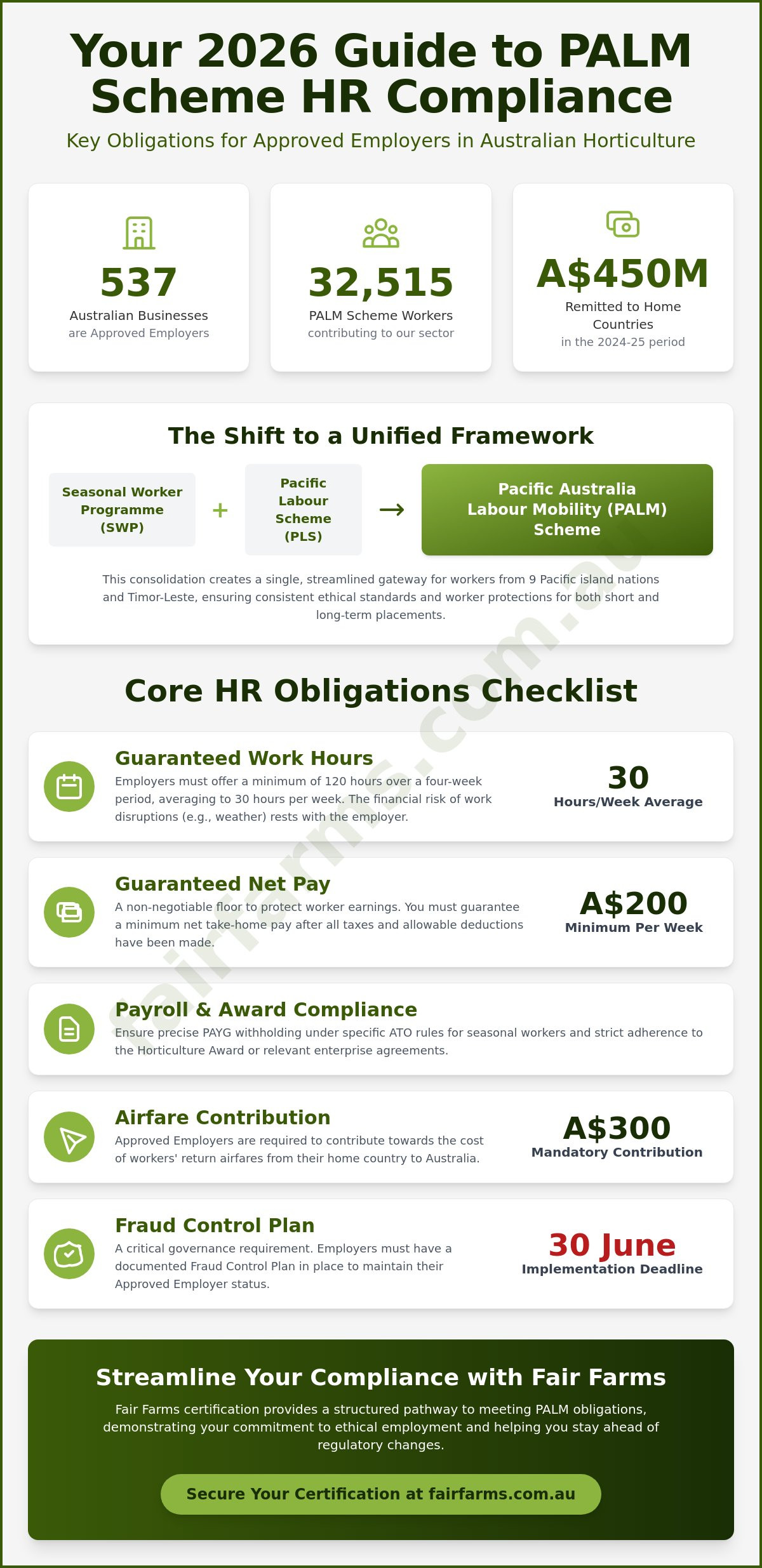
The transition from the Seasonal Worker Programme (SWP) to the Pacific Australia Labour Mobility (PALM) scheme represents more than a simple name change. By April 2022, the SWP officially closed, making way for a consolidated system that merged seasonal work with the longer-term Pacific Labour Scheme. For Australian growers, this evolution has fundamentally altered the seasonal worker program HR requirements they must meet. The PALM scheme acts as a single, streamlined gateway for workers from nine Pacific island countries and Timor-Leste to fill vital roles in regional Australia. This consolidation ensures that whether a worker is here for a six-month harvest or a four-year contract, they're protected by a consistent set of ethical standards and workplace regulations.
The primary objective of this shift is to foster ethical employment practices while addressing the chronic labour shortages that have historically challenged the horticulture sector. It's a move away from the "short-term seasonal" mindset toward a "flexible multi-year" engagement model. This change requires a more sophisticated HR approach. You're no longer just managing a temporary workforce; you're often supporting individuals who are building lives within your local community over several years. Understanding the Pacific Australia Labour Mobility (PALM) scheme history helps clarify why these protections are now so rigorous and why compliance is the foundation of a sustainable business model.
Why the Seasonal Worker Program evolved
The evolution was driven by a need to standardise workplace protections across all Pacific worker streams. In 2026, the focus has sharpened on worker welfare and community integration, ensuring that the "fair go" extends to every person on the farm. The Department of Employment and Workplace Relations (DEWR) now oversees these standards with increased scrutiny. This ensures that the economic benefits of the scheme, which saw A$450 million remitted to home countries in the 2024-25 period, are built on a foundation of genuine social compliance and fair treatment. Standardising these protections helps eliminate the confusion that previously existed between different visa streams.
The Role of the Approved Employer
Becoming an "Approved Employer" is the essential first step for any grower looking to access this labour pool. This status isn't a "set and forget" administrative tick; it's a formal commitment governed by a Deed of Agreement that carries significant HR implications. To retain this status, you must demonstrate a consistent ability to meet high standards of pastoral care and payroll accuracy. Many growers find that aligning their internal systems with Fair Farms certification helps them stay ahead of these requirements. Maintaining your status as an Approved Employer is vital, as losing it can immediately jeopardise your ability to secure the labour needed for future seasons.
Core HR Obligations for Approved Employers in 2026
Meeting seasonal worker program HR requirements in 2026 demands a shift from passive management to active, documented compliance. One of the most critical obligations is the guarantee of work. Employers must offer a minimum of 120 hours over a four-week period, which averages to 30 hours per week. This isn't just a goal; it's a mandatory threshold. If weather or crop cycles disrupt work, the financial risk sits with the employer, not the worker. This ensures stability for the 32,515 PALM workers currently contributing to our agricultural sector, providing them with the financial certainty they were promised when joining the scheme.
Payroll accuracy remains the backbone of ethical employment. Most growers operate under the Horticulture Award, though some utilize specific enterprise agreements. Regardless of the industrial instrument, you must ensure precise PAYG withholding. The ATO maintains specific rules for seasonal workers that differ from standard tax residents, and getting this wrong can lead to significant back-pay issues. Crucially, as of the March 2026 update, you must guarantee a minimum net pay of A$200 per week after all taxes and deductions. This protects workers from scenarios where high costs of living or travel recovery eat up their entire pay packet, ensuring they can still remit funds home.
Before you can recruit from overseas, you must prove that no local workers are available. Labour market testing requires advertising the roles locally for at least two weeks. You need to keep evidence of these advertisements and document the reasons why any Australian applicants were unsuitable. This prioritisation of the local workforce is a core pillar of the Official PALM scheme employer requirements, and it's often the first thing auditors look for during a compliance review.
Welfare and Wellbeing Requirements
Compliance extends far beyond the bank account. Every Approved Employer must appoint a dedicated Welfare and Wellbeing Support Person. This individual serves as a bridge, helping workers navigate life in Australia. They manage everything from cultural briefings to ensuring accommodation meets the mandated ratio of at least one toilet, hand basin, and shower for every 10 workers. Providing safe, reliable transport to the worksite is also your responsibility. This ensures workers aren't left stranded or forced to use unroadworthy vehicles, which is a major focus for the 2026 safety guidelines.
Record Keeping and Reporting
Audits are a constant reality for those in the PALM scheme. You must maintain precise records of every deduction, including the A$300 employer contribution toward airfares and any recovered costs for visa fees. These deductions must be recovered over a minimum period of 12 weeks to maintain the worker's weekly net income. Utilizing Single Touch Payroll (STP) is essential for real-time reporting to the ATO and DEWR. For many growers, achieving Fair Farms certification helps streamline these record-keeping processes, providing a clear framework for audit readiness and ethical transparency.
Labour Hire Standards vs. Direct Recruitment: Choosing Your Pathway
Deciding how to source your workforce is a pivotal strategic choice for any grower. In February 2026, data showed that 426 direct employers were active in the PALM scheme, while 111 labour hire companies supported the sector. Each model presents a different way to manage seasonal worker program HR requirements. Choosing direct recruitment gives you total control over your "Fair Go" culture and on-farm training, but it places the full weight of administrative compliance on your internal team. Conversely, partnering with a labour hire firm can reduce the daily HR burden, provided you select a partner who shares your commitment to ethical standards.
Regardless of the model you choose, you must ensure your operations align with state regulations. Labour hire licensing is mandatory in Queensland, Victoria, South Australia, and the Australian Capital Territory. Engaging an unlicensed provider is a serious breach that can jeopardise your Approved Employer status and lead to heavy fines. Whether you are managing workers directly or through a third party, Fair Farms ethical employment certification provides the necessary framework to verify that every person on your property is treated with dignity and paid correctly.
Due Diligence for Labour Hire Users
Under Australian workplace law, the principle of joint responsibility means that host employers can be held liable for breaches committed by their labour hire providers if they were involved in or aware of the contravention. You cannot simply outsource your ethical obligations. To protect your business, follow this vetting process:
- Verify the provider's current PALM scheme Approved Employer credentials and state labour hire licence.
- Review their history of cost recovery deductions to ensure they don't exceed the 12-week minimum period.
- Conduct regular on-site visits and private worker interviews to confirm that the A$200 weekly net pay guarantee is being met.
- Check that the provider is a member of a recognised social compliance program.
The Benefits of Direct Recruitment
Direct recruitment allows you to build deep, long-term relationships with your workforce. Many growers find that returning workers, who already understand the specific needs of the crop and the farm’s safety protocols, are significantly more productive. While the HR overhead is higher, you avoid paying the margins associated with third-party providers. This model gives you direct oversight of the pastoral care and community induction processes, ensuring that your workers feel truly integrated into the local region. For those who choose this path, becoming Fair Farms members offers access to tools that simplify the complex reporting requirements required by the Department of Employment and Workplace Relations.
The Essential HR Compliance Checklist for Seasonal Labour
Mastering the daily seasonal worker program HR requirements means moving beyond theory and implementing a structured operational rhythm on your farm. Compliance isn't a single event; it's a series of documented actions that begin months before a worker arrives in Australia. By 2026, the expectations for record keeping have intensified, requiring growers to maintain a "paper trail" that proves every worker is safe, fairly paid, and supported. This checklist serves as your roadmap to ensure no critical step is missed during the busy harvest season.
- Pre-arrival: Confirm your Approved Employer status is active and complete labour market testing at least two weeks before recruitment. You must also verify that accommodation meets the 1:10 plumbing ratio and have the mandatory A$200 cash advance ready for each worker upon their arrival.
- Onboarding: Issue a formal Letter of Offer and ensure the worker signs a TFN declaration. Conduct a comprehensive induction that covers both workplace rights and farm-specific safety protocols.
- Operations: Track hours to ensure the 120-hour four-week average is met. Issue weekly pay slips that clearly show all deductions and confirm the worker has received the A$200 minimum net pay guarantee.
- Documentation: Maintain a central register for incident reports, training logs, and evidence of welfare check-ins. Ensure your Fraud Control Plan is finalised before the June 30, 2026, deadline.
Health and Safety (WHS) for Seasonal Teams
Workplace health and safety must be culturally accessible to be effective. It's your responsibility to ensure that safety signage is clear and that all workers, regardless of their English proficiency, understand how to operate machinery safely. Providing fit-for-purpose PPE is a non-negotiable requirement. In the Australian summer, managing heat stress is a primary concern. You should implement formal hydration protocols and scheduled rest breaks to protect your team. You can also leverage the 60% government contribution for job-specific training, which now provides up to A$600 per worker annually, to enhance your team's safety skills.
Audit Preparation Checklist
Audit readiness is about being "always prepared" rather than rushing at the last minute. Start by organising your HR files to mirror the requirements of national certification bodies. This includes verifying that health insurance is active for every worker and that cost recovery for airfares is spread over the mandated 12-week minimum. Self-correcting common payroll errors, such as miscalculating overtime under the Horticulture Award, can prevent minor mistakes from becoming major compliance breaches. To streamline this process, you can Prepare for your audit with Fair Farms Pathways, which offers a structured approach to maintaining these high standards. Achieving Fair Farms membership ensures you have the support needed to navigate these complex administrative tasks with confidence.
Fostering Ethical Employment with Fair Farms Certification
Transitioning from the old SWP to the current PALM scheme involves more than just a change in paperwork. It requires a fundamental commitment to fostering fair and responsible employment practices. For many growers, the sheer volume of seasonal worker program HR requirements can feel overwhelming. Fair Farms membership simplifies this complexity by providing a structured pathway that aligns your internal processes with national standards. By joining this community of 537 approved employers, you aren't just ticking boxes; you're demonstrating to retailers and consumers that your produce is grown under ethical conditions.
Major Australian retailers increasingly require proof of social compliance before they'll stock your fruit or vegetables. A formal certification serves as a clear signal of integrity. It provides you with dedicated HR support specifically tailored to the horticulture industry, ensuring you have a steady, reliable partner to guide you through the intricacies of the 2026 guidelines. This collective approach helps elevate the reputation of the entire Australian farming landscape, making it a preferred destination for the 32,515 workers currently participating in the scheme. By focusing on a "fair go" for every employee, you secure your role as an industry leader.
The Fair Farms Certification Journey
The path to certification is designed to be educational rather than punitive. It begins with comprehensive online training, followed by a robust self-assessment to identify any gaps in your current HR systems. Once you're ready, an audit verifies your compliance with the Fair Farms Standard. This process acts as a vital shield against modern slavery risks, protecting your business from the legal and reputational fallout of supply chain exploitation. You can explore our membership options for growers to see how this journey fits your specific operational needs and helps you maintain your status as a trusted employer.
Long-term Benefits of Ethical HR
Investing in ethical HR practices pays dividends in worker retention and productivity. With the proportion of long-term workers in the PALM scheme rising to 53% as of June 2024, the value of keeping experienced staff has never been higher. When workers feel they've received a fair deal, they're more likely to return season after season, which significantly reduces your recruitment and training costs. This stability enhances your brand reputation both locally and in the global market, positioning your farm as a stable and dependable institution. If you're ready to secure your workforce's future and master the seasonal worker program HR requirements, contact the Fair Farms team today to start your certification journey.
Securing Your Harvest through Ethical Leadership
The shift from the former SWP to the PALM scheme represents a new era for Australian horticulture, where social compliance and operational success are inseparable. By following the 2026 checklist, you ensure your farm meets every mandatory obligation, from the A$200 net pay guarantee to rigorous accommodation standards. Navigating these seasonal worker program HR requirements doesn't have to be a solitary burden for your management team.
Fair Farms is an industry-led initiative by Queensland Fruit & Vegetable Growers (QFVG), designed specifically to support you in this journey. Our program is a recognised standard by major Australian retailers, providing your business with the market access it needs to thrive. With comprehensive online training for farm HR teams and a community of like-minded growers, we help you foster a workplace built on integrity. Join Fair Farms today to secure your farm’s ethical future and ensure your operations remain a benchmark for fair and responsible employment in Australia. Together, we can build a stronger, more resilient agricultural sector that values every worker's contribution.
Frequently Asked Questions
Is the Seasonal Worker Program still running in 2026?
No, the Seasonal Worker Programme (SWP) was officially replaced by the Pacific Australia Labour Mobility (PALM) scheme on 4 April 2022. The PALM scheme now serves as the single program for both seasonal and longer-term workers from the Pacific and Timor-Leste. As of May 2026, all employers must operate under the PALM scheme Approved Employer Guidelines version 2.1 to remain compliant with federal regulations.
What are the main HR requirements for the PALM scheme?
The primary seasonal worker program HR requirements include offering a minimum of 120 hours of work over a four-week period and guaranteeing a minimum net pay of A$200 per week. Employers must also appoint a dedicated Welfare and Wellbeing Support Person for every placement. Additionally, you're required to have a formal Fraud Control Plan in place by 30 June 2026 to protect the integrity of your recruitment processes.
Can I hire seasonal workers directly without a labour hire agency?
Yes, growers can apply to become direct Approved Employers rather than using a third-party agency. In February 2026, there were 426 direct employers successfully managing their own PALM workforce. While this model offers greater control over farm culture and training, it significantly increases your internal administrative load. You'll be responsible for all pastoral care, accommodation vetting, and direct reporting to the Department of Employment and Workplace Relations.
How much do I need to pay seasonal workers under the Horticulture Award?
You must pay workers at least the minimum hourly rate specified in the Horticulture Award 2020 or your relevant enterprise agreement. Beyond the base rate, you must ensure that each worker's take-home pay doesn't fall below the A$200 weekly net guarantee after taxes and deductions. Remember that you're also required to contribute A$300 toward each worker's return international airfare and domestic transfers as part of your employer obligations.
What happens if I fail a PALM scheme compliance audit?
Failing an audit can result in the suspension or permanent revocation of your Approved Employer status, effectively cutting off your access to the PALM workforce. You may also face significant financial penalties from the Fair Work Ombudsman if pay or safety breaches are discovered. Most growers who encounter issues are placed on a strict remediation plan. Maintaining a proactive approach through certification helps you identify and fix these risks before an official audit occurs.
Is accommodation provided by the employer a mandatory HR requirement?
Yes, providing or arranging safe and affordable accommodation is a mandatory requirement for all PALM scheme employers. The accommodation must be vetted and approved by the department before any workers arrive on your property. It must meet specific hygiene and privacy standards, including the mandated ratio of at least one toilet and shower for every 10 workers. You're also responsible for ensuring workers have reliable transport between their residence and the worksite.
How does Fair Farms certification help with PALM scheme compliance?
Fair Farms certification provides a practical framework that translates complex seasonal worker program HR requirements into clear, manageable on-farm actions. By completing the training and self-assessment, you can align your payroll and welfare systems with the PALM Deed of Agreement. This independent verification demonstrates your commitment to ethical employment to both government auditors and major Australian retailers, reducing the risk of non-compliance during official reviews.
Do I need a special licence to employ seasonal workers in Australia?
You must hold Approved Employer status from the federal government to participate in the PALM scheme. If you're operating as a labour hire provider, you'll also need a specific labour hire licence if you're working in Queensland, Victoria, South Australia, or the ACT. Direct growers only need the PALM approval, but they must still comply with all national workplace laws and the specific Deed of Agreement that governs the scheme.