
Calculating Pro Rata Leave: A Guide for Australian Horticulture Growers
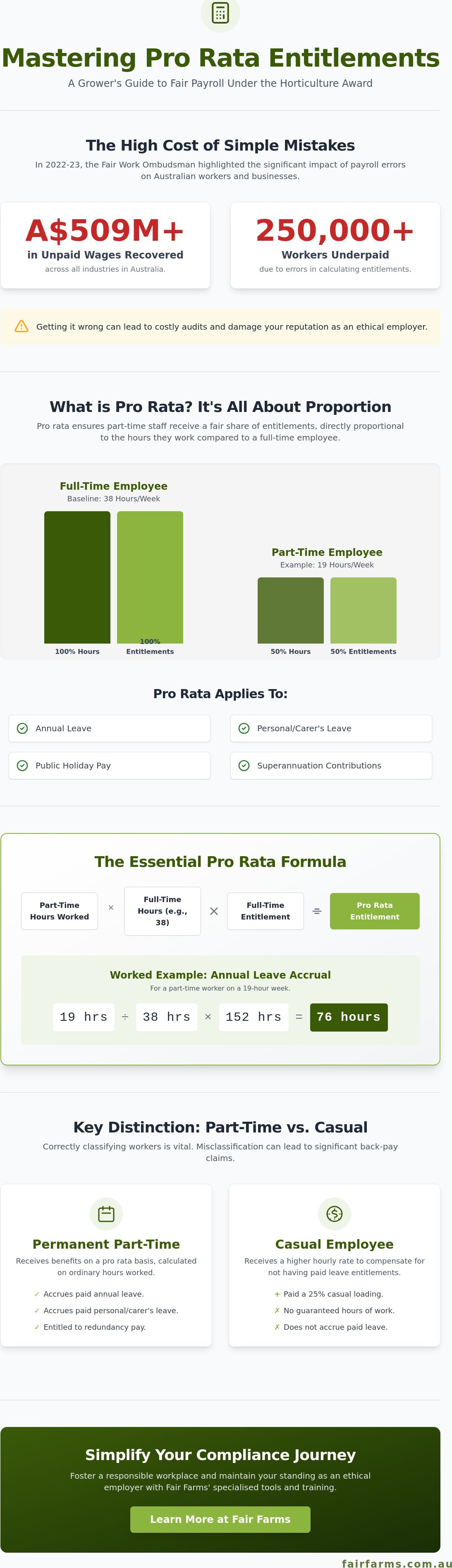
In the 2022-23 financial year, the Fair Work Ombudsman recovered over A$509 million in unpaid wages for more than 250,000 Australian workers, with many errors stemming from simple mistakes in calculating entitlements. For a grower, getting a pro rata calculation wrong isn't just a minor payroll error; it's a risk that can lead to costly audits and damage your hard-earned reputation as an ethical employer.
You likely recognise that managing seasonal staff turnover under the Horticulture Award is a complex task that requires constant vigilance. It's natural to feel some pressure when organising your payroll to balance the demands of harvest with the precision required for legal compliance. This guide will help you master the essentials of these calculations, ensuring your part-time and seasonal team members receive their fair entitlements while you maintain total confidence in your payroll. We'll provide the clear formulas you need to foster a responsible workplace and ensure your farm remains a leader in social compliance.
Key Takeaways
- Understand how to use the standard 38-hour full-time equivalent to accurately calculate pro rata entitlements for your part-time workforce.
- Master the step-by-step formula for accruing annual and personal leave to ensure every worker receives their fair go under the Horticulture Award.
- Identify the common payroll pitfalls that lead to underpayment allegations and Fair Work Ombudsman audits.
- Learn how to maintain your standing as an ethical employer by implementing transparent and compliant leave management systems.
- Access specialised Fair Farms tools and online training designed to simplify the complexities of horticultural payroll and social compliance.
Table of Contents
- What is Pro Rata and Why Does it Matter for Growers?
- How to Calculate Pro Rata: The Essential Step-by-Step Formula
- Applying Pro Rata to Leave Entitlements in Horticulture
- Avoiding Compliance Risks: The Cost of Getting it Wrong
- Simplifying Your Compliance Journey with Fair Farms
What is Pro Rata and Why Does it Matter for Growers?
The term pro rata originates from Latin, literally meaning 'in proportion'. In a legal and financial context, it describes the process of assigning a value to a fraction of a whole based on its relationship to the total. For Australian growers, applying a pro_rata approach is essential for managing a diverse workforce that often includes permanent part-time and seasonal staff. It ensures these employees receive a fair share of full-time benefits, directly reflecting the time they contribute to the farm's operations.
This methodology creates a transparent pathway for both the employer and the worker, removing the guesswork from payroll. It's a system built on integrity, where a worker who completes 19 hours of a 38-hour week receives exactly half the entitlements of their full-time counterparts. Correct application isn't just a matter of good business; it's a core requirement under the Fair Work Act 2009. Failing to calculate these figures accurately can lead to underpayment issues that attract the attention of the Fair Work Ombudsman. This principle applies to several key areas of employment, including:
- Base wages for part-time schedules.
- Annual leave and personal/carer's leave accruals.
- Public holiday pay for eligible days.
- Superannuation contributions.
Pro Rata vs. Casual Loading
Understanding the distinction between permanent part-time and casual employees is vital for compliance. While part-time staff receive pro_rata leave entitlements, casual employees are typically paid a 25% loading on top of their base rate. This loading is designed to compensate for the lack of paid leave and redundancy benefits. Misclassifying a worker who has a regular, predictable pattern of work can lead to significant back-pay claims if they're later deemed to be a permanent employee entitled to accrued leave. Following the 2021 amendments to the Fair Work Act, growers must also be aware of casual conversion requirements, which highlight the need for clear record-keeping. Getting this classification right from day one is a hallmark of a responsible employer.
The Role of the Horticulture Award
The Horticulture Award 2020 provides the specific framework for how these entitlements function within the unique pressures of the agricultural sector. It sets the baseline for a 'fair go', ensuring that even during peak harvest periods, the rights of workers are protected. Pro rata leave is the proportional accrual of benefits based on ordinary hours worked. By adhering to these industry standards, growers foster a culture of ethical responsibility and communal progress. This commitment to social compliance doesn't just protect the business from legal risk; it builds a reputation that helps attract and retain quality staff in a competitive market. It demonstrates that your farm is a supportive partner in the industry's journey toward better standards.
How to Calculate Pro Rata: The Essential Step-by-Step Formula
Mastering the mathematical side of employment law is a practical way to demonstrate your commitment to a fair workplace. To begin, you must establish the baseline for a full-time employee under the Horticulture Award. In most Australian agricultural settings, this is 38 ordinary hours per week. Once you have this Full-Time Equivalent (FTE) figure, you can determine the specific ratio for any part-time or seasonal staff member based on their actual hours worked during a pay period.
Accuracy is the foundation of trust between a grower and their team. By using a standardised formula, you remove ambiguity and ensure that every worker receives their 'fair go' as defined by the National Employment Standards. This methodical approach protects your business from the risk of underpayment claims while ensuring your seasonal workforce feels valued for their contribution. This level of precision is a key indicator of an ethical and well-managed farm.
The Standard Pro Rata Calculation
The formula for a pro_rata accrual is straightforward but requires precision. You divide the employee's ordinary hours worked by the full-time hours, then multiply that result by the full-time entitlement. For example, if a full-time worker earns 152 hours of annual leave each year, a part-time worker completing 19 hours a week would accrue 76 hours annually. This calculation ensures that every hour of labour contributes fairly to the worker's long-term benefits. Whether you run fortnightly or monthly pay cycles, applying this ratio consistently is vital for maintaining clean records.
Handling Public Holidays and Overtime
Confusion often arises when dealing with overtime and public holidays. It's a common mistake to include overtime in leave calculations; however, accruals are strictly based on ordinary hours. If a public holiday falls on a day your part-time employee is normally rostered to work, they're entitled to be paid for their ordinary hours for that day. If the holiday falls on a day they don't work, no payment is required. Ensuring your payroll software is configured to recognise these distinctions is a vital step in maintaining compliance. For growers seeking to validate their internal systems, the Fair Farms Certification process offers a structured way to review and improve these payroll practices.
Consistency in these calculations is what separates a compliant operation from one at risk of an audit. By following these steps, you ensure that your pro_rata payments are always accurate, fostering a culture of transparency and respect across your entire workforce.
Applying Pro Rata to Leave Entitlements in Horticulture
Growers often oversee a rotating team of packing shed staff and orchard hands whose hours fluctuate with the seasons. Applying pro_rata principles to leave ensures these workers are treated with the same integrity as full-time management. Annual leave isn't a static benefit; it's a progressive accrual that grows with every hour a part-time staff member spends on the farm. For instance, a worker in the packing shed completing 24 hours of sorting and grading per week will accrue their leave at a rate of roughly 2.46 hours for every 38 hours worked. This system ensures that every minute of ordinary labour is accounted for, preventing the errors that often lead to underpayment allegations.
Personal and carer's leave operates under the same logic. When a seasonal employee needs time off for a family emergency or illness, their paid entitlement is based on their ordinary hours. You can find detailed tools to track these figures via the Fair Work Ombudsman's leave entitlements portal. For long-term staff, long service leave milestones at 7 or 10 years must also be calculated proportionally, reflecting the worker's average hours over their tenure. Maintaining this level of transparency isn't just about compliance; it's about building a culture of trust and a 'fair go' for everyone on the property.
Seasonal Work and Continuous Service
Managing workers who return for every harvest requires a clear understanding of continuous service. If a picker's contract ends in May and they're rehired in November, the gap usually doesn't count toward leave accrual, but the periods of active service often count as one continuous block for long service leave. It's vital to keep precise records of these dates to ensure returning staff are recognised for their loyalty. Growers who join as Fair Farms members gain access to resources that help track these complex employment histories and ensure seasonal transitions are handled ethically.
Parental Leave and Pro Rata Rights
Ethical employment practices extend to supporting staff through major life transitions. When a part-time employee accesses parental leave, their payments and return-to-work rights are protected based on their established pro_rata working patterns. Pro rata leave ensures workers aren't penalised for choosing flexible or part-time arrangements. This approach maintains high social standards on the farm, proving that your business values the long-term wellbeing of its workforce. It's a practical way to foster a stable, committed team that feels supported by their employer during significant life events.
Avoiding Compliance Risks: The Cost of Getting it Wrong
The financial consequences of miscalculating entitlements are severe and far-reaching. Since 2021, the Fair Work Ombudsman has identified the horticulture sector as a top priority for compliance enforcement due to historically high rates of non-compliance. A minor error in a pro_rata calculation might seem insignificant for one worker, but across a seasonal crew of 50 or 100 people, these discrepancies quickly snowball into six-figure back-pay liabilities. Beyond the immediate financial sting, businesses found in breach face public naming and shaming, which can permanently tarnish a farm's reputation and its standing in the local community.
Maintaining accurate records is a legal non-negotiable that requires a methodical approach. Under the Fair Work Act 2009, Australian growers must keep detailed payroll and leave records for at least 7 years. These records must be accessible and legible, providing a clear trail of how every cent was paid and how every hour of leave was accrued. Failing to produce these documents during an audit is an immediate red flag that can lead to significant court-ordered penalties. Integrity in record-keeping is the first step toward proving you're a responsible and ethical employer.
Preparing for a Payroll Audit
Regular internal checks are the best defence against an unexpected visit from the Ombudsman. You should verify that your payslips clearly display leave balances and that your software correctly applies the pro_rata formula to ordinary hours only. Many growers find that a structured review of their internal systems provides the peace of mind they need to focus on the harvest. Engaging with Fair Farms certification pathways allows you to verify your compliance systems against rigorous industry standards, ensuring your payroll is robust enough to withstand external scrutiny. This proactive stance helps you spot errors before they become systemic problems.
Ethical Sourcing and Retailer Expectations
In the modern Australian market, social compliance is a ticket to play. Major supermarkets and wholesalers now require proof of ethical employment practices as a condition of supply. They aren't just looking for a signature; they want evidence that your part-time and seasonal workers receive their full legal entitlements. Correct leave accrual is a fundamental component of your social compliance profile. By prioritising fair pay and transparent practices, you secure your place in the supply chain and contribute to the long-term sustainability of the entire industry. To strengthen your farm's standing, you can become a Fair Farms member to access dedicated HR support tailored for the unique pressures of horticulture.
Simplifying Your Compliance Journey with Fair Farms
Managing a farm's payroll shouldn't be a source of constant anxiety for growers. While the technicality of a pro_rata calculation requires absolute precision, you don't have to navigate these regulatory requirements in isolation. Fair Farms acts as a principled mentor, providing the educational framework and tools needed to foster fair and responsible employment practices across the Australian horticulture landscape. By moving from confusion to clarity, you protect your farm's reputation and ensure your workers receive their fair go. This commitment to communal progress is what distinguishes industry leaders from those merely following the rules.
Our mission is to transform social compliance from a complex burden into a steady, reliable part of your business operations. Joining a community of like-minded growers allows you to share insights and stay ahead of changes to the Fair Work Act. This collective strength builds a more resilient sector, where ethical responsibility is the standard rather than the exception. Demonstrating this commitment through formal certification provides the transparency that modern supply chains demand, securing your farm's future in an increasingly scrutinised market.
Member Resources and Training
Our specialised online training modules break down complex Fair Work requirements into clear, instructional steps. Members gain access to a suite of templates and calculators specifically tailored for the Horticulture Award, ensuring your pro_rata accruals are accurate and compliant every time. These resources help you implement a system of record-keeping that stands up to scrutiny. By encouraging a culture of transparency and integrity on your farm, you build a loyal workforce that feels valued and respected.
Take the Next Step Toward Certification
Formal certification is a powerful tool for building trust with retailers and consumers alike. Choosing to become a Fair Farms member is a strategic move that provides your business with the gravity required for national recognition. We support you through every stage of the audit and certification process, acting as a supportive partner rather than a rigid enforcer. If you're ready to verify your payroll systems or need guidance on complex employment standards, contact our team for a confidential discussion about your compliance needs today.
Securing Your Farm's Future Through Ethical Payroll Practices
Accurate payroll is the bedrock of a sustainable farming operation. By mastering the pro_rata formula and ensuring your leave records remain meticulous for the required 7-year period, you shield your business from the Fair Work Ombudsman's ongoing scrutiny. This transparency doesn't just satisfy legal auditors; it demonstrates a genuine commitment to providing a 'fair go' for your workers. Integrity builds trust. Such a commitment fosters a loyal team that understands their contribution is valued and protected under the law.
As an industry-led initiative developed by a prominent Australian horticulture industry body, Fair Farms provides the practical HR support and training needed to navigate these technical complexities. Our certification is recognised by major Australian retailers, ensuring your produce meets the highest social standards required in today's market. You'll join a community of growers who are already setting the standard for ethical employment in Australia.
Become a Fair Farms Member today to access expert HR support and compliance tools
Taking these steps today ensures your farm remains a respected and ethical leader in the Australian horticulture sector for years to come.
Frequently Asked Questions
What is the difference between pro rata and 'prorated'?
Pro rata is the formal Latin term used in Australian legal and industrial contexts; "prorated" is the past tense verb more common in American business settings. In the Australian horticulture sector, you'll almost exclusively see the term pro_rata in official Fair Work documents and Awards. Both terms describe the same process of proportional allocation based on a full-time equivalent.
Can I pay out pro rata leave instead of the worker taking time off?
You can only pay out leave in very specific circumstances to ensure workers don't miss out on necessary rest. Under the Horticulture Award 2020, an employer and employee can agree to cash out annual leave as long as the worker retains a balance of at least 4 weeks. This agreement must be in writing for every instance. Otherwise, accrued leave is typically paid out only when the employment relationship ends.
How do I calculate pro rata leave for a worker who started mid-year?
Calculate the total ordinary hours the worker has completed since their specific commencement date. Divide these hours by 38, the full-time weekly baseline, and multiply by the annual entitlement. This ensures a worker who joins in October for the summer harvest receives exactly what they've earned by the end of the year without any complex guesswork.
Does pro rata apply to casual workers in the horticulture industry?
No, pro_rata leave entitlements don't apply to casual employees. Instead, casuals receive a 25% loading on their base hourly rate to compensate for the lack of paid leave and other permanent benefits. It's vital to correctly classify your staff to ensure you're paying the correct loading or accruing the correct leave to avoid back-pay claims.
What happens to pro rata leave if a farm business is sold?
When a farm business is sold, the new employer usually becomes responsible for the accrued entitlements of any staff who continue their employment. This is known as a transfer of business under the Fair Work Act. If the new owner chooses not to recognise previous service, the initial employer must pay out all accrued annual leave as part of the termination process.
Is superannuation calculated on a pro rata basis for part-time staff?
Superannuation is paid on ordinary time earnings, which naturally reflects the hours a part-time staff member works. Since 1 July 2022, the A$450 per month threshold was removed. This means you must pay the current super guarantee rate on all ordinary earnings for your part-time team, regardless of how many hours they complete each week.
How do I handle pro rata leave for workers on the Horticulture Award?
Handling leave under the Horticulture Award requires tracking ordinary hours on a weekly or fortnightly basis. Leave accrues progressively during the year according to the employee's ordinary hours of work. You must ensure your payroll system is set to the 38-hour full-time equivalent to maintain strict compliance with the National Employment Standards and avoid audit risks.
What are the record-keeping requirements for pro rata entitlements?
You must keep accurate payroll and leave records for a minimum of 7 years. These records must include the employee's start date, ordinary hours worked, and a clear history of leave accrued and taken. The Fair Work Ombudsman requires these documents to be readily accessible for inspection to prove your farm's commitment to fair and transparent employment practices.