
Horticulture Award Australia 2026: A Comprehensive Guide to Compliance and Excellence
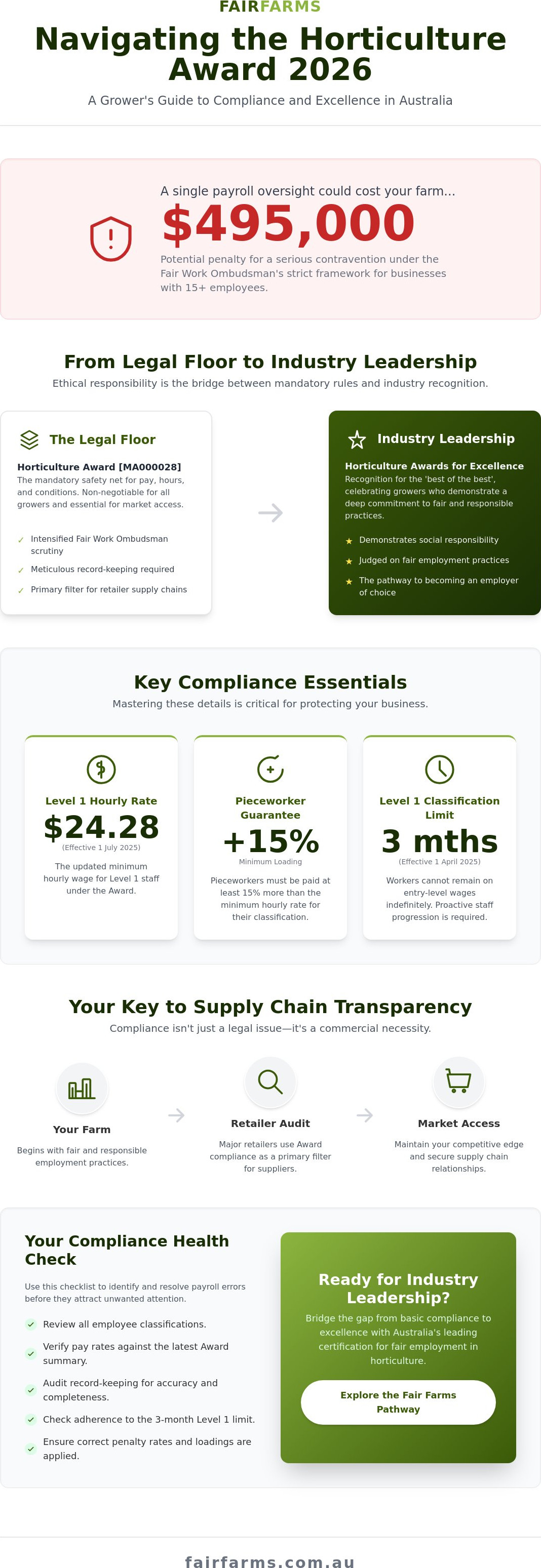
Could a single payroll oversight really cost your farm $495,000? For Australian growers with 15 or more employees, the Fair Work Ombudsman's strict penalty framework means that missing a detail in the horticulture award Australia 2026 is no longer just a paperwork headache; it's a major financial risk. As our industry shifts toward higher transparency, meeting the standards of the Horticulture Award [MA000028] has evolved. It's no longer just a legal floor. It's now the essential benchmark for any farm that wants to secure retail market access and be recognised for industry excellence.
We know that balancing seasonal labour demands with the three month limit on Level 1 classifications feels like a constant juggle. It's difficult to focus on your crop when you're worried about a surprise audit or the difference between mandatory compliance and excellence certifications. This guide provides the certainty you're looking for. We'll break down the 1 July 2025 pay increases, such as the $24.28 hourly rate for Level 1 staff and the 15% minimum loading for pieceworkers. You'll gain a clear roadmap to help eliminate payroll errors, protect your reputation, and foster a truly fair and productive workplace.
Key Takeaways
- Distinguish between mandatory legal obligations and industry recognition to ensure your farm meets the highest standards of ethical responsibility.
- Master the updated pay rates and classification rules within the horticulture award Australia 2026 to protect your business from significant Fair Work penalties.
- Discover why major retailers now use Award compliance as a primary filter for choosing suppliers and how you can maintain your competitive edge.
- Access a clear, supportive roadmap for conducting a compliance health check to identify and resolve payroll errors before they attract unwanted attention.
- Learn how to bridge the gap between basic legal requirements and industry leadership by fostering fair and responsible employment practices.
Understanding the Horticulture Award in 2026: Legal Floor vs. Industry Excellence
In the Australian farming community, the term "Horticulture Award" often pulls the conversation in two distinct directions. For a farm manager processing the weekly payroll, it refers to the Horticulture Award [MA000028], a complex legal instrument that dictates the mandatory minimums for pay, hours, and conditions. For a business owner looking to the future, it might instead bring to mind the prestigious trophies handed out at the annual Hort Connections Gala Dinner. While these two concepts seem worlds apart, they're inextricably linked. In the current landscape of the horticulture award Australia 2026, you cannot achieve industry excellence without first mastering the legal floor.
Ethical responsibility is the bridge between these two definitions. The Australian labour law framework establishes the ground rules, but leading growers recognise that a "fair go" in the workplace is more than just a compliance checkbox. It's the prerequisite for any form of industry recognition. Whether you're aiming for a trophy or simply trying to pass a retail audit, your journey starts with a deep understanding of your obligations under the 2026 regulatory environment.
The Legal Framework: Horticulture Award [MA000028]
The Horticulture Award [MA000028] is the mandatory safety net covering the vast majority of employees in the industry, including growers, harvesters, and labour hire providers. In 2026, the Fair Work Ombudsman has intensified its focus on this sector, using sophisticated data matching to identify underpayments. This heightened scrutiny follows significant changes, such as the 1 April 2025 rule that limits Level 1 classifications to a maximum of three months. This ensures workers don't remain on entry-level wages indefinitely, regardless of their prior experience. Staying compliant means more than just paying the right rate; it requires meticulous record-keeping and a proactive approach to staff progression.
The Aspirational Framework: 2026 Awards for Excellence
At the other end of the spectrum are the 2026 Horticulture Awards for Excellence. These accolades celebrate the "best of the best" across categories like Grower of the Year, Young Grower, and Women in Horticulture. These awards are often presented at the Hort Connections Gala Dinner, the industry's premier networking event. However, the judging criteria have evolved. For the "Community Stewardship" category, judges now look closely at a farm's social footprint. A farm that fails to demonstrate fair and responsible employment practices is unlikely to be shortlisted. By following the Fair Farms certification pathway, growers can prove they've moved beyond basic compliance and are ready for industry leadership. Mastering the horticulture award Australia 2026 requirements is the first step toward standing on that stage.
Key Compliance Requirements for Horticulture Pay Rates in 2026
Managing a farm's payroll in the current regulatory environment requires a rigorous commitment to accuracy. Navigating the horticulture award Australia 2026 involves more than just knowing the base rates; it requires a deep understanding of how classifications, loadings, and penalty rates intersect. For many growers, the complexity of seasonal labour makes it easy to overlook small details that can lead to significant Fair Work Ombudsman penalties. Ensuring every worker is paid correctly isn't just about avoiding a $495,000 fine for a serious contravention. It's about demonstrating the integrity of your business to your staff and the broader supply chain.
Correct classification remains the foundation of a compliant payroll system. You must clearly distinguish between full-time, part-time, and casual employees, as each group carries different entitlements and obligations. To ensure you're working from the most accurate data, you should regularly consult the Horticulture Award summary provided by the Fair Work Ombudsman. In 2026, the scrutiny on these classifications has intensified, particularly regarding the transition of casual workers to permanent roles and the strict three month limit on Level 1 entry-level status.
Penalty rates are another area where errors frequently occur. Under the Horticulture Award [MA000028], full-time and part-time staff are entitled to 200% of their ordinary hourly rate for public holidays, while casuals receive 225%. Overtime for casuals is calculated at 175% inclusive of their loading. Keeping track of these variations during a busy harvest period is challenging, but failing to do so puts your farm at risk. If you're feeling overwhelmed by these requirements, joining a community of like-minded growers can provide the peer support and resources needed to stay on track.
Casual Loading and the 2026 Minimum Wage
Casual employees make up a significant portion of the seasonal workforce and are entitled to a 25% loading to compensate for the lack of paid leave and other permanent benefits. Following the Annual Wage Review, a 3.5% increase was applied to all minimum award rates effective from the first full pay period on or after 1 July 2025. This adjustment means a Level 1 casual employee must now receive a minimum of $30.35 per hour. Many smaller operations struggle with pro-rata calculations for seasonal staff who work irregular hours, making digital record-keeping more important than ever.
Piecework Rates and the Minimum Floor
Piecework remains a common incentive-based payment method, but it's now governed by a strict "minimum income floor". This ensures that every worker is guaranteed at least the minimum hourly rate for the hours they've worked each day, regardless of their output. A piece rate must be set to allow a competent pieceworker to earn at least 15% more than their minimum hourly rate. For a Level 1 casual employee, this target rate is at least $34.90 per hour. You must record the actual hours worked by every pieceworker to prove they haven't fallen below this mandatory floor, a step that is often missed during high-pressure harvest weeks.
Why Award Compliance is Essential for Supply Chain Transparency
The push for total transparency in the Australian ag supply chain has reached a critical turning point in 2026. It's no longer enough to grow the highest-quality produce; you have to prove you grew it ethically. Major retailers are increasingly using adherence to the horticulture award Australia 2026 as a non-negotiable filter for their preferred suppliers. When a supermarket buyer assesses your operation, they're looking for evidence that you're fostering fair and responsible employment practices at every level. If that evidence is missing, the quality of your crop won't save your contract.
This shift is heavily influenced by the reporting requirements of the Modern Slavery Act. Large companies must now identify and address risks within their entire supply chain, making any breach of the Horticulture Award summary of conditions a major red flag. Labour hire providers are under the same microscope. In 2026, maintaining a labour hire licence requires a spotless record of Award compliance. For growers, using an unlicensed or non-compliant provider is a risk that could lead to immediate disqualification from the supply chains of Australia's biggest retailers.
Meeting Retailer Expectations for Ethical Sourcing
Supermarkets now expect third-party verification of your employment standards. They're looking for systematic evidence that you're meeting every obligation. During a typical audit, buyers look for:
- Evidence of correct overtime and public holiday pay rates.
- Proof that pieceworkers are earning above the minimum income floor.
- Clear records of staff progression from Level 1 to Level 2 after three months.
- Verification that labour hire providers are fully licensed and compliant.
Just following the rules isn't enough to secure those lucrative, long-term contracts anymore. You need to demonstrate a proactive commitment to social compliance that protects both your farm's reputation and the retailer's brand. It's about building a culture of integrity that withstands the scrutiny of any external audit.
The Risk of Non-Compliance in the 2026 Market
The financial impact of a compliance breach goes far beyond back-pay orders or Fair Work penalties. In the 2026 market, a single failure can lead to being "blacklisted" by major buyers, a blow that many family-run farms simply can't survive. When you lose the trust of the supply chain, recovery is a long and difficult road. Protecting your business requires a methodical approach to auditing and improvement. Fair Farms Certification acts as a vital shield against these risks, providing the independent verification that retailers demand while ensuring your farm remains a trusted leader in the industry.
How to Organise a Compliance Health Check for Your Farm
Conducting a regular health check is the most effective way to ensure your farm stays ahead of regulatory changes. The Fair Farms approach is methodical and supportive, designed to guide you through the complexities of the horticulture award Australia 2026 without the stress of a formal government audit. By identifying potential issues early, you protect your business from the Fair Work Ombudsman's heavy penalties, which can reach $19,800 per breach for an individual. It's about moving from a state of worry to one of quiet confidence in your administrative systems.
A thorough self-audit does more than just tick boxes; it builds a foundation of integrity. When your payroll is accurate and your classifications are correct, you foster a culture of trust with your workforce. This internal transparency is often the first step toward achieving industry excellence. If you're unsure where to begin, becoming a Fair Farms member provides access to the tools and peer support needed to streamline this process.
Step 1: Review Payroll and Classification
Start by auditing every employee against the specific classification levels in the Horticulture Award [MA000028]. In 2026, you must verify that no employee has remained at Level 1 for longer than three months, as the Fair Work Commission now mandates progression after this period. You should also check that all mandatory allowances are being triggered correctly in your software. For example, the wet work allowance of $2.50 per hour or the meal allowance of $16.03 must be paid whenever the specific conditions are met. Digital record-keeping is your best defence here. Ensure your team is using "Record My Hours" apps or similar digital systems correctly to provide a clear, indisputable trail of time on site.
Step 2: Engage with Professional HR Support
Managing compliance on your own is a high-risk strategy in the current regulatory environment. Rules around piecework floors and casual loading are nuanced, and a single misinterpretation can lead to costly back-pay orders. Joining a dedicated industry body for Grower Membership gives you access to expert guidance and templates that take the guesswork out of HR. Beyond just documents, you can use online training modules to upskill your farm managers. This ensures that those on the ground understand the "fair go" principles as well as the office staff do.
Finally, social compliance relies on open communication. We encourage a culture of "Fair Talk" where employees feel comfortable raising pay queries directly with management. When workers know their concerns will be heard and addressed professionally, the risk of external disputes drops significantly. To begin upskilling your leadership team today, explore the range of Fair Farms Online Training modules available to members.
The Pathway to Excellence: Beyond Basic Compliance
While meeting the legal requirements of the horticulture award Australia 2026 is vital for business survival, it shouldn't be the limit of your ambition. We view the mandatory pay rates and conditions as a solid foundation rather than a final destination. True industry leadership involves moving past the fear of audits and embracing a culture of communal progress. By choosing to go beyond the bare minimum, you aren't just protecting your farm; you're actively contributing to a more resilient and respected Australian agricultural sector. It's about shifting your focus from what you must do to what your business can achieve.
Fostering fair and responsible employment practices is a powerful tool for ethical branding. In a competitive market where seasonal labour is often scarce, being a "preferred employer" is a significant advantage. Workers share their experiences; they know which farms provide a "fair go" and which ones merely meet the legal floor. Certification provides a clear signal to the workforce that your farm is a safe, ethical, and reliable place to work. This investment in your people leads to a measurable long-term ROI, as reduced staff turnover and higher productivity directly improve your bottom line. It's a simple equation. When you treat your team with integrity, they're more likely to invest their best efforts back into your crop.
Fostering Fair and Responsible Employment Practices
Moving from a mindset of "avoiding fines" to "attracting the best talent" requires a proactive approach to your farm's reputation. In 2026, seasonal workers are more informed than ever about their rights under the horticulture award Australia 2026. They look for employers who offer more than just the $30.35 casual hourly rate. They seek workplaces that value safety, progression, and clear communication. By achieving certification, you demonstrate to the entire industry that your farm is a leader in social compliance. This status doesn't just attract workers; it also secures your position with retailers who are under increasing pressure to source from ethical suppliers.
Join the Fair Farms Movement
The Fair Farms pathway is designed to be a transformative journey for your business. It bridges the gap between basic compliance and the high standards required for the 2026 Horticulture Awards for Excellence. Whether you're aiming for the "Grower of the Year" title at the next Hort Connections Gala or simply want to solidify your reputation within the supply chain, we're here to support your progress. Our methodical approach ensures that your transition to industry excellence is steady, reliable, and grounded in practical farming reality. Let's work together to ensure that the Australian horticulture industry remains both ethical and profitable for generations to come. Contact Fair Farms today to start your compliance journey and move your business toward a brighter, fairer future.
Securing Your Farm’s Future Through Integrity
Mastering the horticulture award Australia 2026 is about more than just avoiding penalties; it's about building a business that stands the test of time. You've seen how correct classifications and transparent pay structures act as the bedrock for retail trust and employee loyalty. By moving beyond the legal floor, you're not just ticking boxes. You're fostering a workplace culture where everyone has a fair go, ensuring your farm remains a preferred choice for both workers and major buyers.
Fair Farms is here to support you at every step of this journey. Developed by Queensland Fruit & Vegetable Growers (QFVG) and backed by Federal Government funding, our programme is the recognised industry-standard for social compliance in Australian horticulture. We provide the tools, training, and community support you need to lead with confidence in a shifting market. Become a Fair Farms Member and secure your farm’s future. Together, we can build a stronger, more ethical industry that we're all proud to lead. Your commitment today ensures a more resilient landscape for the growers of tomorrow.
Frequently Asked Questions
What are the minimum pay rates for the Horticulture Award in 2026?
As of the 1 July 2025 wage review, the minimum hourly rate for a Level 1 adult employee is $24.28 for full-time and part-time workers, or $30.35 for casuals. These rates increase at each classification level, reaching $35.15 for Level 5 casuals. It's essential to check the latest Fair Work Pay Guide for specific allowances and penalty rates that apply to your team in the horticulture award Australia 2026 landscape.
Does the Horticulture Award cover labour hire workers on my farm?
Yes, the Horticulture Award [MA000028] applies to all employers and employees in the industry, which explicitly includes labour hire providers. If you engage labour hire, you must ensure the provider is licensed and paying their staff according to the correct legal standards. Using a non-compliant provider exposes your farm to significant supply chain risks and potential legal complications under current workplace laws.
How do I nominate my business for the Horticulture Awards for Excellence?
Nominations for the 2026 Horticulture Awards for Excellence are typically submitted through the official Hort Connections portal. Categories such as Grower of the Year or Young Grower are judged on innovation, sustainability, and community contribution. While Fair Farms doesn't manage the trophy nominations, our certification helps you demonstrate the high ethical standards that judges look for in winning entries.
What is the difference between a casual and a seasonal worker under MA000028?
The term "seasonal worker" generally describes someone hired for a specific harvest period, but they are legally classified as either casual or fixed-term employees under the Award. Casual employees receive a 25% loading and have no firm advance commitment to ongoing work. In contrast, fixed-term employees are entitled to paid leave but don't receive the casual loading, making the distinction vital for payroll accuracy.
Are piecework rates still legal in the Australian horticulture industry in 2026?
Piecework rates remain legal in 2026, provided they comply with the minimum wage guarantee. You must set a rate that allows a competent worker to earn at least 15% more than the minimum hourly rate. Crucially, every pieceworker must be paid at least the minimum award rate for the actual hours they worked that day if their piecework earnings fall short of the hourly floor.
What records must I keep to satisfy a Fair Work Ombudsman audit?
You are legally required to keep time and wages records for seven years to satisfy a Fair Work Ombudsman audit. These records must include the employer’s and employee’s names, the employee’s status, and the specific hours worked, including start and finish times. For pieceworkers, you must also record the piecework agreement and the actual output achieved during those specific hours to prove compliance.
Can Fair Farms represent me in a legal dispute with the Fair Work Commission?
Fair Farms provides HR support and training to help you stay compliant, but we don't offer direct legal representation in disputes. Our role is to act as a principled mentor, helping you avoid conflict through robust systems and ethical practices. If you face a formal legal challenge with the Fair Work Commission, you should seek advice from a qualified legal professional or industrial relations expert.
How does Fair Farms certification help with supermarket supply chain requirements?
Fair Farms certification provides the independent, third-party verification that major retailers require to manage their modern slavery risks. By participating in the programme, you demonstrate that your farm has undergone a rigorous audit of its employment practices. This transparency builds trust with buyers and helps secure your position as a preferred supplier within the horticulture award Australia 2026 framework.