
Managing Seasonal Workers: Best Practices for Farms in Australia
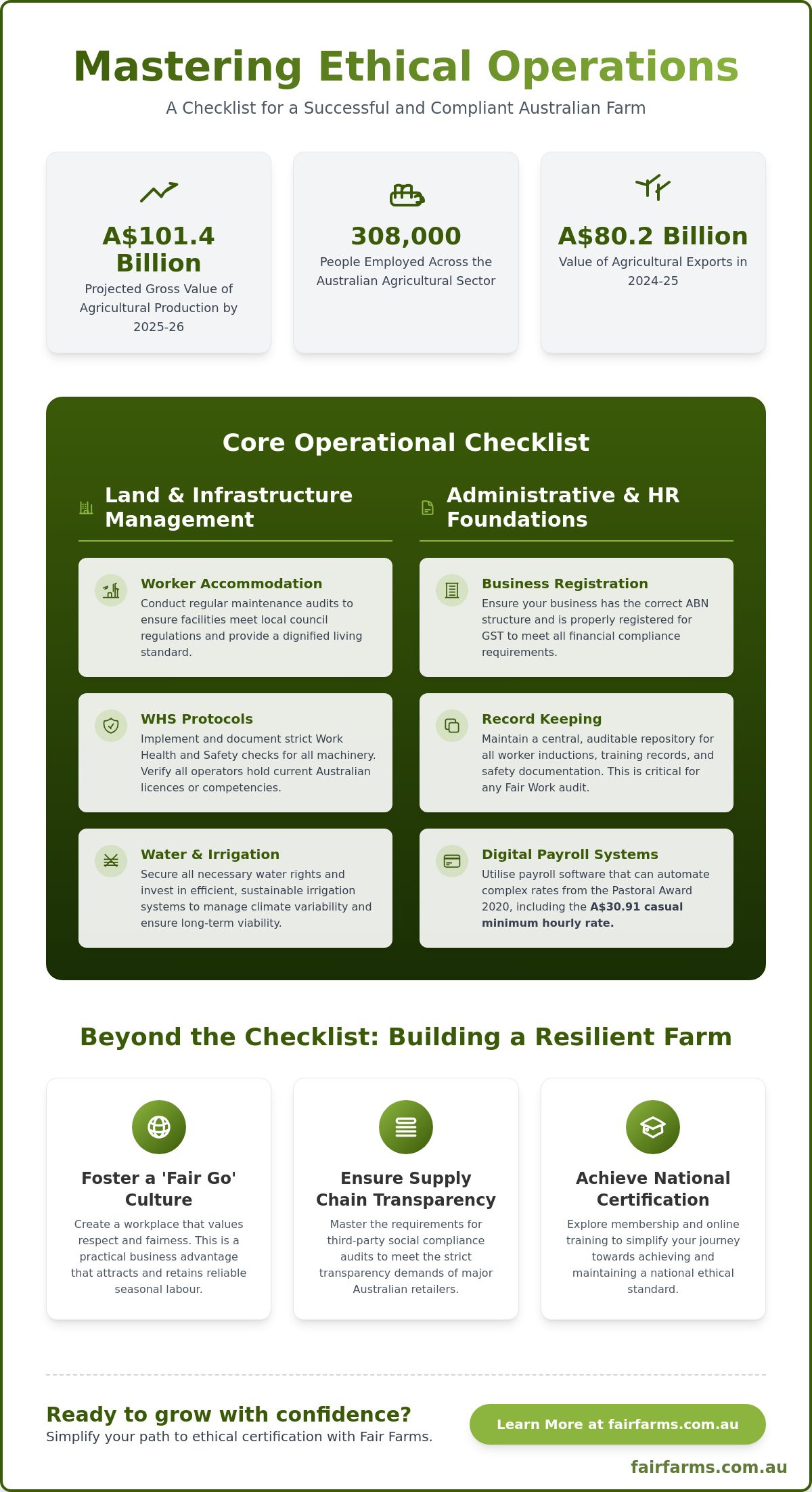
With the gross value of agricultural production projected to reach a record A$101.4 billion in 2025-26, the pressure on farms across Australia to perform has never been higher. For the 308,000 people employed across the sector, success is no longer just about yield; it's about the ethical integrity of the workplace. You've likely found that managing seasonal labour while staying compliant with the Pastoral Award 2020 is one of the most complex parts of your daily business.
It's a challenge to balance the needs of your crop with the strict supply chain demands of major retailers and the latest PALM scheme regulations. This article provides a clear roadmap to help you master these core requirements and run a successful, ethical operation for your farm in Australia. We'll walk through a comprehensive operational checklist that covers the Fair Farms Standard Version 4, updated wage rates like the A$30.91 casual minimum, and the practical steps to foster a fair workplace that stands up to any audit.
Key Takeaways
- Understand why Australian horticulture faces unique scrutiny and how to navigate shifting labour and environmental standards.
- Learn to implement a robust operational checklist that streamlines physical setup and HR record-keeping for better compliance.
- Discover how fostering a "fair go" culture on farms australia wide serves as a practical business advantage that attracts reliable seasonal labour.
- Master the requirements for third-party social compliance audits to meet the strict transparency demands of major Australian retailers.
- Explore how membership and online training can simplify your journey towards achieving and maintaining national ethical certification.
The Landscape of Modern Farms in Australia
The current state of Agriculture in Australia reflects a sector of immense scale and complexity. As the gross value of production is set to hit a record A$101.4 billion in 2025-26, the industry is moving beyond traditional output metrics. On modern farms Australia-wide, success is increasingly measured by how well a business integrates with its community and environment. While broadacre and livestock cover 57.1% of the land, the horticulture sector stands out for its high labour intensity and direct connection to the supermarket shelf.
This visibility brings unique scrutiny to our growing regions. Consumers and retailers now demand proof of ethical labour and sustainable practices, making social compliance a non-negotiable part of the business model. With 308,000 people employed in the sector as of 2024-25, the human element of farming is its most valuable asset. Fair Farms is an initiative that balances productivity with people. The 2026 economic outlook suggests that while commodity prices fluctuate, the demand for ethically sourced produce remains a stable growth driver. This shift is transforming how growers manage their daily operations and their long-term investments in the workforce.
Key Sectors and Regional Diversity
Australian agriculture is defined by its variety, from massive broadacre grain operations to intensive fruit and vegetable production. Climate variability remains the most significant driver of management strategies, forcing growers to be highly adaptable to shifting weather patterns. Managing water resources and soil health isn't just an environmental goal; it's a financial necessity for long-term viability. Maintaining a strong national reputation also relies heavily on biosecurity. With agricultural exports valued at A$80.2 billion in 2024-25, protecting our "clean and green" status is a collective responsibility for every grower in the country. This reputation allows us to compete in premium international markets where quality and safety are paramount.
The Evolving Regulatory Environment
The regulatory framework for farms Australia has tightened significantly over the last few years. The Fair Work Ombudsman maintains a constant presence in the sector, focusing on the Pastoral Award 2020 and the rights of seasonal workers. For medium-to-large operations, the Modern Slavery Act requires a deeper look into supply chains to ensure no exploitation occurs at any level. In 2026, compliance isn't an optional extra or a box-ticking exercise; it's a core business function. Growers who view these regulations as a framework for excellence, rather than a burden, are better positioned to access premium markets through programs like Fair Farms Pathways. This shift towards transparency ensures that the industry remains resilient and respected on the global stage.
Operational Checklist: Setting Up for Success
Establishing a new venture or refining an existing one on farms australia wide requires a dual focus on physical assets and administrative rigour. Success in the 2026 season isn't just about the quality of the harvest; it's about the systems that support it. A robust operational framework ensures that when peak season arrives, your focus remains on productivity rather than scrambling to meet compliance gaps. This begins with a comprehensive audit of your site and your office systems well before the first worker arrives on site.
Land and Infrastructure Management
Physical infrastructure must meet both safety and ethical standards to ensure a productive environment. Your checklist should prioritise the following:
- Worker Accommodation: Perform regular maintenance audits on all housing facilities. Ensure they meet local council regulations and provide a dignified living standard, which is a key requirement for ethical certification.
- WHS Protocols: Implement strict Work Health and Safety protocols for all machinery. This includes documented pre-start checks and ensuring every operator holds the correct Australian licence or competency ticket.
- Water and Irrigation: Secure your water rights and invest in sustainable irrigation systems. With climate variability increasing, efficient water use is essential for both environmental stewardship and financial survival.
Administrative and HR Foundations
The administrative side of farming has become increasingly technical. Your business must be registered for GST and have an appropriate ABN structure that reflects your operating model. A central repository for all worker inductions and safety training records is no longer optional; it's a primary requirement for any Fair Work audit. Digital payroll systems are now the industry standard, specifically those capable of automating the complex Pastoral Award 2020 rates, such as the A$30.91 hourly casual rate effective from July 2025.
If you are sourcing labour through the Pacific Australia Labour Mobility (PALM) scheme, your systems must track the A$355 visa application charges and the mandatory 120-hour work guarantee over every four-week period. Managing these specific requirements accurately is what separates high-performing operations from those at risk of compliance failures. Integrating technology like performance data recorders allows you to track yield and labour efficiency in real time, providing the data needed to make informed management decisions. You should also ensure your insurance portfolio includes professional indemnity and farm-specific cover to protect against the unique risks of the Australian landscape. For those looking to streamline these processes, becoming one of our registered members provides access to tools that simplify these administrative burdens on farms australia has come to rely on for national food security.
The Ethical Labour Standard: A "Fair Go" in the Field
Many growers feel that managing ethical labour standards is a mountain of paperwork that gets in the way of actual farming. This objection is understandable given the speed of harvest, but viewing compliance as a hurdle is a mistake. On modern farms australia wide, treating workers fairly is a strategic business decision that secures your reputation. The "fair go" isn't just a moral concept; it's a practical advantage that ensures you have a reliable team when the fruit is ready to pick. By prioritising the welfare of your staff, you reduce the risk of costly Fair Work audits and ensure your produce isn't locked out of major supermarket supply chains.
Non-compliance carries heavy consequences. The Fair Work Ombudsman has the power to issue significant fines, and some retailers will delist suppliers who cannot prove social compliance. The Horticulture Award 2020 serves as the absolute baseline for employment on Australian farms, setting the minimum legal requirements for pay and conditions. Engaging with the Fair Farms initiative helps you navigate these rules with confidence, moving beyond simple box-ticking to a sustainable business model.
Managing Seasonal and Labour Hire Workers
Sourcing labour often requires third-party help, but the responsibility for worker welfare remains with the grower. You must vet every labour hire provider to ensure they hold a valid state-based licence. It's also vital to conduct VEVO checks to confirm every worker has a legal right to work in Australia. Clear communication is key, especially regarding pay structures. Since the 2022 changes to the Horticulture Award, you must ensure that pieceworkers are guaranteed a minimum hourly rate, currently A$30.91 for casual Level 1 adults as of July 2025. Documenting this comparison is essential for demonstrating transparency during an audit.
Building an Ethical Workplace Culture
A productive farm depends on a culture where workers feel respected and safe. Providing training and development opportunities isn't just for permanent staff; it shows seasonal workers they are valued members of the team. This investment leads to higher worker retention, reducing the time you spend on inductions every season. You also need a clear process for handling grievances. A safe "whistleblower" environment allows issues to be resolved internally before they escalate into legal disputes. Linking ethical treatment to productivity creates a virtuous cycle that benefits both the grower and the workforce. If you're ready to formalise these practices, you can start your journey through Fair Farms Pathways to gain the recognition your hard work deserves.
Supply Chain Transparency and Quality Assurance
Securing a spot on the supermarket shelf in 2026 requires more than just high-grade produce. Major Australian retailers, including Coles, Woolworths, Metcash, and Aldi, now mandate proof of ethical conduct through the Fair Farms Standard Version 4. This shift from voluntary participation to an expected industry benchmark reflects a broader move toward total supply chain transparency. For those managing farms australia wide, this isn't about adding more red tape. It's about protecting your business from the reputational and financial risks associated with modern slavery and wage theft. Being able to prove your compliance through verifiable data is now the only way to maintain a "social licence" to operate in the premium retail sector.
Preparing for an audit shouldn't be a last-minute scramble. It's a methodical process of aligning your daily operations with national standards. By treating quality assurance as a core business function, you ensure that your farm remains a preferred supplier in a competitive market. This proactive approach turns compliance into a powerful marketing tool, proving to external stakeholders that your productivity doesn't come at the expense of your people.
Meeting Retailer Expectations
Aligning with retailer demands involves three practical steps that move your farm from baseline compliance to industry leadership:
- Step 1: Conduct a gap analysis. Review your current HR policies and safety protocols against the Fair Farms Standard to identify where your documentation or practices might fall short.
- Step 2: Implement formal training. Ensure all staff, from permanent managers to seasonal pickers, complete training modules that cover their rights, safety requirements, and workplace conduct.
- Step 3: Engage with a certification pathway. Move beyond self-assessment by joining an industry-led program that provides the framework for independent verification.
The Role of Certification in Market Access
Certification acts as a "passport" for entry into both domestic and export markets. While environmental certifications like ISO 14001 focus on your ecological footprint, social certifications like Fair Farms address the human element of your business. Retailers look for this specific distinction to ensure they aren't exposed to labour risks. In 2026, having these credentials in place is often the deciding factor in whether a supply contract is renewed or terminated. If you're ready to secure your place in the supply chain, you can learn more about the Fair Farms certification pathway and how it supports your long-term growth. This structured journey provides the clarity needed to navigate complex audits with confidence. To get started on your own compliance journey, contact our team to discuss your supply chain requirements and find the right support for your operation.
Fostering Future Growth with Fair Farms
Fair Farms stands as the industry-led solution designed to help growers navigate the evolving demands of the Australian horticulture sector. While the previous sections outlined the regulatory and operational hurdles, membership provides the practical tools to clear them. By joining, you're not just signing up for a certification; you're investing in a system that protects your farm's reputation and long-term resilience. This is about ensuring that the 308,000 people working on farms australia wide are supported by businesses that embody the "fair go" spirit. Our program bridges the gap between complex workplace laws and the daily realities of running a productive agribusiness.
Membership is a statement of intent. It signals to your workers, your customers, and the wider community that you value integrity as much as yield. As the industry moves toward that A$101.4 billion production milestone, the growers who thrive will be those who view ethical standards as a foundation for growth rather than a secondary concern. Fair Farms provides the steady, reliable guidance needed to turn these values into a sustainable operational reality.
Support Tailored for Growers
Navigating the Horticulture Award 2020 can be a full-time task in itself. Our members gain access to specialised HR resources that are built specifically for the unique needs of fruit and vegetable production. You'll receive regular updates on legislative changes, ensuring you're never caught off guard by shifts in Fair Work requirements or the annual wage adjustments that affect your bottom line. This support simplifies the path to ethical certification by providing a clear, step-by-step framework that replaces confusion with confidence. You can explore our membership options for Australian growers to see which level of support best fits your current operation.
Joining a Community of Professional Farmers
There is significant value in connecting with other ethical agribusinesses across the country. Membership allows you to share best practices and learn from peers who are also committed to fostering fair and responsible employment. Once you have achieved certification, you can use the Fair Farms logo on your packaging and marketing materials. This serves as a powerful signal to retailers that your business meets the highest standards of social compliance, often making the difference in high-stakes supply chain negotiations. Standing out as a professional, ethical grower is your greatest competitive advantage in a fluctuating market.
It's time to move from baseline compliance to industry leadership. Every step you take toward ethical certification strengthens the reputation of the entire Australian horticulture industry. If you're ready to secure your supply chain and support your workforce, contact Fair Farms today to start your journey. Our team is here to act as a trusted industry guardian, guiding you through the certification pathway with transparency and practical, hardworking advice.
Leading the Way in Ethical Horticulture
The path to a resilient agricultural sector is built on the dual pillars of operational excellence and ethical responsibility. Managing farms australia wide now requires a sophisticated approach to labour compliance and supply chain transparency. By implementing a robust operational checklist and embracing the "fair go" culture, you protect your business from the risks of non-compliance while securing your place with major retailers. This transition from baseline legality to industry leadership is the most effective way to ensure long-term viability.
Success in this evolving market is more manageable with the right partner. Developed by Queensland Fruit & Vegetable Growers (QFVG), Fair Farms offers dedicated HR support tailored specifically for the horticulture sector. Our program is recognised by major Australian retailers as a trusted benchmark for social compliance. Choosing this pathway provides the clarity and community needed to thrive in a competitive landscape. It's a commitment to your workers and the future of your business.
Join Fair Farms today and lead the way in ethical Australian farming. Taking this step ensures your operation remains a trusted and sustainable part of our national food story.
Frequently Asked Questions
What are the main legal requirements for starting a farm in Australia?
Starting an agricultural business requires a valid Australian Business Number (ABN) and registration for Goods and Services Tax (GST) if your expected turnover exceeds A$75,000. You must also secure specific water rights and ensure your land use complies with local council zoning regulations. From an employment perspective, you're legally bound to follow the Pastoral Award 2020 or the Horticulture Award 2020, which dictate minimum pay and safety standards.
How much does it cost to get Fair Farms certified in 2026?
The total investment for certification depends on your business size and the specific membership level you choose. While Fair Farms provides the training and framework, you'll also need to account for the fees charged by independent auditing bodies for the onsite assessment. This structured approach ensures that the certification remains a credible and transparent signal of ethical conduct to major retailers across the country.
Do I need a licence to use labour hire workers on my farm?
Across various jurisdictions in Australia, growers are legally required to use only licensed labour hire providers. It's your responsibility to verify their credentials through the appropriate regulatory body or national register before any work begins. Using an unlicensed provider can lead to heavy financial penalties for your business, even if you weren't aware of their status.
What is the Horticulture Award and who does it apply to?
The Horticulture Award 2020 is the legal document that sets the minimum pay rates and working conditions for the majority of employees in the sector. It applies to any business involved in sowing, planting, raising, or harvesting fruit and vegetables. As of July 2025, the minimum hourly rate for a Level 1 adult casual worker under this award is A$30.91, which includes the mandatory 25% casual loading.
Can I manage my own farm audits or do I need a third party?
While you can conduct internal self-assessments to prepare, a formal certification requires an audit from an approved third-party body. This independent verification is what gives retailers the confidence to include your produce in their supply chains. Using a neutral auditor ensures that your compliance with the Fair Farms Standard is measured against a consistent, national benchmark that stands up to public scrutiny.
What happens if my farm fails a Fair Work compliance check?
Failing a compliance check can result in significant fines, compliance notices, or court-enforceable undertakings that require you to change your business practices. Beyond the direct legal costs, a failure often leads to immediate exclusion from major retail contracts. On many farms australia wide, the reputational damage of a compliance failure is often more costly than the fines themselves, as it can take years to rebuild trust with workers and buyers.
How does ethical certification improve my farm’s profitability?
Ethical certification improves your bottom line by opening doors to premium domestic and export markets that require proof of social compliance. It also reduces the hidden costs of high staff turnover; workers are 40% more likely to return to a farm where they feel safe and respected. By reducing the risk of legal disputes and streamlining your HR processes, you can focus more resources on increasing yield and operational efficiency.
What are the best practices for managing seasonal worker accommodation?
The most effective approach is to ensure all housing meets or exceeds local council health and safety standards while providing a dignified living environment. This includes regular maintenance of sanitation facilities and providing secure storage for personal belongings. Best practice also involves using clear, written accommodation agreements that are separate from the employment contract, ensuring that every worker understands their rights and responsibilities during their stay.