
Social Compliance Certification for Horticulture in Australia: The Complete 2026 Guide

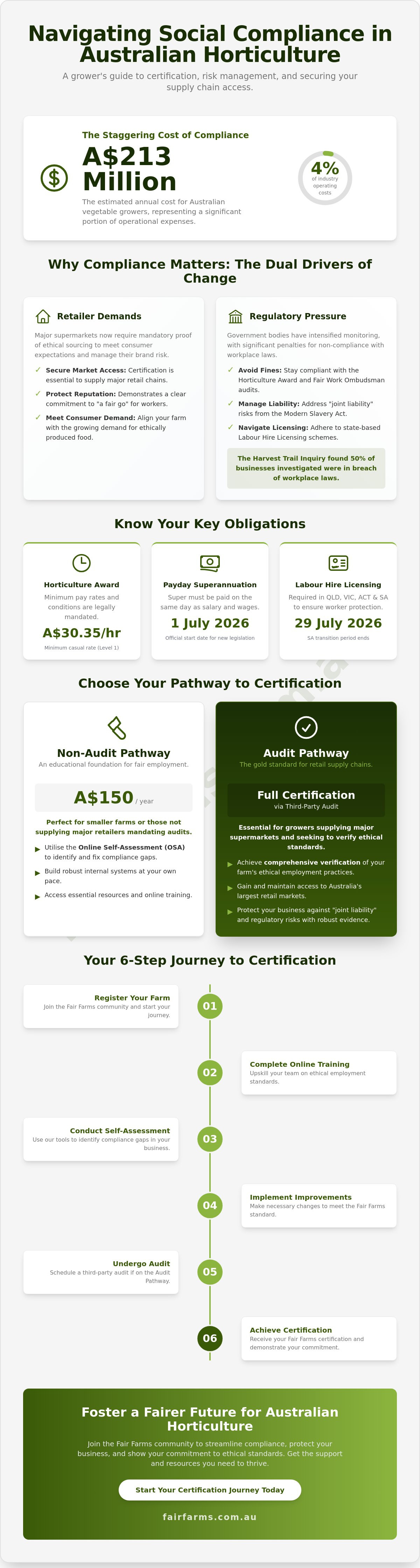
Did you know that compliance costs for Australian vegetable growers have climbed to an estimated A$213 million per year? This represents roughly 4% of the industry's total operating costs. It's a staggering figure that highlights the growing pressure on your bottom line. You're likely feeling the weight of the Horticulture Award 2020, especially with casual rates at A$30.35 per hour and the upcoming Payday Superannuation changes on 1 July 2026. Securing the social compliance certification horticulture Australia retailers require often feels like an uphill battle against paperwork and rising overheads.
We understand that you want to do the right thing by your workers while keeping your business viable and competitive. This guide will show you how to streamline your certification process, protecting your farm from industrial relations risks and the tightening requirements of the Modern Slavery Act. We'll explore the 2026 regulatory landscape, covering everything from South Australia's new labour hire licensing deadlines to practical steps for verifying your ethical standing to major retail buyers. By the end of this article, you'll have a clear pathway to fostering fair employment practices without drowning in administrative complexity.
Key Takeaways
- Understand how social compliance acts as a shield for your business reputation and ensures continued access to major Australian retail supply chains.
- Identify the most efficient social compliance certification horticulture Australia pathway for your farm, choosing between the comprehensive Audit Pathway or the flexible Non-Audit option.
- Master the six-step journey to certification, including how to use Fair Farms Online Training to upskill your team on ethical employment standards.
- Protect your enterprise from "joint liability" risks by learning how to verify the compliance of your labour hire providers through specialised audit pathways.
- Gain access to professional HR support and resources specifically designed to help you navigate the complexities of the Horticulture Award with confidence.
Understanding Social Compliance in the Australian Horticulture Sector
Social compliance isn't just another administrative hurdle; it's the formal verification of ethical employment and workplace standards across your entire operation. In the past, many in the industry relied on the "she'll be right" approach to industrial relations. However, the 2019 Harvest Trail Inquiry changed the landscape forever. The Fair Work Ombudsman found that 50% of the 638 businesses investigated were in breach of workplace laws, leading to a national push for transparency. For growers today, achieving social compliance certification horticulture Australia is about proving you provide a "fair go" through rigorous, evidence-based practices.
The regulatory pressure has only intensified with the Modern Slavery Act 2018. While the mandatory reporting threshold applies to entities with an annual consolidated revenue of at least A$100 million, the impact trickles down to every farm. Large retailers must now scrutinise their entire fresh produce supply chain to identify and remediate forced labour risks. If you can't demonstrate a clear commitment to ethical standards, you risk losing access to these vital markets. Social compliance sits within the broader global movement of Ethical trade, focusing on the human element of the production process.
The Drivers of Change: Retailers vs. Regulators
Major Australian supermarkets have shifted their stance from seeing ethical sourcing as "optional" to making it a "mandatory" requirement for supply. This shift isn't just about corporate social responsibility; it's a response to consumer demand for ethically grown food. Simultaneously, the Fair Work Ombudsman has increased its monitoring of horticultural businesses, focusing on vulnerable workers and complex supply chains. To put it simply, social compliance is a holistic commitment to worker welfare and legal integrity that ensures your business remains resilient against both retail audits and government inspections.
Key Regulatory Pillars for Australian Growers
Navigating the Horticulture Award (MA000028) is a core component of staying compliant. With adult casual Level 1 employees earning a minimum of A$30.35 per hour as of June 2025, and strict rules regarding piecework and record-keeping, the margin for error is slim. Additionally, state-based Labour Hire Licensing schemes in Queensland, Victoria, the ACT, and South Australia add another layer of complexity. In South Australia, the scheme expanded in January 2026, with a transition period ending 29 July 2026 for newly captured providers. Utilising the Fair Farms Pathways simplifies this "burden of proof" by providing a structured framework to organise your records and demonstrate your compliance to any auditor or regulator who walks through your gate.
Choosing the Right Pathway: Audit vs. Non-Audit Certification
Every farm is unique. A small family orchard has different compliance needs compared to a large-scale berry producer. Fair Farms recognises this diversity by offering a flexible, tiered approach. This ensures that every grower, regardless of their size or market, can participate in a social compliance certification horticulture Australia program that adds value without imposing unnecessary financial strain.
The choice of pathway often depends on where your produce ends up. As highlighted in the Horticulture compliance report, the industry faces varied challenges across different supply chains. Whether you are selling at a local farmers market or supplying a national supermarket chain, there is a structured route designed to help you demonstrate your commitment to fair work standards.
The Non-Audit Pathway (NAP) Explained
The Non-Audit Pathway (NAP) is an entry-level option priced at A$150.00 per year. It's specifically designed for smaller operations or those not currently supplying major retailers that mandate a third-party audit. The cornerstone of this pathway is the Online Self-Assessment (OSA). This tool allows you to identify potential risks within your business and implement improvements at your own pace. It serves as an educational foundation, helping you build robust internal systems. If your business expands and you decide to supply a major supermarket, you can transition from NAP to the full Audit Pathway, carrying your established documentation with you.
The Audit Pathway: Meeting Retailer Expectations
For growers supplying major Australian supermarkets, the Audit Pathway is the industry standard. This pathway costs A$250.00 per year and requires a successful third-party audit to achieve certification. While Fair Farms provides the framework and the Fair Farms Manual to help you organise your systems, the audit itself is conducted by one of six approved independent auditing bodies. These independent verifications give retail buyers the confidence that your produce is grown under ethical conditions. For those managing external labour, the LHP Audit Pathway (starting from A$795.00 per year) provides a specific framework to ensure your contractors are also meeting their legal obligations. You can explore the specific requirements for each of these Fair Farms Pathways to see which one best aligns with your current business goals.
The 6-Step Pathway to Fair Farms Certification
The journey toward formal recognition begins with a clear, six-step process designed to guide you from registration through to final approval. This structured approach ensures that achieving social compliance certification horticulture Australia is manageable and transparent. The process begins with Step 1: Registration, which typically takes between 45 and 60 minutes to complete. During this stage, you'll choose the membership level that fits your business model. Step 2 involves engaging with Fair Farms Online Training. This isn't just about reading a manual; it's about upskilling your management team on the practicalities of fair employment practices.
Step 3 is the Online Self-Assessment (OSA), where you'll look closely at your own operations to identify any areas needing attention. Following the OSA, Step 4 moves into the Audit phase for those on the Audit Pathway. This involves a site visit from an independent auditor to verify your practices. Step 5 is the Audit Review and Remediation, where any identified gaps are addressed. Finally, Step 6 is the awarding of your certification, allowing you to demonstrate your ethical standing to the market and your retail partners.
Mastering the Online Self-Assessment (OSA)
The OSA is the most critical tool in your compliance toolkit. It acts as a "mock audit," allowing you to identify gaps in your HR systems before an external auditor arrives. Many growers find that their biggest challenges lie in record-keeping and payslip compliance, areas where the Fair Work Ombudsman frequently finds errors. If the OSA highlights a weakness, don't panic. You can utilise Fair Farms Online Training to target those specific areas and strengthen your systems before moving forward. This proactive approach reduces stress and ensures you're fully prepared for the final verification stage.
Navigating the Audit and Remediation
During an on-site audit, the auditor will review your documentation and conduct private interviews with workers to ensure that what's on paper matches the reality on the ground. It's common to receive "Non-Conformances" during this process. These aren't failures; they're opportunities for improvement. You'll have a set timeframe to remediate these issues and provide evidence of the fix. Once Step 6 is reached, you'll receive your certification status. You can then proudly display your certification on your packaging or marketing materials and share your digital certificate directly with retail buyers to secure your market access and build long-term trust.
Addressing the Challenges of Labour Hire and Ethical Sourcing
Engaging labour hire providers (LHPs) is a standard practice for managing peak seasons, but it carries a significant "joint liability" risk. Under Australian workplace laws, a grower can be held legally and financially responsible if their labour contractor fails to pay workers correctly or breaches safety standards. This risk makes social compliance certification horticulture Australia a vital safeguard for your enterprise. By ensuring your labour providers are also committed to ethical standards, you protect your business from the reputational and legal fallout of third-party non-compliance.
The LHP Audit Pathway, starting from A$795.00 per year, offers a robust framework to vet your contractors. This is particularly crucial given the shifting state-based regulations. For instance, labour hire providers in South Australia now face expanded licensing requirements, with a transition period ending 29 July 2026. Verifying that your providers hold both a valid state licence and a recognised social compliance certification is the only way to ensure your supply chain remains "above board" and resilient against regulatory scrutiny.
Best Practices for Managing Seasonal Labour
Managing a seasonal workforce requires more than just filling roles; it involves meeting strict pay standards. Since the introduction of the minimum wage guarantee for pieceworkers, you must ensure that every worker earns at least 15% more than the minimum hourly rate for their classification. For a casual Level 1 employee, this means their piecework earnings should exceed the A$30.35 hourly rate. Providing comprehensive inductions and clear training for a diverse workforce ensures everyone understands their rights and your expectations. Implementing ethical labour practices directly improves worker retention and farm productivity by fostering a loyal and motivated team.
Supply Chain Transparency and Retailer Trust
Modern slavery has become a top-tier risk for Australian supermarket procurement teams, with an estimated 41,000 people in modern slavery across the country as of March 2026. Retailers are under immense pressure to report on their supply chains, and they increasingly prefer suppliers who can offer real-time visibility. A Supply Chain Membership allows you to monitor your network of suppliers and contractors through a single, transparent platform. This verified data builds a foundation of trust, helping you secure long-term partnerships with buyers who value integrity as much as quality. If you're ready to secure your supply chain, you can contact our team to discuss the best membership options for your network.
Fostering a Fairer Future: Joining the Fair Farms Community
Choosing to pursue social compliance certification horticulture Australia is about more than just meeting a retail requirement; it's about joining a community of like-minded growers dedicated to the "fair go." Fair Farms doesn't act as a rigid enforcer. Instead, we operate as a supportive mentor, providing the tools and knowledge you need to succeed. This industry-led programme is built by growers, for growers, ensuring that the standards are practical, achievable, and deeply rooted in the realities of Australian farm management. When you join, you aren't just buying a certificate; you're investing in a partnership that values your business's long-term reputation and ethical standing.
One of the most significant advantages of this community is access to dedicated HR support. Navigating the Horticulture Award is notoriously complex, with its specific provisions for overtime, allowances, and the 15% piecework premium. Our team provides guidance that's tailored specifically to these horticultural regulations, helping you avoid the common pitfalls that lead to Fair Work Ombudsman interventions. By streamlining your processes today, you're building a more resilient business for tomorrow. You can take the first step toward this peace of mind by exploring the Fair Farms membership options and selecting the pathway that best suits your current operation.
Ongoing Support and Resources for Members
Compliance isn't a "set and forget" task. It requires staying informed about shifting industrial relations trends and regulatory updates. As a member, you'll receive our "Fair Talk" newsletter, which keeps you across everything from the July 2026 Payday Superannuation changes to new labour hire licensing deadlines. We also provide a comprehensive library of templates and manuals. These resources take the guesswork out of record-keeping and payslip compliance, ensuring your internal systems are always up to standard. If you ever feel stuck or need specific advice on a workplace issue, you can contact the Fair Farms team for personalised guidance from people who understand the unique challenges of the Australian bush.
The "Fair Go" Advantage
In a competitive labour market, your reputation as an employer is your greatest asset. Achieving certification allows you to position your farm as an "Employer of Choice," making it easier to attract and retain the high-quality workers you need for a successful harvest. There's also a significant psychological benefit to being "audit-ready" at all times. You won't need to scramble when a regulator or a retail buyer asks for proof of your employment practices; the evidence will already be organised and verified. Ultimately, fostering fair and responsible employment practices is the foundation of a sustainable Australian horticulture industry. It protects our workers, secures our markets, and ensures that the "fair go" remains a reality for everyone in the supply chain.
Secure Your Market Access and Lead with Integrity
Social compliance is no longer just a box-ticking exercise; it's a fundamental shift in how we protect the Australian "fair go." By choosing the right pathway and following the structured 6-step process, you transform your HR systems into a shield that protects both your business and your workers. Staying ahead of labour hire regulations and retail expectations ensures your produce remains on supermarket shelves while your farm remains resilient against industrial risks.
Securing your social compliance certification horticulture Australia status positions your farm as a leader in ethical trade. This industry-led programme, developed by Queensland Fruit & Vegetable Growers (QFVG), is already trusted by over 450 certified businesses across the country. These growers are already reaping the rewards of verified ethical standing and streamlined retail access. They've moved beyond the stress of "audit-readiness" to a place of confidence and communal progress.
You don't have to navigate these complex regulations alone. Our team is here to act as a mentor, providing the training and support needed to make compliance a natural part of your daily operations. Join the Fair Farms movement and secure your farm’s future today. Together, we'll build a stronger, more transparent horticulture sector that we can all be proud of.
Frequently Asked Questions
Is social compliance certification mandatory for all Australian farms?
No, it's not a legal requirement for every farm under federal law, but it's a commercial necessity for most. Major Australian supermarkets require verified social compliance to maintain supply contracts. Choosing to obtain social compliance certification horticulture Australia ensures you meet these market access requirements while protecting your farm from industrial relations risks.
How much does Fair Farms certification cost for a mid-sized grower?
For a grower on the Audit Pathway, the annual membership fee is A$250.00. If you don't supply major retailers and choose the Non-Audit Pathway, the fee is A$150.00 per year. These fees cover your membership and access to the Fair Farms platform. You must pay the third-party auditing body separately for the actual on-site audit costs.
Can I use Fair Farms certification to meet Coles and Woolworths requirements?
Yes, Fair Farms is widely recognised by major Australian retailers as a valid verification of ethical employment. It's designed to align with the sourcing requirements of supermarkets like Coles and Woolworths. By achieving this certification, you provide the evidence these buyers need to ensure their supply chains are free from exploitation and meet their corporate social responsibility standards.
What happens if my farm fails a social compliance audit?
You don't "fail" in the traditional sense; instead, the auditor identifies "Non-Conformances" that require attention. You'll receive a report outlining these gaps and a specific timeframe to remediate them. Once you provide evidence that the issues are fixed, your certification can proceed. It's a supportive process aimed at continuous improvement rather than immediate disqualification.
How long does the Fair Farms certification process typically take?
The timeline varies depending on your farm's readiness, but the initial registration takes about 45 to 60 minutes. Completing the Online Self-Assessment (OSA) and training depends on your own pace, while the audit depends on the availability of your chosen auditing body. Most growers find the entire journey takes a few months to complete from start to finish.
Do I need a separate audit for every labour hire provider I use?
You don't need a separate audit for each provider, but you're responsible for their compliance under joint liability laws. We recommend using labour hire providers who have completed the LHP Audit Pathway. This ensures they've been independently verified, which significantly reduces your risk of being held liable for their potential workplace breaches or pay errors.
What is the difference between a social audit and a quality assurance (QA) audit?
A quality assurance audit focuses on food safety and product standards, while a social audit focuses on people and workplace conditions. While QA ensures the produce is safe for consumers, social compliance certification horticulture Australia ensures the people picking and packing it are treated fairly. Both are essential for modern agribusiness but cover entirely different regulatory pillars.
Can I complete the training and OSA if I am not yet ready for a full audit?
Yes, you can absolutely engage with the training and OSA without committing to a full audit. The Non-Audit Pathway is perfect for smaller operations that want to upskill their team and identify HR gaps. It allows you to build a foundation of ethical practices at your own pace before transitioning to the Audit Pathway when your business needs change.