
Social Compliance Certification in Horticulture: The 2026 Australian Grower’s Guide
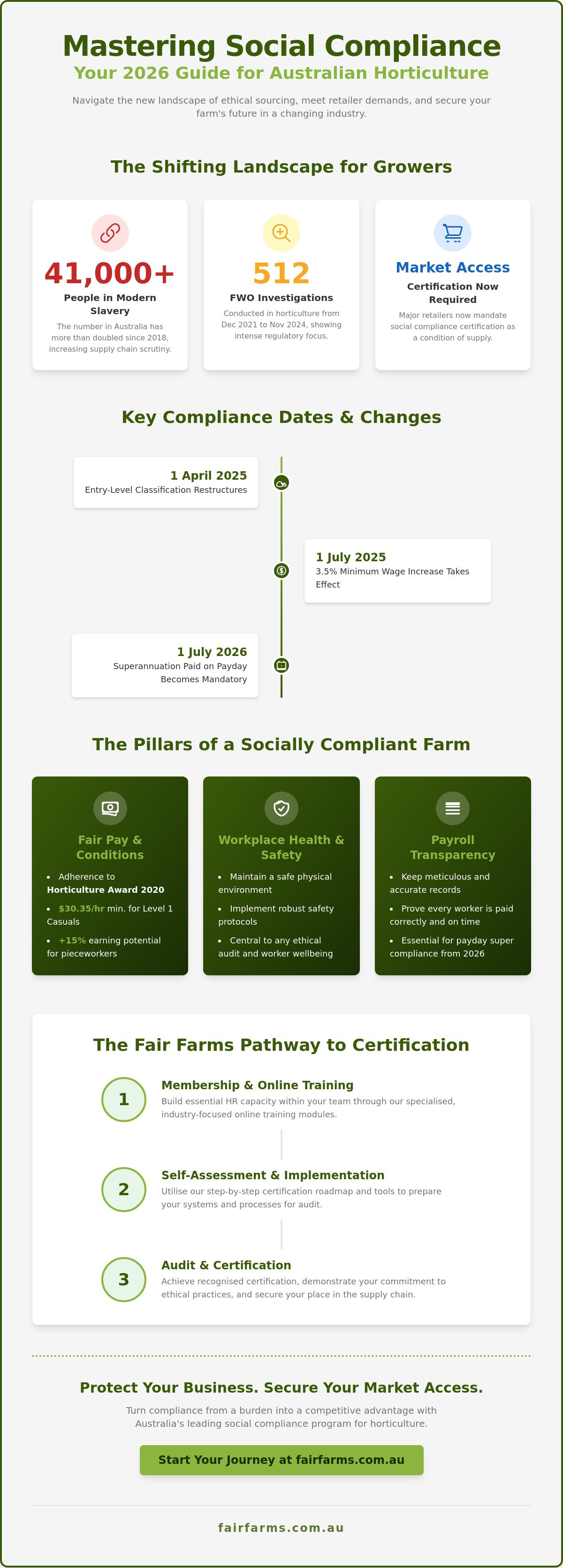
An estimated 41,000 people are currently living in conditions of modern slavery across Australia, a figure that has more than doubled since 2018. For local growers, this isn't just a distant headline; it's a direct challenge to the integrity of our supply chains. You're likely already feeling the pressure from major retailers to prove your ethical standing while managing the 3.5% minimum wage increase that kicked in on 1 July 2025. Between the 360 Fair Work Ombudsman site inspections recorded recently and the new requirement to pay superannuation on paydays starting 1 July 2026, the administrative burden can feel overwhelming.
We understand that you want to provide a fair go for your workers without your farm operations grinding to a halt. This guide helps you master social compliance certification horticulture standards, ensuring you maintain vital market access and protect your business reputation. We'll walk through the 1 April 2025 entry-level classification restructures and the 12% superannuation guarantee; providing a clear pathway to a streamlined, audit-ready workplace that supports both your people and your bottom line.
Key Takeaways
- Learn why major retailers now demand social compliance certification horticulture as a non-negotiable requirement for securing and maintaining supply chain contracts.
- Understand the evolving regulatory landscape for 2026, including your specific reporting obligations under the Modern Slavery Act and the Fair Work Act.
- Discover why Australian-specific standards offer more practical value than global platforms by aligning directly with our local industrial relations system.
- Follow the structured Fair Farms pathway to build internal HR capacity through dedicated online training and a step-by-step certification roadmap.
- Explore how an industry-led membership provides the specialised HR support needed to foster a fair, productive, and legally compliant workplace.
Understanding Social Compliance Certification in Horticulture
In the 2026 Australian agricultural landscape, social compliance has evolved from a voluntary "gold standard" into a fundamental requirement for staying in business. It's no longer enough to simply claim you treat your workers well. Major retailers like Coles, Woolworths, and Aldi now require objective proof through a recognised social compliance certification horticulture program. This shift is driven by a growing demand for transparency across the entire supply chain, ensuring that every punnet of berries or head of lettuce is produced without exploitation. For growers, achieving certification is the most effective way to secure market access while shielding the farm from significant reputational damage and the legal risks associated with non-compliance.
The financial stakes are high. Recent data suggests the total cost of compliance for the Australian vegetable industry has reached approximately $213 million per year. While this represents about 4% of operating costs, the cost of being locked out of the market is far greater. By aligning with global sustainability standards while focusing on local legal requirements, growers can turn compliance into a competitive advantage rather than a mere administrative hurdle.
The Evolution of Ethical Sourcing in Australia
The history of social standards in our sector has moved rapidly from informal handshakes to rigorous, data-driven audits. Social compliance is the verification of fair, safe, and legal employment practices. As of early 2026, the Anti-Slavery Commissioner is pushing for mandatory due diligence, which would legally obligate companies to prevent and address risks rather than just reporting on them. Even though the Modern Slavery Act 2018 reporting threshold remains at $100 million in annual revenue, smaller growers are feeling the ripple effects as larger buyers demand transparency from every tier of their supply chain.
Key Pillars of a Socially Compliant Farm
To succeed in a social audit, your farm must demonstrate excellence across several core areas. The most critical pillar is adherence to the Horticulture Award 2020. This includes managing the 3.5% minimum wage increase from 1 July 2025 and ensuring the 12% Superannuation Guarantee is correctly applied. Other essential components include:
- Fair Pay and Conditions: Ensuring Level 1 casual employees receive at least $30.35 per hour and that piecework rates allow average workers to earn 15% above the minimum.
- Workplace Health and Safety (WHS): Maintaining a safe physical environment and robust safety protocols, which are central to any ethical audit.
- Payroll Transparency: Keeping meticulous records to prove that every worker is paid correctly and on time, especially with the 1 July 2026 shift to payday superannuation.
Building these pillars doesn't happen overnight. It requires a commitment to a structured Fair Farms certification pathway that guides you through the complexities of Australian workplace law.
The Regulatory Landscape: Fair Work and Modern Slavery
The legal environment for Australian growers is more rigorous than ever. Between December 2021 and November 2024, the Fair Work Ombudsman conducted 512 investigations specifically within the horticulture sector. This level of scrutiny proves that "I didn't know" won't protect your business from hefty fines or legal action. Navigating the Fair Work Act requires a proactive approach, especially when managing the seasonal fluctuations of your workforce. Achieving social compliance certification horticulture serves as your primary defence, demonstrating that your farm operates within the bounds of both national and state-based laws.
Compliance isn't just about federal law; it's also about the intersection of state-based labour hire licensing in regions like Queensland, Victoria, and South Australia. These schemes require growers to ensure their labour providers are fully licensed and reputable. Failing to do so can lead to severe penalties, regardless of whether the breach was intentional. In this climate, transparency is the only way to safeguard your farm's future and maintain the trust of your buyers.
Mastering the Horticulture Award
The Horticulture Award is the bedrock of seasonal employment. Many growers stumble on piecework rates, which must ensure a worker with average productivity earns at least 15% more than the minimum hourly rate. For a Level 1 employee, this means a minimum of $27.92 per hour. With the 3.5% wage increase from 1 July 2025 and the upcoming shift to payday superannuation on 1 July 2026, the complexity is rising. Regular internal payroll audits are a necessity to ensure you don't fall behind on these shifting requirements.
Modern Slavery Risks in the 2026 Supply Chain
Modern slavery includes any situation where a worker cannot leave their job due to threats or coercion. In Australia, an estimated 41,000 people are currently in these conditions, a figure that has doubled since 2018. When engaging labour hire providers, you must watch for "red flags" like rates that seem too low to cover legal wages or providers who lack proper documentation. Transparency is your best tool for mitigating these risks. By fostering fair and responsible employment practices, you protect your workers and your farm's reputation. If you're feeling the weight of these regulations, becoming a Fair Farms member provides the specialised HR support and resources needed to stay compliant without the administrative stress.
Comparing Local vs. Global Social Compliance Standards
Choosing the right framework for your farm is a strategic business decision that impacts your daily operations and your bottom line. While international ethical data platforms provide a broad framework for responsible sourcing, they often lack the granular detail required to navigate the specific intricacies of the Australian industrial relations system. A generic global audit might overlook whether your payroll systems are configured for the 12% superannuation rate or if your piecework records meet the strict transparency requirements of our local awards. This is where a dedicated social compliance certification horticulture programme proves its worth by bridging the gap between global expectations and the practical realities of Australian farming.
The differences in cost and administrative complexity are also significant. Many global supplier platforms charge annual fees in foreign currency, often ranging from approximately £215 to £365 per year, per site. In contrast, the Fair Farms certification audit pathway registration fee is $250 + GST. Beyond the registration costs, the real value lies in the reduced administrative burden. Local pathways are designed by the industry for the industry, meaning the documentation and evidence required are already familiar to Australian growers. You won't spend hours translating international corporate social responsibility jargon into tasks that make sense in a packing shed or out in the field.
Why Local Context Matters for Compliance
Generic global audits often miss nuances because they aren't built to verify the specific protections embedded in our national laws. Local standards integrate Australian Fair Work requirements directly into the audit process. This ensures that when an auditor visits your farm, they're looking for exactly what the Fair Work Ombudsman expects to see. Having Australian-based support is a major advantage here. If you're struggling to interpret how recent wage adjustments affect your specific crew structures, you can access mentors who understand our unique industrial relations landscape rather than dealing with an international helpdesk that doesn't know a piece rate from a flat rate.
Retailer Acceptance and Market Access
In 2026, the "Big Three" supermarkets—Woolworths, Coles, and Aldi—have clear, non-negotiable requirements for their suppliers regarding ethical sourcing. They recognise both global and local schemes, but an industry-led certificate often simplifies the onboarding process for new supply contracts. It provides a common language between the grower and the retailer's compliance team. Being a certified ethical employer isn't just about avoiding penalties; it's a long-term commercial advantage. It makes your business a preferred partner in a market that's increasingly sensitive to social risks. To gain the full benefit of these industry-aligned resources, many growers find that a Fair Farms membership is the most efficient way to maintain their competitive edge and secure their place on supermarket shelves.
The Fair Farms Pathway: Your Certification Roadmap
Achieving a social compliance certification horticulture isn't a hurdle to clear; it's a structured journey toward business resilience. Following a clear roadmap ensures that your farm doesn't just pass an audit but builds a culture of fair work that lasts. This process is designed to be methodical, moving from initial commitment to objective verification and ongoing improvement.
Step 1 begins with your registration and commitment to the Fair Farms certification pathway. For growers on the audit pathway, the $250 + GST registration fee opens the door to a suite of resources specifically tailored to the Australian context. Step 2 involves completing online training modules. These are essential for building the internal HR and compliance knowledge required to manage modern workforces. In Step 3, you'll complete a Self-Assessment Questionnaire (SAQ). This tool acts as a mirror for your current business practices, highlighting where your documentation might be thin or where your payroll processes need a tune-up before an auditor arrives.
Step 4 is the independent third-party audit itself. Because you've followed the previous steps, you can face this with confidence. Finally, Step 5 is about achieving and maintaining your certification. Social compliance is a process of continuous improvement, not a "set and forget" task. It requires staying updated with changes like the 1 July 2026 shift to payday superannuation or annual award rate adjustments.
Preparing for Your Audit
Preparation is everything. You'll need to organise essential documentation well in advance, including employment contracts, recent payslips, and workplace health and safety records. Conducting a "mock audit" is a highly effective way to catch common compliance gaps early. This internal review allows you to verify that your record-keeping matches the reality on the ground. It's also vital to train your supervisors and staff so they understand the audit process. When your team knows what to expect, the actual audit day runs much more smoothly.
The Role of Online Training
Staff education is the foundation of a compliant workplace. Digital modules simplify complex topics such as fatigue management and worker rights, making them accessible to a diverse workforce. By using these tools, you can ensure that every supervisor understands their legal obligations under the Horticulture Award. Tracking training progress is also a practical way to demonstrate due diligence to auditors. It proves you've taken proactive steps to foster a fair and responsible environment. If you're ready to start your journey, contact our team today to discuss the best pathway for your farm.
Why Fair Farms Membership is the Strategic Choice for 2026
Choosing a pathway toward social compliance certification horticulture involves more than just ticking boxes on an audit sheet; it's about selecting a partner that understands the Australian soil you work in. A Fair Farms membership isn't a mere subscription. It's a commitment to a values-based framework that fosters fair and responsible employment practices across our nation. While global platforms offer generic checklists, an industry-led programme provides the quiet confidence that your farm is meeting local expectations. You're joining a community of ethical growers who believe that a "fair go" for workers is the only way to build a sustainable future for Australian agriculture.
The strategic advantage of membership lies in its ability to turn complex regulations into manageable daily tasks. With the Fair Work Ombudsman conducting 512 investigations in our sector between late 2021 and late 2024, the risk of going it alone is simply too high. Membership provides a shield against the administrative burden, allowing you to focus on what you do best: growing world-class produce. It's a collaborative effort to protect the reputation of the Australian horticulture industry on a global stage, ensuring our supply chains remain clean, transparent, and resilient.
Dedicated HR Support for Growers
Most growers aren't industrial relations experts, and they shouldn't have to be. Membership gives you access to dedicated HR support tailored specifically for the complexities of the Horticulture Award. Whether you're navigating a workplace relations dispute or trying to implement the new payday superannuation rules coming in on 1 July 2026, expert guidance is just a phone call away. You'll have access to a library of templates and resources that simplify HR administration, from compliant employment contracts to payroll checklists. Think of it as having a principled mentor in the compliance space, helping you avoid the common pitfalls that lead to audit failure or legal penalties.
Building a Resilient Horticulture Sector
Ethical certification is a powerful tool for worker retention and productivity. In a market where labour is often scarce, being a recognised fair employer makes your farm a preferred workplace. When workers feel safe and respected, turnover drops and efficiency rises. This stability is the bedrock of long-term sustainability for Australian farming. By investing in social compliance, you're not just securing a contract with a supermarket; you're protecting the long-term viability of your family business. If you're ready to secure your supply chain and lead with integrity, Contact Fair Farms to start your journey today.
Lead the Way in Ethical Australian Farming
Navigating the 1 July 2026 shift to payday superannuation and the 12% super guarantee doesn't have to be a solo effort. By adopting a social compliance certification horticulture program, you're doing more than just meeting a retailer's requirement; you're future-proofing your business against the rising risks of modern slavery and protecting the integrity of the Australian "fair go". This proactive approach ensures your farm remains a preferred partner for major supermarkets while maintaining a productive, loyal workforce.
Developed by Queensland Fruit & Vegetable Growers (QFVG), Fair Farms offers the only pathway designed specifically for our local conditions and is recognised by every major Australian retailer. You'll gain access to tailored HR support that simplifies the administrative weight of the Horticulture Award, allowing you to focus on your harvest with total peace of mind. Our community is built on the belief that ethical practices are the bedrock of a successful agricultural sector.
Join Fair Farms today and secure your farm’s future. We're here to help you foster a fair, productive, and resilient workplace that will thrive for generations to come.
Frequently Asked Questions
Is social compliance certification mandatory for Australian growers?
Social compliance certification isn't a legal requirement under Australian federal law for every farm, but it's a commercial necessity for most. If you want to supply major retailers like Woolworths, Coles, or Aldi in 2026, you'll find it's a non-negotiable part of their vendor requirements. These businesses use certification to verify that their suppliers meet the ethical standards expected by Australian consumers and the Modern Slavery Act.
How much does it cost to get Fair Farms certified in 2026?
Registration fees for the Fair Farms audit pathway are $250 + GST for growers and suppliers. If you're a labour hire provider, the registration fee for the audit pathway is $795. These costs cover your initial registration and access to the online training platform. You'll also need to budget separately for the independent third-party audit, which is conducted by an approved auditing body at their market rates.
What is the difference between a social audit and a quality assurance audit?
A social audit focuses on the welfare and legal rights of your people, while a quality assurance audit addresses food safety and product standards. While a QA audit might check your chemical shed or packing line, a social audit examines payroll records, employment contracts, and workplace safety protocols. Both are essential for market access, but they serve different purposes in protecting your business reputation and ensuring a fair go for workers.
Can I use Fair Farms certification to meet supermarket requirements?
Yes, Fair Farms is a recognised standard for the "Big Three" Australian supermarkets and many other major buyers across the country. It was specifically designed to help growers meet these commercial requirements while ensuring compliance with the Horticulture Award and the Fair Work Act. Using a locally developed social compliance certification horticulture program ensures your audit is relevant to the unique industrial relations landscape in Australia.
How long does the certification process typically take?
The timeline for certification typically ranges from three to six months, depending on your farm's current level of HR readiness. Completing the online training and Self-Assessment Questionnaire (SAQ) can be done relatively quickly, but you'll need time to address any gaps identified in your processes. Once you're ready, you'll need to book an audit with an external provider, which can take several weeks depending on their current availability.
What happens if I fail my first social compliance audit?
Failing an audit simply means the auditor has identified "non-conformances" that you need to rectify before certification is granted. You'll receive a detailed report outlining the areas that don't meet the standard, such as missing documentation or incorrect overtime calculations. You're then given a specific timeframe to provide evidence that you've corrected these issues. This process of continuous improvement is a core part of achieving social compliance certification horticulture.
Do labour hire providers need their own social compliance certification?
Labour hire providers are strongly encouraged to hold their own certification to demonstrate they are ethical partners in the supply chain. While growers are responsible for their own sites, engaging a certified labour hire provider significantly reduces your risk of third-party non-compliance. Fair Farms offers a specific Labour Hire Membership designed to ensure these businesses meet the same rigorous standards as the growers they support on the ground.
How often do I need to renew my social compliance certificate?
Most certifications require an annual or biennial renewal to ensure your practices remain up to date with changing industrial laws. The frequency of your full audit often depends on your previous audit results and the level of risk identified by the certification body. Maintaining your membership ensures you have ongoing access to the latest HR templates and training modules as regulations like the Horticulture Award continue to evolve.