
Employer Obligations for Migrant Farm Workers in Australia: The 2026 Compliance Guide
In 2026, your "licence to operate" in the Australian horticulture sector depends less on your harvest volume and more on your commitment to ethical labour standards. Managing employer obligations for migrant farm workers Australia has become a rigorous process, especially with the Migration Amendment (Strengthening Employer Compliance) Act 2024 and the 4.75% increase to Horticulture Award wages. You likely feel the growing pressure from major retailers to prove your ethical credentials while trying to handle the complexities of visa work rights and piece rate competency.
We recognise that maintaining these standards is a significant undertaking for any regional business. This guide will help you master your legal and ethical responsibilities, ensuring you protect your farm’s reputation and maintain essential access to the supply chain. We'll provide a practical checklist for migrant worker onboarding, strategies for approaching Fair Work or retail audits with confidence, and a clear path toward long-term stability through principled employment practices.
Key Takeaways
- Understand the "same rights" principle to ensure your migrant workforce receives the full protections of the Fair Work Act 2009.
- Implement a robust verification process using VEVO to meet your employer obligations for migrant farm workers Australia and confirm specific visa work rights.
- Navigate the latest Horticulture Award updates to correctly apply minimum pay rates and the mandatory piece rate floor for all seasonal staff.
- Establish a reliable seven-year record-keeping system that safeguards your farm’s reputation during rigorous retail supply chain audits.
- Discover how the Fair Farms Certification pathway offers the training and support needed to demonstrate your commitment to ethical labour standards.
Understanding Your Employer Obligations for Migrant Workers in 2026
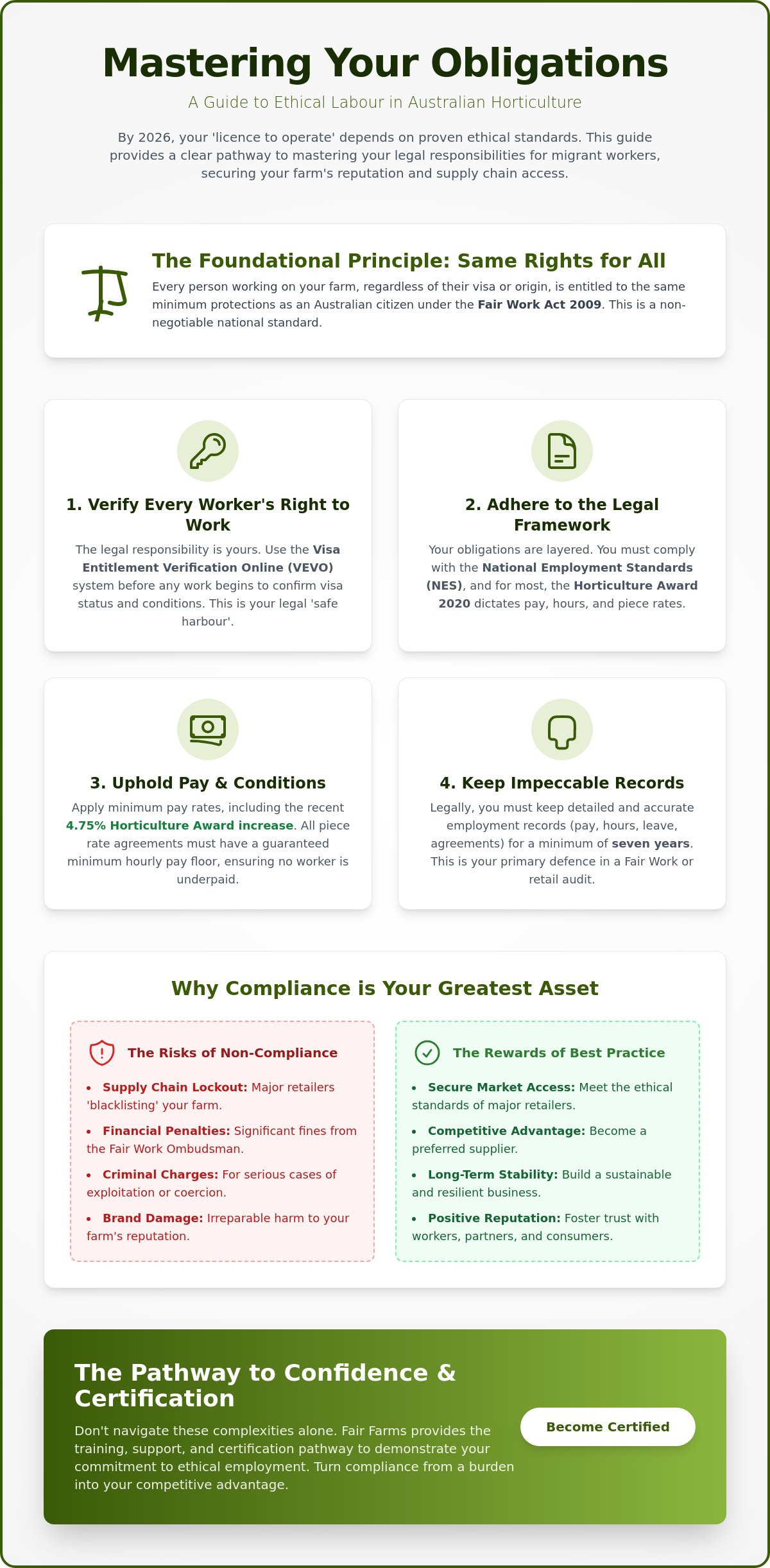
The foundational pillar of Australian workplace law is the "Same Rights" principle. This means every individual working on your farm, regardless of their visa status or country of origin, is entitled to the same minimum protections as an Australian citizen. The Fair Work Act 2009 governs these relationships, ensuring that seasonal agricultural labour is not exploited. The Fair Work Ombudsman actively monitors farm-gate compliance, conducting regular inspections to verify that pay rates, safety standards, and working conditions meet legal benchmarks. As a grower, you aren't just managing a harvest; you're upholding a national standard of equity that defines the integrity of our regional communities.
Ethical treatment has evolved into a core requirement for major Australian retailers and wholesalers. Supermarket chains and export partners now demand transparency throughout the production process. They recognise that their own reputations are linked to your employment practices. Meeting your employer obligations for migrant farm workers Australia is the most effective way to secure your place in these lucrative supply chains. It's about moving beyond basic legal box-ticking to embrace a culture of accountability that resonates with consumers and industry stakeholders alike.
The Core Legal Framework for Australian Agriculture
The hierarchy of employment rights starts with the National Employment Standards (NES), which provide eleven minimum entitlements that apply to all employees. For most growers, the Horticulture Award 2020 is the primary industrial instrument that dictates daily operations. Within this framework, a "migrant worker" includes anyone on a temporary visa with work rights. This encompasses participants in the Pacific Australia Labour Mobility (PALM) scheme, Working Holiday Makers, and student visa holders. To ensure these rights are truly upheld, you must account for cultural and language barriers. Simply providing a contract isn't enough; you must ensure the worker actually understands their entitlements in a language they speak fluently.
Why Compliance Matters for Your Supply Chain
Non-compliance carries risks that extend far beyond financial penalties. In the current market, major supermarket chains can "blacklist" suppliers who fail to meet ethical labour benchmarks. This effectively cuts off your primary route to market. Your brand reputation is your most valuable asset, and it can be tarnished overnight by reports of poor workplace standards. The 2026 agricultural landscape has shifted toward mandatory social audits as a standard business practice. Demonstrating a clear pathway to certification allows you to provide the verified proof of compliance that retailers require. This proactive approach transforms compliance from a burden into a competitive advantage, fostering long-term business stability and trust.
Verifying the Right to Work: Visa Categories and VEVO Requirements
Maintaining your employer obligations for migrant farm workers Australia starts with a rigorous verification process. Under the Migration Act 1958, and the more recent Migration Amendment (Strengthening Employer Compliance) Act 2024, the responsibility to ensure every worker has a valid visa rests solely with the employer. Employing someone in breach of their visa conditions can result in significant civil penalties and, in cases of coercion or exploitation, criminal charges. Using the Visa Entitlement Verification Online (VEVO) system is the only way to confirm a worker's current status and any specific work limitations they might have. It's a simple step that provides a legal "safe harbour" for your business.
For many growers, Working Holiday Makers (Subclass 417 and 462) form the backbone of the harvest. These workers are often motivated by the "88-day requirement," which allows them to apply for a second or third-year visa after completing specified work in regional postcodes. While this provides a steady labour pool, you must be diligent in signing off on this work. Only genuine, paid work that adheres to the Horticulture Award qualifies. Inaccurate reporting or underpayment during this period doesn't just risk the worker's visa; it invites a Fair Work audit of your entire operation.
The VEVO Check: A Step-by-Step Process
Before any work begins, you must obtain written consent from the worker to perform a VEVO check. Once you have their passport details, use the system to identify restricted hours or specific employer conditions. Don't treat this as a one-off task. Best practice in 2026 involves setting a recurring schedule to re-verify visas every three months, especially for workers on bridging visas or those with approaching expiry dates. This methodical approach ensures no one "falls through the cracks" during a busy season.
Special Considerations for PALM Scheme Workers
The Pacific Australia Labour Mobility (PALM) scheme, which supported 32,365 workers as of November 2025, requires a higher level of employer commitment. Unlike the flexibility of the Working Holiday program, PALM participants must be guaranteed minimum weekly hours and provided with accommodation that meets the updated 2026 standards. You're also responsible for their welfare and cultural support, ensuring they can access healthcare and community services. Regular reporting to the Department of Employment and Workplace Relations is a mandatory part of being an approved employer. Growers looking for tailored guidance on these visa nuances often find value in our Membership for Growers, which provides the tools needed for ongoing compliance.
Navigating the Horticulture Award: Pay, Piece Rates, and Deductions
As of 1 July 2026, the financial landscape for Australian growers has shifted with the latest wage increases. The minimum award wage for a Level 1 employee, typically those in their first three months of industry employment, has risen to $25.74 per hour. For Level 2 employees, the rate is now $26.44 per hour. Correctly applying these rates is a non-negotiable part of your employer obligations for migrant farm workers Australia. It's vital to remember that these figures represent the absolute floor. Migrant workers must also receive the same overtime, weekend penalty rates, and public holiday loadings as any local staff member. Miscalculating these entitlements doesn't just lead to back-pay claims; it signals a failure in your ethical oversight that retail auditors will quickly identify.
The 2026 regulatory environment leaves no room for "informal" pay arrangements. Every hour worked must be recorded and compensated according to the Horticulture Award 2020. This includes paying the appropriate casual loading, which remains a critical component for the seasonal workforce. When you prioritise transparent payroll practices, you build a foundation of trust that helps stabilise your labour supply during peak harvest periods.
Calculating Piece Rates Fairly
The "Piece Rate Floor" is now a permanent fixture of the agricultural industry. While you can still pay by the bin or bucket, every pieceworker must earn at least the minimum hourly rate for their classification level for the hours they worked. To remain compliant, your piece rate must be set high enough to allow an "average competent worker" to earn at least 15% above the minimum hourly rate. You must have a written piecework agreement in place before work starts. Your records must track both the units picked and the actual hours spent in the field to prove the floor was met during every pay period.
Managing Deductions and Accommodation
Deductions from a worker's pay are a high-risk area for compliance. Under Australian law, any deduction must be authorised in writing and be "principally for the employee's benefit." You cannot deduct for items that are considered a business expense, such as safety tools, uniform laundry, or general administration fees. If you provide housing, it must meet the updated 2026 on-farm accommodation standards, ensuring the environment is safe, clean, and priced at a fair market rate. Many growers find that using Fair Farms Online Training helps their management teams distinguish between legal recovery of costs and unlawful exploitation, protecting the business from costly Fair Work interventions.
Best Practices for Record-Keeping and Ethical HR Management
Proof of compliance is just as critical as the act of compliance itself. Under Fair Work regulations, you must retain detailed employment records for seven years. This "7-year rule" applies to every aspect of the employment relationship, from initial onboarding to final termination payments. In the high-pressure environment of a harvest, relying on paper diaries or loose spreadsheets is a risk most businesses can no longer afford. Transitioning to digital, automated systems ensures that your data is searchable, secure, and ready for an immediate audit. These systems help you meet your employer obligations for migrant farm workers Australia by flagging missing information or potential pay errors before they become legal liabilities.
Ethical HR management also requires bridging the communication gap. Providing contracts, safety inductions, and payslips in a worker's native tongue isn't just a courtesy; it's a safeguard against misunderstandings that lead to disputes. When a worker fully understands their deductions and entitlements, the risk of perceived exploitation vanishes. This transparency is a powerful tool in preventing modern slavery, as it empowers workers to recognise if their rights are being compromised by third parties. Identifying red flags, such as restricted access to passports or unexplained "transport fees," is a shared responsibility that starts with your internal HR protocols.
Essential Records for Migrant Workers
Your record-keeping system must act as a central repository for specific visa-related documents. This includes current VEVO check results, passport scans, and signed employment contracts that specify the applicable award. Roster accuracy is another non-negotiable requirement. You must log precise start and finish times, including every unpaid break, to demonstrate that the mandatory rest periods were provided. Finally, verify that Tax File Number (TFN) declarations are processed correctly and that superannuation contributions are paid into the worker’s chosen fund by the quarterly deadline. Gaps in these records are often the first thing auditors look for during a site visit.
Vetting Your Labour Hire Providers
If you use a third-party agency, remember that the legal concept of joint liability means the grower is often held responsible for the agency’s failings. Always verify that your provider holds a valid Labour Hire Licence for your specific state or territory. Ask direct questions about their business model: how do they calculate their margin while still meeting the 2026 Horticulture Award rates? If the price seems too low to cover legal wages and overheads, it likely is. To help secure your business, we offer dedicated HR Support for Growers to assist in vetting these critical partnerships and maintaining a clean supply chain.
Securing Your Supply Chain with Fair Farms Certification
In the 2026 horticultural market, the distance between the farm gate and the supermarket shelf is bridged by verified ethical standards. Major Australian retailers now require transparent proof that their suppliers are meeting every legal benchmark. Successfully managing employer obligations for migrant farm workers Australia is no longer just a back-office task; it’s a critical business strategy that secures your supply chain access. Fair Farms provides the structured framework you need to navigate these complexities with confidence, transforming compliance from a source of stress into a badge of industry leadership.
Choosing a path of ethical responsibility does more than just satisfy a retail contract. It builds a resilient business that attracts a higher calibre of seasonal staff and fosters a culture of integrity within our regional communities. By joining a network of principled stakeholders, you contribute to a sustainable future for the entire sector. This collective commitment to fair treatment ensures that the Australian agricultural brand remains strong, both domestically and in competitive export markets.
The Fair Farms Certification Journey
- Upskill your team: Complete our comprehensive Fair Farms Online Training modules to ensure your management team understands the latest regulatory changes.
- Identify gaps: Conduct a thorough self-assessment to find and resolve any compliance issues before they escalate into audit failures.
- Achieve formal recognition: Learn more about the pathway to earning your Fair Farms Certification, providing the proof of ethical practice that major retailers demand.
Ongoing Support for Members
The regulatory landscape for migration and industrial relations never stands still. Our members receive regular updates on the Horticulture Award and shifting visa requirements, ensuring they stay ahead of the curve. You’ll gain access to expert HR Support for Growers, tailored specifically for the unique challenges of the agricultural industry. This isn't just about passing an audit; it's about being part of a community dedicated to a fair and prosperous future for Australian farming. We invite you to join our membership and take the next step in your compliance journey.
Building a Future-Proof Agricultural Business
Upholding your employer obligations for migrant farm workers Australia is a continuous journey of integrity rather than a simple administrative task. By prioritising transparent record-keeping and rigorous visa verification, you protect your business from legal risk and ensure your produce reaches the supermarket shelf. These practices don't just satisfy auditors; they build a more reliable workforce that respects your commitment to fair treatment. As an industry-led initiative by QFVG, Fair Farms is recognised by major Australian retailers and supports a national network of ethically certified growers who are leading the way in workplace standards.
The 2026 landscape demands a proactive approach to labour management. Moving toward formal certification allows you to demonstrate your ethical leadership to consumers and the wider regional community. We are here to support you in navigating these regulatory requirements and securing your place in the supply chain. Contact the Fair Farms team today to secure your compliance and supply chain access. Your dedication to these principled standards ensures the long-term prosperity of your farm and the stability of the entire agricultural sector.
Frequently Asked Questions
Do migrant workers have different pay rates than Australian citizens?
Migrant workers are entitled to the same minimum pay rates as Australian citizens under the Fair Work Act 2009. As of 1 July 2026, this includes a minimum of $25.74 per hour for Level 1 and $26.44 for Level 2 employees under the Horticulture Award. You must also provide the same penalty rates, overtime, and casual loading. Paying different rates based on visa status is illegal and a serious breach of your employer obligations for migrant farm workers Australia.
How often should I check a migrant worker’s visa status via VEVO?
You should check a worker's status via VEVO before they commence work and at least every three months during their employment. This regular schedule is essential for monitoring bridging visas or those with approaching expiry dates. Keeping a record of these checks provides a legal safe harbour for your business. It demonstrates that you have taken reasonable steps to ensure every person on your farm has the right to work in Australia.
Can I deduct the cost of accommodation directly from a worker’s wages?
You can only deduct accommodation costs if the arrangement is authorised in writing and is principally for the employee's benefit. The housing must meet the updated 2026 on-farm accommodation standards, ensuring it is safe, clean, and fairly priced. You cannot use deductions to recover general business expenses or safety equipment costs. Transparency is key; workers must receive a clear breakdown of any deductions on their payslips to avoid claims of exploitation.
What is the "minimum hourly floor" for pieceworkers in horticulture?
The minimum hourly floor ensures that every pieceworker earns at least the minimum hourly rate for their classification level, regardless of their output. If a worker's piece rate earnings fall below this floor for the hours they worked, you must pay the difference. This requirement is a mandatory part of the Horticulture Award 2020. It protects seasonal staff from underpayment while still allowing competent workers to earn 15% above the minimum rate through high productivity.
Am I responsible if my labour hire agency underpays their workers?
Yes, growers can be held legally responsible for underpayments made by their labour hire providers under the principle of joint liability. If an agency breaches workplace laws, the Fair Work Ombudsman can pursue the grower for accessorial liability. It's vital to vet your providers by checking their Labour Hire Licence and understanding their margin. Relying on an agency doesn't absolve you of your employer obligations for migrant farm workers Australia or the need for ethical oversight.
What documents must I provide to a migrant worker before they start?
Before a migrant worker starts, you must provide them with the Fair Work Information Statement and the Casual Employment Information Statement. You also need to provide a written employment contract or piecework agreement that clearly outlines their pay rates and conditions. Providing these documents in the worker's native language is highly recommended. It ensures they fully understand their rights and helps prevent disputes during your harvest season.
What happens if a worker’s visa expires while they are still employed?
If a worker's visa expires, you must cease their employment immediately to avoid breaching the Migration Act 1958. It is a criminal offence to knowingly or recklessly employ an individual who does not have valid work rights. If you identify an expired visa through a VEVO check, you should advise the worker to contact the Department of Home Affairs. You cannot allow them to continue working until they provide proof of a new, valid visa.
How does Fair Farms certification help with supermarket audits?
Fair Farms certification provides a rigorous, independent social audit that is recognised by major Australian retailers like Coles, Woolworths, and Aldi. By achieving certification, you demonstrate that your farm meets high ethical standards without having to undergo multiple, separate audits for different buyers. It streamlines your compliance process and gives retailers the confidence that your supply chain is free from exploitation, securing your ongoing market access.