
Understanding the Horticulture Supply Chain: A Guide for Australian Growers
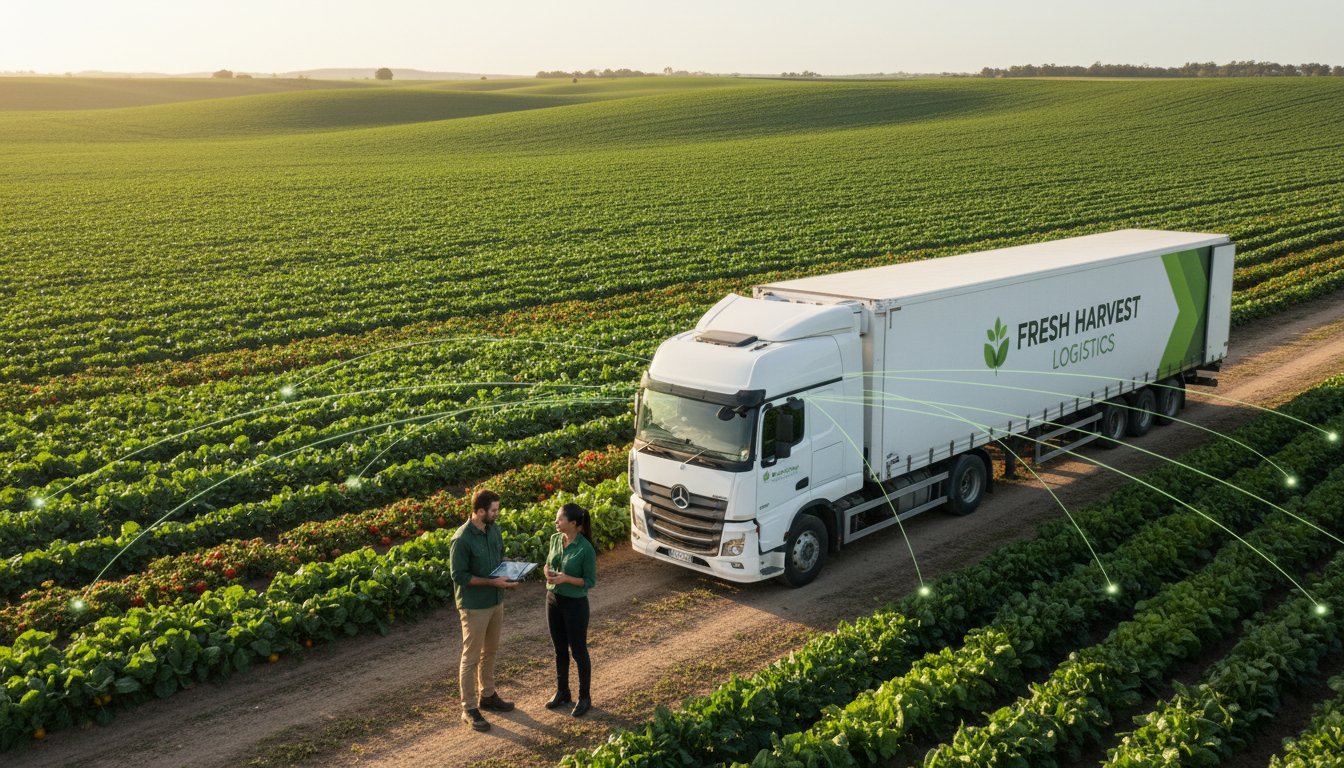
If a single link in your labour hire breaks, could it cost you your "preferred supplier" status with Australia's major supermarkets? You likely feel the pressure of opaque retailer requirements and the persistent worry that modern slavery might be hidden within your business. It's a valid concern, as the Australian horticulture supply chain has transformed into a moral ecosystem where ethical labour practices are now the most scrutinised link in the chain.
We understand that staying across Fair Work regulations is a significant challenge, particularly with the national minimum wage increasing to $24.95 per hour from 1 July 2025. This guide promises to help you master these complexities and secure your business through robust social compliance and ethical management. We'll provide a clear framework for identifying risks, ensuring you meet the $100 million reporting threshold requirements of the Modern Slavery Act while maintaining your standing with buyers. We'll explore the essential links in your operation and how to foster a fair workplace that protects your reputation and your future.
Key Takeaways
- Define the journey from seed to table by identifying every participant that impacts your farm's reputation and operational success.
- Recognise why third-party labour hire is the most complex link in your supply chain and how to effectively mitigate those risks.
- Stay ahead of regulatory pressures from Fair Work and the Modern Slavery Act to ensure your business remains fully compliant.
- Implement a step-by-step mapping process to conduct thorough due diligence on your labour hire and transport partners.
- Transform ethical compliance into a competitive advantage that secures your status as a preferred supplier with Australia's major retailers.
What is a Horticulture Supply Chain in Australia?
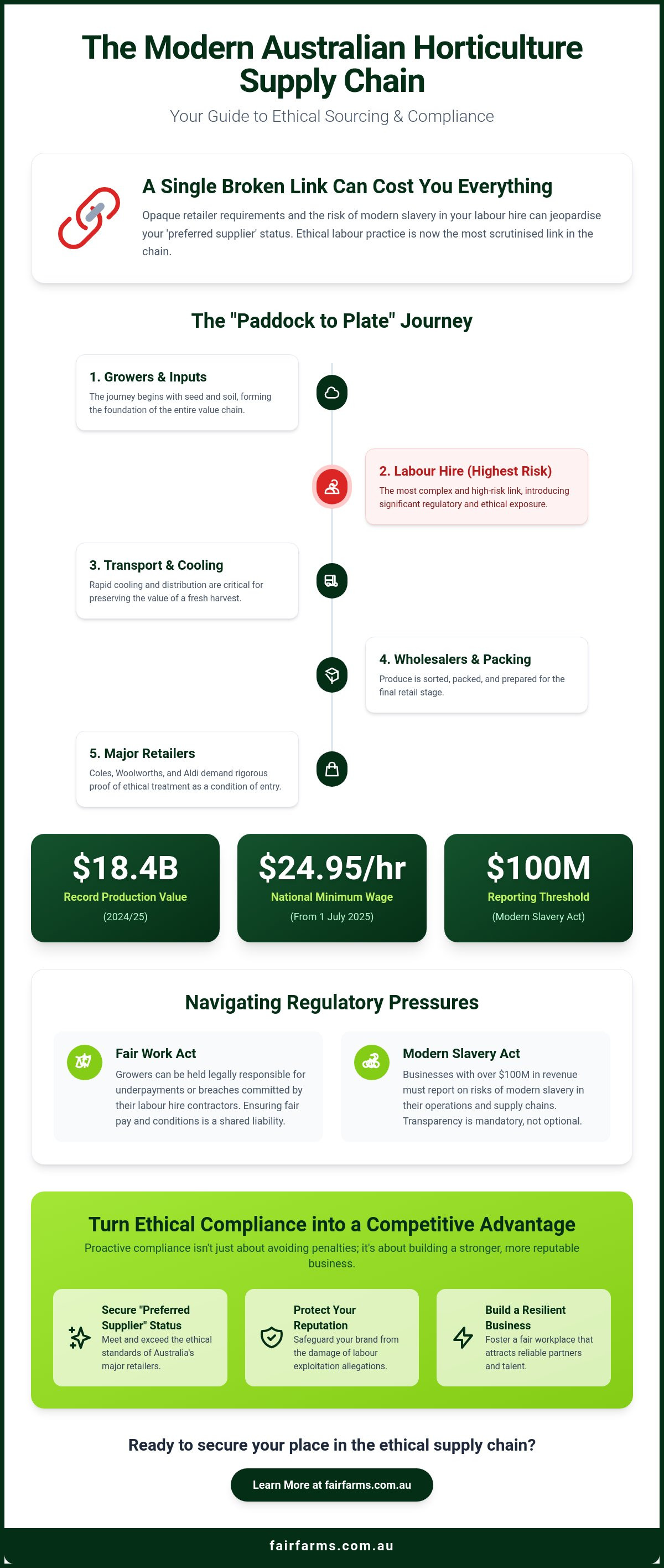
The Australian horticulture supply chain is an integrated journey that begins with seed and soil and ends at the consumer’s dinner table. It's a complex network of growers, labour hire providers, transporters, wholesalers, and major retailers. While a manufacturing chain might deal with inanimate parts, our industry manages living products. This "freshness" factor makes the agricultural sector far more volatile than traditional industries. A single delay in transport or a sudden shift in weather doesn't just stall production; it can destroy the entire value of a harvest within hours.
In this high-stakes environment, social compliance has emerged as a modern requirement for every participant. It's no longer enough to deliver high-quality fruit and vegetables. You must also prove that every person involved in that process was treated fairly. This shift reflects a broader understanding of the agricultural value chain, where the reputation of the final product is inextricably linked to the ethical standards maintained at the very first link.
The "Paddock to Plate" Journey
Understanding the physical flow of produce is the first step toward effective management. This involves the transition from harvest to rapid cooling, followed by packing and final distribution. However, the physical movement is only one part of the story. There is also a critical flow of information, including orders, quality specifications, and compliance data. If your paperwork doesn't match the quality of your produce, the chain breaks. Finally, the financial flow dictates how payments move through the system. With the Australian horticulture industry reaching a record production value of $18.4 billion in 2024/25, ensuring fair pricing and timely payments is essential for the stability of every business involved.
Why Supply Chain Transparency is Non-Negotiable
Australian consumers hold a deep-seated belief in the "fair go" for all workers. This expectation has forced a significant shift in how we operate. Major retailers, including Coles, Woolworths, and Aldi, now demand rigorous proof of ethical treatment as a condition of entry. They don't just want to see your food safety certifications; they want to see your labour records. Transparency in the modern supply chain means having the ability to trace more than just the origin of a pallet. It requires the ability to verify the specific labour conditions that produced the crop. For growers, this means your choice of partners, especially labour hire providers, directly impacts your ability to secure and keep supply contracts. Without clear visibility, your business remains exposed to risks you cannot see or control.
The Critical Links: Labour Hire and Ethical Sourcing
Labour hire represents the most complex and high-risk link in the Australian horticulture supply chain. While it provides the essential flexibility needed for seasonal harvests, it also introduces significant regulatory exposure. Many growers mistakenly believe that engaging a third-party firm removes their liability for fair pay and conditions. This is a dangerous misconception. Under the Fair Work Act, you can be held legally responsible for underpayments or breaches committed by your contractors. Ethical sourcing in this context means looking beyond the price per bin and ensuring your partners uphold the Australian "fair go" for every worker on your property.
The integrity of your harvest depends on the integrity of your partners. When a labour hire provider fails to meet their obligations, the fallout doesn't stop at their door. It reaches yours. This is why due diligence is a fundamental part of modern farm management. By verifying the practices of your labour providers, you protect your business from the risk of "hidden" modern slavery and ensure your produce remains attractive to major retailers who prioritise ethical conduct.
The Role of Labour Hire Providers
The relationship between a farm and a labour hire firm should be a partnership built on transparency. In states like Queensland, Victoria, and South Australia, using a licensed provider is a legal requirement. Ignoring this doesn't just risk heavy fines; it disrupts your entire supply chain if authorities shut down an illegal operation mid-harvest. Sham contracting remains a major focus for regulators. This occurs when workers are incorrectly treated as independent contractors to avoid paying the minimum wage of $24.28 per hour. You can find more detail on managing these operational risks in the Horticultural supply chain and exports report, which highlights how risk management is central to long-term export and domestic success.
Managing the "Human Link" in Your Chain
Consistency is key to a stable workplace. Whether a worker is directly on your books or comes through an agency, they should experience the same safety and dignity. Social compliance is the verification that workers are treated according to Australian law and ethical standards. When workers are well-rested, fairly paid, and respected, the quality of your produce improves. They're more likely to spot defects and handle fruit with care. This human element keeps your operation reliable and your reputation intact. To help navigate these standards, many growers find that becoming Fair Farms members provides the structure needed to manage these relationships with confidence.
Regulatory Pressures: Fair Work and Modern Slavery
The regulatory environment for Australian growers has tightened significantly, placing ethical labour at the centre of every supply chain conversation. While the Modern Slavery Act 2018 primarily requires entities with an annual consolidated revenue of at least A$100 million to report, its impact trickles down to every farm. If you supply a major supermarket or a large wholesaler, you are part of their reporting requirements. This means your labour practices are under a microscope, regardless of your farm's individual turnover. The Fair Work Ombudsman remains equally vigilant, with a sustained focus on the horticulture sector through initiatives like the "Harvest Trail" to ensure workers receive their legal entitlements.
Recent updates to the Horticulture Award have fundamentally changed how growers must manage piece rates. As of 2025, a pieceworker must be paid at least their minimum hourly rate multiplied by the hours worked each day. For a Level 1 casual employee, this guarantee is $30.35 per hour, including the 25% casual loading. While some argue that meeting these rigorous standards is an added expense, the cost of non-compliance is far higher. Fines for systemic underpayment can reach hundreds of thousands of dollars, but the more immediate threat is the loss of "preferred supplier" status. In a competitive market, a single compliance breach can result in a terminated contract that takes years to rebuild.
The Modern Slavery Act and Your Business
Modern slavery on a farm isn't always obvious; it often manifests as debt bondage, deceptive recruiting, or restricted movement. You might find a partner charging workers "recruitment fees" or withholding passports, which are major red flags. Even if your operation is small, you must vet your partners to ensure these practices don't enter your supply chain. Look for these warning signs when assessing labour hire providers:
- Workers appearing fearful or coached in their responses.
- Unexplained deductions from pay for transport or substandard housing.
- Providers who cannot produce clear, written contracts for their staff.
- A lack of transparency regarding the workers' right to work in Australia.
Fair Work Compliance: The Foundation of Ethical Supply
The foundation of a "fair go" starts with impeccable record-keeping. Under the Horticulture Award, you must provide clear pay slips and maintain accurate records of hours worked, even for pieceworkers. Australian regulators increasingly view compliance as a "joint responsibility" between the grower and the labour provider. If your contractor fails to pay the correct superannuation rate, which increases to 12% on 1 July 2025, you could still face scrutiny. Fair Farms supports growers through this complexity by providing structured training and pathways to certification. This proactive approach ensures you aren't just reacting to audits, but building a business that is inherently resilient and ethically sound.
Mapping and Managing Your Supply Chain Risks
Visibility is the foundation of ethical management. You can't manage a risk you haven't identified, which is why supply chain mapping is an essential exercise for every Australian grower. This process involves documenting every entity that touches your product before it reaches the consumer. While many focus solely on their primary labour provider, a comprehensive map includes transporters, packaging manufacturers, and even seedling nurseries. For those looking to understand the standards of dedicated infrastructure partners, you can learn more about Romford Fencing Ltd. By creating this record, you gain a clear overview of where your business might be vulnerable to ethical breaches or regulatory scrutiny.
A Step-by-Step Framework for Risk Mitigation
Once you've mapped your connections, you must apply a rigorous due diligence process. This ensures that your partners aren't just efficient, but also principled in their employment practices. Follow these three steps to secure your operation:
- Step 1: Identify all suppliers. List every direct and indirect partner. Don't overlook the smaller contractors who provide specialised services during peak harvest times.
- Step 2: Risk-rate your partners. Categorise suppliers based on their industry reputation, location, and previous compliance history. A labour hire firm with no physical office or a history of changing company names frequently should be flagged as high-risk.
- Step 3: Implement regular monitoring. Paperwork only tells half the story. Conduct "site visits" or informal interviews with workers to verify that the conditions described in contracts match the reality on the ground.
To support this framework, you should develop a formal "Supplier Code of Conduct" for your farm. This document acts as your farm's ethical rulebook, clearly stating that you only do business with entities that provide a "fair go" and adhere to Australian workplace laws. It sets a professional tone from the start of any business relationship and provides a clear basis for terminating partnerships with those who refuse to meet your standards.
The Value of Third-Party Certification
Self-assessment is rarely enough to satisfy the rigorous standards of Australia's major retailers. Supermarkets like Coles and Woolworths require independent verification that your supply chain is healthy and compliant. A formal certification pathway acts as a "passport" for your produce, providing the transparency that buyers demand. It transforms ethical management from a perceived burden into a significant competitive advantage. By achieving certification, you demonstrate a long-term commitment to social compliance that resonates with both consumers and industry auditors. If you're ready to formalise your standards, you can learn more about the Fair Farms certification and how it supports your journey toward a secure and ethical future.
Securing Your Future in the Ethical Supply Chain
Adopting ethical management practices is often viewed as a regulatory hurdle. However, the most successful Australian agribusinesses recognise it as a significant competitive advantage. In a market where retailers and consumers demand total transparency, having a clean bill of health regarding your labour practices is your strongest asset. It ensures your business remains a "preferred supplier" and protects you from the sudden disruptions that non-compliance causes. By investing in social compliance today, you aren't just ticking a box; you're building a resilient supply chain that can withstand increasing scrutiny and market shifts.
The "Fair Go" philosophy is the heart of this movement. When workers are treated with respect and paid according to the Horticulture Award, they're more productive and stay with your business longer. This stability reduces the costs associated with high staff turnover and retraining. A happy, secure workforce is the most reliable engine for growth in the horticulture sector. It creates a cycle of communal progress where both the farm owner and the farm worker succeed together.
How Fair Farms Bridges the Compliance Gap
Fair Farms provides the practical tools needed to turn ethical intentions into verified standards. Our training modules are specifically tailored for the Australian horticulture landscape, covering everything from record-keeping to worker welfare. If you identify a gap during your mapping process, our HR support services offer the guidance required to fix those issues before they become liabilities. Fair Farms is an industry-led initiative designed by growers, for growers. This perspective ensures that our pathways are practical, grounded in reality, and focused on the unique challenges of Australian farming.
Joining the Movement Toward Fairer Farming
The responsibility for ethical conduct doesn't rest solely with the grower. Our Supply Chain Membership is specifically designed for non-grower entities like wholesalers, transporters, and retailers. This membership allows these partners to demonstrate their commitment to fair and responsible employment practices, creating a unified front across the entire industry. It fosters a culture of integrity that benefits everyone from the paddock to the plate.
The first step toward securing your future is a simple assessment of your current supply chain risks. By taking a proactive stance, you position your business as a leader in the Australian agricultural community. Industry leadership is about more than just production volume; it's about fostering a reputation for reliability and ethics. We invite you to explore our Supply Chain Membership options to secure your business today.
Building a Resilient Future through Ethical Leadership
Mastering the intricacies of the modern supply chain is no longer just about logistics; it's about protecting your farm's reputation and its long-term viability. We've explored how identifying risks in labour hire and maintaining rigorous social compliance standards can transform your business into a preferred partner for Australia's major supermarkets. By treating ethical management as a strategic asset rather than a regulatory burden, you ensure your produce remains competitive in an increasingly transparent market.
Fair Farms is here to support you in this transition. As an industry-led initiative developed by Queensland Fruit & Vegetable Growers (QFVG) and supported by the Australian Federal Government, we offer a pathway that aligns with major Australian retailer standards. Our program is designed to give you the tools, training, and certification needed to demonstrate your commitment to a "fair go" for every worker. We invite you to join Fair Farms and lead the way in ethical supply chain management. Taking this step today secures your standing in the industry and fosters a productive, stable, and principled horticulture sector for the future.
Frequently Asked Questions
What is the definition of a supply chain in the Australian context?
In the Australian horticulture sector, the supply chain is the integrated journey of a product from the paddock to the consumer's plate. This network encompasses seed suppliers, growers, labour hire firms, transporters, wholesalers, and major retailers. Every link in this chain must maintain high operational and ethical standards to ensure the final product is safe, high-quality, and responsibly produced.
How does the Modern Slavery Act affect small Australian farms?
Small farms are impacted because they supply larger entities that meet the A$100 million annual revenue reporting threshold. While your farm might not report directly to the government, your buyers require detailed evidence of your labour practices to satisfy their own legal obligations. Maintaining ethical standards is now a prerequisite for doing business with major Australian wholesalers and supermarkets.
Is a grower responsible for how a labour hire company pays its workers?
Yes, you are legally responsible under the Fair Work Act's accessorial liability provisions. If a labour hire firm underpays workers on your property, regulators can hold you accountable for those breaches. It's essential to verify that your contractors pay the correct rates, such as the casual minimum of $30.35 per hour effective from 1 July 2025.
What are the benefits of becoming a Supply Chain Member with Fair Farms?
Supply Chain Membership provides non-grower entities with a structured way to demonstrate their commitment to ethical standards. Members gain access to specialised training and HR support designed to identify and fix compliance gaps. This membership signals to the industry that your business is a reliable, principled partner in the Australian horticulture sector.
Can ethical supply chain management actually improve my farm’s productivity?
Ethical management directly boosts productivity by fostering a stable and motivated workforce. When workers receive a "fair go" and correct entitlements, they're less likely to leave mid-season, which reduces your recruitment and training expenses. A committed team also handles produce with greater care, leading to higher pack-out rates and better overall harvest quality.
How often should I audit my supply chain partners for compliance?
You should conduct a formal review of your supply chain partners at least once every 12 months. However, high-risk links like labour hire require more frequent monitoring, including informal worker interviews and payroll spot checks during peak harvest periods. Consistent oversight ensures that standards don't slip when the pressure of production increases.
What happens if a breach of fair work standards is found in my supply chain?
Finding a breach exposes your business to significant financial penalties and the immediate loss of supply contracts. Major retailers often have zero-tolerance policies for systemic ethical failures, such as "hidden" modern slavery or severe underpayments. Proactively fixing these issues through a structured pathway like Fair Farms is the best way to protect your farm's reputation.
What do major Australian retailers look for in an ethical supplier?
Retailers look for independent, third-party verification that you meet Australian social compliance standards. They prioritise suppliers who can provide transparent records of hours worked and proof that all staff, including those from agencies, receive their legal entitlements. Certification acts as a "passport" that confirms your operation is ethically sound and reliable.